


Accounting Dissertation Topics for 2026

The questions below have been collected from student forums, academic discussion boards, and higher education communities. They reflect the real concerns students face when choosing a dissertation topic in accounting.
- What are the most relevant accounting dissertation topics for 2026?
- How do I find a topic that suits my level, whether undergraduate, master’s, or PhD?
- Which areas of accounting are currently attracting research attention?
- Can I see examples of well-structured accounting dissertation topics with research aims and objectives?
- Are there easy accounting dissertation topics for undergraduates that are still academically credible?
- What are the trending accounting dissertation topics in 2026 that align with industry changes?
- Where can I get help narrowing down my accounting research topics to one that fits my strengths?
Introduction: Why Your Accounting Dissertation Topic Matters
Choosing the right dissertation topic is one of the most important academic decisions a student makes. In a field as broad and evolving as accounting, this choice shapes the quality of your research, your engagement with the literature, and your ability to contribute something meaningful to the field.
Accounting sits at the intersection of finance, law, governance, and business strategy. A well-chosen topic allows you to demonstrate mastery of established frameworks whilst engaging with emerging debates. Whether your focus is on financial reporting, auditing and assurance, taxation, or corporate governance, your topic should reflect both academic depth and real-world relevance.
This post is designed to help students at all levels move from confusion to clarity. If you feel overwhelmed by the number of possible directions, or unsure whether your idea meets academic expectations, this guide will give you structure, inspiration, and confidence.
Students who need additional support with topic refinement or proposal writing can explore online dissertation help services that offer guidance aligned with university standards.
Download Accounting Dissertation Topics PDF
Many students find it useful to have a curated and personalised list of dissertation topics they can review offline and share with their supervisors. A downloadable PDF containing a tailored selection of accounting research topics, compiled by subject-matter experts, is available to students who complete a short topic request form.
The PDF is aligned with 2026 research expectations and covers topics from across all major subfields in accounting. It is suitable for undergraduate, master’s, and PhD students and can be used as a starting point for your dissertation proposal.
Why Choosing the Right Accounting Dissertation Topic Matters
The topic you select determines the scope of your entire dissertation. It influences which methodologies you can use, what literature you will engage with, and how examiners assess the academic value of your contribution.
In accounting, the stakes are particularly high because the field is directly linked to regulatory changes, global financial standards, and business practice. A topic that was relevant two years ago may no longer reflect current debates. Similarly, a topic that is too broad will lack analytical rigour, whilst one that is too narrow may not generate enough literature for a strong review.
Selecting a topic with a clear research gap ensures that your dissertation has purpose. It shows your examiner that you understand not just what has been studied, but what still needs investigating. This is the foundation of credible academic research.
Key Research Areas in Accounting You Can Explore
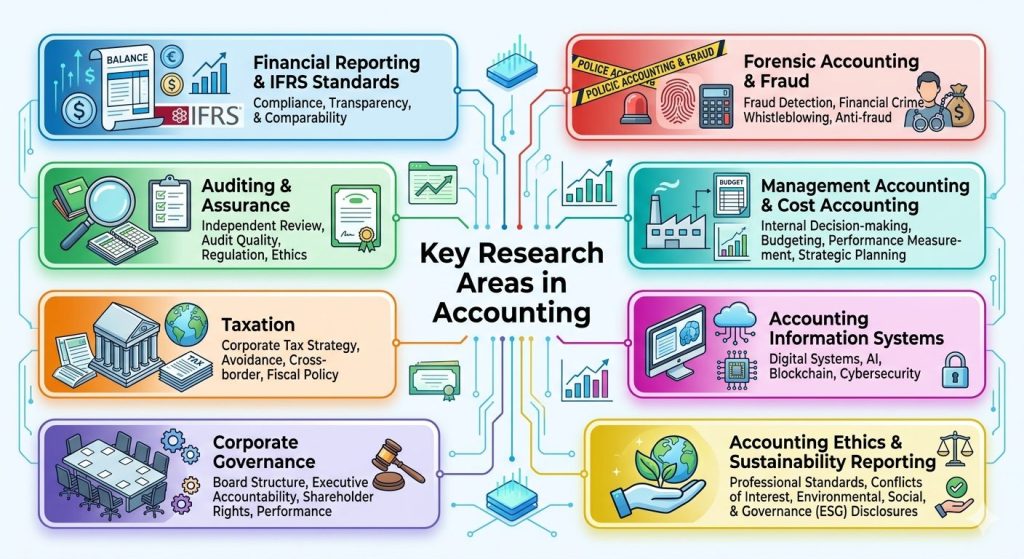
Accounting is a broad discipline with several established and growing subfields. Students working on accounting thesis topics in 2026 should consider the following research domains, each of which offers substantial scope for original investigation.
Financial Reporting and IFRS Standards
This area examines how organisations report financial information and how international standards such as IFRS shape that process. Research in this domain often focuses on compliance, transparency, and comparability across jurisdictions.
Auditing and Assurance
Auditing and assurance research explores how independent reviews of financial statements function, their reliability, and how audit quality is affected by regulation, technology, and professional ethics.
Taxation
Taxation research covers corporate tax strategy, tax avoidance, cross-border taxation, and the role of fiscal policy in economic behaviour. This area has grown in importance with increased scrutiny of multinational tax practices.
Corporate Governance
Corporate governance focuses on how organisations are directed and controlled, including board structures, shareholder rights, executive accountability, and the relationship between governance and financial performance.
Forensic Accounting and Fraud
Forensic accounting applies accounting principles to legal investigations. Research in this area explores fraud detection, financial crime, whistleblowing, and the effectiveness of anti-fraud measures.
Management Accounting and Cost Accounting
Managerial accounting and cost accounting research examines internal decision-making processes, budgeting, performance measurement, and how cost information is used in strategic planning.
Accounting Information Systems
This area explores how digital systems support financial reporting, data integrity, and decision-making. Research increasingly focuses on artificial intelligence, blockchain, and cybersecurity in accounting contexts.
Accounting Ethics and Sustainability Reporting
Accounting ethics research examines professional standards, conflicts of interest, and ethical decision-making in practice. Sustainability reporting is a rapidly growing area linked to environmental, social, and governance disclosures.
Accounting Dissertation Topics with Examples: Research Aims and Objectives
Understanding how a dissertation topic is structured academically helps students move from a broad idea to a focused and researchable question. Below are five accounting dissertation ideas on corporate finance and other subfields, each with a research aim and supporting objectives.
Example 1: Corporate Tax Avoidance and Stakeholder Trust
Research Aim: To examine how corporate tax avoidance strategies affect stakeholder trust and long-term firm reputation.
- To identify the most common tax avoidance practices used by FTSE 100 companies between 2018 and 2024.
- To assess the relationship between disclosed tax strategies and investor confidence as measured through stock price volatility.
- To evaluate how corporate governance structures moderate the link between tax avoidance behaviour and stakeholder perception.
Example 2: IFRS Adoption and Financial Comparability in Emerging Economies
Research Aim: To investigate the effect of IFRS standards adoption on the comparability of financial statements in emerging market economies.
- To compare financial reporting quality before and after IFRS adoption in selected emerging economies.
- To identify institutional barriers that limit full IFRS compliance in lower-income jurisdictions.
- To assess whether IFRS adoption has improved foreign direct investment flows in these markets.
Example 3: Artificial Intelligence in Audit Processes
Research Aim: To explore how the integration of artificial intelligence tools affects audit quality and efficiency within UK audit firms.
- To map the current adoption of AI-based tools across Big Four and mid-tier audit firms in the UK.
- To assess auditor perceptions of AI reliability and its impact on professional judgement.
- To identify regulatory gaps arising from AI use in statutory audit engagements.
Example 4: Board Gender Diversity and Financial Performance
Research Aim: To analyse the relationship between board gender diversity and financial performance in UK-listed companies.
- To assess the level of gender diversity on boards of FTSE 350 companies from 2016 to 2024.
- To examine the association between female board representation and return on assets.
- To evaluate whether voluntary versus mandatory diversity policies produce different financial outcomes.
Example 5: Earnings Management in Family-Owned Firms
Research Aim: To examine whether family-owned firms engage in earnings management differently from non-family firms.
- To compare accruals-based earnings management between family-owned and widely held firms in Europe.
- To assess whether family ownership concentration influences the extent of real earnings manipulation.
- To explore the moderating role of audit committee independence in limiting earnings management behaviour.
80 Accounting Dissertation Topics for 2026
The following accounting research topics are organised by subfield. Each topic has been developed with 2026 research expectations in mind and is suitable for undergraduate, master’s, or doctoral research proposals. Students looking for easy accounting dissertation topics for undergraduates will find accessible options within each category, alongside more complex topics suitable for advanced research.
Financial Reporting and Transparency
1. The impact of integrated reporting on investor decision-making in FTSE 100 companies.
2. Voluntary versus mandatory disclosure: How do companies decide what to report beyond regulatory requirements?
3. The role of financial reporting quality in reducing information asymmetry between managers and shareholders.
4. Fair value accounting and its effect on financial statement reliability during periods of economic uncertainty.
5. How does the adoption of digital financial reporting formats affect data usability for small investors?
6. The relationship between financial reporting frequency and short-termism in corporate decision-making.
7. Segment reporting under IFRS 8 and its usefulness for analysts: A critical evaluation.
8. The effectiveness of narrative disclosures in annual reports as predictors of future firm performance.
9. How do earnings restatements affect market confidence and firm valuation in listed UK companies?
10. The influence of auditor tenure on the timeliness of financial reporting in mid-cap firms.
Auditing and Assurance Research
11. How has mandatory audit firm rotation affected audit quality in European jurisdictions?
12. The use of data analytics in external audit: Opportunities and risks for audit firms.
13. Non-audit services and auditor independence: A review of post-reform evidence in the UK.
14. The effectiveness of internal audit functions in detecting financial fraud within financial institutions.
15. Audit committee characteristics and their influence on the quality of external audits.
16. How do audit fees respond to changes in firm-level risk and complexity?
17. The growing role of continuous auditing and real-time assurance in corporate reporting.
18. Whistleblowing mechanisms in audit firms: Are they effective at surfacing ethical breaches?
19. Auditor scepticism and its impact on the detection of material misstatements in financial statements.
20. The effect of gender diversity in audit teams on audit quality and client satisfaction.
Taxation and Tax Policy
21. The effectiveness of the OECD’s BEPS framework in reducing multinational profit shifting.
22. How do small and medium enterprises respond to changes in corporate tax rates in the UK?
23. Transfer pricing manipulation and its detection: Evidence from European enforcement cases.
24. The role of tax incentives in driving research and development investment among UK firms.
25. Country-by-country reporting under BEPS Action 13: Does it improve tax transparency?
26. The relationship between effective tax rates and firms’ earnings management behaviour.
27. How do digital service taxes affect the pricing and profitability of global technology firms?
28. Tax morale and compliance behaviour among individual taxpayers: A behavioural perspective.
29. The impact of automatic exchange of information agreements on offshore tax evasion.
30. Environmental taxes as a tool for sustainable behaviour change: Evidence from UK carbon levies.
Corporate Governance and Accountability
31. The relationship between board independence and firm performance in UK FTSE companies.
32. CEO duality and its effect on corporate risk-taking and financial performance.
33. How does ownership concentration affect the quality of financial disclosures in listed companies?
34. The role of remuneration committees in aligning executive pay with long-term value creation.
35. Environmental, social, and governance reporting and its relationship with firm valuation.
36. Shareholder activism and its influence on board composition and corporate strategy.
37. How does the national corporate governance code affect compliance levels among smaller listed firms?
38. The role of institutional investors in promoting sustainable governance practices.
39. Related party transactions and minority shareholder protection in emerging market firms.
40. Corporate social responsibility reporting and its credibility: Are disclosures genuinely informative?
Forensic Accounting and Financial Crime
41. The effectiveness of fraud risk assessment models in predicting financial statement fraud.
42. Forensic accounting techniques and their application in corruption investigations in public sector entities.
43. Money laundering detection: How effective are current anti-money laundering controls in UK banks?
44. The role of forensic accountants in legal proceedings: An analysis of UK court evidence standards.
45. Cryptocurrency fraud and the challenges it presents to forensic investigators.
46. The impact of whistleblower protection legislation on fraud reporting rates in organisations.
47. Ponzi scheme detection: What accounting indicators can identify fraudulent investment structures?
48. The psychology of occupational fraud: Why do trusted employees commit financial crime?
49. Forensic analysis of revenue recognition manipulation in high-growth technology firms.
50. How do digital audit trails assist forensic accountants in reconstructing financial crime timelines?
Management Accounting and Strategic Decision-Making
51. The continued relevance of activity-based costing in modern manufacturing environments.
52. Beyond budgeting: Is rolling forecasting a viable alternative in uncertain business environments?
53. The relationship between management control systems and innovation in knowledge-intensive firms.
54. How do balanced scorecards affect strategic alignment and performance in NHS trusts?
55. Target costing and its application in new product development within automotive supply chains.
56. The role of management accountants in sustainability reporting and integrated value creation.
57. How has the COVID-19 pandemic reshaped budgeting practices in UK higher education institutions?
58. Inter-organisational cost management in supply chains: Evidence from retail sector partnerships.
59. The use of real options analysis in capital investment decisions under conditions of uncertainty.
60. Management accounting practices in non-profit organisations: Balancing accountability and mission.
Accounting Information Systems and Technology
61. The adoption of blockchain technology in accounting: Implications for audit trails and data integrity.
62. Artificial intelligence and automated accounting: How will machine learning reshape the profession?
63. Cloud-based accounting systems and their effect on data security in small and medium enterprises.
64. The role of enterprise resource planning systems in improving financial reporting accuracy.
65. Big data analytics in management accounting: How are large firms using data to drive decisions?
66. Cybersecurity risks in accounting information systems and the role of internal controls.
67. Robotic process automation in accounts payable and receivable: Efficiency gains and risks.
68. The impact of real-time accounting systems on the relevance and timeliness of financial information.
69. XBRL adoption and its effect on financial reporting quality and analyst usage of data.
70. Digital transformation in audit firms: How technology is changing the structure of assurance work.
Accounting Ethics, Sustainability, and Emerging Topics
71. Ethical decision-making frameworks among accounting professionals: Theory versus practice.
72. The role of professional bodies in maintaining accounting ethics standards in the post-pandemic era.
73. Gender pay gap reporting and its relationship with pay equity in UK financial services firms.
74. How do sustainability accounting standards affect the cost of capital for listed firms?
75. Greenwashing in sustainability reports: Can accounting standards reduce misleading disclosures?
76. Social accounting and community impact reporting in local government: A critical assessment.
77. The future of integrated reporting: Are businesses genuinely adopting multi-capital thinking?
78. The influence of cultural dimensions on accounting ethics and professional conduct across countries.
79. How effective is the UK’s Senior Managers and Certification Regime in improving financial accountability?
80. Accounting for intellectual capital: Current challenges and proposed frameworks for intangible asset reporting.
How to Choose the Right Accounting Dissertation Topic for Your Level
Topic selection should be guided by three key factors: your academic level, the resources available to you, and the research gap you aim to address.
Undergraduate students are encouraged to select topics that are clearly scoped and supported by accessible secondary literature. Topics in financial reporting, corporate governance, or management accounting tend to work well at this level. If you are looking for easy accounting dissertation topics for undergraduates, focus on topics that allow you to conduct document analysis or surveys rather than complex econometric modelling.
Master’s students should demonstrate the ability to synthesise existing literature critically and contribute a modest original finding. Topics involving comparative analysis, case studies, or mixed-methods approaches are well suited to master’s level.
PhD candidates are expected to produce original knowledge. Topics should be theoretically grounded, clearly positioned within a specific academic debate, and designed to generate findings that advance the field. Contemporary accounting research topics in areas such as forensic accounting, sustainability reporting, or AI in auditing offer strong potential for doctoral contributions.
Students who are still uncertain about narrowing their ideas after reviewing this list are encouraged to seek accounting assignment support from academic professionals who can help align their topic with their supervisor’s expectations and institutional requirements.
Conclusion
Selecting a strong dissertation topic in accounting is not simply a matter of picking something interesting. It requires understanding the current state of the field, identifying a genuine research gap, and aligning your inquiry with academic standards appropriate to your level.
This post has presented 80 unique, research-ready accounting dissertation topics for 2026, organised across the major subfields of the discipline. Whether your interests lie in financial accounting dissertation topics focused on reporting and disclosure, or in management accounting dissertation ideas related to strategy and control, there is a topic here that can serve as the foundation for credible, meaningful research.
Approach your dissertation with academic integrity, intellectual curiosity, and a clear sense of purpose. The right topic, paired with rigorous methodology and honest engagement with the literature, gives you the best possible platform for producing work that genuinely matters. Take your time, consult your supervisor, and choose a topic that you can commit to with confidence throughout your research journey.
