


Behavioural Economics Dissertation Topics for 2026

Questions Students Are Asking (From Forums and Academic Discussion Platforms)
The questions below have been collected from student forums, university discussion boards, and academic community platforms. They reflect what real students are searching for when they feel uncertain about choosing the right dissertation topic.
- What are the best behavioural economics dissertation topics for 2026?
- How do I know if my research idea is strong enough for a master’s-level dissertation?
- What areas of behavioural economics are most relevant to current academic research?
- Can I write a behavioural economics dissertation on nudge theory or cognitive biases?
- Where can I find behavioural economics research paper topics that are original and up to date?
- Are there dissertation topics suitable for both undergraduate and PhD students in this field?
- What makes a behavioural economics thesis topic academically credible?
Why Choosing the Right Behavioural Economics Dissertation Topic Matters
Choosing the right dissertation topic is one of the most important decisions you will make during your academic journey. In a field as dynamic and interdisciplinary as behavioural economics, your topic shapes not just your research but also your professional identity. A well-chosen topic demonstrates academic awareness, methodological clarity, and a genuine interest in understanding how human behaviour drives economic outcomes.
Behavioural economics sits at the intersection of psychology and economics. It challenges the traditional assumption that people always behave rationally. Researchers in this field study how emotions, mental shortcuts, and social influences shape the decisions people make every day. This makes it a highly relevant and intellectually stimulating area for dissertation research at every academic level.
Students who feel overwhelmed by topic selection often benefit from seeking online dissertation help early in the process. Working with academic experts can help you clarify your research focus, align your ideas with current academic trends, and structure your proposal with confidence.
Download Behavioural Economics Dissertation Topics PDF
If you would like a personalised list of behavioural economics dissertation topics curated by academic experts, you can access a downloadable PDF by completing a short form. The PDF is tailored to your academic level and research interests, giving you a focused starting point that saves time and supports informed decision-making.
Key Research Areas in Behavioural Economics
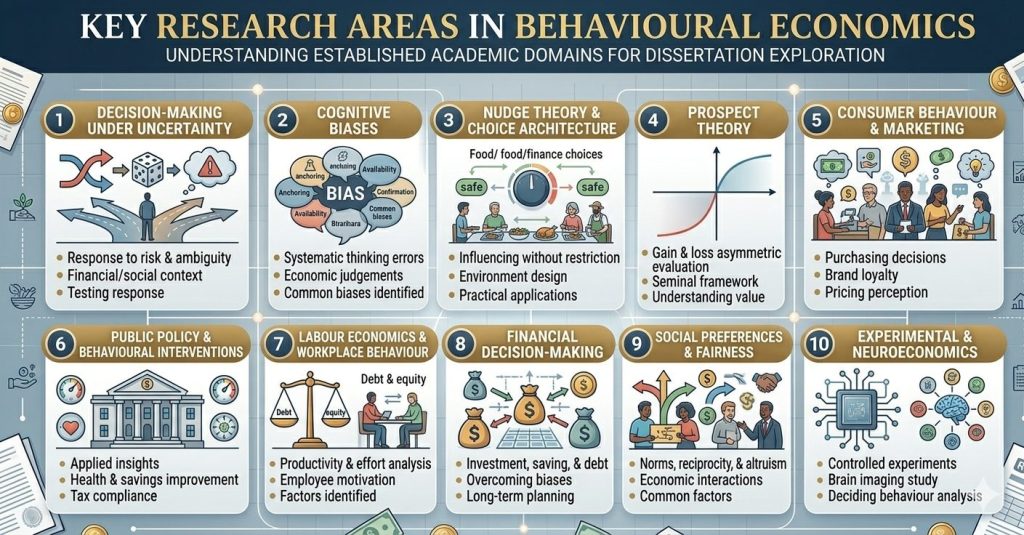
Before you select a dissertation topic, it helps to understand the main research areas within the field. These are established academic domains, not invented trends. Students exploring behavioural economics research topics will typically find their ideas falling into one or more of the following areas.
- Decision-making under uncertainty: How people respond to risk, ambiguity, and incomplete information in financial and social contexts.
- Cognitive biases: Systematic errors in thinking that affect economic judgements, including anchoring, availability, and confirmation bias.
- Nudge theory and choice architecture: How the design of choice environments influences behaviour without restricting freedom of choice.
- Prospect theory: Daniel Kahneman and Amos Tversky’s framework explaining how people evaluate gains and losses asymmetrically.
- Consumer behaviour and marketing: How psychological principles explain purchasing decisions, brand loyalty, and pricing perception.
- Public policy and behavioural interventions: The application of behavioural insights to improve health, savings, tax compliance, and welfare outcomes.
- Labour economics and workplace behaviour: How behavioural factors affect productivity, effort, and employee motivation.
- Financial decision-making: Behavioural biases in investment, saving, and debt management.
- Social preferences and fairness: How norms, reciprocity, and altruism shape economic interactions.
- Experimental and neuroeconomics: Using controlled experiments and brain imaging to study economic decision-making.
Five Example Dissertation Topics with Research Aims and Objectives
The following five examples demonstrate how a strong behavioural economics dissertation topic is structured. Each topic includes a clear research aim and two to three specific research objectives.
Example 1: Nudge Interventions in Public Health Campaigns
Research Aim: To examine the effectiveness of nudge-based interventions in encouraging healthier dietary choices among university students in the United Kingdom.
Research Objectives:
- To review existing literature on nudge theory and its application in health-related behaviour change.
- To assess the impact of canteen layout redesign on food selection patterns among students.
- To identify barriers to the successful implementation of nudge strategies in campus food environments.
Example 2: Cognitive Biases in Financial Planning
Research Aim: To investigate the role of cognitive biases in shaping retirement savings decisions among working adults aged 25 to 45 in England.
Research Objectives:
- To identify the most prevalent cognitive biases affecting long-term financial planning behaviour.
- To analyse how present bias and loss aversion influence pension contribution decisions.
- To evaluate the effectiveness of financial literacy programmes in reducing bias-driven errors.
Example 3: Prospect Theory and Consumer Pricing Perception
Research Aim: To explore how prospect theory explains consumer responses to price framing strategies in the UK retail sector.
Research Objectives:
- To assess how framing price reductions as gains versus losses affects purchase intent.
- To compare the responsiveness of different demographic groups to loss-framed versus gain-framed promotions.
- To recommend evidence-based pricing strategies for retailers using behavioural insights.
Example 4: Behavioural Interventions and Tax Compliance
Research Aim: To evaluate the impact of social norm messaging on self-assessment tax compliance rates in the United Kingdom.
Research Objectives:
- To review HMRC behavioural intervention trials and their reported outcomes.
- To assess the role of descriptive social norms in reducing late tax filings.
- To compare the cost-effectiveness of behavioural messaging with traditional enforcement methods.
Example 5: Decision-Making and Gender Differences in Investment Behaviour
Research Aim: To investigate whether gender-based differences in risk tolerance affect investment decision-making among retail investors in the UK.
Research Objectives:
- To analyse the relationship between gender, risk aversion, and portfolio diversification strategies.
- To assess how overconfidence bias manifests differently across male and female investors.
- To recommend policy adjustments for financial advisers serving diverse investor groups.
80 Behavioural Economics Dissertation Topics for 2026
The topics below are original, academically sound, and suitable for undergraduate, master’s, or PhD research. They are organised under meaningful subheadings based on core subfields within behavioural economics. Each topic is narrowly focused and designed to meet 2026-level academic expectations.
Nudge Theory and Choice Architecture
- How effective are default opt-in pension enrolment schemes in increasing retirement savings among low-income workers in the UK?
- The role of menu design and calorie labelling in reducing unhealthy food choices in NHS hospital cafeterias.
- An evaluation of nudge-based interventions to increase organ donation registration rates in England.
- How placement of healthy food options at the point of sale influences purchasing decisions in UK supermarkets.
- The effectiveness of social norm feedback on household energy consumption in urban British households.
- A behavioural audit of choice architecture in student loan repayment communication from the Student Loans Company.
- How green defaults on energy tariff selection platforms influence consumer uptake of renewable energy in the UK.
- The impact of simplified tax forms and pre-populated data on self-assessment compliance rates.
- Nudging commuters towards public transport: evaluating behaviour change campaigns in Greater Manchester.
- The effectiveness of commitment devices in helping individuals meet personal savings goals in digital banking apps.=
Cognitive Biases and Heuristics
- The anchoring effect in online property valuations: how initial price listings influence buyer negotiation behaviour.
- Availability bias and health risk perception: how media coverage shapes public concern about rare diseases.
- The role of the representativeness heuristic in investment fund selection among retail investors in the UK.
- How confirmation bias affects financial news consumption and portfolio decision-making among amateur traders.
- Overconfidence in entrepreneurial decision-making: evidence from UK startup founders.
- The framing effect in medical treatment decisions: how outcome presentation influences patient choices.
- Status quo bias in mobile phone plan switching: why consumers stay with suboptimal contracts.
- How the sunk cost fallacy affects project continuation decisions in UK public sector organisations.
- Optimism bias in project management: evaluating cost overruns in infrastructure development in England.
- The planning fallacy and academic procrastination among undergraduate students in UK universities.
Prospect Theory and Risk Behaviour
- Loss aversion in housing markets: how reference prices affect seller behaviour during market downturns.
- Applying prospect theory to charitable giving: how loss-framed appeals affect donor generosity.
- The role of reference dependence in consumer satisfaction ratings on digital review platforms.
- How probability weighting under prospect theory shapes gambling behaviour among young adults in the UK.
- Risk aversion and the gender gap in salary negotiation outcomes in graduate employment.
- Prospect theory and insurance purchase decisions: an analysis of over-insurance among low-risk UK households.
- How reference points shape effort in performance-related pay schemes in the UK public sector.
- The endowment effect in second-hand goods markets: consumer reluctance to sell owned possessions at fair value.
- Loss framing in anti-smoking campaigns: does it outperform gain framing in deterring teenage smoking?
- How diminishing sensitivity to financial outcomes influences retirement savings escalation programmes.
Consumer Behaviour and Marketing
- How social proof in online reviews influences consumer trust and purchase decisions on UK e-commerce platforms.
- The scarcity effect in luxury goods marketing: evaluating limited edition product launch strategies.
- Decoy pricing strategies in UK streaming service subscriptions: nudging consumers towards premium tiers.
- How mental accounting shapes consumer spending patterns across different credit card and cash payment types.
- The psychological impact of loyalty reward schemes on repeat purchasing behaviour in UK supermarkets.
- How default subscription renewal models exploit status quo bias in UK software and media services.
- The role of emotional advertising in shaping brand preference among Generation Z consumers in the UK.
- How personalised recommendation algorithms interact with cognitive biases in online shopping behaviour.
- Conspicuous consumption and social identity: behavioural drivers of luxury brand purchasing among UK millennials.
- The effect of time-limited discounts on impulse purchasing in fast fashion retail in the United Kingdom.
Public Policy and Behavioural Interventions
- Evaluating the Behavioural Insights Team’s contribution to UK public health policy between 2010 and 2024.
- The use of behavioural nudges in reducing plastic bag usage following the UK carrier bag charge introduction.
- Behavioural economics and welfare reform: evaluating the design of Universal Credit communications.
- How financial incentives and social norms interact in encouraging workplace pension contributions in the UK.
- A behavioural analysis of the UK government’s COVID-19 vaccination communication strategy.
- The effectiveness of personalised letters versus standardised notices in improving local council tax payment rates.
- Applying behavioural insights to reduce food waste in local authority catering services in England.
- How intelligent street design reduces anti-social behaviour: a behavioural economics perspective.
- The impact of behavioural messaging in driving uptake of smart meter installations in UK homes.
- Using commitment contracts in employment support programmes to improve job search behaviour among long-term unemployed individuals.
Financial Decision-Making and Behavioural Finance
- Present bias and undersaving: why young UK adults consistently fail to meet financial planning benchmarks.
- How behavioural biases contribute to mortgage mis-selling in the UK residential property market.
- The role of mental accounting in student debt management behaviour among recent UK graduates.
- Herd behaviour in UK retail investment during market volatility: lessons from the 2020 pandemic crash.
- How financial education interventions affect cognitive biases in low-income households in England.
- Behavioural barriers to accessing ISA products among young first-time savers in the United Kingdom.
- The psychology of buy-now-pay-later schemes: how deferred payment options affect spending self-control.
- Overconfidence and trading frequency: examining the link between self-assessed expertise and investment returns.
- How the disposition effect leads retail investors to hold losing assets too long and sell winners too early.
- Behavioural explanations for the gender pension gap in the United Kingdom.
Labour Economics and Workplace Behaviour
- How intrinsic motivation is crowded out by financial incentives in the UK public sector.
- The effect of feedback framing on employee performance in performance review cycles in British firms.
- Social comparison and pay transparency: how wage disclosure policies affect worker morale and productivity.
- Fairness perceptions and effort: how relative pay comparisons shape cooperation in team-based workplaces.
- Procrastination and deadline design: evaluating the impact of intermediate milestones on task completion among remote workers.
- Identity economics and professional commitment among NHS frontline workers during organisational change.
- How reciprocity norms shape gift exchange relationships between employers and employees in small UK firms.
- Loss aversion in performance bonuses: are employees more motivated by avoiding penalties than earning rewards?
- The effect of flexible working arrangements on time preference and self-control among UK knowledge workers.
- Behavioural insights into gender differences in negotiating promotions and pay rises in British workplaces.
Social Preferences, Fairness, and Ethics
- Altruism and tax morale: do citizens behave more honestly when they perceive public spending as fair?
- Social norms and peer effects in student academic dishonesty: a behavioural economics analysis.
- How fairness perception affects tipping behaviour in the UK hospitality industry following service charge changes.
- The role of in-group favouritism in charitable donation patterns among British ethnic communities.
- Trust, reciprocity, and cooperative behaviour in community energy projects in rural England.
- How inequality aversion shapes consumer boycott behaviour in response to corporate social responsibility failures.
- The behavioural economics of volunteering: what motivates unpaid labour in UK third sector organisations?
- Social identity and financial risk-taking: how group membership influences investment decisions among UK university students.
- The effect of transparency in AI-generated recommendations on consumer trust and decision autonomy.
- Applying behavioural ethics to whistleblowing decisions: why employees stay silent in the face of organisational misconduct.
How to Choose the Right Topic for Your Academic Level
Not every topic above will suit every student. Selecting the right topic depends on your academic level, available data, and research methodology preferences. Here is a brief guide.
Undergraduate students should aim for focused, well-defined topics with clear access to secondary data. Topics involving literature reviews, case studies, or publicly available datasets work well at this level.
MSc behavioural economics dissertation topics should reflect a higher degree of conceptual sophistication. Postgraduate students are expected to engage critically with theory and may consider primary data collection through surveys, experiments, or interviews.
PhD students are expected to contribute original knowledge to the field. Topics at this level should identify genuine gaps in the literature and propose novel theoretical frameworks or empirical approaches.
If you are unsure where to begin, working with an economics dissertation writing service that specialises in behavioural research can help you refine your ideas and align them with your supervisor’s expectations before you commit to a direction.b
Conclusion
Selecting a strong dissertation topic in behavioural economics is far more than a procedural step. It is the foundation of your entire academic contribution. The right topic reflects intellectual curiosity, awareness of current research debates, and the kind of focused thinking that universities reward.
The 80 behavioural economics dissertation topics in this post cover a wide range of subfields, from nudge theory and cognitive biases to financial decision-making and workplace behaviour. Whether you are an undergraduate student exploring the field for the first time or a postgraduate researcher preparing a sophisticated research proposal, there is a topic here that can support your goals.
Approach your dissertation with confidence. Ground your research in established theory, maintain academic integrity, and allow your topic to evolve through dialogue with your supervisor and the literature. A well-chosen topic, developed with care and supported by sound methodology, will set you apart.
