


Agricultural Economics Dissertation Topics for 2026

Questions Students Are Asking Right Now
The questions below have been gathered from student forums, academic discussion platforms, and peer communities. They reflect the real concerns students face when trying to choose a dissertation topic in agricultural economics.
- What are the best agricultural economics dissertation topics for 2026?
- How do I choose a dissertation topic in agricultural economics that is relevant and researchable?
- What is the difference between undergraduate, MSc, and PhD dissertation topics in this field?
- Are there agricultural economics dissertation topics with examples I can follow?
- What current trends in food security and rural development should my research focus on?
- Can I find agribusiness dissertation topics that are both practical and academically strong?
- Where can I get agricultural economics dissertation help if I am stuck on my topic?
Introduction
Choosing the right dissertation topic in agricultural economics is one of the most important decisions you will make during your academic journey. Agricultural economics sits at the intersection of economics, environmental science, and public policy. It deals with how resources are allocated across food systems, farming industries, and rural communities. A well-chosen topic can set the foundation for a high-scoring dissertation, a strong research portfolio, and even a rewarding career in this growing field.
In 2026, the discipline is more dynamic than ever. Issues such as climate change, global food insecurity, shifting trade policies, and digital transformation in farming are reshaping what students and researchers need to focus on. Students who choose topics aligned with these directions are more likely to produce research that is both academically credible and practically meaningful.
This post is designed to guide you through the process of selecting a strong dissertation topic. Whether you are an undergraduate student writing your first major research project or a postgraduate student working towards an MSc or PhD, this resource gives you the structure, examples, and topic ideas you need to move forward with confidence. If you are currently exploring online dissertation help, this guide will also help you understand what to look for and how to make the most of any academic support you access.
Download Agricultural Economics Dissertation Topics PDF
Students who want a more personalised set of topic suggestions can access a downloadable PDF prepared by academic subject specialists. The PDF contains a curated list of dissertation topics in agricultural economics, selected to match a range of research interests and academic levels. After completing a short form, students receive their personalised PDF directly, making it easier to explore options without spending hours searching online. This resource is particularly useful for students who are at the early stage of topic selection and want a focused starting point.
Why Choosing the Right Agricultural Economics Dissertation Topic Matters
Your dissertation topic shapes every stage of your research process. It determines the sources you will use, the methodology you will apply, and the arguments you will build. A topic that is too broad can leave your research without focus. A topic that is too narrow may not provide enough existing literature to support your analysis. The ideal dissertation topic sits in the middle: focused, researchable, and relevant to current debates in agricultural economics.
Supervisors and examiners also assess your topic choice as part of your overall academic performance. A topic that demonstrates awareness of current research gaps, real-world policy relevance, and methodological feasibility shows academic maturity. Choosing well from the beginning saves significant time later in the writing process.
Students pursuing MSc agricultural economics dissertation topics should pay particular attention to the depth of analysis expected at postgraduate level. The expectation at this stage is not just to describe a problem but to contribute original thinking, even if that contribution is modest. PhD students, meanwhile, are expected to identify clear gaps in the existing literature and propose research that genuinely advances knowledge in the field.
Key Research Areas in Agricultural Economics for 2026
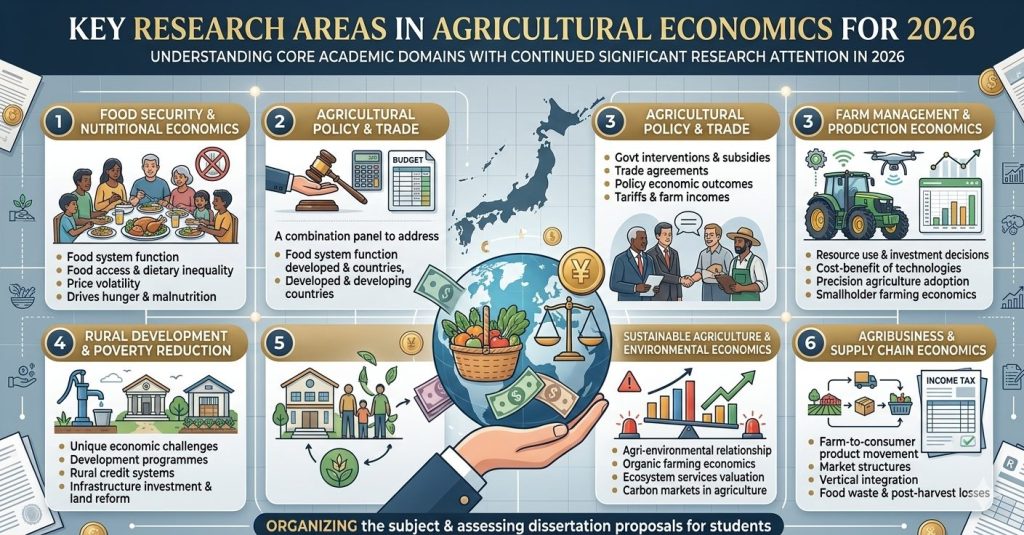
Agricultural economics covers a wide range of academic domains. Understanding these areas helps you identify where your interests and skills align best. The following subfields are well-established within the discipline and continue to attract significant research attention in 2026.
Food Security and Nutritional Economics
This area examines how food systems function to meet the nutritional needs of populations. Research in this subfield explores issues such as food access, dietary inequality, price volatility, and the economic factors that drive hunger and malnutrition in both developed and developing countries.
Agricultural Policy and Trade
Government interventions, subsidies, trade agreements, and regulatory frameworks all shape how agricultural markets operate. Research in this area often focuses on the economic outcomes of specific policies, the impact of tariffs on farm incomes, or the effect of international trade rules on domestic food production.
Farm Management and Production Economics
This subfield looks at how farmers and agribusinesses make decisions about resource use, investment, and production strategies. Topics range from cost-benefit analysis of farming technologies to the adoption of precision agriculture tools and the economics of smallholder farming.
Rural Development and Poverty Reduction
Rural communities across the world face unique economic challenges. Research in this area examines how agricultural development programmes, rural credit systems, infrastructure investment, and land reform policies affect the livelihoods of rural populations.
Sustainable Agriculture and Environmental Economics
This growing subfield explores the relationship between agricultural activity and environmental outcomes. Topics include the economics of organic farming, the valuation of ecosystem services, carbon markets in agriculture, and the economic trade-offs between productivity and environmental protection.
Agribusiness and Supply Chain Economics
Agribusiness dissertation topics in this area focus on how agricultural products move from farm to consumer. Research may examine market structures, vertical integration, price transmission along supply chains, or the economic effects of food waste and post-harvest losses.
Agricultural Economics Dissertation Topics With Examples: Aims and Objectives
The following five examples show how a well-structured dissertation topic is framed academically. Each example includes a research aim and supporting objectives. These are intended to help you understand the format and level of specificity expected in a strong research proposal.
Example 1: The Economic Impact of Climate-Smart Agriculture on Smallholder Farmers in Sub-Saharan Africa
Research Aim:
To assess how the adoption of climate-smart agricultural practices affects the income and productivity of smallholder farmers in Sub-Saharan Africa.
Research Objectives:
- To identify the types of climate-smart practices currently adopted by smallholder farmers in the region.
- To measure the economic outcomes associated with adoption compared to traditional farming methods.
- To evaluate the role of policy support and access to credit in enabling smallholder adoption.
Example 2: Evaluating the Effectiveness of Food Subsidy Programmes on Household Food Security in South Asia
Research Aim:
To examine whether government food subsidy programmes in South Asia effectively reduce household-level food insecurity.
Research Objectives:
- To review existing government food subsidy models across selected South Asian countries.
- To analyse household survey data to assess the relationship between subsidy access and dietary outcomes.
- To identify policy recommendations that improve targeting and efficiency of food subsidy schemes.
Example 3: The Role of Digital Financial Services in Improving Access to Agricultural Credit in Rural Kenya
Research Aim:
To investigate how mobile banking and digital financial services influence access to credit among smallholder farmers in rural Kenya.
Research Objectives:
- To map the landscape of digital financial service providers serving rural agricultural communities in Kenya.
- To assess whether increased access to digital credit improves agricultural investment and output.
- To identify barriers that prevent smallholder farmers from fully utilising digital financial services.
Example 4: Price Volatility in Global Wheat Markets and Its Effect on Food Import-Dependent Economies
Research Aim:
To analyse the economic consequences of wheat price volatility on countries that depend heavily on food imports.
Research Objectives:
- To document patterns of wheat price volatility in global markets over the past decade.
- To assess the macroeconomic effects of price shocks on import-dependent low-income countries.
- To evaluate policy instruments that can buffer the effects of price volatility on national food systems.
Example 5: The Economic Viability of Vertical Farming as an Alternative to Conventional Agriculture in Urban Settings
Research Aim:
To evaluate whether vertical farming presents a commercially and economically viable alternative to conventional food production in urban areas.
Research Objectives:
- To compare the cost structures of vertical farming and conventional farming for selected food crops.
- To assess the market potential for vertically farmed produce within urban consumer markets.
- To identify policy and investment conditions that would make vertical farming economically competitive.
80 Agricultural Economics Research Topics for 2026
The following topics are original, researchable, and suited to a range of academic levels. They are organised by subfield and numbered in fixed ranges for easy navigation. Use these as starting points, and feel free to refine them to suit your specific context or geographical focus.
Food Security and Nutritional Economics
1. The economic determinants of chronic food insecurity in rural communities of Eastern Africa.
2. Assessing the cost-effectiveness of school feeding programmes as a food security intervention in low-income countries.
3. How rising food prices affect nutritional outcomes in urban low-income households: evidence from South Asia.
4. The relationship between agricultural biodiversity and dietary diversity in smallholder farming communities.
5. Economic analysis of food fortification programmes as a strategy for reducing micronutrient deficiencies in developing economies.
6. The impact of food loss and waste on national food security indices in middle-income countries.
7. Gender disparities in food access and their economic implications for household-level food security in rural West Africa.
8. Analysing the role of social protection schemes in improving food security among landless rural households.
9. The economic effects of conflict on food systems and food security in fragile states.
10. How climate-induced crop failures translate into food insecurity and economic vulnerability at the household level.
Agricultural Policy and Trade
11. The economic impact of agricultural export bans on domestic food prices and farm incomes in developing countries.
12. Evaluating the effectiveness of crop insurance schemes as an agricultural risk management policy in South Asia.
13. How post-Brexit trade policy changes have affected UK agricultural exports to the European Union.
14. The role of agricultural subsidies in shaping smallholder farming decisions in sub-Saharan Africa.
15. Analysing the economic outcomes of land redistribution policies in post-apartheid South Africa.
16. The effect of tariff reductions on domestic agricultural markets under free trade agreements in Southeast Asia.
17. How minimum support price policies affect the income of cereal farmers in India.
18. The economics of water pricing in irrigated agriculture and its effect on resource use efficiency.
19. Evaluating the impact of organic certification standards on market access and farm profitability.
20. Agricultural policy alignment and food sovereignty: an economic analysis of competing frameworks.
Farm Management and Production Economics
21. Economic analysis of precision agriculture adoption among large-scale arable farmers in the United Kingdom.
22. The cost-benefit analysis of transitioning from conventional to regenerative farming systems.
23. How farm size affects productivity and profitability in maize production: evidence from Eastern Europe.
24. The economics of contract farming arrangements for smallholders in the vegetable sector of Southeast Asia.
25. Assessing the return on investment from irrigation infrastructure for smallholder rice farmers in West Africa.
26. The influence of access to extension services on farm productivity and income among smallholder farmers.
27. Economic implications of soil degradation for long-term agricultural productivity in semi-arid regions.
28. The financial viability of agroforestry systems compared to monoculture farming in tropical developing countries.
29. How labour shortages in agriculture affect production costs and farm profitability in high-income countries.
30. Evaluating the economic impact of post-harvest loss reduction technologies on smallholder farmer incomes.
Rural Development and Poverty Reduction
31. The economic impact of rural electrification on agricultural productivity and household income in Sub-Saharan Africa.
32. How access to rural credit markets affects agricultural investment and poverty reduction in low-income countries.
33. Evaluating the effectiveness of conditional cash transfer programmes in reducing rural poverty in Latin America.
34. The role of rural cooperatives in improving market access and income for smallholder farmers in East Africa.
35. Land tenure security and its effect on agricultural investment and rural economic development in South Asia.
36. The economic consequences of rural-to-urban migration on agricultural labour markets and farm productivity.
37. How road infrastructure development affects agricultural market participation among rural farming households.
38. The economics of women’s land rights and their effect on rural household welfare and agricultural output.
39. Assessing the long-term economic outcomes of community-managed irrigation schemes in South Asia.
40. The role of non-farm income in reducing rural poverty and its relationship with agricultural investment behaviour.
Sustainable Agriculture and Environmental Economics
41. The economic trade-offs between agricultural intensification and environmental sustainability in grain-producing regions.
42. Valuing ecosystem services provided by agricultural land in rural Europe: a willingness-to-pay analysis.
43. The economics of carbon sequestration in agricultural soils and implications for climate policy design.
44. How payments for ecosystem services programmes affect farmer behaviour and land management decisions.
45. The financial costs and benefits of transitioning to certified organic production for small and medium-scale farms.
46. Economic analysis of pesticide reduction policies and their effects on farm productivity and profitability.
47. The economic case for integrating biodiversity corridors into commercial agricultural landscapes.
48. Assessing the cost of water pollution from agricultural runoff and evaluating market-based remediation approaches.
49. The economics of drought-resistant crop varieties and their adoption among smallholder farmers in semi-arid Africa.
50. How carbon pricing mechanisms affect land use decisions and agricultural production in high-income economies.
Agribusiness and Supply Chain Economics
51. The economic effects of supermarket consolidation on farm-gate prices and the bargaining power of agricultural producers.
52. Analysing price transmission along the dairy supply chain and its implications for farmer profitability in the UK.
53. The economic impact of food safety standards on the ability of developing-country exporters to access premium markets.
54. How digital marketplace platforms are transforming agricultural supply chains and income distribution in East Africa.
55. The role of vertical integration in agribusiness and its economic effects on independent smallholder suppliers.
56. Evaluating the economic performance of farmer-owned cooperatives versus investor-owned firms in the grain sector.
57. The economic implications of shortening food supply chains for both producers and consumers in urban areas.
58. Assessing the financial costs of food fraud in global supply chains and exploring regulatory responses.
59. The economics of cold chain investment for reducing post-harvest losses in tropical fresh produce sectors.
60. How blockchain-based traceability systems affect trust, transaction costs, and market access in agricultural trade.
Technology, Innovation and Digital Agriculture
61. The economic returns to agricultural research and development investment in low- and middle-income countries.
62. Assessing the economic impact of mobile phone-based market information systems on smallholder farmer decision-making.
63. The adoption economics of drone technology in large-scale crop monitoring and its effect on input use efficiency.
64. Economic analysis of artificial intelligence applications in pest and disease forecasting for commercial agriculture.
65. The financial barriers to digital agriculture adoption among smallholder farmers in rural South Asia.
66. How biotechnology adoption affects crop yield, input costs, and net farm income in maize-producing regions.
67. The economics of smart irrigation systems and their potential for reducing water consumption in arid agricultural areas.
68. Evaluating the cost-effectiveness of remote sensing technologies for monitoring crop performance at scale.
69. The economic viability of insect-based protein as an alternative feed ingredient in the poultry and aquaculture sectors.
70. How e-commerce platforms are changing market access dynamics for smallholder horticultural producers in South Asia.
Climate Change, Risk and Agricultural Finance
71. The economic vulnerability of rain-fed smallholder farming systems to increasing climate variability in East Africa.
72. Assessing the uptake and financial performance of index-based crop insurance among smallholder farmers in India.
73. How climate change projections affect long-run agricultural land values in temperate cereal-growing regions.
74. The economic impact of extreme weather events on agricultural GDP in small island developing states.
75. Evaluating the role of development finance institutions in funding climate adaptation in the agricultural sector.
76. The economics of agricultural water storage and its implications for drought resilience in semi-arid Sub-Saharan Africa.
77. Analysing the financial inclusion needs of women farmers and the role of gender-responsive agricultural finance.
78. The economic effects of rising temperatures on livestock productivity and farm income in tropical regions.
79. How remittances from migrant workers influence agricultural investment and risk-taking behaviour of rural households.
80. The economic implications of land degradation for agricultural investment decisions and rural poverty in Southern Africa.
How to Choose the Right Agricultural Economics Dissertation Topic for Your Level
Undergraduate Students
At undergraduate level, your dissertation is typically between 8,000 and 12,000 words. Your topic should be focused, supported by existing literature, and answerable using secondary data or a straightforward primary data collection method. Agricultural economics dissertation topics for undergraduates work best when they are geographically specific and tied to a clear economic question.
MSc Students
MSc agricultural economics dissertation topics require a higher level of analytical rigour. You are expected to engage with econometric methods, theoretical frameworks, or advanced qualitative approaches. Your topic should demonstrate that you are aware of the existing research landscape and that your work fills at least a small gap. Look for topics where data is available and where your analysis can produce findings with policy relevance.
PhD Students
PhD topics in agricultural economics must make an original contribution to knowledge. The scope is much broader, and your research question should emerge from a thorough review of the literature. If you are struggling to identify a gap, seeking agricultural economics dissertation help from a specialist academic advisor can significantly accelerate this process. PhD research in this field increasingly involves mixed methods, large-scale datasets, or innovative theoretical modelling.
Tips for Developing Strong Agricultural Economics Research Paper Topics
Turning a general interest into a strong agricultural economics research paper topic requires a few careful steps. Follow these guidelines to sharpen your thinking.
- Start with a broad area of interest, then narrow it down by asking who, where, when, and under what conditions.
- Check recent issues of journals such as the American Journal of Agricultural Economics, the Journal of Agricultural Economics, and Food Policy to see what questions researchers are currently exploring.
- Make sure your topic is feasible within your time frame and with the data sources available to you.
- Discuss your shortlisted topics with your supervisor before committing to one.
- Avoid topics that are already saturated in the literature unless you can offer a genuinely new angle or geographical context.
- Consider how your research connects to current debates in agricultural policy, food systems, or rural development.
Conclusion
Choosing a strong dissertation topic in agricultural economics is the first and most important step in producing high-quality academic research. The 80 topics in this post span the full breadth of the discipline, from food security and sustainable agriculture to agribusiness, digital innovation, and climate finance. Each one is designed to be researchable, academically grounded, and relevant to the challenges facing agricultural systems in 2026.
The examples of research aims and objectives show how a focused topic can be developed into a structured research plan. Whether you are at undergraduate, master’s, or doctoral level, the key is to choose a topic that genuinely interests you, fits within your level of expertise, and connects to real-world issues in the field.
If you are still unsure where to begin, take time to read widely, consult your supervisor, and use the resources available through your institution. Approaching your dissertation with curiosity, honesty, and academic integrity will serve you far better than rushing into a topic that does not fit. This is your opportunity to contribute meaningfully to a field that matters deeply for the future of food, farming, and rural communities worldwide.
