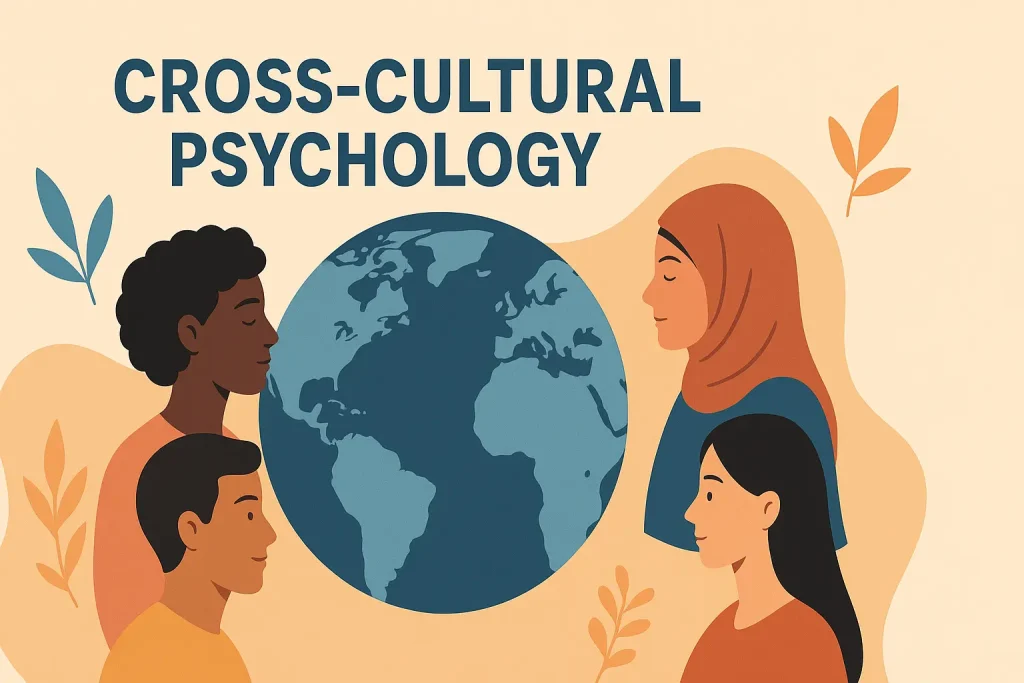
Cross-Cultural Psychology Dissertation Topics 2026

Cross-Cultural Psychology Dissertation Topics

Cross-Cultural Psychology Dissertation Topics 2026

“Explore how Cross-Cultural Psychology reveals the impact of culture, identity, and diversity on human behaviour, emotion, and cognition.”

Table of Contents

Introduction to Cross-Cultural Psychology Dissertation Topics 2026

“Cross-Cultural Psychology explores how cultural values, beliefs, and social structures influence behaviour and mental processes across societies.”

In 2026, Cross-Cultural Psychology will remain a crucial element in explaining how individuals with varying cultural backgrounds think, feel, and act. This study explores the connection between culture and psychology, revealing how traditions, language, religion, and social norms determine human cognition, emotion, and interaction. As students research these complex cultural patterns, many rely on expert psychology dissertation help to analyse cultural behaviours effectively. With increasing diversity in societies, as people are subjected to globalization and migration, the need to understand these psychological variations has never been greater.

Cross-Cultural Psychology is an intersection between anthropology, sociology, and psychology, which enables researchers to examine universal human characteristics, and behavioural specifics of a particular culture. It fosters inclusivity, empathy, and cultural intelligence capabilities that are required in a multicultural education and health care as well as international business settings.

Why Cross-Cultural Psychology Is Important in 2026

  • Globalization and Migration: Multicultural societies have come about as a result of increased international movement of individuals across borders and cultural awareness can be exploited to provide social harmony and flexibility in the workplace.
  • Cultural Impact of Mental Health: The therapists and counselors will be required to alter their methods according to the cultural beliefs, communication, and emotional expressions.
  • Connecting Social Sciences: The field bridges the relationship between psychology and other social sciences (anthropology and sociology) to investigate the effects that identity and community have on human motivation and perception.

Cultural Identity, Belonging, and Self-Concept Dissertation Topics (2026)

“Understanding how individuals define themselves across cultural and ethnic boundaries.”

The topic of cultural identity and self-concept has become the focus of Cross-Cultural Psychology in 2026 because the process of globalization and migration transforms the way people conceptualize themselves and the others. Cultural identity is an aspect that illustrates the ways in which people relate with their own cultural background together with their traditions and communities, and at the same time, adjust to the new cultural environments. The emotional well-being, self-esteem, and belonging is usually determined by this tension of not losing cultural background and becoming a part of a different society.

There has been an interest in bicultural and multicultural identities as people continue to mature learning to operate in more than one cultural setting. They tend to be enriched and conflicted at the same time as they develop their own worldviews yet at other times they are hit with the acculturation stress or confusion of identity. The knowledge of these psychological processes assists researchers and counselors to come up with interventions that would facilitate mental health and social integration among different societies.

Some of the major points of interest are the individualism vs. collectivism debate, which involves how culture determines self-perception, a sense of autonomy and the sense of belonging to a group. On the same note, the young people in the globalized settings have difficulties in balancing between cultural pride and societal demands, which affects their emotional strength and self-esteem.

Dissertation Ideas:

  • “Cultural Identity Formation Among Immigrants: A Psychological Perspective (2026 Study).”
  • “The Impact of Bicultural Identity on Emotional Adjustment and Social Belonging.”
  • “Individualism vs. Collectivism: A Cross-National Study on Self-Concept Development.”
  • “Acculturation and Identity Conflict Among Second-Generation Migrants.”
  • “Cultural Adaptation and Self-Esteem in Globalized Youth Populations.”
Get Free Customized Dissertation Topics

Get 3 customized dissertation topics tailored to your interests for free! Simply contact us on WhatsApp, and our experts will help you select the perfect topic that aligns with your academic goals and career aspirations.

Cross-Cultural Communication and Interpersonal Dynamics Dissertation Topics (2026)

“Exploring how communication patterns differ across cultures and influence relationships.”

Cross-cultural communication is one of the key fields of study in psychology in a world of globalization. It looks at the differences in language, non-verbal communication and expression of emotions across different cultures and the effects of such differences on socialization, collaboration and relationships. Learning how to communicate with people in culturally diverse settings will support and increase empathy, minimize conflict, and create more inclusive places to work and live.

Verbal and Non-Verbal Communication Across Cultures

There is more than just verbal communication like non-verbal cues like the eye contact, gestures, tones, and body language have a deeper cultural meaning. And an example here is that direct eye contact means that one is confident in the West but may be perceived as disrespect in the East. These differences have an effect on perception, trust in cross-cultural interactions and emotional attachment.

Cultural Sensitivity and Emotional Expression

Cultural sensitivity fosters the ability to collaborate and emotional awareness in the multicultural workplace. Also, cultural structures such as power distance influence expression of feelings or presentation of opinions. The advent of online communication has further complicated matters, and in most cases, tones or intent might be misunderstood during intercultural communication.

Empathy and Emotional Intelligence in Intercultural Relations

To overcome communication gaps it is essential to have empathy and emotional intelligence. The greater the interpersonal relations and professional achievement, the better adapted people are to the cultural differences, both emotionally and cognitively.

Dissertation Ideas:

  • “Non-Verbal Communication Differences Between Eastern and Western Societies.”
  • “Cultural Sensitivity in Multinational Workplaces: A Psychological Perspective.”
  • “Language, Power Distance, and Emotional Expression Across Cultures.”
  • “Digital Communication and Misinterpretation in Cross-Cultural Contexts.”
  • “The Role of Empathy and Emotional Intelligence in Intercultural Communication.”

Cultural Influences on Mental Health and Well-Being Dissertation Topics (2026)

“Investigating how culture shapes perceptions of mental health, therapy, and emotional regulation.”

Mental health studies keep identifying in 2026 that culture is a defining factor in individual experiences of and interpretation and help-seeking of psychological distress. Cross-Cultural Psychology emphasizes that cultural values, beliefs, and traditions have a great impact on the attitude to mental illness, coping strategies, and preferences toward treatment. Knowledge of these differences can assist professionals develop more non-discriminatory and efficient mental health practices.

Cultural Stigma and Attitudes Toward Mental Health

Cultural stigma is the biggest obstacle to psychological assistance. Mental illness is still a source of weakness or shame particularly in many societies hence it will not be reported and avoided in seeking treatment. The cross cultural studies contrast the perception of various communities on emotional distresses in some cases they perceive it in a medical perspective whereas others perceive it as the imbalance of the spirits that need to be healed through the community or religion.

Therapy, Coping, and Cultural Adaptation

  • Western and Indigenous Healing Approaches: While Western models emphasize cognitive and behavioural therapies, indigenous cultures rely on community rituals, mindfulness, and holistic healing.
  • Collectivist vs. Individualist Coping Styles: Collectivist societies prioritize social support and family involvement, whereas individualist cultures focus on self-reliance and autonomy.
  • Religion and Emotional Resilience: Faith-based coping provides psychological comfort, enhancing emotional regulation and reducing stress.

Dissertation Ideas:

  • “Cultural Stigma and Attitudes Toward Mental Illness: A Cross-Cultural Comparison.”
  • “Therapy and Healing Practices Across Cultures: Western Medicine vs. Indigenous Approaches.”
  • “Collectivist vs. Individualist Coping Styles: Their Effect on Psychological Well-Being.”
  • “Cultural Barriers to Mental Health Services in Migrant Populations (2026 Research).”
  • “Religious and Cultural Influences on Stress and Emotional Resilience.”

Migration, Acculturation, and Globalization Dissertation Topics (2026)

“Exploring psychological adjustment and identity reconstruction in multicultural transitions.”

Migration and globalization in a more interconnected world has transformed the way people view identity and sense of belonging and emotional adaptation. The psychological mechanism of acculturation to fit the new culture without losing his original identity is the focus of the modern Cross-Cultural Psychology. This involves a process of accommodation to acculturative stress, homesickness and cultural shock, which may affect emotional health and social behavior.

Psychological Adjustment and Cultural Adaptation

The emotional transition is experienced by migrants, refugees, and international students as they go through foreign surroundings. The adoption can be challenged by factors such as language barriers, social isolation and discrimination and supported by factors such as resilience, optimism and social support. Cultural shock is an interim, albeit, considerable experience in terms of confidence and identity in new societies.

Globalization and Identity Reconstruction

Globalization promotes cultural integration, which creates youth values and self-image. Although it fosters openness and multicultural appreciation, it can also lead to the identity conflict or loss of traditional values. The authors investigate the impact of globalization on emotional resilience and intercultural competence in cross-border situations.

Dissertation Ideas:

  • “The Psychology of Migration: Coping Mechanisms Among Refugees and Immigrants.”
  • “Acculturative Stress and Emotional Adaptation Among International Students.”
  • “Cultural Shock and Social Integration in Expat Communities (2026 Study).”
  • “Impact of Globalization on Youth Cultural Identity and Values.”
  • “Resilience and Coping in Cross-Cultural Adjustment Experiences.”

Gender, Family, and Cross-Cultural Roles Dissertation Topics (2026)

“Understanding how culture shapes gender expectations, family dynamics, and identity.”

Cultural systems have a significant bearing on the way societies outline gender roles and family roles, as well as social expectations. Nowadays, in 2026, scientists become more and more concerned about the ways globalization and modernization are changing the traditional modes of gender and family. Cross-Cultural Psychology analyses these variations in order to comprehend the connection between values, beliefs and power relations and development of relationships and identity.

Cultural Influence on Parenting and Family Systems

There are many parenting styles that differ according to cultures based on the different cultures authoritative and individualist are more dominant in Western societies, whereas the collectivist parenting bases on obedience, interdependence and respect to the elderly. These cultural models influence emotional development, independence and self-esteem among children.

Gender Roles and Social Change

Gender roles are changing as the societies strike a balance between traditional values and liberal values. The issue of empowerment of women, gender equality at workplaces, and the changing family dynamics have taken the world by storm as the subject of study. The intergenerational cultural differences usually arise in the family of immigrants when younger generations embrace new social values more rapidly than their parents.

Dissertation Ideas:

  • “Cultural Variations in Parenting Styles and Child Development.”
  • “Gender Role Perceptions Across Cultures: A Comparative Study.”
  • “Intergenerational Cultural Gaps in Immigrant Families (2026 Research).”
  • “Marriage, Family Values, and Social Change in Collectivist vs. Individualist Societies.”
  • “Cultural Identity and Gender Equality in Modern Work Environments.”

Workplace Diversity and Cross-Cultural Leadership Dissertation Topics (2026)

“Exploring cultural intelligence, diversity, and leadership in global organizations.”

Diversity in the workplace and cross-cultural leadership is present in 2026 and is part of successful organizations in the world. As multinational teams are now the new reality, leaders are forced to acquire Cultural Intelligence (CQ) the skill to read, adjust and lead efficiently across culture. Cross cultural leadership focuses on empathy, flexibility, and inclusiveness to promote communication, motivation, and team building in diverse set-ups.

Cultural Intelligence and Leadership Effectiveness

High-CQ leaders are sensitive to culture and change their strategies in accordance to gain inspiration and minimize misconceptions. This has demonstrated to have direct effects on the engagement and productivity of employees in multicultural workplaces.

Diversity, Inclusion, and Emotional Intelligence

Another way of good leadership in 2026 is the promotion of diversity, equity and inclusion (DEI). Emotional intelligence is important in the resolution of cultural conflicts, developing trust, and the well-being of diverse employees. Intercultural training programs are now used to develop a global mindset in organizations with the view that employees could work anywhere in the world without fear.

Dissertation Ideas:

  • “Cultural Intelligence (CQ) and Leadership Effectiveness in Multinational Companies.”
  • “Cross-Cultural Team Dynamics: Psychological Predictors of Collaboration Success.”
  • “Diversity, Inclusion, and Employee Well-Being in Global Workplaces.”
  • “Emotional Intelligence and Conflict Resolution Across Cultures.”
  • “Global Mindset Development Through Intercultural Training (2026 Study).”

Education, Learning, and Cognitive Differences Across Cultures (2026)

“Investigating how culture shapes learning styles, motivation, and educational outcomes.”

Cultural values affect education systems in the world with their impact in the learning preferences, motivation and teacher student relationships. Cross-Cultural Psychology in 2026 aims at the comprehension of the influence that culture has on educational performance and cognitive growth. Scholars are examining the way students of varying backgrounds solve problems, memorize and be creative in the academic setting.

Cultural Learning Styles and Motivation

The students in the cultures of collectivism tend to value the success of a group and the respect of authority, as compared to those in individualist cultures who focus on personal success and their independence of thinking. These differences affect academic motivation, participation and preferences in feedback.

Cognitive and Technological Adaptation in Global Education

Classrooms that are technology based have revolutionized the education in the world and have provided the opportunity to collaborate with individuals of different cultures using online learning. Nonetheless, there are some differences in cultural attitudes towards technology, self-learning, and communication, which influence the level of engagement and the outcomes.

Dissertation Ideas:

  • “Cultural Differences in Learning Preferences: A Cross-National Study.”
  • “Teacher–Student Relationship Dynamics in Multicultural Classrooms.”
  • “Achievement Motivation and Parental Expectations Across Cultures.”
  • “Technology-Enhanced Learning and Cultural Adaptation in Global Education.”
  • “Cross-Cultural Cognitive Development: Understanding Thinking and Problem-Solving Styles.”

Ethics, Prejudice, and Intergroup Relations Dissertation Topics (2026)

“Examining discrimination, prejudice, and moral values in intercultural settings.”

In the globalized world, intergroup relations and ethics are the topical issues of Cross-Cultural Psychology. The discipline examines the different ways in which moral values, social identity and prejudice are differentiated among societies and determine how groups interact. The objective is to create tolerance, equality and cultural peace in various communities.

Understanding Implicit Bias and Moral Reasoning

Implicit bias can be very subconscious and tends to influence the way individuals view other people of varying backgrounds. Religion, upbringing and education impact on morality and ethical decision-making as shown by cross-cultural studies that determine differences in perceptions of justice and fairness between countries.

Promoting Tolerance and Social Cohesion

Psychologists seek to enhance multicultural integration through intergroup dialogue programs and prejudice reduction programs. The knowledge of the prejudice mechanisms is useful in the development of interventions aimed at fostering empathy, acceptance, inclusive social policies.

Dissertation Ideas:

  • “Implicit Bias and Stereotyping: A Cross-Cultural Perspective.”
  • “Cultural Differences in Moral Reasoning and Ethical Decision-Making.”
  • “The Psychology of Prejudice Reduction in Multicultural Societies.”
  • “Intergroup Tolerance and Social Cohesion in Globalized Communities.”
  • “Cross-Cultural Perceptions of Justice and Fairness (2026 Research).”

Emerging Trends and Future Research Directions in Cross-Cultural Psychology (2026)

“Blending AI, globalization, and cultural neuroscience for the future of diversity research.”

The Future of Cross-Cultural Psychology is decided by technological innovation and interdisciplinary collaboration. Researchers are creating AI, neuroscience and data analytics to study human diversity around the world. These tools can be used to study cross-cultural tendencies in emotion, cognition, and adaptation more accurately than ever before.

AI, Big Data, and Cultural Neuroscience

Acculturative stress prediction, emotional expression in different languages, and social adaptation patterns are now being predicted using AI. In the meantime, cultural neuroscience combines brain imaging with the investigation of the influence of cultural norms on the perception, empathy, and morality.

Globalization and Virtual Identity Formation

Since the digital spaces are expanding, virtual migration is bringing new dimensions of cultural identity and belonging. Scholars are reviewing the effects of digital spaces in diversity, inclusion, and ethics of communication across the world.

Dissertation Ideas:

  • “AI in Cultural Adaptation Studies: Predicting Acculturative Stress and Behaviour.”
  • “Cultural Neuroscience: Brain-Based Understanding of Cultural Processing.”
  • “Big Data in Cross-Cultural Psychology: Measuring Global Attitudes and Beliefs.”
  • “Digital Migration and Identity Formation in Virtual Cross-Cultural Spaces.”
  • “Ethical and Social Challenges in Global Psychological Research (2026).”

FAQs on Cross-Cultural Psychology Dissertation Topics 2026

What are trending Cross-Cultural Psychology dissertation topics for 2026?

According to the trending topics in 2026, it is possible to mention cultural identity formation, migration and acculturation, diversity in the work place, and cultural neuroscience. These sections dwell into the process of globalization and technology redefining social interaction, behaviour and emotional adaptation across societies.

Cultural adjustment, cross-cultural communication patterns, and cross-cultural mental health stigma can be the areas of interest of undergraduate students. These subjects provide research-based information on practical counseling about cultural adaptation and psychological strength.

Globalization fosters the culture of hybrid identities and cross-cultural empathy, as well as the sensitivity to diversity, and inclusive views on human behaviour. It has increased the study of multicultural education, digital communication and cultural integration.

Such ethical issues as cultural prejudice, informed consent, and minority representation are present. Cross-national psychological researchers should be culturally sensitive, fair and ethically accountable.

Download Cross-Cultural Psychology Dissertation Topics PDF

Conclusion: Best Cross-Cultural Psychology Dissertation Topics 2026

“Cross-Cultural Psychology dissertation topics 2026 explore how culture influences thought, emotion, and behaviour across diverse societies.”

Cross-Cultural Psychology is becoming an important discipline in the wake of globalization as the world continues to become more interconnected today. Through observing the influences of cultural differences on values, motivation and cognition, the area fills the void that exists in understanding the connection between psychology, sociology, and anthropology, and provides a platform on which empathy and inclusion can be fostered.

These dissertation subjects assist learners to define cultural adjustment, diversity and emotional health and the complexity of human behaviour in the world, thereby developing more empathetic perceptions of the world human behaviour.

“The Cross-Cultural Psychology dissertation ideas for 2026 inspire research that connects minds, bridges cultures, and fosters understanding in a rapidly changing world.”

FREE Tools
GPA Calculator
Dissertation Breakdown
Case Converter Tool
Word Counter Tool
Use all these Tools for
100% Free
OUR PROCESS
Dissertation Order Placement

Our process starts when you place the order on our website after chatting with our agent.

Order Screening & Approval

Once the order is placed, it is ensured that it comes in our expertise before its acceptance.

Writer Assigning

A writer is assigned based on the degree requirement.

Topic & Outline Submission

3 topics are shared for approval. The outline comprises of Research Gap, Research Questions & Objectives, and Conceptual Framework.

Proposal Submission & Approval

After outline approval, the proposal is drafted and submitted for approval.

Dissertation Writing

The dissertation writing process begins based on approved guidelines.

Review by Quality Assurance Team

Our Quality Assurance team ensures that the work is original and error-free.

Dissertation Submission

The final dissertation is submitted after passing through all quality checks.