


Endocrinology Dissertation Topics for 2026

Questions Students Are Asking About Endocrinology Dissertations
Students across university forums and academic discussion platforms regularly share their concerns about selecting a dissertation topic. Whether you are just starting out or have already narrowed down a research area, these questions reflect what many students ask at this stage:
- What are the most relevant endocrinology dissertation topics for 2026?
- How do I choose an endocrinology research topic that suits my academic level?
- What are the latest endocrinology research topics I should explore?
- Are there endocrinology dissertation topics with examples I can use as a guide?
- Which hormone research topics are appropriate for a master’s-level dissertation?
- How do clinical endocrinology topics differ between undergraduate and PhD research?
- What endocrine system dissertation topics are considered current and researchable?
- Where can I find endocrinology dissertation help to structure my research properly?
If any of these questions sound familiar, this post was written with you in mind.
Why Choosing the Right Endocrinology Dissertation Topic Matters
Endocrinology is one of the most dynamic and clinically relevant branches of medicine. It covers the study of hormones, glands, and the complex biological systems that regulate nearly every function in the human body. Conditions such as diabetes mellitus, thyroid disorders, and adrenal dysfunction affect millions of people globally, making research in this field both scientifically valuable and socially meaningful.
Choosing the right dissertation topic in endocrinology is not just an academic exercise. It shapes the quality of your research, the depth of your contribution to the field, and your ability to demonstrate critical thinking at the level your university expects. A well-chosen topic gives you a manageable scope, a clear research direction, and the opportunity to produce work that is genuinely useful.
This post is designed to support students at undergraduate, master’s, and PhD levels. It offers structured guidance on how endocrinology topics are organised academically, provides worked examples, and presents 80 original dissertation topics suitable for 2026-level research expectations. Students who are unsure where to start or who feel overwhelmed by the breadth of the subject will find this post a reliable starting point.
Download Endocrinology Dissertation Topics PDF
Many students prefer to review their options in a structured format they can return to at any time. A downloadable PDF containing a curated list of endocrinology dissertation topics, selected and reviewed by academic subject experts, is available for students who need a more personalised starting point.
Students receive this resource after completing a short form. The topics in the PDF are matched to academic level and research interest, making them particularly useful for those who have not yet settled on a direction. Whether you are exploring clinical endocrinology topics for a master’s programme or looking for PhD-level research ideas, the PDF offers a focused and academically reliable reference.
Key Research Areas in Endocrinology Worth Exploring
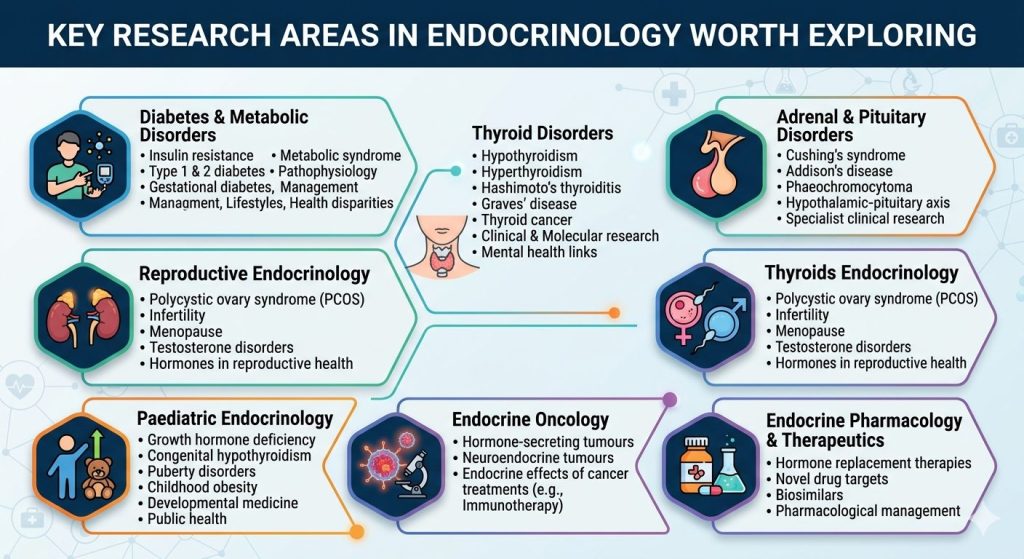
Before selecting a dissertation topic, it helps to understand how the field of endocrinology is broadly organised. This gives your topic selection a clear academic context and helps you align your research with established scholarly traditions.
Diabetes and Metabolic Disorders This is one of the most extensively researched areas in endocrinology. It covers insulin resistance, type 1 and type 2 diabetes mellitus, gestational diabetes, and metabolic syndrome. Research in this area tends to focus on pathophysiology, pharmacological management, lifestyle interventions, and health disparities.
Thyroid Disorders Thyroid research spans hypothyroidism, hyperthyroidism, Hashimoto’s thyroiditis, Graves’ disease, and thyroid cancer. It is a productive area for clinical and molecular research, with emerging interest in the link between thyroid function and mental health.
Adrenal and Pituitary Disorders This subfield includes conditions such as Cushing’s syndrome, Addison’s disease, phaeochromocytoma, and disorders of the hypothalamic-pituitary axis. These are less common conditions but are well represented in specialist clinical research.
Reproductive Endocrinology This area covers polycystic ovary syndrome (PCOS), infertility, menopause, testosterone disorders, and the role of hormones in reproductive health across the lifespan.
Paediatric Endocrinology Topics here include growth hormone deficiency, congenital hypothyroidism, puberty disorders, and childhood obesity. This subfield links closely with developmental medicine and public health.
Endocrine Oncology This is a growing area examining hormone-secreting tumours, neuroendocrine tumours, and the endocrine effects of cancer treatments such as immunotherapy.
Endocrine Pharmacology and Therapeutics Research here focuses on hormone replacement therapies, novel drug targets, biosimilars, and the pharmacological management of hormonal imbalance.
Five Example Endocrinology Dissertation Topics with Research Aims and Objectives
These examples are intended to show how a strong dissertation topic is constructed academically. Each includes a research aim and two to three objectives to demonstrate the level of focus required.
Example 1: Insulin Resistance and Dietary Patterns in Urban Adults
Research Aim: To examine the relationship between dietary patterns and insulin resistance among adults living in urban settings.
Objectives:
- To identify dietary patterns associated with elevated fasting insulin levels in urban adult populations.
- To assess the role of ultra-processed food consumption in the development of insulin resistance.
- To explore whether gender differences moderate the association between diet quality and insulin sensitivity.
Example 2: Thyroid Dysfunction and Cognitive Decline in Older Adults
Research Aim: To investigate the association between subclinical thyroid disorders and cognitive function in adults aged 65 and above.
Objectives:
- To review current clinical evidence linking subclinical hypothyroidism with cognitive impairment.
- To compare cognitive performance outcomes between treated and untreated thyroid disorder patients.
- To identify gaps in current screening guidelines for thyroid-related cognitive risk.
Example 3: PCOS Management Approaches in Young Women
Research Aim: To evaluate the effectiveness of lifestyle and pharmacological interventions in managing polycystic ovary syndrome in women aged 18 to 30.
Objectives:
- To compare the clinical outcomes of metformin therapy versus lifestyle modification in PCOS management.
- To assess the impact of hormonal imbalance on psychological wellbeing in young women diagnosed with PCOS.
- To identify patient preferences for PCOS treatment approaches through a systematic review of qualitative evidence.
Example 4: Glucocorticoid Use and Adrenal Suppression
Research Aim: To examine the risk of adrenal suppression in patients receiving long-term glucocorticoid therapy for chronic inflammatory conditions.
Objectives:
- To quantify the incidence of hypothalamic-pituitary-adrenal axis suppression in long-term glucocorticoid users.
- To evaluate current clinical protocols for monitoring adrenal function in these patients.
- To assess whether dose tapering strategies reduce the risk of adrenal crisis.
Example 5: Endocrine Disrupting Chemicals and Male Fertility
Research Aim: To explore the evidence linking environmental endocrine disrupting chemicals with declining male reproductive hormone levels.
Objectives:
- To review the published evidence on the association between phthalate exposure and reduced testosterone levels in men.
- To assess occupational exposure risks among working-age males in industrialised settings.
- To identify methodological limitations in current endocrine disruption research that affect the reliability of conclusions.
80 Endocrinology Dissertation Topics for 2026
The following topics are organised by subfield to help you identify the research area that best matches your interests and academic level. Each topic is original, researchable, and suited to 2026-level academic expectations. If you need support narrowing down your choice, online dissertation help is available through specialist academic services.
Diabetes Mellitus and Insulin Research
- The role of gut microbiome composition in the development of type 2 diabetes mellitus in middle-aged adults.
- Time-restricted eating and its effect on insulin sensitivity among pre-diabetic individuals.
- The effectiveness of continuous glucose monitoring in improving glycaemic outcomes in type 1 diabetes patients.
- Racial and ethnic disparities in the diagnosis and management of type 2 diabetes mellitus in the United Kingdom.
- Psychosocial barriers to insulin adherence among adults with type 1 diabetes in low-income settings.
- The clinical significance of C-peptide levels as a predictor of beta-cell function in newly diagnosed diabetic patients.
- Gestational diabetes mellitus and long-term cardiometabolic risk in mothers: a systematic review.
- The relationship between sleep duration and insulin resistance in non-diabetic adults.
- Digital health interventions for self-management support in type 2 diabetes: an evaluation of patient outcomes.
- The impact of bariatric surgery on insulin resistance and glycaemic control in morbidly obese adults.
Thyroid Disorders and Thyroid Function Research
- The association between subclinical hypothyroidism and depression in women of reproductive age.
- Autoimmune thyroid disease and pregnancy outcomes: a review of clinical management strategies.
- The influence of iodine deficiency on thyroid function in school-aged children in low-income countries.
- Differentiated thyroid cancer recurrence rates and the adequacy of post-treatment surveillance protocols.
- The effect of levothyroxine treatment on quality of life in patients with Hashimoto’s thyroiditis.
- Thyroid peroxidase antibody positivity and the risk of miscarriage in euthyroid pregnant women.
- The role of selenium supplementation in reducing thyroid antibody levels in Hashimoto’s thyroiditis.
- Graves’ disease management in adolescents: a comparative analysis of antithyroid drug therapy and radioiodine treatment.
- Thyroid function and its association with cardiovascular disease risk in the elderly population.
- The diagnostic accuracy of thyroid ultrasound versus fine-needle aspiration in evaluating thyroid nodules.
Adrenal Disorders and Adrenal Function Research
- Adrenal insufficiency following long-term corticosteroid use: identifying at-risk populations in primary care.
- The clinical presentation and diagnostic delay of Addison’s disease in women under 40.
- Cushing’s syndrome in patients with type 2 diabetes: prevalence, recognition, and clinical management challenges.
- The role of midnight salivary cortisol in the screening of Cushing’s syndrome in outpatient clinical settings.
- Adrenal fatigue as a contested clinical diagnosis: a critical review of the scientific evidence.
- The management of bilateral adrenal hyperplasia and its impact on blood pressure control.
- Phaeochromocytoma crisis in emergency medicine: a review of presentation patterns and immediate management.
- The psychological impact of a diagnosis of adrenal insufficiency on patient quality of life.
- Adrenal androgen excess and its contribution to metabolic abnormalities in women with PCOS.
- Post-operative adrenal function recovery in patients following unilateral adrenalectomy for Conn’s syndrome.
Reproductive Endocrinology and Hormonal Imbalance
- The impact of anti-Müllerian hormone levels on the prediction of ovarian response during IVF cycles.
- Hormonal imbalance in women with endometriosis and its association with infertility outcomes.
- Testosterone supplementation therapy in hypogonadal men: long-term cardiovascular risk and clinical benefits.
- The role of prolactin levels in the diagnosis and management of unexplained infertility.
- Menopause hormone therapy and breast cancer risk: re-evaluating the evidence from long-term cohort studies.
- Male hypogonadism: comparing diagnostic criteria and treatment outcomes across different national clinical guidelines.
- The endocrine basis of premenstrual dysphoric disorder and the evidence for hormonal interventions.
- Oestrogen receptor sensitivity and its role in the pathogenesis of uterine fibroids.
- Androgen excess in postmenopausal women and its association with metabolic syndrome.
- The effects of hyperprolactinaemia on bone mineral density and fracture risk in women.
Paediatric Endocrinology
- Growth hormone deficiency in children: comparing early versus delayed treatment initiation and final adult height outcomes.
- Congenital hypothyroidism screening programmes and neurodevelopmental outcomes in affected children.
- The rising prevalence of childhood obesity and its association with early-onset insulin resistance.
- Precocious puberty in girls: identifying environmental and endocrine factors driving earlier onset.
- Vitamin D deficiency and its relationship with calcium metabolism disorders in children with chronic illness.
- Type 1 diabetes mellitus in children under five: diagnostic challenges and management in primary care.
- The psychological burden of short stature on adolescents receiving growth hormone therapy.
- Turner syndrome and associated endocrine complications: a review of monitoring and treatment protocols.
- Adrenarche and its clinical significance in the evaluation of early pubic hair development in young girls.
- The long-term endocrine outcomes of childhood cancer survivors following chemotherapy and radiotherapy.
Endocrine Oncology and Neuroendocrine Tumours
- The clinical management of incidentally discovered adrenal masses: a review of international guideline variation.
- Neuroendocrine tumour biomarkers: the diagnostic value of chromogranin A in clinical practice.
- The endocrine effects of immune checkpoint inhibitor therapy in patients with advanced melanoma.
- Parathyroid carcinoma: diagnostic criteria, surgical management, and long-term surveillance strategies.
- Multiple endocrine neoplasia type 1: genetic counselling practices and their impact on family surveillance outcomes.
- The role of somatostatin analogues in controlling hormone secretion in functioning pancreatic neuroendocrine tumours.
- Thyroid cancer incidence trends in Europe: examining the contribution of overdiagnosis to rising rates.
- Cortisol-secreting adrenocortical carcinoma: a review of surgical outcomes and adjuvant treatment strategies.
- Insulinoma diagnosis in patients with unexplained hypoglycaemia: challenges in clinical investigation.
- The relationship between obesity, hyperinsulinaemia, and colorectal cancer risk in postmenopausal women.
Endocrine Pharmacology and Therapeutics
- GLP-1 receptor agonists beyond diabetes: emerging evidence for cardiovascular and renal protection.
- SGLT-2 inhibitors and heart failure outcomes in patients with and without type 2 diabetes mellitus.
- Hormone replacement therapy formulations and patient adherence in the management of surgical menopause.
- The clinical effectiveness of teriparatide versus bisphosphonates in treating osteoporosis associated with endocrine disorders.
- Medical management of acromegaly: comparing the outcomes of somatostatin analogues and GH receptor antagonists.
- Thyroid hormone analogue therapy in lipid management: evidence, risks, and current prescribing practices.
- The pharmacological management of Graves’ hyperthyroidism in pregnancy: balancing maternal and foetal outcomes.
- Long-acting insulin analogues and hypoglycaemia risk in older adults with type 2 diabetes.
- Metformin use in non-diabetic endocrine conditions: a review of clinical applications and evidence quality.
- Emerging pharmacological targets for the treatment of adrenal disorders: a translational research overview.
Environmental Endocrinology and Public Health
- Endocrine disrupting chemicals in food packaging and their association with hormonal imbalance in adults.
- The effect of air pollution exposure on thyroid hormone levels in urban populations.
- Bisphenol A exposure and reproductive hormone disruption in male workers in manufacturing industries.
- The relationship between pesticide exposure and the risk of type 2 diabetes mellitus in agricultural workers.
- Night shift work, melatonin suppression, and the risk of thyroid dysfunction in female healthcare workers.
- The endocrine effects of microplastic ingestion: what current animal models tell us about human risk.
- Social deprivation and access to endocrine specialist care: a health inequalities perspective.
- The long-term endocrine consequences of COVID-19 infection: evidence from post-pandemic clinical follow-up studies.
- Climate change and its projected impact on the prevalence of heat-related hormonal disorders in older adults.
- The role of health literacy in diabetes self-management outcomes among ethnic minority communities.
How to Choose the Right Endocrinology Dissertation Topic for Your Level
Selecting the right topic means matching the scope and complexity of your research question to what your academic level requires. Many students find it helpful to seek endocrinology dissertation help at this stage, particularly when they are uncertain about whether a topic is too broad, too narrow, or too ambitious for the time available.
At undergraduate level, your dissertation typically requires you to demonstrate an understanding of existing research through a literature review or small-scale empirical study. Topics should be focused, clear, and achievable within a limited timeframe. Topics 1 to 30 in the list above are well-suited to this level.
At master’s level, you are expected to show greater analytical depth. Your topic should allow you to critique existing evidence, identify a gap in the literature, and propose or carry out focused primary or secondary research. Topics from all sections of the list above are appropriate, provided you have a clear methodology.
At PhD level, your topic must make an original contribution to knowledge. This does not mean discovering something entirely new, but it does mean adding something meaningful, whether through a novel research design, a previously unstudied population, or a new synthesis of existing evidence. Topics in the endocrine oncology, environmental endocrinology, and pharmacology sections tend to offer the most scope for PhD-level contribution.
Conclusion
Choosing the right dissertation topic in endocrinology is one of the most important decisions you will make during your academic journey. A well-defined topic that matches your level, interests, and the current state of research in the field gives you the best chance of producing work that is academically credible and personally meaningful.
The 80 endocrinology dissertation topics presented in this post are designed to cover a wide range of subfields, from diabetes mellitus and thyroid disorders to environmental endocrinology and pharmacology. They reflect current academic trends, real-world clinical concerns, and areas where new research is genuinely needed.
Take time to review the topics carefully. Consider which areas you have studied most deeply, which questions genuinely interest you, and where you believe your skills as a researcher are strongest. If you remain uncertain after reviewing this post, speaking with your dissertation supervisor or accessing specialist academic support can help you move forward with greater clarity.
Approaching your dissertation with academic integrity and a genuine desire to contribute to your field will serve you far better than any shortcut. The right topic, paired with a structured research approach, is where strong dissertations begin.
