


Botany Dissertation Topics for 2026

Questions Students Are Asking About Botany Dissertation Topics
The following questions have been gathered from student forums, academic discussion platforms, and university support groups. They reflect the real concerns students face when choosing a dissertation topic in botany.
- What are the most relevant botany dissertation topics for 2026?
- How do I choose a botany research topic that is narrow enough for a dissertation?
- Which plant science dissertation topics are suitable for undergraduate level?
- What are the latest botany research topics in plant genetics and ecology?
- Can I get botany dissertation topics with examples of research aims and objectives?
- Are there masters botany dissertation topics that align with current environmental issues?
- Where can I find botany dissertation help if I get stuck during research?
Why Choosing the Right Botany Dissertation Topic Matters
Choosing a dissertation topic in botany is one of the most important academic decisions a student will make. A well-chosen topic gives your research direction, purpose, and academic credibility. A poorly chosen one can leave you overwhelmed, stuck, or writing a thesis that lacks focus.
Botany, the scientific study of plants, is a discipline that stretches across ecology, genetics, physiology, pathology, and conservation. The range of available topics can feel both exciting and daunting. That is why it is essential to understand not just what you are interested in, but what is researchable, academically grounded, and relevant to current scientific thinking.
This post exists to make that decision easier. Whether you are at undergraduate, master’s, or PhD level, you will find structured guidance, real examples, and a broad list of original plant biology dissertation topics to help you move forward with clarity.
Download Botany Dissertation Topics PDF
Many students find it helpful to have a curated, expert-reviewed list of dissertation topics they can refer to at their own pace. A downloadable PDF containing personalised botany dissertation topics, developed by academic specialists in plant science, is available for students who need focused guidance beyond what a general article can provide.
Students receive this PDF after completing a short form, which allows the academic team to tailor the list to your specific level of study and area of interest. The topics included are reviewed regularly to ensure they reflect current research priorities in botany and plant biology.
If you are unsure about your direction or feel overwhelmed by the number of available options, this resource can be a practical starting point.
Key Research Areas in Botany You Can Explore
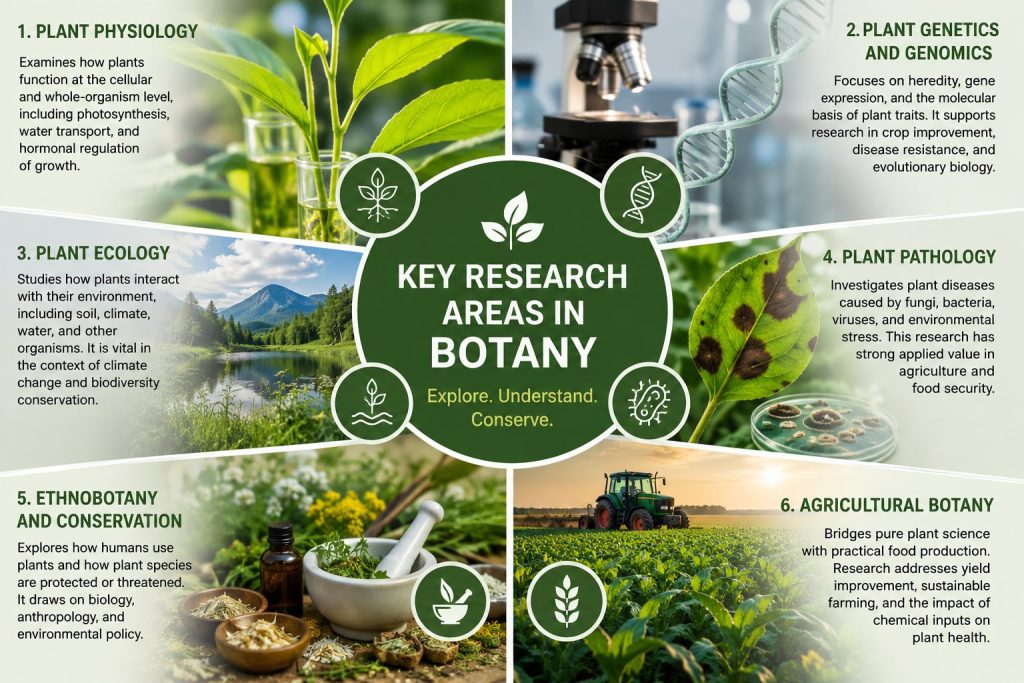
Before selecting your topic, it helps to understand which research areas currently sit at the centre of botanical science. These domains are not trends; they are well-established fields that continue to generate new knowledge and academic interest.
Plant Physiology examines how plants function at the cellular and whole-organism level. Topics here might explore photosynthesis efficiency, water transport mechanisms, or hormonal regulation of growth.
Plant Genetics and Genomics looks at heredity, gene expression, and the molecular basis of plant traits. This area supports research into crop improvement, resistance to disease, and evolutionary biology.
Plant Ecology studies how plants interact with their environments, including soil, climate, water, and other organisms. It is particularly relevant in the context of climate change and biodiversity loss.
Plant Pathology investigates the diseases that affect plants, including those caused by fungi, bacteria, viruses, and environmental stress. Research here has strong applied value in agriculture and food security.
Ethnobotany and Conservation explores how humans use plants and how plant species are protected or threatened. It draws on biology, anthropology, and environmental policy.
Agricultural Botany bridges pure plant science with practical food production. Research in this area addresses yield improvement, sustainable farming, and the impact of chemical inputs on plant health.
Each of these areas can support a strong dissertation at any level of study.
Five Example Botany Dissertation Topics With Research Aims and Objectives
The following examples demonstrate how a well-structured dissertation topic looks in practice. Each includes a research aim and two to three objectives to help you understand the academic architecture behind a strong proposal.
Example 1: The Effect of Drought Stress on Photosynthesis in Wheat Varieties
Research Aim: To investigate how varying levels of drought stress affect photosynthesis rates in commercially grown wheat varieties in the United Kingdom.
Research Objectives:
- To measure changes in chlorophyll content under controlled drought conditions
- To compare photosynthetic efficiency across three wheat cultivars
- To identify which physiological mechanisms provide the greatest drought resilience
Example 2: Mycorrhizal Fungi and Their Role in Plant Nutrient Uptake in Urban Soils
Research Aim: To examine how mycorrhizal fungi populations in degraded urban soils influence nitrogen and phosphorus uptake in native plant species.
Research Objectives:
- To assess mycorrhizal colonisation rates in urban versus rural soil samples
- To measure nutrient uptake efficiency in plants grown in both soil types
- To evaluate whether soil remediation techniques improve fungal-plant relationships
Example 3: Genetic Diversity in Endangered British Wildflowers
Research Aim: To analyse genetic diversity levels in three endangered wildflower populations across protected nature reserves in England.
Research Objectives:
- To collect and sequence genetic material from target species across multiple sites
- To compare genetic variability between isolated and connected populations
- To recommend conservation strategies based on genetic vulnerability findings
Example 4: The Impact of Microplastics on Seed Germination in Vegetable Crops
Research Aim: To determine the effect of microplastic concentrations in soil on seed germination rates and early root development in lettuce and radish.
Research Objectives:
- To design a controlled laboratory experiment simulating microplastic-contaminated soil
- To record germination rates and root morphology across concentration levels
- To evaluate potential long-term risks to food crop production
Example 5: Traditional Medicinal Plants Used by Indigenous Communities in Sub-Saharan Africa
Research Aim: To document and scientifically evaluate the pharmacological basis of medicinal plants identified through ethnobotanical surveys in rural communities.
Research Objectives:
- To conduct structured interviews with traditional healers to compile a plant inventory
- To review existing phytochemical studies on the identified species
- To assess the conservation status of the most frequently used medicinal plants
80 Botany Dissertation Topics for 2026
The following topics are organised under relevant subfields. Each is designed to be narrow in scope, academically sound, and suitable for 2026-level research. Students working on plant science dissertation topics at any level will find options appropriate to their study stage.
Plant Physiology and Biochemistry
- Investigating the role of abscisic acid in stomatal closure during water stress in Arabidopsis thaliana
- Comparing chlorophyll a and b ratios in shade-adapted versus sun-adapted plant species
- The effect of soil salinity on osmotic adjustment mechanisms in halophytic coastal plants
- Analysing the relationship between auxin distribution and gravitropism in maize seedlings
- How elevated carbon dioxide concentrations alter the rate of dark respiration in C3 plants
- The influence of light quality on anthocyanin biosynthesis in red-leafed ornamental plants
- Investigating ethylene production in post-harvest banana fruit and its regulatory pathways
- Comparing nitrogen assimilation efficiency between leguminous and non-leguminous crops
- The role of aquaporins in mediating water movement across root cell membranes under drought
- Examining how temperature fluctuations affect the activity of RuBisCO in alpine plant species
Plant Genetics and Molecular Biology
- CRISPR-Cas9 gene editing for disease resistance in commercially grown tomatoes
- Quantitative trait loci mapping for drought tolerance in African sorghum varieties
- Epigenetic modifications in response to UV-B radiation in Solanum lycopersicum
- Comparative genomics of polyploid wheat species and their wild diploid relatives
- The role of small RNA pathways in regulating floral development in Brassica oleracea
- Investigating transposable element activity under heat stress in rice genomes
- Gene expression profiling in mycorrhiza-colonised roots of Medicago truncatula
- Identifying resistance gene analogues in wild potato species for late blight control
- The molecular basis of vernalisation in winter barley cultivars
- Analysing mitochondrial DNA variation to trace evolutionary relationships in Orchidaceae
Plant Ecology and Biogeography
- Altitude-driven shifts in plant community composition on Scottish Highland moorlands
- The role of seed dispersal mechanisms in forest regeneration after wildfire in Mediterranean Europe
- Comparing above-ground biomass accumulation in rewilded versus grazed grasslands
- Invasive plant species and their effect on native soil microbial communities in riparian zones
- Phenological responses of spring-flowering plants to changing temperatures in urban parks
- The influence of canopy gap size on understorey plant species richness in temperate woodlands
- Examining pollinator-plant network structure in fragmented agricultural landscapes
- How soil pH gradients shape vascular plant diversity in lowland heath ecosystems
- The role of plant litter chemistry in decomposition rates across deciduous forest sites
- Assessing the impact of artificial light at night on nocturnal plant-pollinator interactions
Plant Pathology and Disease Management
- The epidemiology of Phytophthora infestans in UK potato fields under changing rainfall patterns
- Identifying novel biocontrol agents against Botrytis cinerea in strawberry production
- Bacterial canker spread in cherry orchards and the effectiveness of copper-based treatments
- The role of plant volatiles in signalling resistance to aphid colonisation in wheat
- Evaluating fungicide resistance in Zymoseptoria tritici populations in English arable farms
- How silicon supplementation reduces blast disease severity in paddy rice
- Comparing systemic acquired resistance responses in tomato and pepper after Pseudomonas infection
- The effect of crop rotation on soilborne pathogen levels in brassica production systems
- Viral co-infection dynamics in field-grown courgette plants and yield implications
- Investigating the role of soil microbiome diversity in suppressing Fusarium wilt in lentils
Conservation Botany and Biodiversity
- Ex situ conservation of rare fern species through spore banking and tissue culture
- Assessing the genetic health of reintroduced populations of Cypripedium calceolus in England
- The effectiveness of habitat corridors in maintaining plant species connectivity in fragmented landscapes
- Seed longevity testing for UK priority species in the Millennium Seed Bank collection
- Ethnobotanical knowledge loss among ageing rural communities in South Wales
- How climate projections affect the future range of calcicole plant species in the British Isles
- Restoration success metrics for blanket bog vegetation after commercial peat extraction
- Monitoring invasive Rhododendron ponticum removal and native woodland recovery in Scotland
- The role of traditional land management in preserving grassland plant diversity in southern England
- Genetic erosion in ancient woodland herb populations isolated by agricultural expansion
Agricultural Botany and Crop Science
- The effect of biostimulant seed treatments on early root architecture in winter wheat
- Comparing water use efficiency across heritage and modern barley varieties under semi-arid conditions
- The role of cover crops in improving soil organic matter and subsequent cash crop yield
- Nitrogen fixation efficiency of Rhizobium strains across different soil pH levels in legume crops
- Assessing the phytoremediation potential of sunflower in cadmium-contaminated horticultural soils
- How delayed harvest dates affect grain protein content and quality in oats
- The impact of intercropping maize and cowpea on weed suppression and soil fertility
- Evaluating organic mulching strategies on fruit set and water retention in strawberry fields
- Comparing silicon availability in organic versus conventionally managed soils and its effect on wheat
- The influence of mycorrhizal inoculants on phosphorus uptake in organic vegetable production
Ethnobotany and Medicinal Plants
- Documenting wild plant use among Romani communities in Eastern Europe and assessing conservation implications
- The pharmacognostic properties of Plantago lanceolata in traditional British herbal medicine
- Comparing antioxidant activity in standardised extracts of commonly used African medicinal plants
- Seasonal variation in the alkaloid content of Atropa belladonna in temperate garden cultivation
- How urbanisation affects the availability of culturally important wild food plants in West African cities
- Ethnobotanical survey of plants used in childbirth by Amazonian communities and their bioactive profiles
- Evaluating the anti-inflammatory activity of compounds isolated from Echinacea purpurea roots
- Traditional use of aquatic plants in South Asian folk medicine and its phytochemical basis
- Comparing volatile oil composition in wild versus cultivated populations of Lavandula angustifolia
- The potential of under-researched UK native plants as sources of antimicrobial compounds
Plant Responses to Climate Change
- Modelling the northward range expansion of thermophilous tree species in response to warming in Britain
- The effect of elevated ozone concentrations on stomatal density and leaf gas exchange in oak
- How increased atmospheric CO2 affects the nutritional quality of leafy vegetables
- Assessing phenotypic plasticity in coastal dune plant species exposed to increased storm frequency
- The response of soil seed banks to increased freeze-thaw cycle frequency in upland Britain
- Changes in plant-herbivore interactions under projected temperature and precipitation scenarios
- Evaluating the resilience of mangrove ecosystems to sea level rise in tropical coastal zones
- How drought frequency affects mycorrhizal dependency in Mediterranean shrubland species
- The effect of heatwave events on pollen viability and reproductive success in insect-pollinated wildflowers
- Projected shifts in the timing of leaf senescence in temperate deciduous trees under climate scenarios
How to Choose the Right Topic for Your Level
Not every topic above will be appropriate for every student. The level of your study shapes the depth and scope your dissertation should achieve.
Undergraduate students should select topics that are focused, practically manageable, and grounded in a clear scientific question. A topic from plant physiology or agricultural botany often works well at this level because it can be tested through controlled experiments or literature-based analysis.
Master’s students are expected to make a modest original contribution. Topics from plant genetics, plant ecology, or conservation botany offer scope for genuine research design, data collection, and interpretation. Many students writing at this level also seek online dissertation help to ensure their methodology is correctly structured before submission.
PhD students need a topic that addresses a genuine gap in knowledge. Topics in molecular biology, climate change responses, or emerging areas of ethnobotany tend to suit this level because they offer both depth and the opportunity for publishable findings.
Conclusion
Selecting the right dissertation topic in botany is not simply about finding something interesting. It is about choosing a question that is academically meaningful, practically researchable, and appropriately scoped for your level of study.
The 80 botanical research topics listed here represent some of the most relevant and timely directions for plant science research in 2026. They span a wide range of subfields and reflect both long-standing academic concerns and emerging scientific priorities.
A strong dissertation begins with a strong question. Once you have that, the rest of the research process becomes far more manageable. Students who invest time in their topic selection consistently produce more coherent, confident, and academically rewarding dissertations.
If you are still unsure which direction suits your interests and academic background, do not hesitate to seek biology dissertation writing service support or speak with your supervisor early in the process. The earlier you commit to a well-framed question, the more time you have to develop the research that follows.
Approach your dissertation with intellectual curiosity, academic honesty, and a genuine desire to contribute to the understanding of plant science. That combination is what distinguishes exceptional work from the merely adequate.
