


Corporate Law Dissertation Topics for 2026

Questions Students Are Asking About Corporate Law Dissertation Topics
The following questions have been gathered from student forums, academic discussion boards, and online communities where law students share their concerns about dissertation writing. If you have asked yourself any of these, you are not alone.
- What are the best corporate law dissertation topics for 2026?
- How do I choose a corporate law thesis topic that is original and researchable?
- What corporate law dissertation topics work for an LLM student?
- Are there ideas in corporate law suitable for an LLB student without prior research experience?
- What topics in corporate law are appropriate for my PhD thesis?
- How do corporate law thesis ideas differ for a GDL dissertation compared to a traditional law degree?
- Which areas of corporate law are most relevant to current legal debates?
- Can I get a list of hot dissertation topics in corporate law to narrow down my options?
Why Choosing the Right Corporate Law Dissertation Topic Matters
Choosing a dissertation topic in corporate law is one of the most significant academic decisions you will make during your degree. Corporate law sits at the intersection of business regulation, governance, ethics, and global commerce. The topic you choose will shape your research methodology, determine the depth of your legal analysis, and signal to future employers or academic institutions how seriously you engage with the field.
Many students feel overwhelmed at this stage, and that is entirely understandable. Corporate law is a broad and evolving discipline. In 2026, it intersects with sustainability law, digital regulation, fintech governance, and international trade in ways that were not possible even five years ago. This means there are more opportunities than ever before, but also more complexity to navigate.
If you are feeling unsure, seeking online dissertation help from a qualified academic source can give you the structure and direction you need to move forward with confidence.
This post covers 80 original, academically sound corporate law dissertation topics, organised by subfield, along with sample topics with aims and objectives to help you understand what strong dissertation framing looks like.
Download Corporate Law Dissertation Topics PDF
Students often find it useful to have a curated, personalised list they can reference offline. After completing a short academic preferences form, students can receive a downloadable PDF prepared by academic specialists in corporate law. The PDF contains a tailored selection of dissertation topics matched to your academic level, research interests, and institutional requirements. This resource is particularly helpful for students who want focused guidance without having to sort through every option manually.
Key Research Areas in Corporate Law
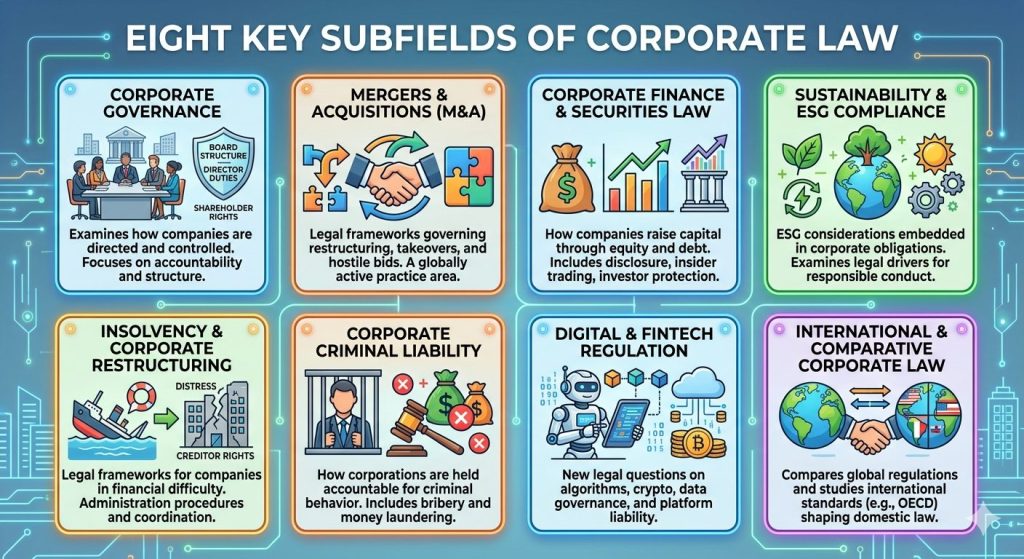
Before selecting a topic, it helps to understand the main subfields within corporate law where meaningful dissertation research takes place. These areas are grounded in established academic and legal practice, not invented trends.
Corporate Governance This area examines how companies are directed and controlled. It covers board structure, director duties, shareholder rights, and accountability mechanisms within public and private companies.
Mergers and Acquisitions (M&A) M&A law looks at the legal frameworks that govern corporate restructuring, takeovers, hostile bids, and post-merger compliance. It remains one of the most active areas of corporate legal practice globally.
Corporate Finance and Securities Law This subfield covers how companies raise capital through equity and debt markets, regulatory obligations around disclosure, insider trading, and investor protection.
Sustainability and ESG Compliance Environmental, Social, and Governance (ESG) considerations are now embedded in corporate legal obligations across many jurisdictions. Research in this area explores how law can drive responsible business conduct.
Insolvency and Corporate Restructuring This covers legal frameworks for companies in financial distress, creditor rights, administration procedures, and cross-border insolvency coordination.
Corporate Criminal Liability This area explores how corporations are held accountable for criminal behaviour, including bribery, fraud, money laundering, and regulatory breaches.
Digital and Fintech Regulation As technology reshapes corporate operations, new legal questions arise around algorithmic accountability, cryptocurrency regulation, data governance, and platform liability.
International and Comparative Corporate Law This subfield compares how different jurisdictions regulate corporate behaviour and examines how international standards such as OECD guidelines shape domestic law.
Five Example Dissertation Topics with Aims and Objectives
The following examples demonstrate how to move from a broad idea to a structured, academically viable dissertation topic.
Example 1: Director Accountability in ESG Reporting
Research Aim: To examine the extent to which current UK corporate law holds directors personally accountable for inaccurate or misleading ESG disclosures.
Research Objectives:
- To analyse existing statutory and common law duties placed on directors in relation to sustainability reporting under UK law.
- To evaluate the effectiveness of enforcement mechanisms currently available against directors who breach ESG disclosure obligations.
- To propose reforms that would strengthen director accountability in line with evolving international ESG standards.
Example 2: Shareholder Activism and Board Composition
Research Aim: To investigate how shareholder activism influences board composition and corporate strategy in FTSE 100 companies.
Research Objectives:
- To identify patterns in shareholder activism campaigns targeting board diversity and leadership structure between 2018 and 2024.
- To assess the legal tools available to shareholders to influence board decisions under UK company law.
- To evaluate whether shareholder-driven board reforms produce measurable improvements in corporate governance outcomes.
Example 3: Cryptocurrency Assets and Corporate Insolvency
Research Aim: To explore how UK insolvency law applies to companies holding significant cryptocurrency assets at the point of administration.
Research Objectives:
- To examine how cryptocurrency is classified as a corporate asset under current English law.
- To assess the legal challenges faced by insolvency practitioners when realising crypto assets for creditor distribution.
- To propose a regulatory framework for handling digital assets in corporate insolvency proceedings.
Example 4: Corporate Liability for Supply Chain Human Rights Abuses
Research Aim: To examine whether English corporate law adequately addresses the liability of parent companies for human rights violations committed by their overseas subsidiaries.
Research Objectives:
- To review recent case law and legislative developments relating to parent company liability in the UK.
- To compare the UK approach with mandatory human rights due diligence legislation in France and Germany.
- To assess the potential impact of a proposed UK Supply Chain Due Diligence Act on corporate legal risk management.
Example 5: Algorithmic Decision-Making and Director Duties
Research Aim: To investigate how the increased use of AI-driven decision-making tools affects the discharge of director duties under the Companies Act 2006.
Research Objectives:
- To analyse the legal definition of directorial duty of care in the context of AI-assisted business decisions.
- To identify legal gaps in the current accountability framework when decisions are partially or fully automated.
- To recommend legislative or regulatory changes to clarify director responsibility in AI-integrated corporate environments.
80 Corporate Law Dissertation Topics for 2026
The following topics are organised by subfield. They are suitable for undergraduate (LLB), postgraduate (LLM or GDL), and doctoral (PhD) research depending on the depth of analysis pursued. Students looking for best corporate law dissertation topics that are narrow, focused, and academically rigorous will find this list particularly useful.
Corporate Governance and Board Accountability
- The effectiveness of the UK Corporate Governance Code 2024 in promoting board diversity in FTSE 250 companies.
- The legal boundaries of non-executive director independence under English company law.
- How dual-class share structures affect minority shareholder protection in UK listed companies.
- Remuneration committees and their legal accountability for excessive executive pay in public companies.
- The enforceability of board diversity targets in the absence of mandatory quota legislation in England and Wales.
- Conflicts of interest and the duty of loyalty: a critical assessment of director disclosure obligations under the Companies Act 2006.
- Corporate governance failures in family-owned listed companies: a comparative legal analysis.
- The legal consequences of board-level groupthink in publicly listed financial institutions.
- Whistleblowing frameworks within corporate governance: gaps in legal protection under current UK law.
- Stewardship codes and their legally binding effect on institutional investor behaviour in the UK.
Mergers, Acquisitions, and Takeover Law
- The adequacy of the UK Takeover Code in protecting target company shareholders during hostile bids.
- Legal challenges in cross-border mergers involving UK companies post-Brexit.
- Minority shareholder squeeze-out rights in private equity-led acquisitions under English law.
- Material adverse change clauses in M&A agreements: legal interpretation and enforceability in English courts.
- The role of competition law in blocking vertical mergers in the UK digital economy.
- Due diligence obligations of acquiring companies in the context of environmental liability.
- Reverse break fees in failed M&A transactions: a legal analysis of enforceability under English contract and company law.
- The Takeover Panel’s jurisdiction over digital platform acquisitions: gaps and reform proposals.
- Legal risks associated with earn-out clauses in small and medium enterprise acquisitions.
- Statutory merger thresholds and their adequacy in regulating acquisitions in the UK healthcare sector.
Corporate Finance and Securities Regulation
- The effectiveness of the UK Listing Rules reform in attracting international companies to the London Stock Exchange.
- Legal obligations of underwriters in failed initial public offerings under English law.
- Regulatory gaps in the treatment of special purpose acquisition companies (SPACs) under UK securities law.
- Market manipulation through social media: the adequacy of the UK Market Abuse Regulation post-Brexit.
- Insider trading liability for corporate outsiders: a critical examination of the scope of UK law.
- The legal treatment of convertible bonds in corporate restructuring under English law.
- Crowdfunding and investor protection: the adequacy of the Financial Conduct Authority’s regulatory framework.
- Short selling and systemic risk: evaluating the legal response of UK regulators post-2022 market volatility.
- The legal implications of green bonds and sustainability-linked financial instruments for corporate issuers.
- Regulatory arbitrage in cross-listed companies: how dual-listed firms exploit legal differences between the UK and US markets.
ESG, Sustainability, and Corporate Responsibility Law
- Mandatory climate-related financial disclosure and its legal implications for FTSE 100 boards.
- The legal enforceability of net-zero corporate commitments under English contract and company law.
- Greenwashing and corporate liability: an analysis of legal remedies available to investors and regulators.
- How the UK’s Sustainability Disclosure Requirements reshape director duties under the Companies Act 2006.
- The role of pension fund trustees in enforcing ESG compliance through shareholder engagement.
- Nature-related financial disclosures (TNFD) and their emerging corporate legal obligations in the UK.
- Corporate supply chain due diligence obligations: comparing the UK Modern Slavery Act with the EU Corporate Sustainability Due Diligence Directive.
- Social value clauses in public procurement contracts and their enforceability under English law.
- The legal status of ESG ratings agencies and their accountability to regulated entities in the UK.
- Directors’ duties and biodiversity loss: how environmental degradation creates legal exposure for corporate boards.
Corporate Insolvency and Restructuring Law
- The effectiveness of the Corporate Insolvency and Governance Act 2020 in supporting SME recovery post-pandemic.
- Pre-pack administrations and creditor transparency: does the current legal framework go far enough?
- Cross-border insolvency coordination between the UK and EU after Brexit: identifying the legal gaps.
- The legal treatment of pension scheme deficits in corporate insolvency proceedings under English law.
- Wrongful trading liability and its deterrent effect on director risk-taking in financially distressed companies.
- The UNCITRAL Model Law on Enterprise Group Insolvency: implications for multinational corporate structures.
- Cram-down mechanisms in UK restructuring plans: a comparative assessment with US Chapter 11 procedures.
- The legal position of employees as creditors in corporate liquidation under the Employment Rights Act 1996.
- Fraudulent preference claims against secured creditors in insolvency: adequacy of the current legal standard.
- Cryptocurrency and digital asset treatment in UK corporate insolvency proceedings.
Corporate Criminal Liability and Enforcement
- The adequacy of the corporate criminal liability framework following the failure of the Serious Fraud Office v. Barclays prosecutions.
- Deferred prosecution agreements and their effectiveness in deterring corporate fraud in the UK.
- Corporate liability for bribery under the Bribery Act 2010: an evaluation of the “adequate procedures” defence.
- Economic crime and the failure of UK law to prosecute large financial institutions effectively.
- The proposed failure-to-prevent fraud offence under the Economic Crime and Corporate Transparency Act 2023 and its implications for corporate compliance.
- Corporate manslaughter and the barriers to successful prosecution of large organisations in England and Wales.
- Unexplained wealth orders and their application to corporate entities in the UK.
- Whistleblower protection and corporate retaliation: gaps in the legal framework under UK employment and company law.
- Anti-money laundering obligations for corporate service providers: the adequacy of current regulatory enforcement.
- Cross-border corruption and the extraterritorial reach of UK corporate criminal law.
Digital Regulation, Fintech, and Emerging Technologies in Corporate Law
- The legal classification of decentralised autonomous organisations (DAOs) as corporate entities under English law.
- Artificial intelligence and director decision-making: liability gaps in the current UK legal framework.
- Digital securities and the legal challenges of tokenised equity in UK capital markets.
- Legal accountability for algorithmic trading systems causing market instability under UK law.
- The regulatory treatment of embedded finance and buy-now-pay-later products under UK financial services law.
- Corporate data governance obligations under the UK GDPR and their intersection with company law duties.
- Blockchain-based smart contracts in M&A transactions: legal enforceability under English law.
- The legal implications of central bank digital currencies for corporate treasury management and compliance.
- Liability of cloud service providers for corporate data breaches: a corporate law perspective.
- Regulatory sandboxes and their role in shaping fintech corporate governance standards in the UK.
International and Comparative Corporate Law
- A comparative analysis of mandatory board gender quotas in Germany and France and the case for similar reform in the UK.
- The OECD Principles of Corporate Governance 2023 and their influence on UK legislative reform.
- How the EU Corporate Sustainability Reporting Directive affects UK-listed companies with European operations.
- The convergence of corporate governance standards between common law and civil law jurisdictions in the post-pandemic era.
- Legal obstacles to enforcement of foreign court judgments against multinational corporations in English courts post-Brexit.
- Investor-state dispute settlement mechanisms and their implications for corporate regulatory compliance.
- Corporate law reform in emerging markets: lessons for the UK from South Africa’s King IV governance framework.
- The extraterritorial application of US securities law and its legal implications for UK-incorporated companies listed on US exchanges.
- Forum selection clauses in international M&A agreements: enforceability and strategic use under English private international law.
- The global convergence of ESG legal standards: implications for multinational corporate compliance and board accountability.
Conclusion
Selecting the right dissertation topic in corporate law is the first and most important step in producing research that is academically rigorous, practically relevant, and intellectually rewarding. The 80 topics presented in this post reflect the current landscape of corporate law in 2026, spanning governance, finance, sustainability, criminal accountability, digital regulation, and comparative legal analysis.
Whether you are pursuing corporate law thesis topics as an LLB student writing your first major piece of independent research, or exploring topics in corporate law for a PhD thesis that contributes original scholarship to the field, the core principle remains the same. Your topic must be narrow enough to be researchable within your word limit, grounded in established legal frameworks, and connected to current debates in the field.
If you are still unsure where to start, structured online dissertation help from qualified academic specialists can make the difference between uncertainty and a confident, well-directed research proposal. The key is to begin early, read widely across your chosen subfield, and choose a topic that genuinely interests you. Sustained academic curiosity is what drives successful dissertations.
Approach your dissertation not as a burden but as an opportunity to contribute something meaningful to the conversation in corporate law. With the right topic, a clear research aim, and a structured methodology, you are already on your way to producing work you can be proud of.

The example research aims and objectives make the topic selection process much clearer for students who struggle with narrowing their scope. Topics like cryptocurrency insolvency and cross-border restructuring also show how modern corporate law is becoming more interconnected with digital assets and international regulation.