


Employment Law Dissertation Topics for 2026

Questions from Student Forums & Academic Discussion Platforms
The following questions reflect what students commonly ask when searching for guidance on their employment law dissertations. They have been gathered from academic forums, university discussion boards, and student communities online.
- What are the best employment law dissertation topics for 2026 that are current and academically credible?
- I am an LLB student. What dissertation topics in employment law for LLB students would suit my level?
- How do I find thesis ideas related to employment law for my LLM research proposal?
- What employment law research topics focus on emerging issues like gig economy or AI in the workplace?
- Are there specific topics in employment law for PhD students in 2026 that supervisors are actually approving?
- How do I narrow a broad employment law area into a focused, researchable dissertation topic?
- What are the best topics for an employment law dissertation that combine legal theory with practical workplace issues?
Choosing the right dissertation topic is one of the most important academic decisions a law student will ever make. In employment law, this decision carries particular weight. The field sits at the intersection of individual rights, corporate responsibility, social policy, and economic change. Getting the topic right means your research will be relevant, researchable, and rewarding to write.
This post gives you a structured guide to employment law dissertation topics for 2026. Whether you are writing at undergraduate level or developing a doctoral proposal, you will find topic ideas, research frameworks, and guidance to help you move forward with confidence. Students seeking additional support can explore online dissertation help from academic professionals who specialise in law research.
Download Employment Law Dissertation Topics PDF
Students who want a personalised list of curated dissertation topics can access a downloadable PDF prepared by academic subject specialists. The document is tailored to your level of study and research interests in employment law.
To receive your copy, you are asked to complete a short form so that the academic team can match the PDF to your specific research needs. The form takes under two minutes to complete, and no extensive personal information is required beyond your study level and area of interest.
Why Choosing the Right Employment Law Dissertation Topic Matters
Employment law is one of the most dynamic areas of legal study. It responds directly to shifts in labour markets, changes in legislation, developments in case law, and broader societal changes such as remote working, platform economies, and artificial intelligence in the workplace.
A well-chosen topic gives your dissertation a clear purpose. It makes it easier to define your research question, construct a strong methodology, and contribute something meaningful to the existing body of knowledge. A topic that is too broad will leave you struggling to structure your argument. A topic that is too narrow may not have enough source material to support a substantial piece of academic writing.
Students who select a focused, original, and timely topic are better placed to produce research that impresses supervisors, earns strong marks, and, in some cases, contributes to genuine academic or policy debate. For students working on their employment law research topics, this is the foundation everything else is built on.
Suggested Infographic (placed here): A visual flowchart titled “How to Choose Your Employment Law Dissertation Topic” showing the journey from broad area → narrowing process → researchable question → methodology choice. Alt text: “Flowchart showing steps to select a focused employment law dissertation topic for 2026.” Image size: 1200×628px.
Key Research Areas in Employment Law for 2026
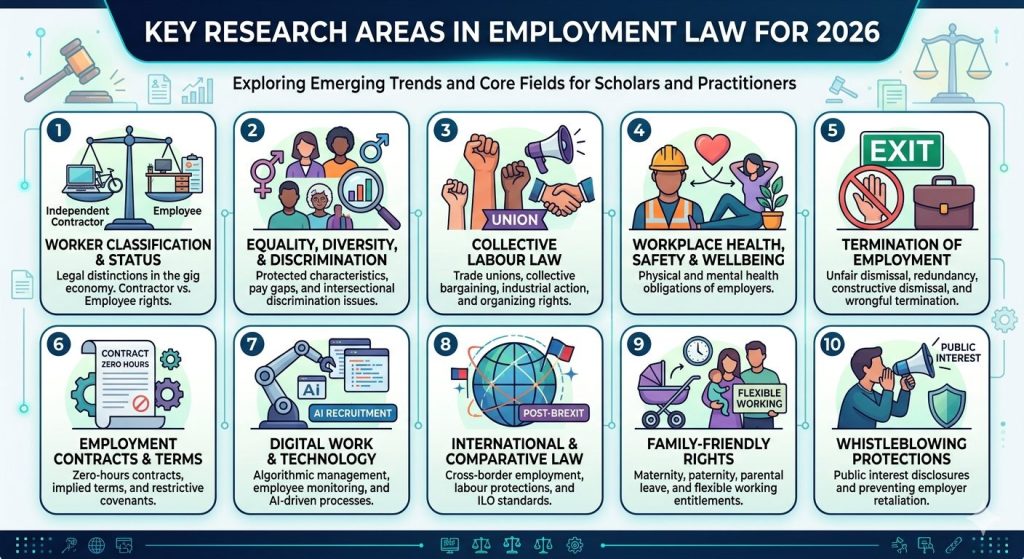
Employment law covers a wide range of subjects. Before you settle on a specific topic, it helps to understand the main research domains that scholars and practitioners are currently exploring. Below are the core areas from which most dissertation topics are drawn.
- Worker Classification and Status – the legal distinction between employees, workers, and independent contractors, especially relevant in the gig economy.
- Equality, Diversity, and Discrimination Law – including protected characteristics, pay gaps, and intersectional discrimination.
- Collective Labour Law – trade unions, collective bargaining, industrial action, and the right to organise.
- Workplace Health, Safety, and Wellbeing – physical and mental health obligations of employers.
- Termination of Employment – unfair dismissal, redundancy, constructive dismissal, and wrongful termination.
- Employment Contracts and Terms – zero-hours contracts, implied terms, restrictive covenants, and flexibility clauses.
- Digital Work and Technology in Employment – algorithmic management, employee monitoring, and AI-driven recruitment.
- International and Comparative Employment Law – cross-border employment, post-Brexit labour protections, and ILO standards.
- Family-Friendly Rights – maternity, paternity, parental leave, and flexible working entitlements.
- Whistleblowing and Employment Protections – public interest disclosures and employer retaliation.
Example Employment Law Dissertation Topics with Aims and Objectives
The following five examples show how a well-constructed employment law dissertation topic is structured at academic level. Each example includes a research aim and supporting objectives to illustrate what a strong proposal looks like.
1. The Legal Status of Gig Economy Workers Under UK Employment Law: Adequacy and Reform
Research Aim: To critically examine whether existing UK employment law adequately protects gig economy workers and to identify what legislative reforms may be necessary.
- To analyse the current three-tier worker classification system under UK law and its application to platform workers.
- To evaluate key tribunal and Supreme Court decisions on gig economy worker status since 2016.
- To assess proposed reforms and compare the UK approach with regulatory developments in the European Union.
2. Algorithmic Management and the Right to Dignity at Work: A Legal Analysis
Research Aim: To examine whether UK employment law sufficiently protects workers subjected to algorithmic management systems that affect their performance, pay, and job security.
- To define algorithmic management and review its use across logistics, retail, and platform industries.
- To assess how data protection legislation and employment law interact in managing algorithmic systems.
- To evaluate whether existing legal frameworks adequately protect worker dignity and autonomy.
3. Gender Pay Gap Reporting in the UK: Legal Obligations, Compliance, and Effectiveness
Research Aim: To evaluate the effectiveness of mandatory gender pay gap reporting as a legal mechanism for reducing pay inequality in large UK organisations.
- To review the legislative basis and scope of gender pay gap reporting under the Equality Act 2010 and associated regulations.
- To analyse reporting data across sectors and assess patterns of compliance and non-compliance.
- To recommend targeted legal reforms to strengthen enforcement and improve transparency.
4. Constructive Dismissal in Remote Working Environments: Emerging Legal Challenges
Research Aim: To investigate how the growth of remote working has affected the legal standards and judicial interpretation of constructive dismissal claims in UK employment tribunals.
- To review the established legal test for constructive dismissal and how it has been interpreted before and after widespread remote working.
- To examine tribunal cases where remote working arrangements formed part of constructive dismissal claims.
- To consider whether current legal standards are adequate for hybrid and remote workplaces.
5. Post-Brexit Employment Rights: Continuity, Divergence, and the Future of UK Labour Law
Research Aim: To critically assess the extent to which UK employment law has diverged from EU labour standards since Brexit and to evaluate the implications for workers’ rights.
- To map the key EU employment law directives that formerly applied in the UK and their current legislative status.
- To analyse domestic regulatory changes made since the UK’s departure from the EU internal market.
- To evaluate the risks and opportunities presented by post-Brexit employment law divergence.
Suggested Infographic (placed here): A two-column comparison visual titled “Before and After Brexit: Key Employment Law Changes” showing EU-derived rights versus current UK status. Alt text: “Infographic comparing EU employment law rights with post-Brexit UK employment law provisions in 2026.” Image size: 1200×628px.
80 Employment Law Dissertation Topics for 2026
The following 80 topics are organised by subfield within employment law. Each topic is focused, researchable, and suited to 2026 academic standards. They span undergraduate, master’s, and doctoral levels, and each can be shaped into a strong research proposal with the right methodology. Students looking for more personalised guidance on any of these can seek dissertation help from specialists in employment and labour law.
Gig Economy and Worker Classification
- The adequacy of UK employment law in protecting food delivery platform workers from unfair treatment
- Worker or employee? A critical analysis of tribunal inconsistencies in classifying app-based drivers
- Platform work and the minimum wage: enforcement gaps and legislative responses in the UK
- The European Platform Work Directive and its implications for UK law post-Brexit
- Zero-hours contracts in the care sector: legal protections, exploitation risks, and reform proposals
- Bogus self-employment in the construction industry: legal remedies and regulatory failures
- The impact of the Supreme Court’s Uber ruling on worker status claims in the UK
- Dependent contractors in comparative law: lessons from Canada and Germany for UK reform
- Gig economy workers and pension rights: a legal gap analysis under UK auto-enrolment law
- The role of trade unions in representing platform workers: legal barriers and emerging strategies
Discrimination, Equality, and Protected Characteristics
- Intersectional discrimination in UK employment law: the limits of the single-strand approach
- Age discrimination in recruitment processes: legal obligations and employer practice
- Reasonable adjustments for disabled employees in hybrid working environments
- Caste discrimination in UK employment: legislative gaps and judicial responses
- Menopause and the workplace: whether UK law adequately protects menopausal employees
- Belief-based discrimination in employment: the expanding scope of philosophical belief under the Equality Act
- Racially hostile workplace cultures and the limits of indirect discrimination claims
- Pregnancy and maternity discrimination in the NHS: patterns, barriers, and legal enforcement
- Sexual harassment at work: assessing the impact of the Worker Protection Act 2023 on employer duty
- Pay transparency as a legal tool for reducing the gender pay gap in financial services
Dismissal, Redundancy, and Termination of Employment
- The qualifying period for unfair dismissal claims: whether two years is proportionate and just
- Automatically unfair dismissal for whistleblowing: an analysis of tribunal outcomes post-2015
- Redundancy selection criteria and indirect discrimination: lessons from recent case law
- Fire and rehire practices in the UK: legal accountability, ethical concerns, and reform proposals
- Constructive dismissal and mental health: whether stress-related resignations receive adequate legal recognition
- Summary dismissal for gross misconduct: consistency, proportionality, and employee rights
- Settlement agreements in employment disputes: power imbalances and legal safeguards
- Contractual notice and garden leave: employer use, enforceability, and employee challenges
- Mass redundancy consultations: whether collective consultation rules adequately protect workers
- The impact of artificial intelligence tools on redundancy decision-making and legal liability
Technology, AI, and Digital Employment Law
- Employee monitoring in remote work: legal boundaries under UK data protection and employment law
- AI-driven recruitment tools and discrimination risk: legal obligations of UK employers
- The right to explanation for algorithmic employment decisions under UK GDPR
- Facial recognition surveillance in the workplace: privacy, legality, and employee consent
- Automated performance management systems and the legal risks of unfair dismissal
- Digital right to disconnect: whether UK workers need legislative protection from after-hours contact
- Wearable technology in manufacturing: health and safety obligations and privacy implications
- Artificial intelligence bias in promotion decisions: employer liability and regulatory responses
- Cybersecurity obligations and employee conduct: the legal framework for monitoring and discipline
- Employment contracts and digital delivery platforms: are terms of service an adequate substitute?
Workplace Health, Safety, and Mental Wellbeing
- Employer duty of care for remote workers’ mental health: legal standards and enforcement
- Occupational stress claims: whether UK law provides effective remedies for burned-out employees
- Violence and aggression against health workers: legal protections and employer liability
- The legal framework for managing long COVID in the workplace as a disability
- Bullying at work and the absence of a standalone legal claim: the case for reform
- Psychosocial risk assessments and employer obligations under UK health and safety law
- Reasonable adjustments for anxiety disorders: how consistent is tribunal decision-making?
- Drug and alcohol testing in safety-critical industries: proportionality, consent, and legality
- Musculoskeletal disorders and employer liability in distribution and logistics sectors
- The legal duty to provide mental health first aid: whether a statutory obligation is justified
Collective Labour Law and Trade Unions
- The decline of collective bargaining in the private sector: legal causes and consequences
- Strike law and the minimum service levels legislation: a threat to the right to strike?
- Trade union recognition under the statutory procedure: barriers, delays, and reform options
- The impact of anti-union practices on collective bargaining outcomes in logistics and retail
- Picketing law in the UK: whether current restrictions breach ILO Convention standards
- Worker representation on company boards: a comparative legal analysis of the UK and Germany
- The role of works councils in multinational companies operating in the UK post-Brexit
- Collective consultation and TUPE transfers: gaps in employee protection during business acquisitions
- Union access rights and the digitisation of organising: whether law keeps pace with modern practice
- Solidarity action and sympathy strikes: the case for expanding lawful collective action in the UK
Family-Friendly Rights and Flexible Working
- Shared parental leave uptake in the UK: legal design flaws and proposals for improvement
- The right to request flexible working from day one: early assessment of the 2023 legislative change
- Neonatal care leave as a new statutory right: implementation, employer readiness, and legal gaps
- Paternity leave entitlements in the UK and EU: a comparative analysis of adequacy
- Career progression after maternity leave: legal protections, practical barriers, and enforcement
- Childcare responsibilities and indirect sex discrimination in shift-based roles
- Bereavement leave law in the UK: whether current provisions meet employee needs
- Informal flexible working arrangements and the legal risks of inconsistent employer treatment
- Foster carers and adoption leave: whether UK law adequately recognises non-traditional family structures
- Remote working as a reasonable adjustment for caregiving responsibilities: tribunal trends
International and Comparative Employment Law
- Cross-border employment contracts and applicable law in post-Brexit UK: conflict of laws analysis
- ILO Decent Work standards and their enforceability in UK domestic law
- Labour rights in global supply chains: UK Modern Slavery Act obligations and corporate accountability
- Migrant workers and employment law protections: whether visa status creates legal vulnerability
- The impact of trade agreements on labour standards: a post-Brexit legal analysis
- Seasonal agricultural workers and legal protections under the UK seasonal worker visa scheme
- Labour law harmonisation in the Commonwealth: potential frameworks and legal challenges
- The social clause debate: integrating labour rights into international trade law
- Employee rights in multinational insolvencies: jurisdiction, priority, and protection gaps
- The Employment Rights Bill 2024–25: a comprehensive critical analysis of proposed UK labour law reform
Conclusion
Employment law is a field that demands both academic rigour and awareness of real-world impact. The topics in this post reflect the key legal debates that scholars, practitioners, and policymakers are actively engaging with in 2026. Each one offers a genuine opportunity for original, meaningful research.
The most important step is to choose a topic that you understand, care about, and can pursue with intellectual honesty. A strong dissertation is not defined by its title alone. It is defined by the clarity of the research question, the robustness of the methodology, and the quality of the analysis that supports the conclusions.
Whether you are a final-year LLB student, an LLM candidate working on your research proposal, or a doctoral researcher mapping out a long-term project, the 80 employment law dissertation topics for 2026 in this post give you a structured and credible starting point. Revisit the example topics with aims and objectives to understand how to build your own proposal systematically.
Approach your dissertation with confidence, patience, and academic integrity. The subject of employment law exists to protect people, advance justice, and shape how work is conducted in society. Your research, however focused, contributes to that ongoing conversation.
