


Cybercrime Law Dissertation Topics for 2026

Questions Students Are Asking (From Academic Forums and Discussion Platforms)
Students across the UK and beyond frequently share their struggles with dissertation topic selection on platforms such as The Student Room, Reddit’s r/LawSchool, and various university postgraduate forums. The questions below reflect genuine concerns raised by law students trying to navigate cybercrime law research in 2026.
- What is the best topic for a cybercrime law dissertation that will stand out academically?
- Are there thesis topics related to cybercrime law for my LLM programme that focus on current legislation?
- What cybercrime law issues are suitable for a GDL research paper at undergraduate level?
- How do I find strong research proposal ideas on cybercrime law for my PhD in the UK?
- Where can I find a cybercrime law dissertation topics PDF that includes 2026-relevant ideas?
- How do I narrow down a broad cybercrime topic into a researchable dissertation question?
- Which areas of cybercrime law are most likely to attract supervisor approval in 2026?
If you have asked yourself any of these questions, this post is written with you in mind.
Why Choosing the Right Dissertation Topic in Cybercrime Law Matters
Cybercrime law sits at the crossroads of technology, criminal justice, civil liberties, and international governance. As digital systems become more embedded in everyday life, the legal frameworks designed to regulate online misconduct are constantly under pressure to evolve. This makes the field both academically rich and practically significant.
Choosing the right dissertation topic is not simply about finding something interesting. It is about identifying a research gap, aligning your inquiry with current legal debates, and producing work that contributes meaningfully to an academic conversation. A well-chosen topic gives your dissertation direction, helps you manage scope, and demonstrates to your examiners that you understand the field at a sophisticated level.
Students who receive online dissertation help at the early planning stage consistently report feeling more confident about their topic choice and better equipped to develop a focused research question. Whether you are at undergraduate, master’s, or doctoral level, topic selection shapes the entire trajectory of your research.
Download Cybercrime Law Dissertation Topics PDF
Many students find it useful to have a curated list of dissertation topics they can review offline, share with their supervisors, or annotate as they refine their ideas. A downloadable PDF containing a personalised selection of cybercrime law dissertation topics, compiled by academic specialists, is available for students who complete a short academic preferences form.
The topics within the PDF are tailored to your level of study and research interests, making it a practical resource for students at the undergraduate, LLM, or PhD stage. This is particularly useful for those exploring dissertation topics in cybercrime law for the first time and looking for structured guidance from qualified researchers.
Key Research Areas in Cybercrime Law
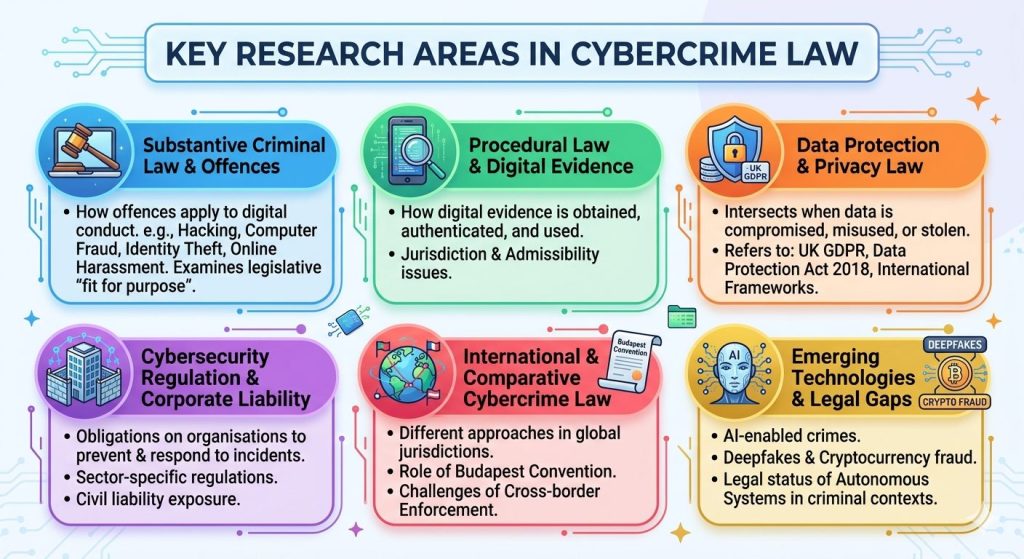
Before selecting a specific topic, it helps to understand the established academic domains within cybercrime law. These areas reflect the major debates in legal scholarship, policy development, and comparative jurisprudence.
Substantive criminal law and cybercrime offences covers how existing criminal offences apply to digital conduct, including computer fraud, hacking, identity theft, and online harassment. This area examines whether current legislation is fit for purpose.
Procedural law and digital evidence focuses on how evidence gathered from digital sources is obtained, authenticated, and used in criminal proceedings. Issues of jurisdiction and admissibility are central here.
Data protection and privacy law intersects with cybercrime where personal data is compromised, misused, or stolen. This area draws on UK GDPR, the Data Protection Act 2018, and international frameworks.
Cybersecurity regulation and corporate liability examines the obligations placed on organisations to prevent and respond to cyber incidents, including sector-specific regulations and civil liability exposure.
International and comparative cybercrime law looks at how different jurisdictions approach cybercrime, the role of the Budapest Convention, and the challenges of cross-border enforcement.
Emerging technologies and legal gaps is a growing area covering artificial intelligence-enabled crimes, deepfakes, cryptocurrency fraud, and the legal status of autonomous systems in criminal contexts.
Five Example Dissertation Topics With Aims and Objectives
The following examples are designed to help you understand how a well-structured dissertation topic is constructed. Each includes a research aim and supporting objectives.
Example 1: The Adequacy of the Computer Misuse Act 1990 in Addressing Modern Cybercrime in the UK
Research Aim: To critically assess whether the Computer Misuse Act 1990 remains adequate to address contemporary forms of cybercrime, including ransomware and state-sponsored hacking.
Objectives:
- To evaluate the legislative history and original scope of the Computer Misuse Act 1990.
- To analyse case law and identify legal gaps exposed by modern cyber offences.
- To recommend specific legislative reforms drawing on comparative models from the EU and United States.
Example 2: Artificial Intelligence and Criminal Liability: Who Is Responsible When an AI Commits a Cybercrime?
Research Aim: To examine the attribution of criminal liability in cases where autonomous AI systems are used to carry out cyber offences.
Objectives:
- To map the current legal framework governing criminal liability in the UK in relation to automated systems.
- To analyse how courts in other jurisdictions have approached AI-related criminal conduct.
- To propose a doctrinal framework for assigning liability in AI-enabled cybercrime scenarios.
Example 3: Ransomware Payments and the Law: Should Paying Ransom Be Criminalised?
Research Aim: To investigate the legal and policy implications of prohibiting or regulating ransomware payments in the UK and internationally.
Objectives:
- To examine existing legal frameworks governing ransomware in the UK, EU, and United States.
- To assess the arguments for and against criminalising ransom payments from a policy perspective.
- To evaluate how regulation could affect corporate decision-making and incident response.
Example 4: Online Child Sexual Exploitation: The Effectiveness of the UK’s Criminal Law Response
Research Aim: To evaluate the effectiveness of UK criminal legislation in combating online child sexual exploitation, particularly in relation to encrypted platforms.
Objectives:
- To outline the statutory framework governing online child sexual exploitation in England and Wales.
- To assess the operational and legal challenges posed by end-to-end encryption.
- To compare the UK approach with those adopted in Australia and Canada.
Example 5: Cryptocurrency, Money Laundering, and the Challenges of Digital Asset Regulation
Research Aim: To examine how effectively current anti-money laundering legislation applies to cryptocurrency transactions and what reforms are needed.
Objectives:
- To analyse the applicability of the Proceeds of Crime Act 2002 to digital asset transactions.
- To assess the Financial Conduct Authority’s regulatory approach to cryptocurrency-related money laundering.
- To recommend reforms to address identified legislative and enforcement gaps.
80 Cybercrime Law Dissertation Topics for 2026
The following topics are organised by subfield within cybercrime law. They are designed to be narrow, researchable, and academically relevant for 2026. Students seeking structured support may also wish to explore professional online dissertation help when developing any of these ideas into a full research proposal.
Computer Misuse and Hacking Law
- Has the Computer Misuse Act 1990 become structurally obsolete in light of cloud computing and remote access technologies?
- The criminalisation of ethical hacking: how UK law fails to distinguish between malicious and authorised penetration testing.
- State-sponsored hacking and the limits of domestic criminal law: a critical analysis of UK jurisdiction.
- Ransomware as a hybrid criminal and national security threat: assessing the adequacy of the UK legal response.
- The mens rea requirements under the Computer Misuse Act: are they sufficient to capture sophisticated cybercriminal intent?
- Criminal liability for distributed denial-of-service attacks: a comparative analysis of UK and German law.
- The role of the National Cyber Security Centre in shaping criminal law enforcement: accountability and legal authority.
- Unauthorised access versus authorised misuse: doctrinal uncertainty in the Computer Misuse Act 1990.
- Cross-border hacking prosecutions: assessing the adequacy of mutual legal assistance treaties in cybercrime cases.
- Should the UK adopt a standalone cybercrime statute? Arguments for comprehensive legislative reform.
Online Fraud and Financial Cybercrime
- The Fraud Act 2006 and online deception: is the legislation capable of addressing evolving digital fraud schemes?
- Push payment fraud and the legal obligation of banks: liability, redress, and regulatory gaps in the UK.
- Investment fraud on social media platforms: the intersection of financial regulation and criminal law.
- Phishing attacks and corporate liability: when does a company bear responsibility for employee victimisation?
- Romance scams and the law: assessing the adequacy of victim protection under current UK legislation.
- Cryptocurrency fraud and the Proceeds of Crime Act 2002: enforcement challenges and asset recovery.
- Non-fungible token fraud: regulatory classification and criminal law responses in the UK.
- Online auction fraud and the application of the Fraud Act 2006 to marketplace platforms.
- Account takeover fraud and the criminal liability of financial institutions for negligent security practices.
- Tax evasion through cryptocurrency: assessing HMRC’s enforcement powers in digital asset cases.
Data Protection, Privacy, and Cybercrime
- The relationship between data breach notification obligations and criminal liability under UK GDPR.
- Ransomware attacks against the NHS: data protection obligations, criminal law, and systemic vulnerability.
- The criminalisation of doxxing in the UK: is there a sufficient legal framework to protect victims?
- Biometric data theft and the law: assessing criminal and regulatory responses to facial recognition misuse.
- The right to be forgotten and cybercriminal records: how data protection law intersects with criminal justice.
- Insider data theft by employees: criminal liability under the Computer Misuse Act and Data Protection Act 2018.
- Deep fake pornography and the law: privacy violations, criminal liability, and legislative reform.
- Smart home devices as vectors of surveillance abuse: privacy law and criminal offence gaps.
- The sale of personal data on the dark web: existing legal responses and their practical limitations.
- Healthcare data breaches and criminal accountability: a comparative analysis of the UK and United States.
Cyberbullying, Online Harassment, and Hate Crime
- The Online Safety Act 2023 and its impact on the criminalisation of online harassment in England and Wales.
- Cyberflashing as a criminal offence: evaluating the provisions introduced by the Online Safety Act 2023.
- Online hate crime and platform liability: assessing how far tech companies share criminal responsibility.
- The adequacy of the Malicious Communications Act 1988 in addressing modern forms of digital harassment.
- Trolling, pile-ons, and the law: collective online harassment and the limits of individual criminal liability.
- Cyberstalking victims and protective legal orders: a review of their effectiveness in UK practice.
- Online abuse of women in public life: assessing the criminal law response and barriers to prosecution.
- The criminalisation of non-consensual intimate image sharing under the Online Safety Act 2023.
- Online radicalisation and criminal law: the boundary between expression and incitement in digital spaces.
- Gendered dimensions of cybercrime victimisation: implications for criminal law reform and sentencing policy.
Artificial Intelligence, Emerging Technology, and Cybercrime
- Deep fake technology and the law of evidence: admissibility challenges in criminal proceedings.
- AI-generated child sexual abuse material: legal classification, criminal liability, and international responses.
- Autonomous malware and the attribution problem: how criminal law should respond to self-replicating threats.
- Large language models and cybercrime facilitation: should AI developers face secondary criminal liability?
- Predictive policing algorithms and the right to fair trial: implications for cybercrime investigations.
- Voice cloning fraud and the criminal law: assessing existing offences and identifying legislative gaps.
- Generative AI and intellectual property crime: when does AI-assisted copying constitute a criminal offence?
- Criminal liability for AI-enabled financial market manipulation: assessing UK law and regulatory frameworks.
- Digital identity fraud using AI: is the UK’s legal framework capable of keeping pace with technological change?
- The Internet of Things and criminal evidence: legal challenges in obtaining and using IoT data in prosecutions.
International and Comparative Cybercrime Law
- The Budapest Convention on Cybercrime: assessing its continued relevance and the case for a second protocol.
- Cybercrime jurisdiction and the principle of territoriality: how UK courts approach cross-border digital offences.
- The UN Cybercrime Treaty negotiations: implications for state sovereignty and human rights.
- A comparative analysis of cybercrime legislation in the UK, EU, and India following digital economy expansion.
- Cybercrime and armed conflict: assessing the applicability of international humanitarian law to state cyber operations.
- Extradition in cybercrime cases: legal barriers, diplomatic challenges, and reform proposals.
- The role of Interpol in cross-border cybercrime enforcement: authority, limitations, and accountability.
- Cybercrime in developing nations: how international legal frameworks fail to account for limited enforcement capacity.
- Mutual legal assistance in cybercrime investigations: evaluating the UK’s bilateral and multilateral treaty obligations.
- Regional cooperation on cybercrime in the Commonwealth: legal harmonisation and practical challenges.
Cybersecurity Regulation and Corporate Liability
- Corporate criminal liability for cybersecurity failures: assessing the adequacy of the UK’s regulatory and criminal frameworks.
- The Network and Information Systems Regulations 2018 and criminal sanctions: enforcement and deterrence.
- Directors’ duties and cybersecurity governance: when does board-level negligence become a criminal matter?
- Critical national infrastructure protection and the criminal law: gaps in the UK’s legislative framework.
- Cyber insurance and moral hazard: the legal implications of insurance-driven cybersecurity decisions.
- Supply chain cybercrime and the law: who bears liability when a vendor’s vulnerability enables an attack?
- Software liability reform: should manufacturers face criminal consequences for knowingly insecure products?
- Cybersecurity regulation in the financial services sector: the FCA’s enforcement powers and their criminal law interface.
- The legal duties of cloud service providers in preventing cybercrime: a gap analysis under current UK law.
- Criminal enforcement of the UK GDPR following data breaches caused by negligent cybersecurity practices.
Cyberterrorism, National Security, and Espionage
- The legal definition of cyberterrorism in UK law: clarity, consistency, and the risk of over-criminalisation.
- The Investigatory Powers Act 2016 and lawful hacking by intelligence services: accountability and oversight.
- Critical infrastructure attacks and the Terrorism Act 2000: assessing the reach of UK counter-terrorism law.
- Foreign state cyber espionage and the limits of domestic criminal prosecution: a UK law perspective.
- The National Security Act 2023 and digital espionage: evaluating new offences in the context of state-sponsored cybercrime.
- Cyber operations in hybrid warfare: the challenge of legal classification under international and domestic law.
- Protecting submarine internet cables from hostile interference: the legal framework under UK and international law.
- Signal intelligence and the right to privacy: how GCHQ’s activities intersect with domestic criminal law principles.
- Countering ransomware as a national security threat: legal authority, offensive cyber operations, and accountability.
- The legal framework governing offensive cyber capabilities in the UK: authority, oversight, and democratic accountability.
Conclusion
Cybercrime law is one of the most dynamic and rapidly evolving areas of legal scholarship. The discipline demands engagement with technology, criminal justice, human rights, and international governance, and no single dissertation can cover it all. That is precisely why topic selection matters so much.
The 80 dissertation topics in cybercrime law presented in this post are designed to give you a clear starting point. They reflect real academic debates, legislative developments, and enforcement challenges that are shaping the field in 2026. Whether you are completing an LLM, writing a GDL research paper, or developing a PhD proposal, there is a topic here that can be shaped into a meaningful and academically rigorous research question.
A good dissertation topic is specific, defensible, and connected to a gap in existing scholarship. As you narrow your focus, consider what evidence is available, what methodology suits your inquiry, and how your work contributes to the conversation. Speaking with your supervisor early, and accessing structured guidance where available, will help you develop that initial idea into a proposal that stands up to scrutiny.
Approach your dissertation not as a hurdle to overcome, but as an opportunity to engage seriously with a field that matters. Cybercrime law affects real people, real organisations, and real governments. Your research, however focused, is part of a broader effort to understand and improve the legal frameworks that govern our digital lives.
