


Pharmacology Dissertation Topics for 2026

What Students Are Asking About Pharmacology Dissertations
The questions below come directly from student forums, academic communities, and higher education discussion platforms. They reflect the real worries and uncertainties that many pharmacology students face when starting their dissertation journey.
- What are the best pharmacology dissertation topics for 2026 that are still researchable?
- Can I find a list of pharmacology dissertation topics suitable for both undergraduate and postgraduate levels?
- What pharmacology thesis topics are trending in academic research right now?
- How do I narrow down my pharmacology research topic so it is specific enough to be manageable?
- Are there pharmacology project topics suitable for PhD research that connect with public health issues?
- Where can I find MSc pharmacology research proposal ideas that my supervisor will approve?
- What areas of pharmacology are universities currently prioritising for dissertation funding?
If any of these questions sound familiar, you are in the right place. This post is designed to answer each of them clearly and practically.
Why Choosing the Right Pharmacology Dissertation Topic Matters
Pharmacology sits at the heart of modern medicine. It connects biological science, clinical practice, and public health in ways that directly affect patient outcomes and healthcare systems worldwide. Choosing the right dissertation topic in this field is not simply an academic formality. It shapes the quality of your research, the strength of your argument, and the value your work adds to the broader scientific community.
A well-chosen topic gives you direction from day one. It helps you identify the right methodological approach, find suitable literature, and demonstrate to your supervisor that you understand your field. A poorly chosen topic, on the other hand, can leave you overwhelmed and unfocused for months.
Many students struggle to settle on a direction because pharmacology is such a vast discipline. From molecular pharmacokinetics to community medicine interactions, from antibiotic resistance to digital therapeutics, the field covers an enormous range of research possibilities. This is precisely why structured guidance matters.
If you are currently working through your options and need support with structuring your research, online dissertation help can be a valuable resource during this stage. Connecting with academic professionals who understand the expectations of pharmacology programmes can save you considerable time and frustration.
Download Pharmacology Dissertation Topics PDF
A downloadable PDF containing a curated list of pharmacology dissertation topics is available for students who want a ready-to-use resource. The list is compiled by academic professionals with expertise in pharmacology research and dissertation supervision.
Students can access this personalised PDF after completing a brief form. The topics within the PDF are organised by research level and subfield, making it easier to identify options that match your academic stage and area of interest.
Key Research Areas in Pharmacology for 2026
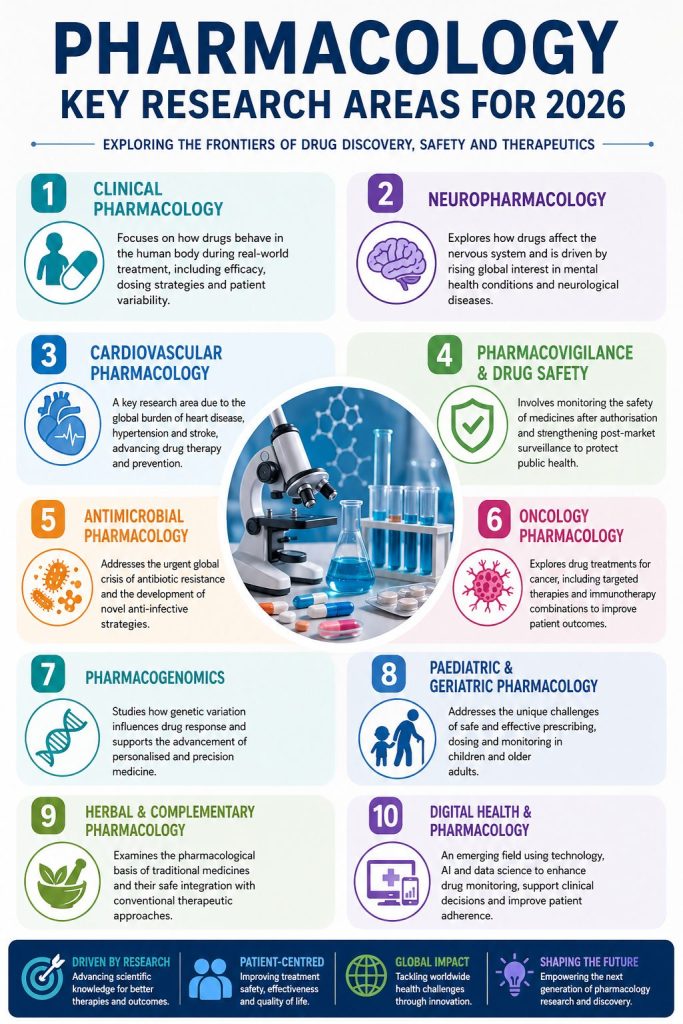
Before exploring specific dissertation topics, it helps to understand the major research domains within pharmacology. These are the areas where active academic inquiry is taking place and where dissertation topics are most likely to receive institutional support and access to resources.
Clinical Pharmacology focuses on how drugs behave in the human body during real-world treatment. Research in this area often involves drug efficacy, dosing strategies, and patient variability.
Neuropharmacology explores how drugs affect the nervous system. It has grown significantly due to rising global interest in mental health conditions and neurological diseases.
Cardiovascular Pharmacology remains one of the most active research areas given the global burden of heart disease, hypertension, and stroke.
Pharmacovigilance and Drug Safety involves monitoring the safety of medicines after they have been authorised. This area is particularly relevant as post-market surveillance frameworks evolve.
Antimicrobial Pharmacology addresses the global crisis of antibiotic resistance, which remains one of the most urgent challenges in healthcare today.
Oncology Pharmacology explores drug treatments for cancer, including targeted therapies and immunotherapy combinations.
Pharmacogenomics studies how genetic variation influences drug response, which is central to the development of personalised medicine.
Paediatric and Geriatric Pharmacology addresses the unique challenges of prescribing and monitoring drugs in children and older adults.
Herbal and Complementary Pharmacology examines the pharmacological basis of traditional medicines and their integration with conventional treatments.
Digital Health and Pharmacology is an emerging area involving the use of technology, artificial intelligence, and data science to improve drug monitoring and patient adherence.
Five Example Dissertation Topics With Research Aims and Objectives
The following five examples show how to structure a pharmacology dissertation topic academically. Each includes a clear research aim and a set of objectives that are measurable and achievable.
Example 1: Antibiotic Stewardship in Hospital Settings
Research Aim: To evaluate the effectiveness of antibiotic stewardship programmes in reducing antimicrobial resistance in NHS hospital settings.
Objectives:
- To identify current antibiotic stewardship strategies implemented in UK hospitals
- To assess the measurable impact of these strategies on resistance rates over a five-year period
- To recommend evidence-based improvements to existing stewardship frameworks
Example 2: Pharmacogenomics and Antidepressant Response
Research Aim: To investigate the role of genetic polymorphisms in determining individual patient responses to selective serotonin reuptake inhibitors (SSRIs).
Objectives:
- To review published literature on pharmacogenomic markers associated with SSRI efficacy
- To identify the most clinically significant gene variants affecting treatment outcomes
- To evaluate the feasibility of routine pharmacogenomic testing in psychiatric practice
Example 3: Drug Adherence in Elderly Patients With Polypharmacy
Research Aim: To examine the barriers to medication adherence among elderly patients prescribed five or more concurrent medications.
Objectives:
- To document the prevalence of polypharmacy in patients aged 70 and above in community care settings
- To identify the cognitive, social, and pharmaceutical barriers most associated with non-adherence
- To propose a pharmacy-led intervention model that can improve adherence rates
Example 4: Nanoparticle Drug Delivery in Cancer Treatment
Research Aim: To assess the therapeutic potential of lipid nanoparticle systems as targeted drug delivery mechanisms in solid tumour pharmacology.
Objectives:
- To compare nanoparticle-based delivery with conventional chemotherapy delivery in terms of bioavailability
- To evaluate current clinical trial data on nanoparticle systems in oncology
- To identify the main regulatory and safety challenges facing this technology
Example 5: Herbal Medicine and Drug Interactions
Research Aim: To investigate clinically significant pharmacokinetic interactions between commonly used herbal supplements and prescription medicines.
Objectives:
- To catalogue the most frequently reported herb-drug interactions in published case reports
- To evaluate the evidence base for each interaction in terms of severity and clinical significance
- To develop guidance recommendations for pharmacists conducting medication reviews
80 Pharmacology Dissertation Topics for 2026
The following 80 topics are organised under key pharmacological subfields. Each topic is designed to be narrow enough to be researchable within a standard dissertation timeframe, while also being academically relevant for 2026.
Drug Safety and Adverse Drug Reactions
- Evaluating the reporting accuracy of adverse drug reactions in UK primary care between 2020 and 2025
- The role of pharmacists in identifying and managing drug-induced liver injury in community settings
- Assessing the long-term cardiovascular risks associated with prolonged NSAID use in middle-aged adults
- The relationship between polypharmacy and increased hospitalisation rates due to adverse drug events
- Developing a systematic framework for classifying adverse drug reactions in paediatric oncology patients
- The underreporting problem in pharmacovigilance: Causes, consequences, and solutions
- Evaluating patient-reported outcomes as a tool for improving adverse event detection in clinical practice
- Drug-induced hyperkalaemia in chronic kidney disease patients receiving renin-angiotensin-aldosterone system inhibitors
- Black box warning drugs and prescribing behaviour: An analysis of physician compliance
- The impact of electronic prescribing systems on reducing medication errors in secondary care
Clinical Pharmacology and Drug Therapy
- Comparative effectiveness of direct oral anticoagulants versus warfarin in atrial fibrillation management
- Off-label drug prescribing in UK hospitals: Patterns, rationale, and regulatory implications
- Evaluating the clinical outcomes of personalised dosing strategies in immunosuppressive therapy for organ transplant patients
- The pharmacokinetic challenges of drug dosing in critically ill patients receiving continuous renal replacement therapy
- Bioequivalence studies in generic drug approval: Methodological limitations and regulatory gaps
- Evaluating therapeutic drug monitoring protocols for vancomycin in intensive care settings
- The role of clinical pharmacists in optimising anticoagulation therapy in atrial fibrillation
- Patient variability in drug metabolism: Implications for fixed-dose prescribing policies
- Evaluating the appropriateness of proton pump inhibitor prescribing in hospitalised patients
- Drug-drug interaction management in patients with multimorbidity: A systematic review
Neuropharmacology and Psychopharmacology
- The pharmacological basis of treatment-resistant depression and emerging therapeutic strategies
- Evaluating the efficacy of ketamine infusion therapy for major depressive disorder in clinical settings
- Neuroinflammation and pharmacological intervention: Exploring the role of microglia in Alzheimer’s disease
- The impact of long-term benzodiazepine use on cognitive function in older adults
- Pharmacological management of agitation and aggression in patients with dementia: Risks and benefits
- Comparing the efficacy of second-generation antipsychotics in first-episode schizophrenia
- Cannabis-based medicines in the management of treatment-resistant epilepsy: A clinical review
- The neuropharmacology of opioid-induced hyperalgesia and its implications for pain management
- Evaluating glutamate-modulating drugs as potential treatments for obsessive-compulsive disorder
- The role of psilocybin in the pharmacological treatment of addiction: Emerging evidence from clinical trials
Cardiovascular Pharmacology
- The pharmacological management of heart failure with preserved ejection fraction: Current evidence and gaps
- SGLT2 inhibitors in cardiovascular protection: Mechanisms beyond glycaemic control
- Evaluating the safety and efficacy of lipid-lowering therapies in adolescents with familial hypercholesterolaemia
- The role of aldosterone antagonists in resistant hypertension management
- Pharmacological strategies for preventing contrast-induced nephropathy in patients undergoing coronary angiography
- Comparing the antithrombotic profiles of ticagrelor and clopidogrel in acute coronary syndrome
- The impact of beta-blocker discontinuation on outcomes in stable chronic heart failure patients
- Evaluating novel pharmacological targets in pulmonary arterial hypertension
- Drug interactions between anticoagulants and antiplatelet agents in patients following percutaneous coronary intervention
- Pharmacogenomics of statin therapy: Predicting myopathy risk through genetic screening
Antimicrobial Pharmacology and Resistance
- The pharmacodynamics of carbapenem-resistant Enterobacteriaceae and treatment strategies in the post-antibiotic era
- Evaluating the clinical effectiveness of phage therapy as an alternative to antibiotics in drug-resistant infections
- The contribution of agricultural antibiotic use to the global antimicrobial resistance burden
- Assessing antifungal resistance in Candida auris: Clinical implications and therapeutic options
- The role of combination antibiotic therapy in managing multidrug-resistant tuberculosis
- Antibiotic prescribing patterns in primary care: A comparison before and after national stewardship initiatives
- Evaluating novel beta-lactamase inhibitors in restoring the activity of existing antibiotics
- The pharmacokinetics of colistin in critically ill patients and implications for dosing optimisation
- Bacteriophage pharmacology: Challenges in dose standardisation and clinical integration
- The impact of hospital infection control policies on reducing hospital-acquired antibiotic-resistant infections
Oncology Pharmacology
- The pharmacological basis of immunotherapy-related adverse events and their clinical management
- Evaluating the role of CDK4/6 inhibitors in hormone receptor-positive breast cancer treatment
- Drug resistance mechanisms in EGFR-mutant non-small cell lung cancer: A pharmacological analysis
- The efficacy of antibody-drug conjugates in relapsed or refractory haematological malignancies
- Pharmacokinetic variability in immunosuppressive therapy following allogeneic stem cell transplantation
- Evaluating the long-term toxicity profiles of checkpoint inhibitors in oncology patients
- The role of tumour microenvironment in modulating drug response in solid cancers
- Pharmacological approaches to overcoming multidrug resistance in ovarian cancer
- Comparing dosing strategies for capecitabine in colorectal cancer: Efficacy versus tolerability
- The pharmacogenomics of tamoxifen metabolism and implications for breast cancer outcomes
Pharmacogenomics and Personalised Medicine
- The clinical utility of CYP2D6 genotyping in guiding antidepressant prescribing decisions
- Pharmacogenomic screening before initiating antiplatelet therapy: A cost-effectiveness analysis
- Genetic determinants of warfarin sensitivity and their relevance to anticoagulation management
- The role of HLA genotyping in predicting drug hypersensitivity reactions to abacavir and carbamazepine
- Evaluating the implementation barriers to pharmacogenomic testing in NHS primary care
- Thiopurine methyltransferase testing in inflammatory bowel disease: Impact on azathioprine prescribing
- Personalised opioid therapy: The role of opioid receptor gene variants in postoperative pain management
- Pharmacogenomics in paediatric oncology: Reducing toxicity through genotype-guided dosing
- The role of DPYD genotyping in preventing severe toxicity from fluoropyrimidine chemotherapy
- Population pharmacogenomics and health inequality: Ensuring diverse genetic data in drug development
Herbal, Complementary, and Traditional Pharmacology
- The pharmacological mechanisms of berberine in managing type 2 diabetes: A systematic review
- Herb-drug interactions in oncology patients using complementary medicines alongside chemotherapy
- Evaluating the anti-inflammatory activity of curcumin and its bioavailability limitations
- The pharmacological basis of adaptogenic herbs in stress and adrenal fatigue management
- Assessing the safety and efficacy of St John’s Wort as a treatment for mild to moderate depression
- The role of traditional Chinese herbal formulas in managing chronic pain: Evidence and pharmacological basis
Drug Delivery, Formulation, and Emerging Technologies
- Lipid nanoparticle systems for targeted mRNA vaccine delivery: Lessons from COVID-19 applications
- Evaluating the pharmacokinetic advantages of intranasal drug delivery for central nervous system conditions
- The role of 3D printing in personalised pharmaceutical compounding and dose customisation
- Artificial intelligence in pharmacovigilance: Evaluating machine learning models for adverse event signal detection
How to Select the Right Topic for Your Academic Level
Choosing a topic that matches your academic level is one of the most important decisions in dissertation planning. Students completing undergraduate dissertations in pharmacology are expected to demonstrate clear understanding of a defined research question, supported by a strong literature review and basic analytical reasoning.
At MSc level, pharmacology research proposal ideas need to show methodological awareness and the capacity to evaluate conflicting evidence. The topic should be specific enough to be explored in depth within the word limit, but broad enough that sufficient published literature exists.
PhD-level topics must make an original contribution to knowledge. Pharmacology project topics suitable for PhD research should address genuine gaps in the literature, propose innovative methodologies, or challenge existing theoretical frameworks. Topics related to pharmacogenomics, novel drug delivery technologies, and antimicrobial resistance are particularly well aligned with current funding priorities.
If you are still unsure which direction suits your level, seeking online dissertation help from an experienced pharmacology academic can help you identify the right fit before you commit to a topic formally.
Conclusion
Selecting a strong pharmacology dissertation topic is one of the most significant academic decisions you will make as a student. The right topic sets the tone for your entire research process, shapes your relationship with your supervisor, and determines the quality of your academic contribution.
This post has introduced the key research domains within pharmacology, provided structured examples of well-formed dissertation topics, and offered 80 original ideas to help you begin identifying your research direction. Whether you are working toward an undergraduate qualification, an MSc, or a PhD, there is a topic in this list that can serve as a meaningful starting point.
Approach your dissertation with confidence, academic integrity, and a clear sense of purpose. Use the resources available to you, including academic supervision, library databases, and peer-reviewed literature. The quality of your research will reflect the care you put into choosing and developing your topic.
A well-chosen dissertation topic in pharmacology does not just earn you a qualification. It can contribute to medical knowledge, influence prescribing practice, or help shape future drug policy. That is a genuinely important responsibility, and one worth taking seriously from the very beginning.
