


Pulmonology Dissertation Topics for 2026

80 academically sound, researchable topics for undergraduate, MSc, and PhD students in respiratory medicine
Questions gathered from student forums and academic discussion platforms
- What are some trending pulmonology dissertation topics for undergraduate students in 2026?
- Can you suggest unique and researchable thesis topics in pulmonology for an MSc programme in the UK?
- What are the most recent pulmonology project topics suitable for a PhD research proposal?
- What are good pulmonology research paper ideas for BSc students with no clinical experience?
- How do I know if my chosen pulmonology topic is narrow enough for a dissertation?
- Which hot topics in pulmonology are most likely to be accepted by supervisors in 2026?
Why Choosing the Right Pulmonology Dissertation Topic Matters
Pulmonology is the branch of medicine concerned with the lungs, airways, and the broader respiratory system. It sits at the intersection of immunology, genetics, environmental science, and clinical practice, which means the range of dissertation possibilities is genuinely vast. However, that breadth is also what makes topic selection one of the hardest parts of the journey.
Choosing a well-defined pulmonology dissertation topic is not simply a procedural step. It shapes every aspect of what comes after: your literature review, your methodology, your ethical clearance requirements, and ultimately the quality of your contribution to the field. A topic that is too broad will leave you with no clear argument. A topic that is too narrow may have insufficient literature to draw from. Getting this balance right from the start is what sets a strong dissertation apart.
If you are feeling overwhelmed by the process, you are in the right place. Students often reach out for online dissertation help specifically at the topic-selection stage, and that is completely understandable. This post is designed to give you a clear framework, practical examples, and 80 original dissertation ideas to work with.
Respiratory disease continues to be one of the leading causes of morbidity and mortality worldwide, and research in this field has accelerated significantly following the COVID-19 pandemic. Topics that would have been considered speculative five years ago are now the centre of active clinical trials, policy discussions, and international funding programmes. For students writing in 2026, this means there is no shortage of academically credible and genuinely urgent questions to pursue.
Download Pulmonology Dissertation Topics PDF
Academic experts have curated a personalised list of pulmonology dissertation topics, formatted and ready for use in your research proposal. You can receive this PDF by completing a short form with your academic level and area of interest.
The form takes under two minutes to complete. Topics are matched to your programme level and specialisation.
Key Research Areas in Pulmonology Students Can Explore
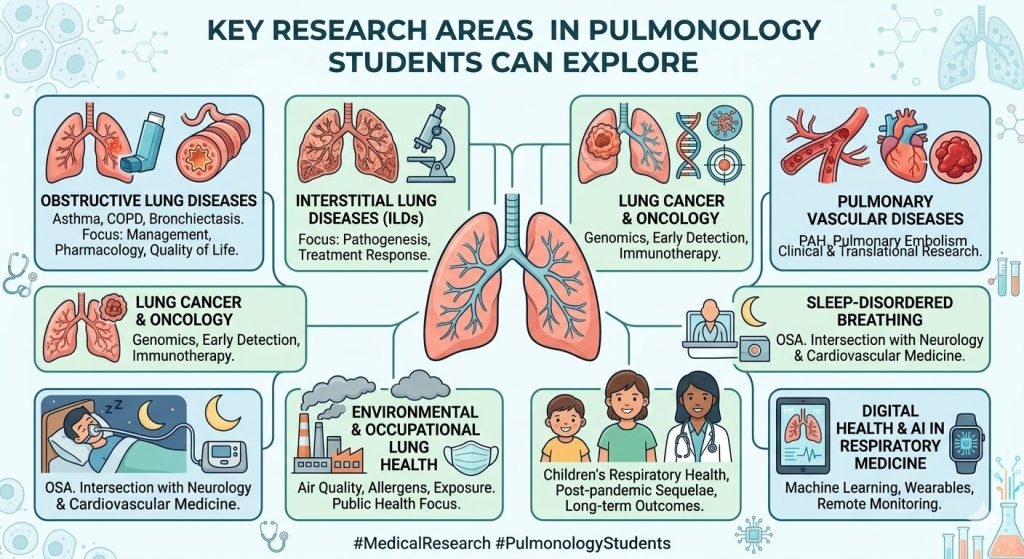
Before selecting a specific topic, it helps to understand the main subfields that make up modern pulmonology research. Each of the areas below represents a domain with active scholarly output, peer-reviewed journals, and ongoing clinical studies.
- Obstructive lung diseases such as asthma, chronic obstructive pulmonary disease (COPD), and bronchiectasis remain central areas of investigation, particularly regarding disease management, pharmacological advances, and patient quality of life.
- Interstitial lung diseases (ILDs), including idiopathic pulmonary fibrosis (IPF) and sarcoidosis, represent growing areas of interest because of unresolved questions around pathogenesis and treatment response.
- Lung cancer and oncology intersects pulmonology with genomics, early detection technologies, and immunotherapy, offering rich territory for dissertation-level research.
- Pulmonary vascular diseases, including pulmonary arterial hypertension (PAH) and pulmonary embolism, are subjects of active research in both clinical and translational settings.
- Sleep-disordered breathing, especially obstructive sleep apnoea (OSA), offers accessible topics for students interested in the intersection of respiratory health and neurology or cardiovascular medicine.
- Environmental and occupational lung health addresses how air quality, allergens, occupational exposures, and climate change affect respiratory outcomes, and is particularly suitable for public health-focused students.
- Paediatric pulmonology explores how respiratory diseases present, progress, and are managed differently in children, including post-pandemic sequelae and long-term outcomes.
- Digital health and artificial intelligence in respiratory medicine is an emerging area examining how machine learning, wearables, and remote monitoring are changing diagnostic and management pathways.
Five Example Pulmonology Dissertation Topics with Research Aims and Objectives
Understanding how to structure a dissertation topic is just as important as choosing the right subject. The examples below demonstrate what a well-formed topic looks like, combining a specific focus with a clear research aim and achievable objectives.
Undergraduate / BSc
1. The Role of Inhaled Corticosteroids in Reducing Asthma Exacerbation Rates Among Adolescents in Urban Areas
Research Aim: To evaluate the clinical effectiveness of inhaled corticosteroid therapy in reducing acute asthma exacerbations among adolescents living in high air-pollution urban environments.
- To review existing clinical evidence on inhaled corticosteroid use in adolescent asthma management.
- To compare exacerbation rates across studies conducted in high-pollution versus low-pollution urban settings.
- To identify gaps in current treatment guidelines regarding environmental co-factors in adolescent asthma care.
MSc
2. Genetic Predictors of Idiopathic Pulmonary Fibrosis Progression: A Systematic Review
Research Aim: To identify and critically evaluate genetic biomarkers that predict disease progression in patients diagnosed with idiopathic pulmonary fibrosis.
- To systematically review literature on gene variants associated with IPF severity and fibrotic progression.
- To assess the methodological quality of included studies using validated appraisal tools.
- To identify consensus genetic markers and highlight areas requiring further primary research.
PhD
3. Artificial Intelligence-Based Spirometry Interpretation: Accuracy, Bias, and Clinical Implementation Challenges
Research Aim: To investigate the diagnostic accuracy, potential algorithmic biases, and real-world implementation barriers of AI-driven spirometry interpretation tools across diverse patient populations.
- To evaluate the diagnostic performance of leading AI spirometry tools against gold-standard pulmonologist interpretation.
- To examine whether AI tools exhibit performance disparities across demographic subgroups, including age, sex, and ethnicity.
- To assess clinician and patient perspectives on the integration of AI-based diagnostics within existing respiratory care pathways.
MSc / PhD
4. Long-COVID Pulmonary Sequelae: Prevalence, Characteristics, and Clinical Management in Primary Care Settings
Research Aim: To examine the prevalence and clinical characteristics of persistent respiratory symptoms following COVID-19 infection and evaluate current management strategies in primary care.
- To synthesise published cohort data on post-COVID respiratory symptom prevalence and duration.
- To compare management protocols across NHS trusts and equivalent international healthcare systems.
- To propose evidence-based recommendations for primary care respiratory management of long-COVID patients.
Undergraduate / BSc
5. Patient Adherence to COPD Maintenance Therapy: Barriers and Facilitators in Rural Communities
Research Aim: To explore the factors that influence medication adherence among COPD patients residing in rural areas with limited access to specialist respiratory care.
- To identify personal, social, and healthcare system barriers to COPD maintenance therapy adherence in rural settings.
- To compare adherence rates reported in urban versus rural COPD populations from the existing literature.
- To recommend targeted interventions that could improve adherence outcomes in underserved rural communities.
A Comprehensive List of Pulmonology Dissertation Topics for 2026
The following 80 topics are organised by subfield to help you identify the area that best aligns with your academic interests, programme level, and available resources. Each topic has been written to be specific, researchable, and relevant to current scholarship. If you need further guidance in narrowing or refining a topic, seeking online dissertation help from a specialist can save considerable time.
Genetics, Immunology, and Pathogenesis in Pulmonology
- The role of telomere shortening in the pathogenesis of familial idiopathic pulmonary fibrosis.
- Epigenetic modifications in occupational asthma: a comparison of DNA methylation patterns across exposure groups.
- MUC5B gene polymorphisms as predictors of IPF disease severity and treatment response.
- The immunological basis of eosinophilic asthma: implications for targeted biologic therapy selection.
- Autoimmune mechanisms in connective tissue disease-associated interstitial lung disease.
- T-helper cell subtype dysregulation in severe asthma: pathogenic implications and therapeutic targets.
- The genetic overlap between COPD and lung cancer: shared susceptibility loci and implications for early screening.
- Innate lymphoid cell dysfunction in the pathogenesis of pulmonary sarcoidosis.
- Mitochondrial DNA mutations and their contribution to age-related decline in pulmonary function.
- Genetic determinants of corticosteroid resistance in moderate-to-severe asthma patients.
Psychological, Social, and Economic Impacts in Pulmonology
- The prevalence and clinical significance of depression in patients with newly diagnosed COPD.
- Health-related quality of life in adults living with bronchiectasis: a cross-sectional survey analysis.
- Social determinants of asthma hospitalisation rates among deprived urban communities in the UK.
- Psychological distress as a predictor of poor inhaler adherence in COPD patients: a longitudinal perspective.
- The economic burden of uncontrolled asthma on NHS secondary care services.
- Stigma and self-management challenges in adults diagnosed with alpha-1 antitrypsin deficiency.
- The impact of lung cancer diagnosis on caregiver mental health and family functioning.
- Respiratory disease and educational attainment: examining outcomes in children with poorly controlled asthma.
- Gender disparities in the diagnosis and management of COPD in UK primary care.
- Financial toxicity of novel biologic therapies for severe asthma: patient perspectives and NHS resource implications.
Suggested Infographic Placement: After topic 20, an infographic titled “Social and Economic Burden of Respiratory Disease in the UK” would enhance engagement here. It could display statistics on COPD hospitalisation costs, asthma prevalence by deprivation quintile, and quality-of-life scores. Recommended image size: 1200 x 800 px. Alt text: “Infographic showing social, psychological, and economic impacts of respiratory disease in the United Kingdom, 2026.”
Treatment, Management, and Interventions in Pulmonology
- Comparing the efficacy of triple inhaler therapy versus dual bronchodilation in moderate-to-severe COPD.
- The clinical effectiveness of pulmonary rehabilitation in patients with post-COVID respiratory impairment.
- Mepolizumab versus benralizumab in severe eosinophilic asthma: a network meta-analysis of randomised trials.
- Non-invasive ventilation protocols for acute hypercapnic respiratory failure: comparing hospital versus home initiation.
- High-flow nasal cannula therapy in acute hypoxaemic respiratory failure: evidence review and clinical application.
- The role of macrolide antibiotics in reducing exacerbation frequency in non-cystic fibrosis bronchiectasis.
- Antifibrotic therapy in progressive pulmonary fibrosis: nintedanib versus pirfenidone outcomes beyond IPF diagnosis.
- Lung volume reduction surgery versus bronchoscopic lung volume reduction: comparative outcomes in advanced emphysema.
- The effectiveness of structured self-management education programmes in reducing COPD readmission rates.
- Inhaler device selection and patient-reported ease of use: implications for adherence in elderly COPD patients.
- Immunotherapy for non-small-cell lung cancer: real-world outcomes versus randomised trial results.
- The use of extracorporeal membrane oxygenation (ECMO) in severe ARDS: indications, outcomes, and ethical considerations.
- Proton pump inhibitor therapy in preventing aspiration-related exacerbations in IPF patients.
- Nebulised hypertonic saline versus standard care in acute bronchiolitis: a systematic review of paediatric evidence.
- Palliative care integration in advanced COPD: barriers to timely referral and patient outcomes.
Environmental and Lifestyle Factors in Pulmonology
- The impact of long-term ambient particulate matter (PM2.5) exposure on forced vital capacity in non-smoking adults.
- Indoor air quality and respiratory symptom burden in children from low-income households: a case-control study design.
- E-cigarette use and lung function decline: a critical review of evidence from prospective cohort studies.
- Occupational exposure to silica dust and the risk of progressive massive fibrosis in mining industry workers.
- Climate change, pollen seasonality, and increasing asthma exacerbation rates across European urban centres.
- The relationship between obesity and obstructive sleep apnoea severity: a dose-response analysis of existing literature.
- Wood smoke exposure and COPD risk in rural low-income populations without tobacco exposure.
- Physical activity levels and their association with lung function trajectories in young adults with mild asthma.
- Microplastic inhalation and respiratory inflammation: emerging evidence and research priorities for 2026.
- The effect of smoking cessation pharmacotherapy on long-term lung function recovery in COPD patients.
- Respiratory health outcomes in agricultural workers exposed to organophosphate pesticides: a scoping review.
- Impact of household mould exposure on asthma severity in children aged 5 to 16 years.
- Wildfire smoke and acute respiratory presentations in emergency departments: patterns and clinical correlates.
- Dietary patterns and pulmonary function: examining anti-inflammatory diets in adults with chronic airway disease.
- Traffic-related air pollution and incident COPD in non-smokers: a systematic review of epidemiological evidence.
Suggested Infographic Placement: After topic 50, an infographic titled “Environmental Risk Factors for Respiratory Disease” would work well. It could visually map pollutants (PM2.5, ozone, tobacco, indoor allergens) to specific pulmonary conditions. Recommended size: 1200 x 900 px. Alt text: “Infographic illustrating the relationship between environmental and lifestyle factors and pulmonary disease risk in 2026.”
Advanced Technologies, Innovations, and Future Directions in Pulmonology
- Artificial intelligence-assisted CT lung cancer screening: diagnostic accuracy and false-positive rates in low-dose protocols.
- Machine learning models for predicting COPD exacerbation hospitalisation: a comparison of algorithmic approaches.
- Digital spirometry devices in primary care: accuracy, patient acceptability, and implementation feasibility.
- Exhaled breath volatile organic compound profiling as a non-invasive biomarker for COPD phenotyping.
- Wearable respiratory monitoring devices for detecting nocturnal desaturation in sleep apnoea outpatients.
- Telemedicine-delivered pulmonary rehabilitation: effectiveness and patient engagement compared to face-to-face programmes.
- CRISPR-Cas9 gene editing in the treatment of cystic fibrosis: current progress and translational barriers.
- Robotic bronchoscopy for peripheral lung lesion biopsy: safety, diagnostic yield, and learning curve analysis.
- Endobronchial ultrasound-guided sampling in the staging of mediastinal lymph nodes in lung cancer.
- Stem cell therapy for pulmonary fibrosis: pre-clinical evidence, mechanisms, and translational challenges.
- Bioprinting of airway tissue constructs: scientific progress and long-term potential for tracheal reconstruction.
- Liquid biopsy for circulating tumour DNA in non-small-cell lung cancer: clinical utility and current limitations.
- Drone-delivered respiratory medication to rural and remote populations: feasibility, cost, and ethical review.
- Digital health applications for asthma self-management: a systematic review of patient outcome data from 2020 to 2025.
- Predictive modelling of asthma readmission risk using electronic health records: a machine learning approach.
Paediatric Pulmonology and Developmental Respiratory Health
- Long-term pulmonary outcomes in children who received mechanical ventilation during the neonatal period.
- The effect of prematurity on lung development and childhood asthma risk: a 10-year follow-up perspective.
- Recurrent wheezing in early childhood: identifying predictors of persistent asthma at school age.
- Managing acute severe asthma in paediatric emergency settings: adherence to GINA guidelines in UK hospitals.
- Cystic fibrosis-related diabetes: prevalence, management challenges, and impact on lung function in adolescents.
Pulmonary Vascular Disease, Sleep, and Critical Care
- Pulmonary arterial hypertension in women of childbearing age: risk stratification and pregnancy management.
- Balloon pulmonary angioplasty versus riociguat in chronic thromboembolic pulmonary hypertension: outcome comparison.
- Sleep apnoea and cardiovascular comorbidity: the role of CPAP therapy in reducing incident atrial fibrillation.
- Central sleep apnoea in heart failure patients: pathophysiology, diagnosis, and therapeutic challenges.
- Massive pulmonary embolism management: thrombolysis versus catheter-directed therapy in haemodynamically unstable patients.
- ICU-acquired weakness in mechanically ventilated ARDS patients: prevalence, prevention, and rehabilitation outcomes.
- Post-intensive care syndrome and respiratory function: long-term sequelae in ARDS survivors.
- Prone positioning protocols in moderate-to-severe ARDS: fidelity to evidence-based guidelines in UK ICUs.
- Extravascular lung water measurement in critically ill patients: clinical utility and outcome prediction.
- Risk factors for ventilator-associated pneumonia in ICU patients: a systematic review with meta-analysis.
Conclusion
Pulmonology is a field where intellectual curiosity, clinical relevance, and public health urgency all converge. The 80 dissertation topics presented in this post cover a broad range of subfields, from molecular genetics and immunopathology to environmental epidemiology, digital innovation, and critical care. Each topic has been designed to be narrow enough for realistic dissertation research yet significant enough to contribute meaningfully to existing scholarship.
When selecting your thesis topics in pulmonology, prioritise topics that genuinely interest you, align with your academic level, and can be completed within your available time and resources. A well-chosen topic will sustain your motivation through the months of research and writing ahead. If you are pursuing an MSc programme in the UK or developing a PhD research proposal, seek early supervisor input once you have shortlisted two or three options.
Choosing interesting dissertation topics in Pulmonology does not have to be a solitary process. Academic communities, faculty mentors, and specialist dissertation support services all exist to help you refine your focus and approach your research with the rigour it deserves. Approach your dissertation as an opportunity to add a small but genuine piece of knowledge to a field that directly affects millions of lives, and you will find the process far more rewarding than daunting.
