


Urology Dissertation Topics for 2026

What Students Are Asking About Urology Dissertations
The following questions have been gathered from student forums, academic discussion boards, and higher education communities. They reflect what real students ask when they feel uncertain about choosing the right dissertation topic in urology.
- What are the most relevant urology dissertation topics for 2026?
- How do I find a dissertation topic in urology that is narrow enough to be researchable?
- What urology research topics are suitable for undergraduate students?
- Are there specific dissertation topics in urology for MSc students in the UK?
- Where can I find a complete list of urology dissertation topics that are academically appropriate?
- What are the best PhD thesis ideas in urology that align with current medical research?
- How do I write a strong research proposal for a urology dissertation?
If any of these questions sound familiar, this guide was written for you.
Why Choosing the Right Urology Dissertation Topic Matters
Choosing a dissertation topic is one of the most important academic decisions a student makes. In a clinical and rapidly evolving field like urology, your topic signals your understanding of the discipline, your awareness of current medical challenges, and your ability to contribute meaningful knowledge to the field.
Urology sits at a unique intersection of surgery, oncology, nephrology, and public health. Research in this field can directly affect patient outcomes, inform clinical practice, and shape healthcare policy. That is why your dissertation topic must be both academically sound and practically relevant.
Students who invest time in selecting a focused, original, and feasible topic tend to produce stronger research, score better, and find the process significantly less stressful. This guide is designed to help you make that decision with confidence.
If you feel overwhelmed at any stage of your dissertation journey, seeking online dissertation help from qualified academic advisors can give you structured support without compromising your academic integrity.
Download Urology Dissertation Topics PDF
Many students find it helpful to review a curated, expert-compiled list of dissertation topics before making their final selection. A downloadable PDF containing a personalised list of urology dissertation topics, tailored to your level of study, is available to students who complete a short academic preferences form.
This resource is compiled by subject specialists with backgrounds in urology, medical research, and academic writing. The topics in the PDF are organised by research subfield and academic level, making it easier for you to shortlist ideas that fit your supervisor’s expectations and your institution’s requirements.
Understanding the Key Research Areas in Urology
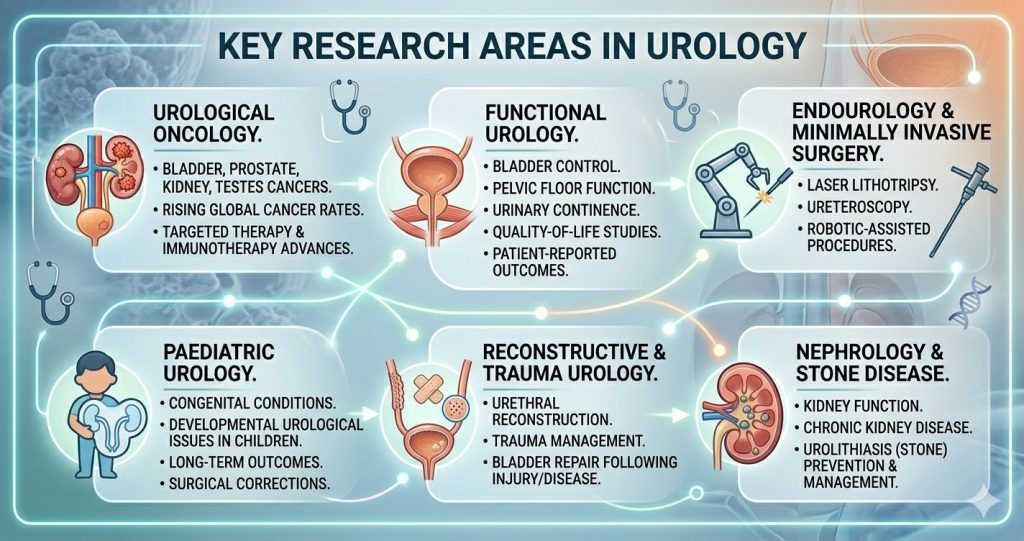
Before diving into individual topics, it helps to understand the major subfields within urology. These areas are grounded in established academic and clinical research, and they form the backbone of most urology dissertations at undergraduate, master’s, and doctoral level.
Urological Oncology covers cancers of the bladder, prostate, kidney, testes, and upper urinary tract. It is one of the most active research areas due to rising global cancer rates and significant advances in targeted therapy and immunotherapy.
Functional Urology examines conditions that affect bladder control, pelvic floor function, and urinary continence. Research here often intersects with quality-of-life studies and patient-reported outcomes.
Endourology and Minimally Invasive Surgery focuses on surgical techniques involving the urinary tract, including laser lithotripsy, ureteroscopy, and robotic-assisted procedures.
Paediatric Urology addresses congenital and developmental urological conditions in children, where long-term outcomes and surgical corrections are central research concerns.
Reconstructive and Trauma Urology involves studies on urethral reconstruction, trauma management, and bladder repair following injury or disease.
Nephrology and Stone Disease explores kidney function, chronic kidney disease, and urolithiasis, including prevention, management, and recurrence.
Urology and Public Health investigates how urological conditions are distributed across populations, how healthcare systems respond, and what policies could improve outcomes.
Five Dissertation Topic Examples with Aims and Objectives
The following examples show how to move from a broad interest to a clearly structured dissertation topic. Each example includes a research aim and supporting objectives.
Example 1: Prostate Cancer Screening Disparities
Research Aim: To examine racial and socioeconomic disparities in prostate cancer screening rates in the United Kingdom between 2018 and 2024.
Objectives:
- To identify demographic groups with lower uptake of PSA screening programmes
- To explore the systemic and cultural barriers that influence screening behaviour
- To assess the policy implications of unequal screening access on prostate cancer outcomes
Example 2: Robotic Surgery in Radical Cystectomy
Research Aim: To evaluate the clinical outcomes of robot-assisted radical cystectomy compared to open surgery in patients with muscle-invasive bladder cancer.
Objectives:
- To compare complication rates and recovery times between surgical approaches
- To assess quality-of-life outcomes reported by patients in the 12 months following surgery
- To review current evidence from randomised controlled trials published since 2019
Example 3: Antibiotic Resistance in Urinary Tract Infections
Research Aim: To investigate the growing prevalence of antibiotic-resistant pathogens in uncomplicated urinary tract infections and their implications for first-line treatment guidelines.
Objectives:
- To review resistance patterns across common uropathogens in NHS outpatient settings
- To evaluate the effectiveness of alternative antimicrobial strategies
- To propose evidence-based recommendations for updating prescribing guidelines
Example 4: Urinary Incontinence in Elderly Care Settings
Research Aim: To assess the management of urinary incontinence in long-term care facilities in England and identify gaps between clinical guidelines and practice.
Objectives:
- To audit incontinence management protocols used across a sample of care homes
- To explore care staff perceptions of their training and confidence in managing incontinence
- To evaluate patient dignity and wellbeing outcomes linked to continence care practices
Example 5: Kidney Stone Recurrence and Dietary Intervention
Research Aim: To determine the role of dietary modification in reducing kidney stone recurrence in adult patients with calcium oxalate urolithiasis.
Objectives:
- To review systematic evidence on dietary risk factors for stone recurrence
- To assess the effectiveness of structured nutritional counselling programmes
- To explore patient adherence and long-term outcomes associated with dietary intervention
A Comprehensive List of Urology Dissertation Topics for 2026
The following 80 dissertation topics are organised under meaningful subfield categories. Each topic is original, academically sound, and suitable for 2026-level research. They are appropriate for undergraduate, MSc, and PhD proposals.
Urological Oncology
- Evaluating the diagnostic accuracy of multiparametric MRI in detecting clinically significant prostate cancer in men aged 50 to 70
- The role of liquid biopsy in monitoring treatment response in metastatic bladder cancer
- Disparities in access to immunotherapy for urothelial carcinoma across NHS regions
- Assessing the long-term psychological impact of radical prostatectomy on male patients in the UK
- PD-L1 expression as a predictive biomarker in muscle-invasive bladder cancer treated with checkpoint inhibitors
- Comparing survival outcomes of nephron-sparing surgery versus radical nephrectomy in localised renal cell carcinoma
- The clinical utility of the PSMA PET scan in restaging biochemically recurrent prostate cancer
- Factors influencing active surveillance adherence in low-risk prostate cancer patients
- Impact of socioeconomic deprivation on testicular cancer diagnosis delay and treatment outcomes in the UK
- Evaluating the role of cytoreductive nephrectomy in the era of targeted therapy for metastatic clear cell renal carcinoma
Functional Urology and Continence
- The effectiveness of pelvic floor muscle training in reducing urinary incontinence in postmenopausal women
- Comparing sacral neuromodulation outcomes in men and women with overactive bladder syndrome
- Psychological predictors of treatment adherence in patients undergoing behavioural therapy for urge incontinence
- Assessing the quality of life impact of nocturia in adults over 65 in primary care settings
- The relationship between obesity and stress urinary incontinence in women of reproductive age
- Evaluating the long-term outcomes of mid-urethral sling procedures in women with mixed urinary incontinence
- Prevalence and underreporting of male urinary incontinence in community-based health surveys
- Botulinum toxin A as a treatment for refractory detrusor overactivity: a systematic review of patient outcomes
- Exploring the lived experience of urinary incontinence in adult males following pelvic radiotherapy
- The role of urodynamic studies in predicting surgical success in women with urodynamic stress incontinence
Endourology and Minimally Invasive Surgery
- Clinical outcomes of single-use flexible ureteroscopes versus reusable scopes in kidney stone management
- Comparing laser lithotripsy technologies: holmium versus thulium fibre laser in ureteroscopy
- Robotic-assisted versus laparoscopic pyeloplasty in adult patients with ureteropelvic junction obstruction
- The learning curve associated with robot-assisted radical prostatectomy in high-volume UK urology centres
- Evaluating day-case ureteroscopy for ureteric stones: safety, feasibility, and patient satisfaction
- Fluorescence-guided surgery using hexaminolevulinate in non-muscle-invasive bladder cancer detection
- Percutaneous nephrolithotomy versus shock wave lithotripsy for lower pole renal calculi: a comparative outcomes study
- The role of retrograde intrarenal surgery in managing stones greater than 2 cm
- Assessing complications and readmission rates following ambulatory laparoscopic nephrectomy in the UK
- Evolution and adoption of single-port robotic urological surgery in British teaching hospitals
Paediatric Urology
- Long-term urinary outcomes following hypospadias repair in boys: a 10-year retrospective analysis
- The psychological impact of vesicoureteral reflux diagnosis and treatment on children and their families
- Evaluating the effectiveness of antimicrobial prophylaxis in children with high-grade vesicoureteral reflux
- Management strategies for posterior urethral valves and their impact on renal function in adolescence
- Incidence and clinical outcomes of cryptorchidism treated with orchidopexy in children under five
- Bladder dysfunction in children with spina bifida: current management approaches and quality-of-life outcomes
- Parental decision-making in the surgical management of duplex kidney anomalies in infants
- The role of minimally invasive surgery in paediatric pyeloplasty: outcomes across UK specialist centres
- Assessing nocturnal enuresis management in school-age children within UK primary care
- Long-term renal outcomes following pyeloplasty for ureteropelvic junction obstruction in neonates
Stone Disease and Nephrology
- The association between type 2 diabetes and calcium oxalate urolithiasis in adult outpatient populations
- Evaluating the 24-hour urine metabolic profile as a tool for personalising stone prevention strategies
- Dietary calcium intake and its paradoxical role in reducing urinary oxalate excretion in stone formers
- The impact of climate change and rising temperatures on kidney stone incidence in the United Kingdom
- Uric acid nephrolithiasis: metabolic risk factors and emerging pharmacological prevention strategies
- Comparing citrate supplementation protocols for recurrent calcium stone disease in adults
- Gut microbiome alterations and their association with oxalate hyperabsorption in stone-forming patients
- Evaluating the cost-effectiveness of medical expulsive therapy for distal ureteric stones in NHS settings
- Investigating the relationship between chronic kidney disease progression and recurrent nephrolithiasis
- Ambulatory management of renal colic in UK accident and emergency departments: current practice and gaps
Urological Infections and Antimicrobial Resistance
- Antimicrobial resistance patterns in catheter-associated urinary tract infections in UK intensive care units
- The effectiveness of D-mannose supplementation in reducing recurrent uncomplicated urinary tract infections in women
- Exploring the use of bacteriophage therapy as an alternative treatment for drug-resistant uropathogens
- Prevalence and risk factors for ESBL-producing Escherichia coli in urinary tract infections within community settings
- Prophylactic antibiotic protocols for transrectal prostate biopsy: a review of emerging alternatives
- The impact of antibiotic stewardship programmes on urinary tract infection management in NHS hospitals
- Clinical outcomes of non-antibiotic management strategies for recurrent urinary tract infections in postmenopausal women
- Fungal urinary tract infections in immunocompromised patients: epidemiology, management, and outcomes
- Urethral microbiome composition and its association with recurrent urinary tract infection susceptibility
- Evaluating point-of-care urine dipstick testing accuracy in diagnosing urinary tract infections in elderly patients
Reconstructive Urology and Trauma
- Surgical outcomes of urethroplasty for bulbar urethral stricture using oral mucosa grafts
- The role of tissue engineering in urethral reconstruction: current evidence and future directions
- Managing pelvic fracture urethral distraction defects: a comparative review of surgical approaches
- Assessing functional and quality-of-life outcomes following penile prosthesis implantation in men with erectile dysfunction secondary to trauma
- Posterior urethral reconstruction in women: challenges, outcomes, and patient-reported satisfaction
- Long-term outcomes of neobladder construction following radical cystectomy in younger patients
- The influence of radiation history on complication rates in urethral reconstruction surgery
- Artificial urinary sphincter implantation for post-prostatectomy incontinence: outcomes and revision rates in UK centres
- Evaluating the role of dermal matrix grafts in complex urethral reconstruction procedures
- Patient-reported outcomes and sexual function following continent urinary diversion
Urology, Public Health, and Healthcare Policy
- Assessing the impact of the NHS prostate cancer awareness campaign on PSA testing rates from 2020 to 2024
- Inequalities in bladder cancer diagnosis and treatment across ethnic minority groups in England
- Exploring the mental health burden of chronic urological conditions using UK population-based data
- The economic cost of overactive bladder syndrome to the NHS: a health economics analysis
- Evaluating telemedicine as a model for follow-up care in non-muscle-invasive bladder cancer patients
- Barriers to urological care access in rural communities across Scotland and Wales
- Patient experience of shared decision-making in localised prostate cancer treatment selection
- The role of nurse-led urology clinics in reducing outpatient waiting times in NHS trusts
- Comparing international clinical guidelines for managing benign prostatic hyperplasia: implications for UK practice
- Exploring the use of artificial intelligence tools in triaging urology referrals within NHS integrated care systems
How to Choose the Right Urology Dissertation Topic
Selecting one topic from a list of 80 can still feel daunting. These practical steps can help you move from a list of possibilities to a single, focused research question.
Match your topic to your academic level. Undergraduate dissertations benefit from focused, clearly scoped topics that do not require primary clinical data collection. MSc students can engage more critically with existing literature and may include secondary data analysis. PhD candidates are expected to generate original contributions, often through primary research or systematic reviews that address a genuine gap.
Consider data availability. Some topics in urological oncology, for example, rely on NHS datasets, hospital records, or published trial data. Before finalising your topic, confirm that the data or literature base you need actually exists.
Talk to your supervisor early. Your supervisor’s expertise will shape how far you can go with a topic. A topic they are familiar with means better feedback, stronger guidance, and a smoother review process.
Narrow down before you start. The biggest mistake students make is choosing a topic that is too broad. For example, “prostate cancer treatment” is not a dissertation topic. “Patient-reported quality-of-life outcomes following robot-assisted prostatectomy in men under 60 in the UK” is.
Students working on dissertation topics in urology for the first time often benefit from reviewing published dissertations in their institution’s library as well as consulting with their academic department before committing to a topic.
Conclusion
Selecting the right dissertation topic in urology is a process that deserves careful thought, subject knowledge, and awareness of the current academic and clinical landscape. The 80 topics in this guide represent a wide range of subfields, from oncology and minimally invasive surgery to public health policy and antimicrobial resistance. Each one has been chosen because it is researchable, timely, and aligned with the standards expected in 2026 academic research.
Whether you are a final-year undergraduate narrowing down your options, an MSc student seeking a topic that adds analytical depth, or a PhD candidate looking for a genuine research gap, this guide provides a reliable starting point. Use these topics as a foundation, then work with your supervisor to shape them into a research question that is truly yours.
Approach your dissertation with academic integrity, intellectual curiosity, and a clear structure. The process is challenging, but with the right topic and the right support, it is entirely manageable.
