


Podiatry Dissertation Topics for 2026: 80 Research Ideas for Every Academic Level
Questions Students Are Asking About Podiatry Dissertation Topics
Based on questions gathered from student forums, academic discussion platforms, and postgraduate research communities, here are the most common concerns students share when choosing a dissertation topic in podiatry:
- “What are the most relevant podiatry research topics for 2026?”
- “How do I know if my dissertation idea is strong enough for a master’s or PhD?”
- “What areas of podiatry are currently under-researched?”
- “Can I find a dissertation topic that connects podiatry with public health or technology?”
- “What makes a good podiatric thesis idea at the undergraduate level?”
- “How should I structure my research aim and objectives for a podiatry dissertation?”
- “Are there trending podiatry dissertation topics that supervisors are likely to approve?”
If any of these questions sound familiar, this post is designed specifically for you.
Introduction: Why Choosing the Right Podiatry Dissertation Topic Matters
Choosing a dissertation topic is one of the most consequential decisions you will make as a podiatry student. Your topic shapes your entire research journey, from the literature you review to the methods you use and the conclusions you draw.
Podiatry is a clinically rich and rapidly evolving field. It sits at the intersection of musculoskeletal health, diabetes care, biomechanics, surgery, and preventive medicine. This means students have access to a wide range of podiatry dissertation ideas, but it also means the challenge of narrowing down to one focused, researchable question is very real.
Whether you are completing an undergraduate programme, preparing an MSc podiatry research proposal, or developing PhD-level podiatry thesis ideas, your topic needs to demonstrate academic depth, practical relevance, and ethical soundness. This post walks you through everything you need to know to make that decision with confidence.
Students who need additional guidance during the research design phase can explore online dissertation help to find structured support from academic professionals.
Download Podiatry Dissertation Topics PDF
Many students find it useful to have a curated, expert-reviewed list of topics they can return to during the planning phase. A downloadable PDF containing a personalised selection of podiatry dissertation topics, aligned with your academic level and research interests, is available through a short form. The list is prepared by academic specialists familiar with current podiatry research standards and university assessment criteria.
Why Selecting the Right Dissertation Topic in Podiatry Is Academically Important
Dissertation topics in podiatry must go beyond general interest. They must address a gap in existing literature, be feasible within your time and resource constraints, and contribute meaningfully to clinical knowledge or policy understanding.
A strong topic also demonstrates to your supervisors and examiners that you understand the field. It signals academic maturity. When your topic is narrow, focused, and clearly motivated by a real clinical or social problem, the rest of your dissertation tends to fall into place far more naturally.
Podiatry research topics for students must also align with ethical guidelines. Research involving patient data, clinical assessments, or vulnerable populations requires ethical approval, and this needs to be factored into topic selection from the very beginning.
Key Research Areas in Podiatry That Students Can Explore
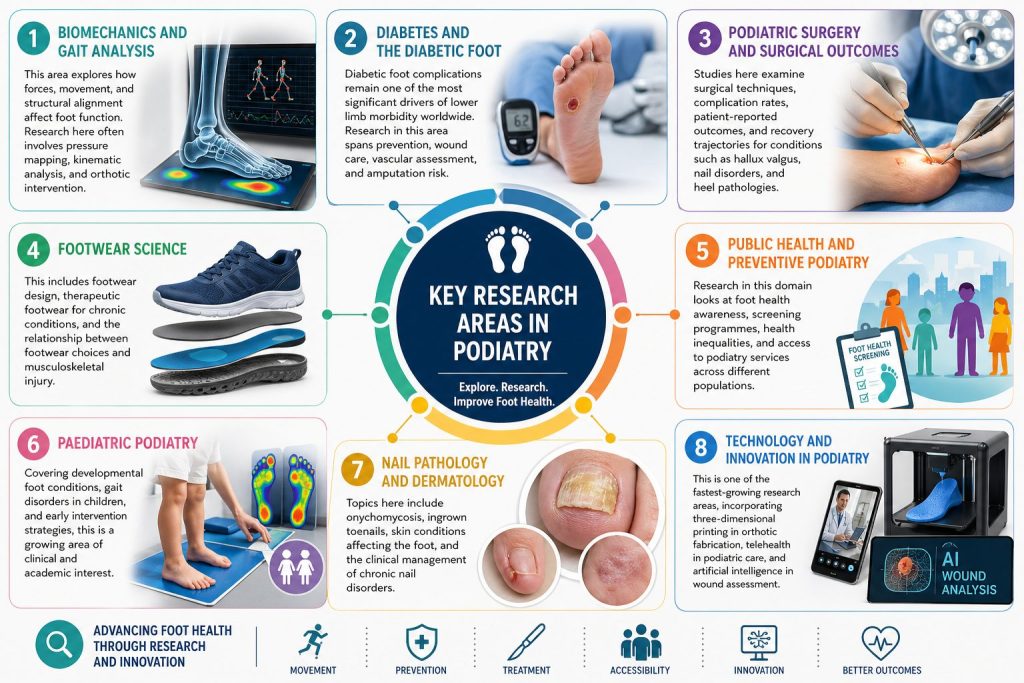
Podiatry covers a broad clinical landscape. Students searching for podiatry project topics for an undergraduate dissertation will find that the field naturally organises into several well-established domains, each with rich scope for original research.
Biomechanics and Gait Analysis This area explores how forces, movement, and structural alignment affect foot function. Research here often involves pressure mapping, kinematic analysis, and orthotic intervention.
Diabetes and the Diabetic Foot Diabetic foot complications remain one of the most significant drivers of lower limb morbidity worldwide. Research in this area spans prevention, wound care, vascular assessment, and amputation risk.
Podiatric Surgery and Surgical Outcomes Studies here examine surgical techniques, complication rates, patient-reported outcomes, and recovery trajectories for conditions such as hallux valgus, nail disorders, and heel pathologies.
Footwear Science This includes footwear design, therapeutic footwear for chronic conditions, and the relationship between footwear choices and musculoskeletal injury.
Public Health and Preventive Podiatry Research in this domain looks at foot health awareness, screening programmes, health inequalities, and access to podiatry services across different populations.
Paediatric Podiatry Covering developmental foot conditions, gait disorders in children, and early intervention strategies, this is a growing area of clinical and academic interest.
Nail Pathology and Dermatology Topics here include onychomycosis, ingrown toenails, skin conditions affecting the foot, and the clinical management of chronic nail disorders.
Technology and Innovation in Podiatry This is one of the fastest-growing research areas, incorporating three-dimensional printing in orthotic fabrication, telehealth in podiatric care, and artificial intelligence in wound assessment.
Five Example Dissertation Topics With Research Aims and Objectives
These examples are included to help you understand how a well-structured podiatry dissertation topic is framed academical
Example 1: Diabetic Foot Ulcer Prevention
Topic: The effectiveness of pressure-redistributing insoles in preventing diabetic foot ulcers among high-risk outpatients in community podiatry settings.
Research Aim: To evaluate whether customised pressure-redistributing insoles reduce plantar ulcer incidence in patients with type 2 diabetes attending community podiatry services.
Research Objectives
Example 2: Gait Analysis in Elderly Populations
Topic: The relationship between age-related changes in foot posture and fall risk in community-dwelling older adults.
Research Aim: To investigate how structural foot changes associated with ageing contribute to increased fall risk in adults aged 65 and above.
Research Objectives
Example 3: Telehealth in Podiatric Practice
Topic: Patient satisfaction and clinical outcomes in teledermatology consultations for chronic nail disorders: a mixed-methods study.
Research Aim: To evaluate the clinical utility and patient acceptability of telehealth consultations for the management of chronic nail pathology.
Research Objectives:
Example 4: Footwear and Adolescent Foot Health
Topic: The impact of school footwear policies on foot health outcomes in secondary school students aged 11 to 16.
Research Aim: To examine how footwear standards enforced by secondary school policies relate to the prevalence of foot pain and deformity in adolescents.
Research Objecti
Example 5: Orthotic Intervention for Plantar Fasciitis
Topic: Comparing the short-term effectiveness of prefabricated and custom foot orthoses in the management of chronic plantar heel pain.
Research Aim: To determine whether custom foot orthoses offer superior outcomes to prefabricated devices in patients with plantar fasciitis of six months or more.
Research Objectives:
- To measure pain levels and functional disability at baseline, six weeks, and twelve weeks using validated outcome measures
- To compare patient-reported satisfaction between both intervention groups
- To assess the cost-effectiveness of each orthotic type in a community podiatry context
80 Podiatry Dissertation Topics for 2026
These topics are original, narrowly focused, and designed for 2026 research standards. They span undergraduate, master’s, and doctoral levels. Use them as starting points and refine them with your supervisor’s guidance.
Diabetic Foot and Vascular Health
- The role of podiatric-led foot screening in reducing diabetic amputation rates within urban primary care settings
- Comparing the accuracy of non-invasive vascular assessment tools used by podiatrists in identifying peripheral arterial disease
- The effectiveness of offloading devices in healing neuropathic diabetic foot ulcers: a systematic review of clinical evidence
- Glycaemic control and its correlation with wound healing outcomes in patients with diabetic foot ulcers
- Patient knowledge and self-management behaviours related to diabetic foot care in South Asian communities in the United Kingdom
- Podiatrist-led multidisciplinary foot clinics and their impact on hospitalisation rates for diabetic foot complications
- The relationship between peripheral neuropathy severity and foot ulcer recurrence in patients with type 1 diabetes
- Barriers to timely diabetic foot care in rural and semi-rural communities: a qualitative investigation
- Exploring the use of biofilm-targeted wound therapies in chronic diabetic foot ulcer management
- The effectiveness of patient education programmes in improving diabetic foot care adherence among older adults
Biomechanics, Gait, and Orthotic Intervention
- Lower limb kinematic differences between individuals with and without pes planus during prolonged walking
- The effect of foot orthoses on knee adduction moment in patients with medial compartment osteoarthritis
- Ground reaction force patterns in runners with chronic Achilles tendinopathy: a comparative biomechanical study
- The impact of custom foot orthoses on tibial stress fracture recurrence in female distance runners
- Comparing plantar pressure distribution in individuals with hallux valgus before and after conservative orthotic management
- The influence of arch height on energy expenditure during treadmill walking in healthy adults
- Foot posture index as a predictor of lower extremity injury risk in recreational football players
- Biomechanical outcomes of three-dimensional-printed custom foot orthoses versus traditionally manufactured devices
- The effect of real-time gait retraining using biofeedback on chronic patellofemoral pain in adult patients
- Rearfoot eversion and tibial internal rotation coupling in individuals with chronic ankle instability
Paediatric Podiatry and Developmental Foot Health
- The prevalence and clinical significance of flexible flat foot in children aged 5 to 12 attending primary care settings
- Parental perceptions of their child’s foot health and the uptake of podiatric services in the United Kingdom
- Gait maturation milestones and their variance across different body mass index categories in school-age children
- The effect of foot orthotic therapy on walking speed and stride length in children with developmental coordination disorder
- Comparing functional outcomes of early versus delayed podiatric intervention for juvenile hallux valgus
- Childhood obesity and its relationship to foot pain and postural deformity: a cross-sectional school-based study
- In-toeing gait in toddlers: natural resolution versus orthotic management outcomes at five years
- The impact of sports participation on foot and ankle injury rates in children aged 8 to 14
- Footwear fit in early childhood: parental purchasing behaviours and their clinical consequences
- Club foot management following Ponseti casting: long-term outcomes in school-age children
Footwear Science and Injury Prevention
- The relationship between high-heel footwear use and chronic musculoskeletal pain in working-age women
- Running shoe cushioning technologies and their effectiveness in reducing lower limb impact loading
- Therapeutic footwear adherence in patients with rheumatoid arthritis: barriers, enablers, and clinical outcomes
- The effect of footwear modifications on balance and fall prevention in community-dwelling elderly adults
- Occupational footwear standards in healthcare workers and their association with lower limb pain and fatigue
- Minimalist footwear and its effect on foot muscle strength in recreational runners: a 12-week intervention study
- How footwear selection influences plantar pressure in patients with Charcot-Marie-Tooth disease
- School uniform footwear policies and their contribution to adolescent foot pain: a mixed-methods analysis
- The clinical effectiveness of toe spreaders and forefoot padding in managing metatarsalgia
- Custom versus mass-produced diabetic footwear: a comparative study of foot ulcer prevention outcomes
Podiatric Surgery and Clinical Outcomes
- Patient-reported outcomes following minimally invasive surgery for hallux valgus correction: a longitudinal study
- Complication rates and recovery trajectories in patients undergoing nail avulsion under local anaesthetic in community settings
- The impact of surgical intervention for Morton’s neuroma on patient quality of life and functional mobility
- Pre-operative physiotherapy and its effect on postoperative outcomes in patients undergoing podiatric ankle surgery
- Long-term radiographic and clinical outcomes of first metatarsophalangeal joint fusion for end-stage osteoarthritis
- Comparing local anaesthetic agents used in podiatric digital nerve block procedures for pain management
- Infection rates following minor podiatric surgical procedures in community versus hospital settings
- Patient decision-making in elective podiatric surgery: a qualitative exploration of key influencing factors
- The effectiveness of intraoperative imaging in reducing revision surgery rates for hallux rigidus procedures
- Post-surgical plantar pressure redistribution in patients following first ray amputation
Public Health, Health Inequalities, and Access to Podiatry
- Socioeconomic determinants of foot health outcomes in adults receiving podiatry through the National Health Service
- The relationship between obesity and the demand for community podiatric services in England
- Podiatry service access disparities among older adults in care homes: a regional needs assessment
- How ethnic minority populations perceive and access podiatric care in multicultural urban areas
- The role of health literacy in patient engagement with podiatric self-care advice
- Screening programmes for foot health risk in adults with learning disabilities: current practice and gaps
- The impact of austerity-driven service reductions on foot-related hospital admissions in the United Kingdom
- Podiatry workforce supply and demand: a forecast analysis for National Health Service community services up to 2030
- Patient-reported experiences of podiatric care in prisons: a qualitative study
- Exploring the unmet foot health needs of homeless populations through interviews with outreach health workers
Nail Pathology and Dermatology
- The clinical effectiveness of topical treatments versus oral antifungals in managing onychomycosis in older adults
- Recurrence rates of ingrown toenails following partial nail avulsion with and without phenolisation
- Patient experiences of repeated podiatric treatment for chronic ingrowing toenails: a thematic analysis
- The diagnostic accuracy of dermoscopy in differentiating onychomycosis from traumatic nail dystrophy
- Prevalence and management of verrucae pedis in NHS podiatry clinics: a service evaluation
- Assessing the impact of chronic skin conditions such as psoriasis on foot health and podiatric service use
- Cryotherapy versus salicylic acid in the treatment of plantar warts: a comparative effectiveness study
- The use of laser therapy in managing onychomycosis: a systematic review of randomised controlled trials
- Psychological impact of chronic nail disorders on quality of life: a patient perspective study
- Risk factors for nail pathology in elderly care home residents: a retrospective cohort analysis
Technology, Innovation, and Education in Podiatry
- The accuracy of artificial intelligence-powered wound imaging tools in staging diabetic foot ulcers
- Simulation-based learning in podiatry education: student perceptions and clinical competency outcomes
- The use of wearable sensor technology in monitoring gait recovery following podiatric surgery
- Telehealth consultations in podiatry during and after the COVID-19 pandemic: a service evaluation
- Three-dimensional printing of foot orthoses: precision, material performance, and patient acceptability
- Digital health literacy among podiatry students and its relationship to technology adoption in clinical practice
- The application of machine learning in predicting diabetic foot ulcer deterioration from wound photographs
- Augmented reality tools in podiatric surgical training: a feasibility and acceptability study
- Electronic patient records and their effect on continuity of podiatric care across multidisciplinary teams
- The role of social media health information in shaping patient expectations before attending podiatric appointments
Conclusion: Choosing Your Podiatry Dissertation Topic With Confidence
Selecting a dissertation topic in podiatry is not just a procedural step. It is the foundation of your academic contribution to a field that directly affects patients’ lives and mobility. The topics listed in this post reflect the breadth and depth of current podiatry research, from clinical biomechanics and diabetic foot care to public health, technology, and surgical outcomes.
Strong dissertation research begins with curiosity and is shaped by rigour. Whether you are working at undergraduate level or developing an MSc podiatry research proposal, the most important thing is to choose a topic that you can investigate thoroughly within your constraints, one that fills a genuine gap and follows ethical principles.
If you are still feeling uncertain, remember that narrowing a broad interest into a focused research question is a skill that develops with guidance. Take time to read recent literature, speak with your supervisors early, and revisit the examples in this post as a structural reference.
Students who find topic selection particularly challenging can also access online dissertation help to receive tailored academic support during the early planning stages of their research.
Your dissertation is an opportunity to contribute something new to podiatric science. Approach it with academic integrity, intellectual curiosity, and confidence in the rigour of the work ahead.
