


Anti-Corruption Law Dissertation Topics for 2026

Questions Students Are Asking About Anti-Corruption Law Dissertations
These questions have been gathered from student forums, academic discussion boards, and research guidance platforms. They reflect how real students search for dissertation support online, especially when they feel uncertain about where to begin.
- What is the best topic for an anti-corruption law dissertation in 2026?
- How do I find anti-corruption law dissertation topics that are suitable for my academic level?
- Which areas of anti-corruption law are most relevant for postgraduate research right now?
- Can I access an anti-corruption law dissertation topics PDF to save and review offline?
- What topics on anti-corruption law are recommended for undergraduate students?
- What makes a dissertation topic academically strong and researchable at PhD level?
- Where can I get anti-corruption law dissertation help if I am struggling with topic selection?
Introduction: Why Your Dissertation Topic in Anti-Corruption Law Matters
Choosing a dissertation topic is one of the most consequential decisions you will make during your academic journey. In anti-corruption law, this decision carries even more weight because the field sits at the intersection of governance, international relations, criminal law, and public accountability. The quality of your topic shapes the credibility of your research, the clarity of your argument, and the academic contribution your work makes to the field.
Anti-corruption law has grown significantly over the past two decades. Global frameworks such as the United Nations Convention Against Corruption and regional instruments across Africa, Europe, and Asia have expanded the legal landscape. Students researching in this area now need to demonstrate not only legal knowledge but also an understanding of policy, enforcement, and comparative analysis. Whether you are approaching this field for the first time or building on prior legal studies, selecting a well-defined and researchable topic is essential.
This post offers structured guidance to help you choose an academically sound dissertation topic. It also provides a comprehensive list of 80 original anti-corruption law dissertation topics, complete with example structures, research aims, and objectives. If you need personalised support at any point, expert online dissertation help is available to guide you through the entire research process.
Download Anti-Corruption Law Dissertation Topics PDF
Students who prefer to review dissertation topics away from a screen can receive a downloadable PDF version of a curated topic list. This PDF is put together by academic experts who specialise in anti-corruption law and is tailored to your level of study, whether undergraduate, master’s, or PhD.
To receive the anti-corruption law dissertation topics PDF, you are invited to complete a short form. The form allows the team to understand your academic level, area of interest, and research focus so the PDF you receive is relevant to your needs. There are no obligations involved, and the process is straightforward.
Why Choosing the Right Anti-Corruption Law Dissertation Topic Matters
A poorly chosen topic can lead to research that is too broad, too vague, or already well-covered in existing literature. Anti-corruption law is a rapidly evolving field, and your dissertation needs to offer something genuinely new. This might mean examining an underexplored jurisdiction, applying a novel legal framework to an existing problem, or studying a recent development in enforcement practice.
Your topic also signals your intellectual focus to future employers and academic institutions. A clearly defined research question within anti-corruption law demonstrates that you understand the field, can identify gaps in existing knowledge, and are capable of making an original contribution. These qualities matter at every academic level, from undergraduate dissertations to doctoral theses.
Students who rush topic selection often find themselves changing direction midway through their research, which costs time and compromises the quality of the final submission. Investing time in selecting the right topic from the outset is one of the best things you can do for your academic success.
Key Research Areas in Anti-Corruption Law
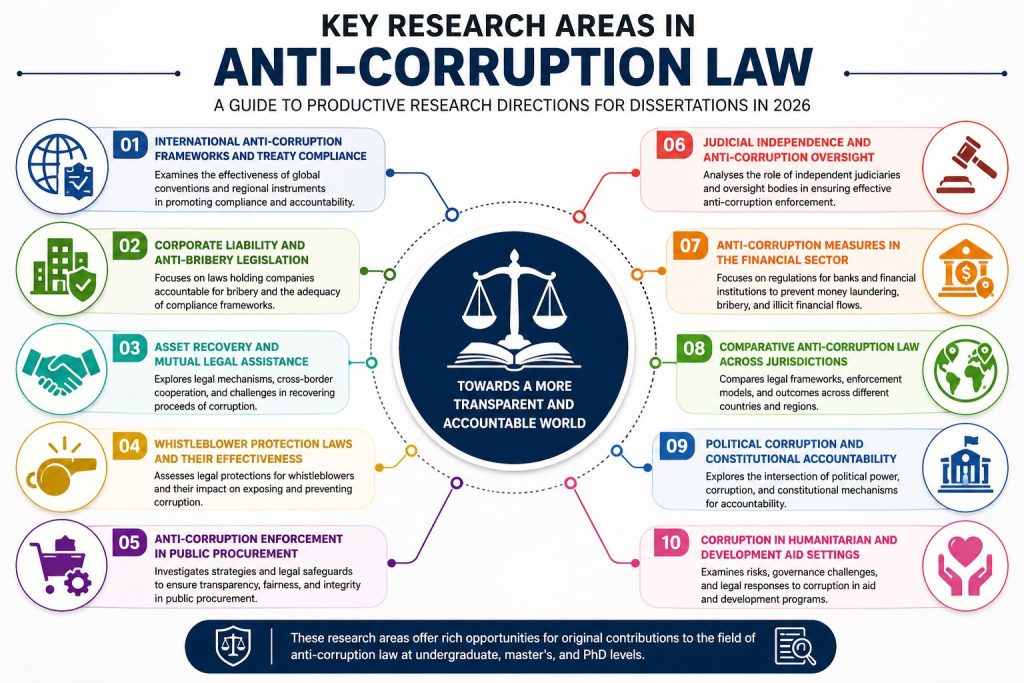
Anti-corruption law draws from multiple disciplines and covers a wide range of institutional, regional, and thematic concerns. The following research areas are well-established within the academic literature and represent productive directions for dissertation research in 2026.
- International anti-corruption frameworks and treaty compliance
- Corporate liability and anti-bribery legislation
- Asset recovery and mutual legal assistance
- Whistleblower protection laws and their effectiveness
- Anti-corruption enforcement in public procurement
- Judicial independence and anti-corruption oversight
- Anti-corruption measures in the financial sector
- Comparative anti-corruption law across jurisdictions
- Political corruption and constitutional accountability
- Corruption in humanitarian and development aid settings
Each of these areas offers scope for original research at multiple academic levels. The topics you will find later in this post are drawn from these and related domains.
Example Dissertation Topics With Research Aims and Objectives
Understanding how a dissertation topic is structured academically will help you develop your own. Each of the following examples includes a research aim and a set of clear, achievable objectives.
Example 1: Corporate Liability Under the UK Bribery Act 2010
Research Aim: To evaluate the effectiveness of the UK Bribery Act 2010 in holding corporations criminally accountable for bribery committed by associated persons.
- To analyse the legal definition of ‘associated persons’ under the Act and its interpretation in case law
- To assess the adequacy of the ‘adequate procedures’ defence in protecting compliant organisations
- To compare the UK’s corporate liability model with equivalent frameworks in the United States and Australia
Example 2: Whistleblower Protection in Anti-Corruption Enforcement
Research Aim: To examine the extent to which current whistleblower protection frameworks in the European Union support effective anti-corruption enforcement.
- To review the EU Whistleblower Protection Directive and its national transposition across member states
- To identify the legal and practical barriers that prevent whistleblowers from coming forward in corruption cases
- To propose legislative improvements that would strengthen whistleblower protection in cross-border corruption investigations
Example 3: Asset Recovery in Developing Nations
Research Aim: To investigate the legal obstacles to successful asset recovery in Sub-Saharan Africa under international anti-corruption law.
- To map the key asset recovery mechanisms available under the UNCAC and related bilateral agreements
- To examine case studies of failed and successful asset recovery efforts in Nigeria, South Africa, and Kenya
- To recommend reforms to international mutual legal assistance processes to improve outcomes for developing nations
Example 4: Anti-Corruption and Public Procurement Reform
Research Aim: To assess the role of legal reforms in reducing corruption in public procurement in South and Southeast Asia.
- To review existing procurement law frameworks in India, the Philippines, and Bangladesh
- To examine how international anti-corruption standards have influenced domestic procurement legislation
- To evaluate the impact of digital procurement systems on corruption risk and accountability
Example 5: Political Corruption and Constitutional Safeguards
Research Aim: To critically analyse the adequacy of constitutional mechanisms in addressing political corruption in transitional democracies.
- To define political corruption and examine how constitutional frameworks attempt to limit its scope
- To compare anti-corruption provisions in the constitutions of post-conflict democracies in Africa and Eastern Europe
- To assess the relationship between constitutional design, judicial independence, and corruption control
80 Anti-Corruption Law Dissertation Topics for 2026
The following topics are organised by subfield within anti-corruption law. They are designed to be narrow, focused, and suitable for undergraduate, master’s, and PhD-level research. Use these as starting points and adapt them to your specific academic context and institutional requirements.
International Anti-Corruption Frameworks
1. The effectiveness of UNCAC implementation in low-income signatory states: a comparative legal analysis
2. State obligations under UNCAC Article 20: a critical assessment of illicit enrichment provisions across jurisdictions
3. The role of the OECD Anti-Bribery Convention in regulating multinational corporate conduct abroad
4. Legal gaps in the G20 Anti-Corruption Action Plan and their implications for enforcement cooperation
5. The African Union Convention on Preventing and Combating Corruption: implementation challenges and reform proposals
6. Comparative analysis of UNCAC peer review mechanisms and their influence on domestic legislative reform
7. Sovereignty and international anti-corruption norms: reconciling national interests with global accountability standards
8. The role of the Financial Action Task Force in shaping anti-corruption law beyond its financial crime mandate
9. Double criminalisation requirements in international anti-corruption treaties: barriers to effective cooperation
10. Legal accountability mechanisms in the Inter-American Convention Against Corruption: a critical review
Corporate Liability and Anti-Bribery Legislation
11. Corporate criminal liability for foreign bribery: comparing the adequacy of UK, US, and French legal frameworks
12. Deferred prosecution agreements in anti-bribery cases: a critical evaluation of their use in England and Wales
13. The ‘adequate procedures’ defence under the UK Bribery Act 2010 and its interpretation by courts
14. Corporate self-reporting in anti-corruption enforcement: incentives, risks, and legal implications
15. Liability of parent companies for anti-corruption breaches committed by foreign subsidiaries
16. The role of compliance programmes in reducing corporate exposure to anti-bribery liability
17. Anti-bribery due diligence in mergers and acquisitions: legal obligations and practical challenges
18. Criminal liability of individuals within corporations for overseas bribery under English law
19. The extraterritorial reach of the US Foreign Corrupt Practices Act and its effect on non-US companies
20. Anti-bribery enforcement in the extractive industries: lessons from recent FCPA and SFO prosecutions
Asset Recovery and Mutual Legal Assistance
21. Tracing and recovering proceeds of corruption through civil forfeiture: a comparative legal study
22. Unexplained wealth orders in the UK: assessing their effectiveness as an anti-corruption tool
23. Mutual legal assistance treaties and their impact on cross-border corruption asset recovery
24. The role of the Stolen Asset Recovery Initiative in supporting developing country asset repatriation
25. Legal challenges in freezing and confiscating corruption proceeds held in offshore financial centres
26. Non-conviction-based asset forfeiture: a comparative analysis of legal safeguards across jurisdictions
27. Correspondent banking de-risking and its unintended consequences for anti-corruption asset recovery
28. Beneficial ownership transparency laws and their contribution to anti-corruption asset tracing
29. International cooperation in asset recovery: evaluating the 2023-2025 reform initiatives under UNCAC
30. The human rights implications of asset freezing orders in anti-corruption proceedings
Whistleblower Protection and Anti-Corruption Enforcement
31. The EU Whistleblower Protection Directive and its transposition into national law: a comparative study
32. Legal protection for whistleblowers who report corruption in the private sector across the Commonwealth
33. Retaliation against anti-corruption whistleblowers: legal remedies and enforcement gaps in the UK
34. Anonymous reporting mechanisms in anti-corruption law: balancing transparency with procedural fairness
35. The role of whistleblower awards in corruption enforcement: comparing the US SEC and UK models
36. Whistleblower protection in authoritarian regimes: legal frameworks and practical limitations
37. Journalistic privilege and anti-corruption investigations: the intersection of press freedom and evidence law
38. Legal barriers to whistleblowing in the public health sector: corruption disclosure in times of crisis
39. Protection of corporate insiders who report bribery to regulators: a gap analysis in Australian law
40. The effectiveness of confidential disclosure mechanisms in anti-corruption agencies in West Africa
Corruption in Public Procurement
41. Legal frameworks for preventing corruption in public procurement in the European Union post-Brexit
42. E-procurement systems and corruption reduction: evaluating the legal and governance dimensions
43. Exclusion and debarment of corrupt bidders in public procurement: a comparative legal analysis
44. Bid-rigging as an anti-corruption enforcement priority: legal tools and prosecutorial challenges
45. Corruption risk in emergency procurement: legal lessons from the COVID-19 pandemic response
46. Transparency obligations in defence procurement and their implications for anti-corruption compliance
47. Public procurement integrity in Sub-Saharan Africa: assessing the legal and institutional architecture
48. The role of audit institutions in detecting and deterring procurement corruption
49. Conflicts of interest in public procurement decisions: legal definitions, detection, and sanctions
50. Corruption in infrastructure procurement in Asia: comparative legal responses and reform trajectories
Political Corruption and Constitutional Accountability
51. Immunity from prosecution for heads of state accused of corruption: examining the limits of international law
52. Constitutional provisions for anti-corruption oversight: a comparative study of emerging democracies
53. Parliamentary privilege and its interaction with anti-corruption investigations in Westminster systems
54. Anti-corruption bodies and their independence from political interference: a legal and institutional analysis
55. Campaign finance laws as anti-corruption instruments: evaluating enforcement in democratic systems
56. Corruption and constitutional crisis: legal responses in countries experiencing democratic backsliding
57. Judicial independence and anti-corruption adjudication: threats, safeguards, and reform recommendations
58. The criminalisation of political corruption in post-conflict societies: transitional justice perspectives
59. Anti-corruption provisions in constitutional drafting processes: lessons from Africa and Latin America
60. Political party financing and corruption: comparative legal regulation in OECD member states
Anti-Corruption in the Financial and Banking Sector
61. Anti-money laundering law as an anti-corruption enforcement tool: assessing regulatory coherence in the UK
62. Correspondent banking relationships and the facilitation of grand corruption: legal accountability gaps
63. The legal responsibility of financial institutions in preventing the laundering of corruption proceeds
64. Sanctions law and anti-corruption enforcement: the role of targeted financial measures in accountability
65. Crypto-assets and corruption proceeds: tracing, seizure, and legal frameworks in a decentralised environment
66. Shell company regulation as an anti-corruption strategy: reviewing UK and EU legislative approaches
67. De-risking by banks in response to anti-corruption and AML obligations: legal and development implications
68. Beneficial ownership registers and their contribution to anti-corruption enforcement in offshore centres
69. Tax evasion and grand corruption: exploring the legal overlap and enforcement coordination challenges
70. Regulatory enforcement in the anti-money laundering and anti-corruption interface: a critical legal review
Emerging and Cross-Cutting Issues in Anti-Corruption Law
71. Artificial intelligence in anti-corruption compliance: legal implications of automated monitoring systems
72. The legal dimensions of environmental corruption and its impact on climate governance
73. Corruption in the humanitarian sector: legal accountability frameworks for NGOs and international agencies
74. Anti-corruption law and development finance: evaluating conditionality and enforcement by multilateral banks
75. The nexus between human rights law and anti-corruption obligations in international treaty regimes
76. Corruption in post-disaster reconstruction: legal frameworks for accountability and oversight
77. Anti-corruption due diligence in global supply chains: legal obligations and compliance gaps
78. Gender and corruption: examining legal frameworks that address the gendered impacts of corrupt practices
79. Legal accountability for corruption in the healthcare sector: a comparative study across high-burden regions
80. Sports corruption and anti-corruption law: evaluating legal mechanisms targeting match-fixing and bribery in sport
Choosing the Right Topic for Your Academic Level
The topics listed above span a wide range of complexity and scope. Students selecting anti-corruption law dissertation topics for undergraduate study should aim for topics that are clearly bounded, comparative, and manageable within a single jurisdiction or a defined legal instrument. Topics in the range of 11 to 30 often work well at this level.
Postgraduate students working at master’s level will benefit from topics that require more analytical depth, engage with competing legal frameworks, and draw on primary legal sources including treaties, legislation, and case law. Topics exploring emerging issues such as digital enforcement tools, supply chain compliance, or the relationship between human rights and anti-corruption law are well suited to master’s dissertations.
For anti-corruption law dissertation topics for PhD students, the expectation shifts significantly towards original contribution. A doctoral topic must identify a genuine gap in existing scholarship, apply a novel theoretical lens or methodology, and generate findings that advance the field. Topics such as the constitutional dimensions of anti-corruption oversight, the legal architecture of international asset recovery reform, or the systemic accountability gaps in multilateral development finance offer scope for that level of inquiry.
How to Develop Your Chosen Topic Into a Research Proposal
Once you identify a topic that interests you, the next step is to develop it into a focused research proposal. Start by reviewing the existing literature in that area. A thorough literature review will help you understand what has already been written, which arguments have been made, and where genuine gaps or contested questions exist.
From that review, you can formulate a precise research question. A good research question in anti-corruption law is one that is answerable through legal analysis, is not already resolved in the scholarship, and is relevant to current practice or policy. You should then develop a set of research objectives that map out the steps you will take to answer that question.
Your methodology matters as well. Most dissertations in law rely on doctrinal analysis, but comparative legal methods, socio-legal approaches, and empirical data analysis are all used in anti-corruption scholarship. Make sure your methodology matches your research question and is appropriate for your academic level.
If you find yourself struggling at any stage of this process, structured anti-corruption law dissertation help from an experienced academic adviser can make a significant difference. Professional guidance helps you refine your question, structure your argument, and ensure your research meets the expectations of your institution.
Conclusion
Anti-corruption law is one of the most intellectually rich and socially significant areas of legal study available to students today. The topics covered in this post reflect the breadth of the field, from international treaty obligations and corporate liability to political accountability and emerging digital enforcement challenges. Selecting the right dissertation topic from within this landscape is the first step towards producing research that is genuinely valuable.
A well-chosen topic, developed with clarity and academic rigour, gives you the foundation you need to produce a dissertation that demonstrates your understanding of the law, your ability to construct a coherent legal argument, and your awareness of current policy and enforcement debates. These qualities will serve you well both during your studies and in your professional life beyond them.
Approach your dissertation with confidence. You do not need to resolve the world’s corruption problems in a single piece of research. What you do need is a clear question, a sound methodology, and the commitment to answer that question with intellectual honesty. The 80 topics and examples provided in this post are here to support that process and to help you take the next step forward with clarity and purpose.
