


History Dissertation Topics for 2026

What Students Are Asking: Questions from Forums and Academic Discussion Platforms
Students across university forums, Reddit threads, and academic support groups regularly raise similar concerns when they begin their dissertation journey. Below are some of the most common questions gathered from those platforms. This post is designed to answer every one of them.
- What are the best history dissertation topics for 2026?
- How do I find a history dissertation topic that is original and researchable?
- Are there dissertation topics in history suitable for undergraduate students?
- What modern history dissertation topics are relevant right now?
- Where can I find British history dissertation topics that examiners will find impressive?
- What are strong thesis topics in history for a PhD student?
- Can I get research proposal topics for a history dissertation that are focused but not too narrow?
- What cultural history dissertation topics are trending in academic research?
- Where do I find a list of history dissertation topics with research aims and objectives?
If any of these questions reflect where you are right now, this post was written for you.
Introduction: Why Your History Dissertation Topic Matters More Than You Think
Choosing the right dissertation topic in history is one of the most consequential academic decisions you will make during your studies. It shapes every stage of your research, from the sources you engage with to the theoretical frameworks you apply. A poorly chosen topic can make the writing process unnecessarily difficult, while a well-chosen one opens up rich lines of inquiry and allows you to produce genuinely original scholarship.
History as a discipline is broad, layered, and continuously evolving. New archival discoveries, changing social conversations, and interdisciplinary approaches are constantly reshaping what historians study and why. This means the field offers enormous opportunity for students who know where to look.
Whether you are working at undergraduate, master’s, or PhD level, this guide will help you understand what strong history research topics look like, how to structure your research proposal, and which areas of the discipline are most relevant for 2026-level academic research.
Download History Dissertation Topics PDF
If you would like a curated and personalised list of history dissertation topics prepared by academic specialists, you can access a downloadable PDF after completing a short form. The topics in the PDF are tailored to your academic level, area of interest, and research focus. Students who use this resource find it especially useful when they are still in the early stages of narrowing down their ideas and need expert guidance to move forward confidently.
Why Choosing the Right History Dissertation Topic Matters
The dissertation is not just a long essay. It is a demonstration of your ability to conduct independent, sustained academic research. In history, this means identifying a gap in existing scholarship, formulating a clear research question, and engaging critically with primary and secondary sources.
Choosing a topic that is too broad makes it impossible to say anything meaningful within your word limit. Choosing one that is too narrow can leave you without enough source material to build a credible argument. The goal is to find a topic that is focused, researchable, and academically significant.
Your topic also determines how well you can demonstrate the core skills examiners look for: critical analysis, source evaluation, contextualisation, and structured argumentation. A strong topic gives you the space to do all of this. A weak one puts you at a disadvantage from the very start.
Students who seek online dissertation help during the topic selection stage consistently report feeling more confident going into their research phase. Getting early guidance on whether your topic is viable can save weeks of frustration later.
Key Research Areas in History That Students Can Explore
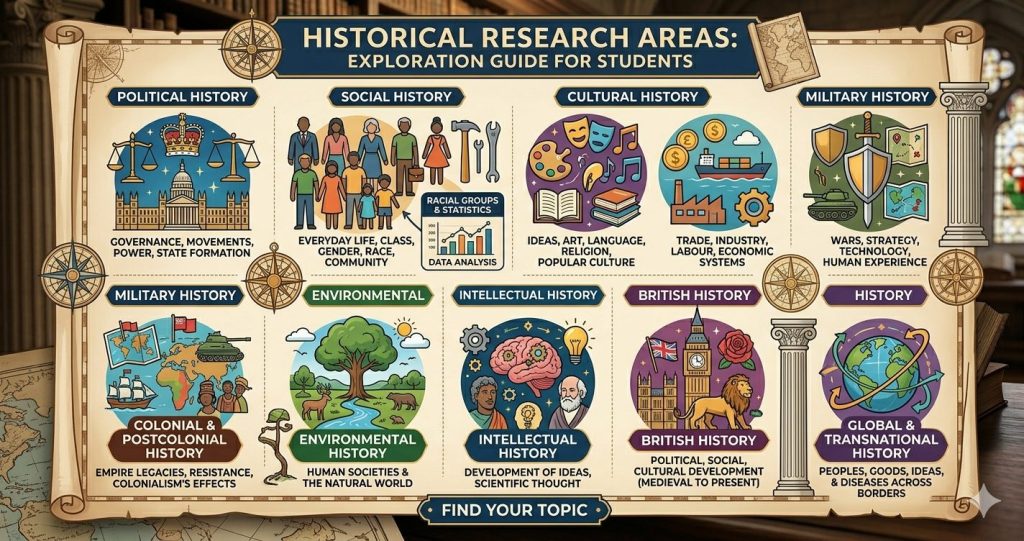
History is not a single discipline. It is a collection of overlapping subfields, each with its own methodologies, debates, and research traditions. Understanding where your interests fit within these areas is the first step in finding a topic that suits your academic level and research goals.
Some of the most established and well-resourced areas include:
- Political history: The study of governance, political movements, power structures, and state formation across different periods and regions.
- Social history: An examination of everyday life, class, gender, race, and community across historical periods.
- Cultural history: How ideas, art, language, religion, and popular culture have shaped and reflected historical change.
- Economic history: The study of trade, industry, labour, and economic systems over time.
- Military history: Wars, strategy, technology, and the human experience of conflict.
- Colonial and postcolonial history: The legacies of empire, resistance movements, and the long-term effects of colonialism.
- Environmental history: The relationship between human societies and the natural world over time.
- Intellectual history: The development of ideas, philosophies, and scientific thought across different eras.
- British history: The political, social, and cultural development of Britain from medieval times to the present.
- Global and transnational history: How peoples, goods, ideas, and diseases moved across borders throughout history.
Each of these areas offers hundreds of viable dissertation topics. The sections below will help you identify which ones are most appropriate for your level and interests.
Five Example Dissertation Topics with Research Aims and Objectives
Understanding how a dissertation topic is properly structured can make a significant difference when you sit down to write your own proposal. The following examples demonstrate what a well-formed history dissertation topic looks like at a high academic standard.
Example 1: The Role of Propaganda in British Home Front Morale During the Second World War
Research Aim: To examine how the British government used propaganda strategies between 1939 and 1945 to sustain civilian morale and shape public perception of the war effort.
Research Objectives:
- To analyse the key propaganda campaigns produced by the Ministry of Information between 1939 and 1945.
- To evaluate how propaganda messaging was adapted in response to shifting public sentiment and military events.
- To assess the extent to which propaganda successfully shaped civilian attitudes and behaviour on the British home front.
Example 2: Gender and Labour in Victorian England’s Textile Industry
Research Aim: To investigate the experiences of female workers in Victorian England’s textile industry and the ways in which gender shaped their working conditions, wages, and social status.
Research Objectives:
- To identify the social and economic factors that led to the widespread employment of women in the Victorian textile sector.
- To examine how factory legislation between 1833 and 1878 affected the working conditions of female labourers.
- To critically assess how contemporary attitudes towards gender and domesticity influenced public and parliamentary responses to female industrial labour.
Example 3: The Transatlantic Slave Trade and the Development of British Commercial Banking
Research Aim: To explore the connections between the profits of the transatlantic slave trade and the early development of British commercial banking institutions in the eighteenth century.
Research Objectives:
- To trace the financial networks that connected slave traders, merchants, and early banking institutions in Bristol and London.
- To examine how capital generated through slave trading was reinvested into emerging financial structures.
- To assess the extent to which historians have addressed or overlooked this relationship in existing literature.
Example 4: Environmental Consequences of Roman Agricultural Expansion in North Africa
Research Aim: To examine the environmental impact of Roman agricultural practices on the landscape and ecology of North Africa between the first and fourth centuries CE.
Research Objectives:
- To identify the key agricultural techniques introduced during Roman occupation of North Africa.
- To analyse archaeological and palaeoenvironmental evidence for soil degradation and deforestation in the region.
- To evaluate how Roman agricultural expansion contributed to longer-term environmental change in the Maghreb.
Example 5: The Cold War and the Decolonisation of Sub-Saharan Africa
Research Aim: To investigate how Cold War competition between the United States and the Soviet Union influenced the decolonisation process in Sub-Saharan Africa between 1955 and 1975.
Research Objectives:
- To examine how superpower rivalry shaped the foreign policy decisions of newly independent African states.
- To analyse the role of the CIA and KGB in supporting or destabilising particular independence movements.
- To assess the long-term political consequences of Cold War interference for post-independence governance in Sub-Saharan Africa.
80 History Dissertation Topics for 2026
The following topics have been organised into thematic subfields. They are suitable for undergraduate, master’s, and PhD-level research proposals. Each topic is designed to be focused, researchable, and relevant to current academic conversations in history.
Ancient History Dissertation Topics
- The political significance of religious festivals in ancient Athens and their role in maintaining civic identity.
- Women’s legal status in ancient Rome compared with classical Greece: a comparative legal history.
- Trade networks between Mesopotamia and the Indus Valley Civilisation and their cultural consequences.
- The administrative structures of the Achaemenid Persian Empire and their influence on later imperial models.
- Slavery and resistance in the Roman Republic: examining the social consequences of the Servile Wars.
- Agricultural innovation in ancient Egypt and its role in sustaining population growth along the Nile.
- The political use of mythology in legitimising authority in ancient Mesopotamian kingship.
- Urban planning and social order in Pompeii: what archaeology reveals about Roman civic life.
- The fall of the Western Roman Empire: a reassessment of internal versus external causes.
- Military organisation and tactics in the Macedonian army under Alexander the Great.
Medieval History Dissertation Topics
- The Black Death and its long-term impact on labour relations and peasant autonomy in fourteenth-century England.
- The role of monasteries as centres of learning and economic activity in early medieval Europe.
- Crusader states and the negotiation of cultural identity between Christian and Muslim populations in the Levant.
- Women and power in the medieval Islamic world: examining the political roles of royal women in the Abbasid Caliphate.
- The Magna Carta and the development of constitutional thought in thirteenth-century England.
- Trade and urban growth in medieval Flanders: the economic foundations of the cloth industry.
- The political fragmentation of the Holy Roman Empire and its consequences for German statehood.
- Heresy and persecution: examining the Inquisition’s role in enforcing orthodoxy in thirteenth-century southern France.
- Viking settlement patterns in the British Isles and their lasting influence on place names and land use.
- The development of chivalric culture and its representation in medieval literary sources.
Early Modern History Dissertation Topics
- The English Reformation and the political motivations behind Henry VIII’s break with Rome.
- Gender, witchcraft, and community tensions in early modern England: a regional case study.
- The Spanish Inquisition as an instrument of political control and social discipline in sixteenth-century Castile.
- The Thirty Years’ War and the remaking of the European state system through the Peace of Westphalia.
- Print culture and the spread of Protestant ideas during the sixteenth-century Reformation.
- Piracy and empire: the role of privateering in English maritime expansion during the Elizabethan era.
- Colonial encounters and the construction of racial categories in sixteenth-century Spanish America.
- The Dutch Golden Age and the relationship between commercial prosperity and artistic patronage.
- Science, religion, and the natural world: examining the reception of the Copernican revolution in Catholic Europe.
- The Mughal Empire’s administrative system and its strategies for managing religious diversity.
British History Dissertation Topics
- The impact of the Industrial Revolution on working-class family structures in northern England.
- The suffragette movement and the use of militant tactics in the campaign for women’s suffrage in Britain.
- Empire, race, and identity: how British imperial culture shaped domestic attitudes towards race in the Victorian era.
- The 1945 general election and the social conditions that produced the postwar Labour landslide.
- Deindustrialisation in South Wales: the social and economic consequences for mining communities after 1984.
- The Windrush generation and the contested meanings of British citizenship between 1948 and 1972.
- Public health reform in Victorian Britain: the role of Edwin Chadwick and sanitary legislation.
- Scotland and the Union: examining arguments for and against Scottish independence in historical perspective.
- The role of the British press in shaping public opinion during the Falklands War.
- National identity, nostalgia, and the politics of memory in postwar British heritage culture.
Modern History Dissertation Topics
- The causes of the First World War: reassessing the role of German foreign policy in the July Crisis of 1914.
- The Russian Revolution of 1917 and the ideological tensions between Bolshevik factions in its immediate aftermath.
- The Holocaust and questions of perpetrator motivation: examining the historiographical debate between intentionalists and functionalists.
- The Marshall Plan and its role in shaping Western European economic recovery and political alignment after 1948.
- Decolonisation and violence: the French war in Algeria and its legacy for postcolonial memory.
- The civil rights movement in the United States and the limits of legislative reform after 1965.
- Mao’s Cultural Revolution: ideological ambition and social catastrophe in twentieth-century China.
- The collapse of the Soviet Union and the competing explanations offered by historians of the Cold War.
- Nuclear deterrence and the politics of fear: how the arms race shaped foreign policy decision-making during the Cold War.
- The rise of global terrorism after the Cold War and its roots in late twentieth-century geopolitical shifts.
Cultural History Dissertation Topics
- The representation of empire in Victorian popular fiction and its role in shaping public attitudes towards colonialism.
- Jazz, race, and modernity: the cultural politics of African American music in 1920s United States.
- Fashion, identity, and resistance: the cultural significance of the Teddy Boy subculture in postwar Britain.
- The cultural impact of the 1960s counterculture on mainstream British society.
- Memory, trauma, and representation: how Holocaust survivors have narrated their experiences in memoir literature.
- National museums and the politics of heritage: whose history is displayed and why?
- The role of sport in forging national identity in twentieth-century Ireland.
- Carnival and social inversion: the political dimensions of popular festivity in early modern Europe.
- Advertising, consumer culture, and the construction of gender roles in mid-twentieth-century Britain.
- The cinema as propaganda: how Hollywood shaped American public opinion during the Second World War.
Colonial and Postcolonial History Dissertation Topics
- Land dispossession and resistance in colonial Kenya: the historical roots of the Mau Mau uprising.
- The role of missionaries in British colonial administration in sub-Saharan Africa.
- Partition, displacement, and memory: the human consequences of the 1947 division of India and Pakistan.
- French colonial education policy in West Africa and its long-term consequences for postcolonial identity.
- The historiography of the Haitian Revolution and its significance for understanding race and freedom in the Atlantic world.
- Colonial medicine and the politics of public health in British India.
- Settler colonialism and indigenous dispossession in nineteenth-century Australia.
- The role of African nationalism in the decolonisation of Ghana under Kwame Nkrumah.
- Economic dependency and underdevelopment: applying dependency theory to the history of Latin American economies.
- The legacies of Belgian colonialism in the Congo and their connection to twentieth-century political instability.
Environmental and Economic History Dissertation Topics
- The Great Famine in Ireland: political economy, colonial policy, and the limits of British relief.
- Enclosure movements in eighteenth-century England and their consequences for rural communities.
- The economic history of the Atlantic slave trade and the debate over reparations in historical perspective.
- Environmental degradation and the decline of the Roman Empire: assessing the ecological dimension of imperial collapse.
- The dust bowl of the 1930s in the United States and the intersection of environmental history with New Deal politics.
- Water management and state power in ancient hydraulic civilisations: Mesopotamia and ancient China compared.
- The history of global commodity chains: how the cotton trade connected empire, industry, and exploitation in the nineteenth century.
- Industrialisation and air pollution in nineteenth-century Britain: the social and political response to urban environmental crisis.
- The Green Revolution of the 1960s and its contested legacy for food security and agricultural inequality in the Global South.
- Climate, disease, and historical change: applying environmental history methodologies to the study of the fourteenth century.
How to Choose the Right History Dissertation Topic for Your Level
Selecting a topic is rarely straightforward, and many students benefit from structured support at this stage. The key questions you should ask yourself are:
- Is there enough primary source material available for this topic?
- Does this topic allow me to make an original contribution, even a small one?
- Is the scope narrow enough to be manageable within my word count?
- Does my supervisor have expertise in this area?
- Does this topic connect with current scholarly debates?
Students at undergraduate level should focus on topics where secondary literature is well established and primary sources are accessible. Master’s and PhD students are expected to engage more directly with historiographical debates and, where possible, to incorporate archival research or untranslated primary sources.
If you are unsure whether your topic meets these criteria, seeking online dissertation help from academic professionals can give you the clarity you need before you commit your research proposal to paper.
Conclusion
Choosing a strong history dissertation topic is not just about finding something you find interesting. It is about identifying a question that is academically significant, practically researchable, and appropriate for your level of study. The 80 research paper ideas for a history dissertation in the UK listed above are designed to help you do exactly that.
History as a discipline rewards students who engage seriously with their sources, think critically about how knowledge is constructed, and approach their subject with intellectual humility. Your dissertation is your opportunity to contribute, however modestly, to that ongoing scholarly conversation.
Whether you are drawn to British history dissertation topics, cultural history dissertation topics, or the broader landscape of modern history dissertation topics, the most important step is to start with a question you are genuinely curious about, and then to ask whether that question can be answered through rigorous historical research.
Take your time, consult your supervisor early, and remember that the best dissertations are rarely the result of the first topic idea. They come from students who were willing to refine, question, and rethink until they found a focus that was truly their own.
