


Commercial Law Dissertation Topics for 2026

Student Questions: What You’re Really Asking
The following questions were gathered from student forums, Reddit academic threads, and university discussion boards. They reflect what students actually type when they are unsure about their dissertation topic in commercial law.
- Which topic is good for a commercial law dissertation in 2026?
- What are the best commercial law dissertation topics for a master’s student?
- How do I find international commercial law dissertation topics that are still underexplored?
- Are there undergraduate commercial law dissertation topics that are not too broad?
- Can I do my dissertation on international commercial arbitration?
- What commercial law topics for research papers are relevant right now?
- How do I narrow down a commercial law dissertation idea into something researchable?
If any of these questions sound familiar, this post was written for you. Read on to find 80 original topics, structured guidance, and practical examples to help you move forward with confidence.
Why Choosing the Right Commercial Law Dissertation Topic Matters
Choosing a dissertation topic is one of the most consequential academic decisions a law student will make. In commercial law, this decision carries particular weight. The field sits at the intersection of contract, trade, finance, corporate regulation, and international dispute resolution. A vague or overly broad topic will not hold up under academic scrutiny. A topic that is too narrow may leave you without enough literature to draw from.
The right topic does three things. First, it fits within a clearly defined area of commercial law. Second, it connects to existing academic debates while adding something fresh. Third, it is researchable within your timeframe and available resources.
Students who struggle at this stage often benefit from accessing structured online dissertation help to understand how topic selection aligns with their academic level and research goals.
This post covers the core research areas within commercial law, provides worked examples of well-structured dissertation topics, and then presents 80 original topics organised by subfield. Whether you are writing at undergraduate, master’s, or PhD level, you will find something here that fits your needs.
Download Commercial Law Dissertation Topics PDF
Academic teams have compiled a downloadable PDF of commercial law dissertation topics personalised to your level of study and research interest. The list is curated by subject specialists and includes topics drawn from current legal developments, emerging regulatory frameworks, and global trade shifts.
Students who complete a short form receive this PDF directly. The form helps the team understand your academic level, preferred subfield, and any topic preferences so they can match you with the most relevant selection.
Key Research Areas in Commercial Law
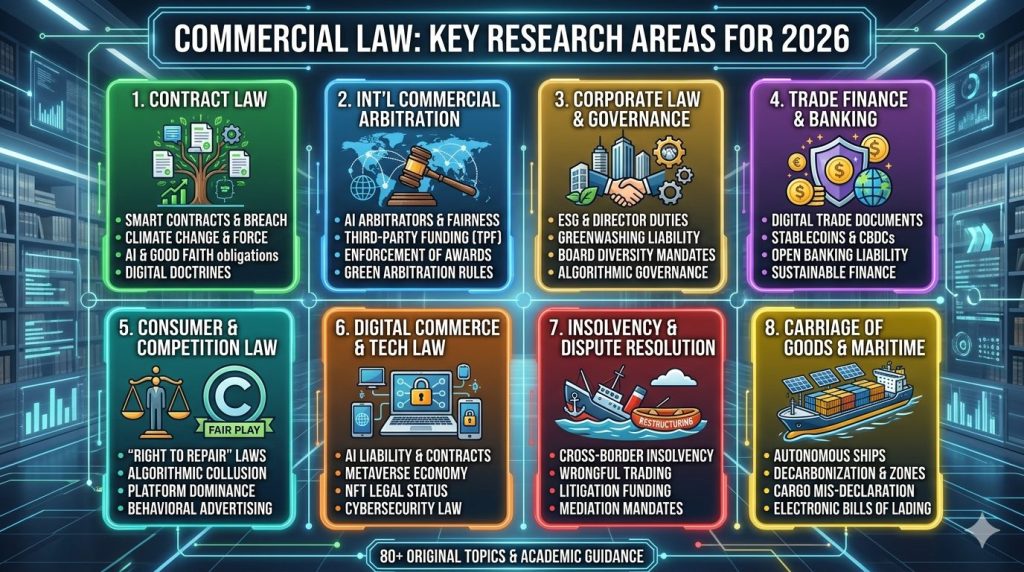
Before selecting a topic, it helps to understand the established subfields that make up commercial law as an academic discipline. These areas are widely recognised by law schools and are reflected in existing scholarship, journal publications, and legislative development.
Contract Law and Commercial Obligations This area examines how contracts are formed, interpreted, enforced, and disputed in commercial settings. It covers standard-form contracts, unfair terms, breach remedies, and performance obligations.
International Commercial Arbitration This is one of the fastest-growing research areas in commercial law. It explores how private disputes between businesses are resolved outside national courts, including institutional rules, enforceability of awards, and jurisdictional challenges.
Corporate Law and Governance Topics here focus on company structure, director duties, shareholder rights, corporate accountability, and the governance of large commercial entities, including multinational corporations.
Trade Finance and Banking Law This area covers letters of credit, guarantees, payment obligations, and the legal frameworks that govern commercial banking relationships.
Consumer and Competition Law Research here examines how commercial markets are regulated to prevent unfair practices, protect consumers, and maintain competitive conditions.
Digital Commerce and Technology Law This is an emerging and expanding subfield covering e-commerce regulation, platform liability, data-driven contracts, and the legal treatment of artificial intelligence in commercial settings.
Insolvency and Commercial Dispute Resolution This area looks at how businesses handle financial failure, how creditors are prioritised, and how disputes between commercial parties are resolved through litigation or alternative means.
Understanding these areas will help you position your topic correctly and identify the relevant literature.
Five Example Dissertation Topics with Aims and Objectives
These examples show students what a well-structured dissertation topic looks like at the proposal stage. Each includes a research aim and two to three objectives.
Example 1: Enforceability of Arbitration Clauses in Online Consumer Contracts
Research Aim: To examine whether standard arbitration clauses embedded in online consumer contracts meet enforceability requirements under English and EU law.
Objectives:
- To analyse how courts in England and Wales have approached challenges to arbitration clauses in digital consumer agreements.
- To compare regulatory approaches to enforceability across UK and EU jurisdictions post-Brexit.
- To evaluate whether current legislative frameworks adequately protect consumers who are bound by online arbitration clauses without informed consent.
Example 2: Director Liability for Greenwashing in Corporate Disclosures
Research Aim: To assess the extent to which directors of publicly listed companies can be held personally liable for misleading environmental claims in commercial disclosures.
Objectives:
- To examine the current duties of directors under the Companies Act 2006 in relation to corporate disclosures.
- To analyse how greenwashing has been treated in securities and corporate governance regulation.
- To recommend reforms that strengthen accountability for directors who approve misleading sustainability claims.
Example 3: The Role of Smart Contracts in International Trade Finance
Research Aim: To investigate whether smart contracts can legally replace traditional documentary credit instruments in international trade transactions.
Objectives:
- To evaluate the legal status of smart contracts under English law and selected common law jurisdictions.
- To identify the key risks associated with relying on smart contracts in cross-border trade finance.
- To propose a legal framework for integrating smart contracts alongside existing trade finance instruments.
Example 4: Jurisdictional Challenges in Cross-Border Insolvency Cases
Research Aim: To examine how English courts manage jurisdictional conflicts in cross-border commercial insolvency proceedings following Brexit.
Objectives:
- To outline the legal framework governing cross-border insolvency in English law, including the UNCITRAL Model Law.
- To identify cases where jurisdictional conflicts have created uncertainty for creditors and administrators post-Brexit.
- To recommend legislative adjustments that could reduce jurisdictional ambiguity in complex international cases.
Example 5: Algorithmic Pricing and Competition Law in Digital Markets
Research Aim: To determine whether algorithmic pricing tools used by dominant online platforms constitute a form of unlawful collusion under UK competition law.
Objectives:
- To examine how algorithmic pricing operates in digital retail markets and where it may cross into anti-competitive behaviour.
- To review existing competition authority enforcement actions involving pricing algorithms in the UK and EU.
- To assess whether current competition law frameworks are equipped to regulate AI-driven pricing strategies effectively.
80 Commercial Law Dissertation Topics for 2026
The following 80 topics are original, researchable, and suitable for undergraduate, master’s, and PhD-level research. They reflect current academic debates, recent legislative developments, and emerging issues in commercial law globally.
Contract Law and Commercial Obligations
- The interpretation of implied terms in long-term commercial supply contracts under English law.
- How courts distinguish between conditions and warranties in commercial sale of goods disputes.
- The enforceability of penalty clauses following the Supreme Court’s decision in Cavendish Square v Makdessi.
- Standard-form contracts in B2B transactions: are they still fair after the Unfair Contract Terms Act?
- The legal treatment of force majeure clauses in commercial contracts following the COVID-19 pandemic.
- Frustration versus force majeure: a comparative analysis of English and French commercial contract law.
- Contractual good faith obligations in English commercial law: is there a case for reform?
- Anticipatory breach in commercial contracts: remedies, timing, and judicial inconsistency.
- The role of entire agreement clauses in limiting liability in commercial transactions.
- Electronic contracting and offer-acceptance rules: is the Electronic Communications Act 2000 still fit for purpose?
International Commercial Arbitration
- The seat of arbitration and its effect on the enforceability of awards in English law.
- Third-party funding in international commercial arbitration: ethical concerns and regulatory gaps.
- Emergency arbitration proceedings: a critical analysis of institutional rules under the ICC and LCIA.
- Confidentiality in international commercial arbitration: balancing transparency with party autonomy.
- The enforceability of ICSID arbitration awards against state-owned commercial entities.
- Arbitral tribunal jurisdiction over fraud allegations: scope, limits, and cross-border implications.
- International commercial arbitration dissertation topics in investor-state disputes: trends and challenges in 2026.
- How the New York Convention 1958 addresses enforcement challenges in non-signatory jurisdictions.
- Virtual arbitration hearings post-pandemic: procedural legitimacy and due process concerns.
- Arbitration of fintech disputes: does existing institutional framework meet the needs of digital commerce?
Corporate Law and Governance
- The duty to promote company success under Section 172 of the Companies Act 2006: is it enforceable?
- Corporate veil piercing in commercial fraud cases: judicial inconsistency and reform proposals.
- Minority shareholder protection in private commercial companies: gaps in English law.
- ESG commitments in corporate governance: legal obligations or reputational choices?
- Board diversity mandates and director appointment practices in listed UK companies.
- The role of non-executive directors in preventing commercial misconduct within large corporations.
- Corporate liability for supply chain violations: beyond the Modern Slavery Act 2015.
- The legal framework for hostile takeovers in the UK: balancing shareholder and stakeholder interests.
- Whistleblower protection in commercial organisations: how effective is the current legal regime?
- Dual-class share structures and their impact on corporate governance accountability in UK companies.
Trade Finance and Banking Law
- The Uniform Customs and Practice for Documentary Credits (UCP 600): are they still commercially effective?
- Legal challenges in digital letters of credit: automating documentary compliance.
- Banker’s autonomy principle in standby letters of credit: limits and judicial erosion.
- The legal treatment of fraud in documentary credit transactions under English law.
- Supply chain finance and the rights of undisclosed assignees in multi-party commercial transactions.
- Blockchain-based trade finance instruments: legal recognition and cross-border enforceability.
- Legal risk in correspondent banking relationships: due diligence, liability, and regulatory compliance.
- Commercial loan covenants and their effect on borrower rights in financial distress.
- The legal implications of negative interest rates on commercial loan agreements.
- Green bonds and sustainable finance frameworks: are current legal structures adequate?
Consumer and Competition Law
- Online subscription traps and the adequacy of UK consumer protection law in the digital economy.
- The Competition and Markets Authority’s approach to merger control in digital platform markets.
- Loyalty discounts and market dominance: where does pricing strategy become anti-competitive?
- Consumer rights in the secondary ticketing market: a critique of enforcement mechanisms.
- The legal treatment of drip pricing in e-commerce under UK consumer law.
- Platform-to-business regulation and power imbalances in online commercial marketplaces.
- Self-preferencing by dominant digital platforms: how should UK competition law respond?
- Consumer redress schemes in financial services: effectiveness and accessibility for commercial disputes.
- Price comparison websites and their potential to distort competitive market behaviour.
- The interaction between consumer law and commercial contract terms in high-value B2C transactions.
Digital Commerce and Technology Law
- AI-generated contracts: legal personhood, enforceability, and liability questions under English law.
- Data ownership in commercial relationships: who controls commercially valuable personal data?
- The legal status of non-fungible tokens (NFTs) as commercial assets under English property law.
- Liability of online platforms for counterfeit goods sold by third-party commercial sellers.
- Automated decision-making in commercial lending: regulatory compliance and legal accountability.
- The law of digital marketplaces: seller obligations, platform duties, and consumer-facing risks.
- Regulating buy-now-pay-later (BNPL) services: gaps in current UK financial and consumer law.
- Terms of service as commercial contracts: enforceability and the problem of unread agreements.
- Cybersecurity obligations in commercial contracts: allocation of risk and liability post-breach.
- The Digital Markets, Competition and Consumers Act 2024: implications for commercial operators in the UK.
Insolvency and Commercial Dispute Resolution
- Pre-pack administration sales in the UK: protecting creditors while enabling commercial rescue.
- The Insolvency Act 1986 and wrongful trading: is the threshold for director liability adequate?
- Restructuring plans under Part 26A of the Companies Act 2006: early judicial experiences and critique.
- The treatment of cryptocurrency holdings in personal and corporate insolvency proceedings.
- Retention of title clauses in commercial contracts: practical enforceability in insolvency situations.
- Set-off rights in commercial insolvency: comparative analysis under English and US law.
- Corporate rescue culture in the UK: lessons from American Chapter 11 restructuring procedures.
- The legal position of unsecured creditors in pre-insolvency restructuring arrangements.
- Mediation in commercial disputes: voluntary participation and the push for compulsory ADR in England.
- The future of litigation funding in commercial dispute resolution following regulatory scrutiny.
International Commercial Law and Cross-Border Trade
- Brexit and its continuing impact on the recognition of English commercial judgments in EU member states.
- The CISG and its exclusion from international sale contracts: why do commercial parties opt out?
- Sanctions compliance in international commercial contracts: legal obligations and force majeure defences.
- The legal framework for commercial agency agreements in cross-border distribution networks.
- Transfer pricing disputes and their intersection with commercial contract law in multinational groups.
- International commercial law dissertation topics for undergraduates: analysing WTO dispute settlement in commercial goods cases.
- The legal regulation of free trade zone commercial activities under bilateral investment treaties.
- Enforcement of foreign commercial judgments in England post-Brexit: a practical assessment.
- Commercial law implications of currency risk clauses in long-term international supply agreements.
- The Belt and Road Initiative and legal challenges for commercial parties operating under Chinese law.
How to Choose the Right Commercial Law Topic for You
With 80 topics in front of you, it is natural to feel unsure about where to start. Narrowing your focus comes down to three practical steps.
First, identify your academic level. Undergraduate dissertations require a clear legal question, good use of primary sources, and a structured argument. Master’s dissertations need original analysis and engagement with academic debate. PhD proposals must demonstrate a genuine gap in existing scholarship.
Second, consider your available resources. Choose a topic where legal materials, case law, and academic literature are accessible to you. Topics that rely on court judgments from your jurisdiction are often more manageable than those requiring multilingual legal sources.
Third, align with your interests. A dissertation written on a topic that genuinely interests you will be more coherent and more enjoyable to research. If you are drawn to technology law, look at topics 51 to 60. If international trade is your passion, topics 71 to 80 are your starting point.
Students who remain undecided after reviewing this list may benefit from structured dissertation help to work through topic selection with an expert in commercial law.
Conclusion
Selecting a strong dissertation topic in commercial law is not just a formality. It shapes everything that follows: the literature you engage with, the methodology you adopt, the arguments you construct, and the quality of your final submission.
This post has introduced 80 original, well-researched topics across seven core subfields of commercial law. Each topic is designed to be specific enough to be manageable yet substantial enough to support a full dissertation at any academic level.
The best commercial law dissertation topics are those that connect a real legal problem to a clear research question, draw on available sources, and leave room for original analysis. Whether you are exploring international commercial arbitration, digital contracts, corporate governance, or cross-border insolvency, you will find that commercial law in 2026 offers no shortage of pressing legal questions.
Approach your dissertation with intellectual curiosity, careful planning, and academic integrity. The topic you choose today will become the foundation of a piece of work you can be genuinely proud of.
