


Civil Law Dissertation Topics for 2026

What Students Are Asking
These questions come from student forums, academic Reddit threads, and university discussion boards. If you have searched online for guidance on your civil law dissertation, chances are you have asked at least one of these already.
- What are the best civil law dissertation topics for 2026?
- How do I choose a civil law dissertation topic that is both original and researchable?
- What are the key research areas in civil law right now?
- Are there any undergraduate dissertation ideas for civil law students that are not overdone?
- What makes a civil law dissertation topic suitable for master’s or PhD level?
- What are the current trends in civil law research I should know about?
- How narrow should my dissertation topic be?
- Can you give me examples of strong civil law research proposal ideas?
Why Choosing the Right Civil Law Dissertation Topic Matters
Choosing your dissertation topic is one of the most consequential decisions you will make during your academic journey. In civil law, this decision shapes not only the scope of your research but also the depth of your legal analysis, the relevance of your arguments, and your ability to make an original contribution to the field.
Civil law governs the private rights of individuals, regulates contracts, property, family relations, torts, and obligations. Because it touches virtually every area of daily life, the field is broad but highly nuanced. A topic that is too wide will leave your research unfocused. A topic that is too narrow may limit the academic literature you can draw on. Getting this balance right is essential for a successful dissertation.
Students who struggle with topic selection often end up writing dissertations that are generic, poorly scoped, or misaligned with their degree level. If you feel overwhelmed, seeking online dissertation help from academic advisors or dissertation consultants early in the process can save you a great deal of time.
The sections below are designed to walk you through research areas, structured topic examples, and 80 original dissertation topics in civil law to help you find your direction with confidence.
Download Civil Law Dissertation Topics PDF
Many students find it helpful to have a curated, personalised list of dissertation topics they can review offline, discuss with supervisors, or use as a starting point for their research proposals. A downloadable PDF containing expert-selected civil law dissertation topics and research proposal ideas is available to students who complete a short academic preferences form.
The PDF is prepared by academic specialists with expertise in civil law, and the topics included are tailored to match your degree level, research interests, and 2026 academic expectations. Students across undergraduate, master’s, and PhD programmes have used this resource to find well-focused dissertation ideas for civil law students that align with their institutional requirements.
Key Research Areas in Civil Law
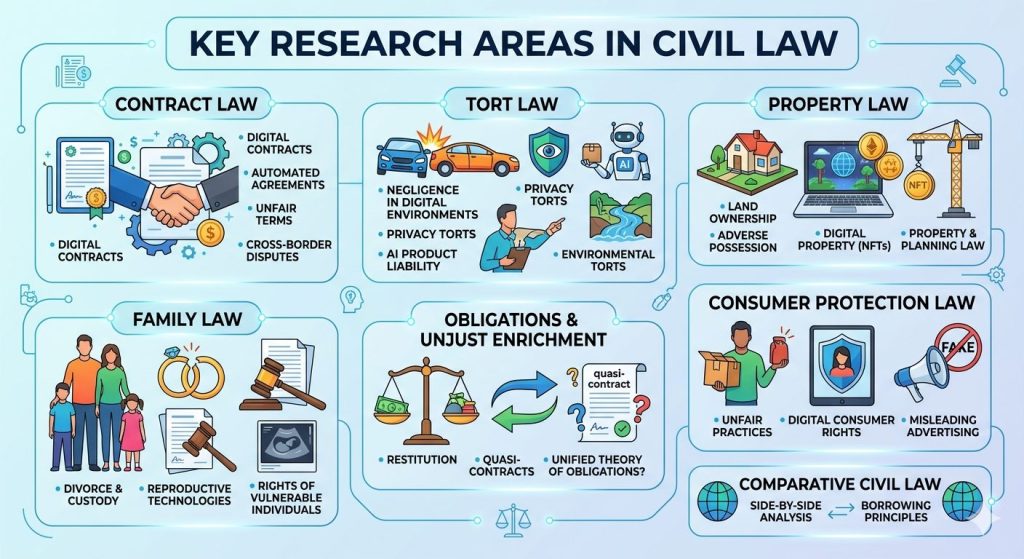
Before you select a dissertation topic, it helps to understand the main research areas within civil law. These areas reflect established academic domains and active areas of legal development. They can also help you identify where your interests sit.
Contract Law
Contract law remains one of the most researched areas in civil law. Current interest focuses on digital contracts, automated agreements, standard-form contracts, unfair terms, and the enforceability of online agreements. There is also growing attention to cross-border contract disputes and the harmonisation of contract law across jurisdictions.
Tort Law
Tort law research has expanded significantly in recent years. Key areas include negligence in digital environments, privacy torts, occupiers’ liability, product liability in the context of AI-generated products, and environmental torts. There is also growing academic interest in the relationship between tort law and human rights.
Property Law
Property law dissertations often explore land ownership, adverse possession, leasehold reform, co-ownership disputes, and the intersection of property rights with planning law. Digital property, including the legal status of virtual assets and non-fungible tokens (NFTs), has recently emerged as a strong area for original research.
Family Law
Family law encompasses divorce, child custody, parental responsibility, domestic abuse, and surrogacy. Research in this area frequently examines how the law responds to changing family structures, reproductive technologies, and the rights of vulnerable individuals, including children and victims of coercive control.
Obligations and Unjust Enrichment
This area covers restitution, quasi-contracts, and the principles governing unjust enrichment. Academic debate continues around how these doctrines interact with contract law and whether a unified theory of obligations is achievable.
Consumer Protection Law
Consumer protection sits at the intersection of contract and regulatory law. Research here examines unfair commercial practices, digital consumer rights, platform liability, misleading advertising, and remedies for defective goods and services.
Comparative Civil Law
Comparative civil law allows students to analyse legal systems side by side. This area is especially productive for identifying gaps, borrowing principles across systems, and assessing how different jurisdictions handle similar legal problems.
Five Example Dissertation Topics with Aims and Objectives
Understanding how a strong dissertation topic is structured can make it easier to develop your own. Below are five examples, each with a research aim and two to three objectives.
Example 1: Liability for AI-Generated Defective Products Under Civil Law
Research Aim: To examine how existing product liability frameworks in civil law can be applied to harm caused by AI-generated products.
Research Objectives:
- To critically analyse current product liability doctrines in the context of autonomous systems.
- To identify the legal gaps that arise when the developer, manufacturer, and user of an AI product are separate entities.
- To recommend legislative reforms that would clarify liability allocation in AI-related civil claims.
Example 2: Digital Contracts and the Doctrine of Consent
Research Aim: To evaluate whether traditional principles of contractual consent remain adequate for regulating digital and automated agreements.
Research Objectives:
- To review how courts have interpreted consent in click-wrap and browse-wrap agreements.
- To assess whether consumers meaningfully consent to standard-form digital contracts.
- To propose doctrinal adjustments that better protect consumer autonomy in digital environments.
Example 3: Adverse Possession and Housing Inequality
Research Aim: To investigate how the doctrine of adverse possession interacts with urban housing inequality in contemporary civil law jurisdictions.
Research Objectives:
- To analyse the historical rationale for adverse possession and its modern application.
- To examine case law in which adverse possession claims have arisen in contexts of housing scarcity.
- To assess whether reform is needed to prevent the doctrine from disproportionately affecting vulnerable property claimants.
Example 4: Unjust Enrichment in Cross-Border Digital Transactions
Research Aim: To determine how the principles of unjust enrichment should apply when digital transactions cross multiple civil law jurisdictions.
Research Objectives:
- To compare how unjust enrichment is treated under English, French, and German civil law.
- To identify the conflicts of law problems that arise in cross-border digital enrichment claims.
- To evaluate whether international harmonisation is achievable and desirable.
Example 5: Coercive Control and Civil Remedies in Family Law
Research Aim: To explore the adequacy of civil law remedies for victims of coercive control within intimate relationships.
Research Objectives:
- To examine how coercive control is legally defined and recognised across different jurisdictions.
- To evaluate the effectiveness of civil injunctions and protective orders as remedies.
- To assess whether dedicated civil legislation for coercive control would improve outcomes for victims.
80 Civil Law Dissertation Topics for 2026
The following topics are organised by subfield. Each is original, academically sound, and suitable for 2026-level research. They are appropriate for undergraduate, master’s, or PhD proposals depending on the depth of analysis applied.
Contract Law Topics
- The legal enforceability of smart contracts under English civil law.
- Standard-form contracts and the adequacy of unfair terms legislation in protecting consumers.
- Misrepresentation in online marketplace agreements: current doctrinal challenges.
- The role of good faith in English contract law: a comparative analysis with French civil law.
- Contractual capacity of minors in digital subscription agreements.
- Force majeure clauses and their application following global supply chain disruptions.
- The law of penalties and its relevance to digital platform breach clauses.
- Duress in employment contracts: how civil law protects vulnerable workers.
- Offer and acceptance in automated e-commerce transactions.
- The doctrine of frustration and its application to climate-disrupted commercial agreements.
Tort Law Topics
- Negligence liability for algorithm-driven financial advice in civil law.
- Defamation on social media and the adequacy of existing civil law remedies.
- Employer liability for remote working injuries under occupiers’ liability principles.
- The duty of care owed by platform operators to users experiencing online harassment.
- Privacy torts and the right to be forgotten in the digital age.
- Psychiatric harm claims in civil negligence: where should the law draw the line?
- Product liability for autonomous vehicle accidents under existing tort frameworks.
- Environmental torts and access to justice for climate-displaced communities.
- The role of contributory negligence in road traffic personal injury claims.
- Vicarious liability and the gig economy: is civil law keeping pace?
Property Law Topics
- The legal status of non-fungible tokens (NFTs) as property under civil law.
- Adverse possession reform and its implications for urban land use.
- Co-ownership disputes in unmarried cohabiting relationships: gaps in civil law protection.
- Leasehold reform and the future of property rights in England and Wales.
- Digital land registration and cybersecurity risks in property transactions.
- Restrictive covenants and their enforceability in modern property development.
- The right to light as a property right: current legal uncertainties.
- Mortgagee rights and borrower protections in cases of repossession.
- Proprietary estoppel and informal land agreements in family contexts.
- Planning law and landowner rights in biodiversity net gain obligations.
Family Law Topics
- The legal recognition of non-traditional family structures in civil law.
- Surrogacy agreements and their enforceability under civil law in the UK.
- Parental alienation and its treatment within civil family law proceedings.
- Domestic abuse and the limitations of civil injunction mechanisms.
- Financial remedies on divorce: adequacy of the current civil law framework.
- International child abduction and the civil law response under the Hague Convention.
- Grandparents’ rights in child contact proceedings: a civil law analysis.
- The legal treatment of prenuptial agreements in England and Wales.
- Reproductive autonomy and civil law: sperm donation, consent, and paternity.
- Child maintenance enforcement: effectiveness of civil remedies against non-paying parents.
Consumer Protection and Commercial Law Topics
- Unfair commercial practices and the adequacy of civil remedies for online consumers.
- Platform liability for third-party seller fraud in e-commerce environments.
- Civil liability for misleading environmental claims made by corporations.
- The right to repair and its implications for consumer contract law.
- Subscription trap practices and the adequacy of consumer cancellation rights.
- Buy now, pay later (BNPL) services and the civil law protection gap for borrowers.
- Civil liability for data breaches under general data protection principles.
- AI-generated product reviews and misrepresentation liability in consumer law.
- The enforceability of refund policies in standard-form consumer contracts.
- Cross-border consumer protection: civil law challenges in international online purchases.
Obligations, Unjust Enrichment, and Restitution Topics
- Unjust enrichment and the recovery of mistaken payments in digital banking.
- The change of position defence in restitution claims: its scope and limitations.
- Proprietary restitution and the tracing of assets in fraud cases.
- Whether English law should adopt a generalised principle of unjust enrichment.
- Restitutionary remedies in cases of failed contracts: a comparative analysis.
- The nature of the enrichment requirement in claims for unjust enrichment.
- Third-party payments and the legal basis for recovery under quasi-contractual principles.
- Total failure of consideration as a ground for restitution in commercial contracts.
- Subrogation as a restitutionary remedy: its doctrinal foundations and limitations.
- Constructive trusts and unjust enrichment: a coherent relationship or a doctrinal mess?
Comparative and International Civil Law Topics
- A comparative study of strict liability in French and English tort law.
- The codification of civil law: lessons the common law tradition can learn.
- Civil law approaches to climate change litigation: comparing EU member state jurisdictions.
- The harmonisation of European contract law post-Brexit: consequences for UK practitioners.
- Civil liability for transboundary environmental harm: a comparative international perspective.
- The recognition and enforcement of foreign civil judgments under private international law.
- Comparative analysis of cohabitation rights in civil law and common law jurisdictions.
- Contractual interpretation in civil law versus common law: a structural comparison.
- Civil law approaches to digital platform regulation: comparing the EU and UK.
- The role of good faith in international commercial contracts under the UNIDROIT Principles.
Emerging and Technology-Focused Civil Law Topics
- Civil liability for harm caused by generative AI systems: who is responsible?
- The legal status of digital wills and electronic estate planning in civil law.
- Autonomous drone operations and negligence liability in civil law.
- Civil law frameworks for regulating metaverse transactions and virtual property disputes.
- Deepfake technology and civil law remedies for reputational and psychological harm.
- Liability for biometric data misuse under civil law principles.
- The enforceability of blockchain-based arbitration clauses in civil disputes.
- Civil liability for algorithmic discrimination in credit and housing decisions.
- 3D-printed products and product liability: who bears civil responsibility for defects?
- Civil law responses to cyberstalking: gaps in existing harassment and tort frameworks.
How to Choose the Right Civil Law Dissertation Topic for Your Level
Knowing which topic suits your degree level is just as important as finding one you find interesting. The guidance below can help you make an informed decision.
Undergraduate Level
At undergraduate level, your dissertation should demonstrate your ability to analyse legal doctrine clearly and apply it to a defined problem. Choose a topic that is focused, well-supported by existing case law and academic literature, and achievable within your word count. Topics from contract law, tort law, and consumer protection tend to work well because the literature is rich and accessible.
If you are unsure how to narrow your topic, reviewing researchable dissertation topics in civil law within your module reading lists can help you identify areas where you already have foundational knowledge.
Master’s Level
At master’s level, you are expected to show critical depth. Your topic should go beyond doctrinal description and engage with theoretical debates, policy questions, or comparative analysis. Topics involving emerging technologies, comparative civil law, or obligations theory are often strong choices.
PhD Level
At PhD level, your dissertation must make an original contribution to civil law scholarship. This means identifying a gap in the literature, formulating a clear research question, and producing findings that advance academic understanding. Topics at this level often combine doctrinal analysis with socio-legal, theoretical, or empirical methodologies.
Tips for Developing a Strong Civil Law Research Proposal
A clear and well-structured research proposal increases your chances of supervisor approval and academic success. Keep the following in mind as you prepare yours.
- Start with a legal problem or gap, not a general area of interest.
- Frame your research question clearly and specifically.
- Identify two to three research objectives that support your aim.
- Briefly outline your methodology, whether that is doctrinal, comparative, or socio-legal.
- Review academic literature early to confirm that your topic has not already been extensively covered.
- Confirm that your topic is suitable for your degree level in terms of scope and depth.
Many students find it helpful to look at civil law research proposal ideas from published dissertations and theses available through university repositories. These can show you what a well-scoped research proposal looks like in practice
Conclusion
Selecting the right dissertation topic in civil law is an academic decision that deserves careful thought and proper planning. The field offers a wide range of research directions, from traditional doctrinal analysis of contract and tort law to emerging questions about technology, digital property, and global legal harmonisation.
The 80 civil law project topics listed in this post are designed to help you identify a direction that is academically sound, original, and appropriate for your level of study. Whether you are an undergraduate looking for a manageable and well-supported topic or a PhD researcher seeking a gap in the existing literature, there is something here to guide your thinking.
Approach your dissertation with intellectual curiosity, a clear research question, and a commitment to academic integrity. Topic selection is only the beginning, but it is the foundation on which everything else is built. Take the time to get it right, and your research will be stronger for it.
All topics listed in this post reflect academic research directions relevant to 2026 and are intended as starting points for your own original research development.
