


Child Law Dissertation Topics for 2026

Questions Students Are Asking About Child Law Dissertations
The questions below have been gathered from student forums, academic discussion platforms, and postgraduate communities. They reflect the real concerns that students bring to their supervisors and online communities when they start thinking about their dissertation.
- How do I choose a topic for a child law dissertation that is both original and researchable?
- What are the best topics of a child law dissertation for 2026?
- Which thesis topics on child abuse law in the UK are still underexplored?
- What topics in child custody law would work for a PhD dissertation?
- What topic should I choose for my child law dissertation if I am unsure where to start?
- Are there research proposal topics in child law that connect to global human rights frameworks?
- How do I align my topic with current legal developments and emerging child welfare debates?
If you have asked yourself any of these questions, this post is written for you. It is designed to help you move from uncertainty to clarity, so that you can walk into your supervisor meeting with confidence.
Why Choosing the Right Child Law Dissertation Topic Matters
Your dissertation topic is the foundation of your entire research journey. In the field of child law, the stakes are particularly high because the subject sits at the intersection of legal theory, human rights, social policy, and lived experience. A well-chosen topic demonstrates not only your academic ability but also your awareness of the legal systems that protect some of the most vulnerable members of society.
Choosing a researchable dissertation topic in child law means selecting something that is specific enough to argue, broad enough to find sources, and relevant enough to contribute meaningfully to the field. Too many students start with a vague area, such as “children’s rights,” and then struggle to define a clear research problem. The guidance in this post will help you avoid that common mistake.
Students who are seeking online dissertation help during the early stages of topic selection often find that reading structured topic lists helps them narrow down their interests faster than reading textbooks alone.
Download Child Law Dissertation Topics PDF
Many students prefer to save and revisit dissertation topics as they develop their research ideas. A downloadable PDF containing a personalised list of child law dissertation topics, curated by academic specialists, is available to students who complete a short information form. The PDF is organised by research area and academic level, making it easier to match topics to your specific programme requirements. This resource is prepared by experienced academic writers who understand what supervisors expect from a strong research proposal.
Key Research Areas in Child Law for 2026
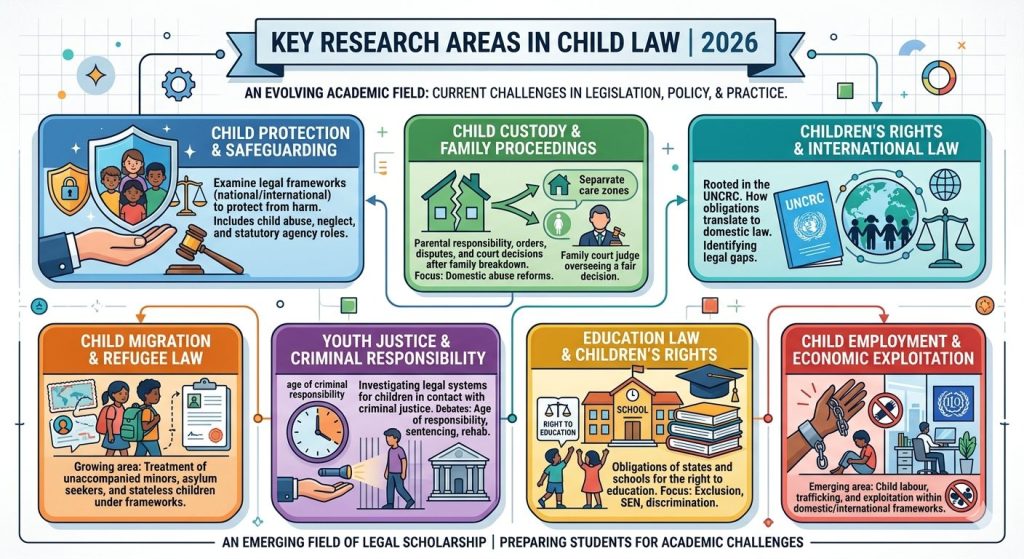
Child law is a rich and evolving academic field. Before selecting a dissertation topic, it helps to understand the main research areas where scholars are currently producing meaningful work. These areas are grounded in established legal scholarship and reflect current challenges in legislation, policy, and practice.
Child Protection and Safeguarding Law This area examines how legal frameworks at national and international levels protect children from harm. It includes child abuse law, neglect, and the role of statutory agencies in delivering child protection services.
Child Custody and Family Proceedings This area covers parental responsibility, residence orders, contact disputes, and the role of courts in making decisions about children following family breakdown. It is a highly active area of legal development, particularly in relation to domestic abuse reforms.
Children’s Rights and International Law Rooted in the United Nations Convention on the Rights of the Child (UNCRC), this area explores how international obligations translate into domestic legislation, and where gaps remain.
Child Migration and Refugee Law This is a growing area of research that examines how unaccompanied minors, asylum-seeking children, and stateless children are treated under immigration and international protection frameworks.
Youth Justice and Criminal Responsibility This area investigates how legal systems treat children who come into contact with the criminal justice system, including debates about the age of criminal responsibility, sentencing, and rehabilitation.
Education Law and Children’s Rights Research in this area considers the legal obligations of the state and schools to protect children’s right to education, with particular focus on exclusion, special educational needs, and discrimination.
Child Employment and Economic Exploitation This emerging area addresses child labour, trafficking, and the economic exploitation of children within both domestic and international legal frameworks.
Five Example Dissertation Topics with Research Aims and Objectives
Understanding how a strong dissertation topic is structured academically can save you considerable time. Below are five example topics, each with a clearly stated research aim and a set of focused research objectives.
Example 1: The Effectiveness of the Children Act 1989 in Responding to Domestic Abuse
Research Aim: To evaluate how effectively the Children Act 1989, as amended by the Domestic Abuse Act 2021, protects children living in households affected by domestic abuse.
Research Objectives:
- To analyse the legislative changes introduced by the Domestic Abuse Act 2021 and their impact on child custody proceedings.
- To examine case law decisions in which courts have balanced parental contact with child safety concerns.
- To assess whether current statutory provisions adequately address the needs of children exposed to coercive control.
Example 2: Unaccompanied Asylum-Seeking Children and the Duty of Care in the UK
Research Aim: To critically examine the legal duty of care owed by local authorities to unaccompanied asylum-seeking children (UASC) under UK immigration and child welfare law.
Research Objectives:
- To identify the legal obligations placed on local authorities under the Children Act 1989 and the Nationality and Borders Act 2022.
- To evaluate the adequacy of age assessment processes and their compliance with child rights principles.
- To compare the UK’s approach to UASC with selected European jurisdictions.
Example 3: The Age of Criminal Responsibility in England and Wales
Research Aim: To assess whether the current age of criminal responsibility in England and Wales, set at ten years, is consistent with children’s rights standards and contemporary developmental science.
Research Objectives:
- To review the neuroscientific evidence regarding adolescent decision-making and moral development.
- To examine arguments presented in recent reform debates at parliamentary and academic levels.
- To compare the English approach with jurisdictions that apply a higher age of criminal responsibility.
Example 4: Online Child Sexual Exploitation and the Adequacy of UK Law
Research Aim: To examine whether existing UK legislation is sufficient to address the evolving landscape of online child sexual exploitation, including emerging digital harms.
Research Objectives:
- To review the legal provisions under the Sexual Offences Act 2003 and the Online Safety Act 2023 as they relate to children.
- To identify legal gaps in the current framework by analysing recent prosecutions and academic commentary.
- To consider whether a dedicated statutory framework for online child protection would be more effective.
Example 5: Parental Alienation and Its Recognition in English Family Courts
Research Aim: To investigate how English courts conceptualise and respond to parental alienation in child arrangement disputes, and whether current judicial practice adequately safeguards affected children.
Research Objectives:
- To review the legal and psychological literature on parental alienation and its contested status.
- To analyse judicial approaches in reported case law from 2015 to 2025.
- To evaluate the implications of the Family Justice Review recommendations for how courts should address alienating behaviours.
80 Child Law Dissertation Topics for 2026
The following topics are organised under key subfields within child law. Each one is original, academically grounded, and suitable for undergraduate, master’s, or PhD research. These researchable dissertation topics in child law reflect current legal debates, legislative reforms, and emerging challenges in child welfare.
Child Protection and Safeguarding Law
- The legal definition of “significant harm” under the Children Act 1989: is it still fit for purpose in 2026?
- Mandatory reporting of child abuse: should England and Wales adopt a statutory duty equivalent to that in Scotland?
- The role of independent reviewing officers in protecting looked-after children: a critical legal appraisal.
- Child death reviews and the lessons learned framework: assessing their legal and procedural adequacy.
- Female genital mutilation protection orders: evaluating their effectiveness as a legal tool in England and Wales.
- The legal framework for forced marriage protection orders and their application to child victims.
- How do courts weigh the paramountcy principle when expert evidence on child risk is contested?
- Legal accountability of social workers in child protection failures: a comparative analysis of England and Germany.
- Child neglect and the threshold criteria: examining inconsistency in judicial interpretation.
- The impact of austerity on local authority child protection services: a legal and policy analysis.
Child Custody, Contact, and Parental Responsibility
- Presumption of parental involvement under the Children and Families Act 2014: does it serve the child’s best interests?
- Supervised contact orders and their enforcement: a critical analysis of judicial practice in England.
- How do courts treat allegations of domestic abuse when determining contact arrangements?
- Parental relocation disputes: striking the balance between parental rights and the child’s right to both parents.
- The role of the Children and Family Court Advisory and Support Service (Cafcass) in disputed contact cases.
- Shared residence orders and their impact on children’s psychological welfare: a legal and empirical review.
- Grandparents’ rights to contact under English law: the case for legislative reform.
- Coercive control as a factor in child arrangement proceedings following Re H-N [2021].
- International child abduction and the Hague Convention: assessing the adequacy of English court responses.
- Should children have independent legal representation in all contested custody proceedings?
Children’s Rights and International Law
- The incorporation of the UNCRC into domestic UK law: assessing progress following the UNCRC (Incorporation) (Scotland) Act 2024.
- Article 12 of the UNCRC and the right of the child to be heard: a gap analysis in English family proceedings.
- Children’s rights in armed conflict: evaluating the Optional Protocol and its enforcement mechanisms.
- The right to identity under the UNCRC: a study of donor-conceived children and anonymous gamete donation law.
- Comparing children’s rights frameworks in common law and civil law jurisdictions: lessons for English law.
- Child soldiers: accountability, rehabilitation, and the limits of international child law.
- The right to education under international law: how do exclusion practices in English schools breach Article 28?
- Children’s right to health and the legal obligations of states under the UNCRC: a post-COVID analysis.
- How effective are UN treaty body reporting mechanisms in driving domestic child law reform?
- The best interests principle in international law: examining its application across different legal cultures.
Child Migration, Asylum, and Statelessness
- Age assessment decisions for unaccompanied asylum-seeking children: legal challenges and human rights concerns.
- The Nationality and Borders Act 2022 and its impact on child asylum seekers in the UK.
- Stateless children and access to education: examining legal obligations under international and EU law.
- Legal safeguards for child trafficking victims within the UK National Referral Mechanism.
- Separated children in immigration detention: is the prohibition on child detention being effectively enforced?
- Family reunification rights of refugee children under UK immigration law post-Brexit.
- Child refugees in Europe: a comparative analysis of reception, protection, and integration law.
- How do UK courts interpret the “best interests” standard in immigration cases involving children?
- The role of guardianship schemes for unaccompanied minors: comparing legal frameworks across the EU.
- Legal responses to children fleeing climate-related displacement: gaps in existing frameworks.
Youth Justice and Criminal Responsibility
- Raising the age of criminal responsibility in England and Wales to 14: a legal and rights-based analysis.
- Knife crime and young offenders: evaluating the effectiveness of current sentencing law.
- Stop and search powers and their disproportionate impact on Black children in England and Wales.
- Child criminal exploitation and the county lines phenomenon: legal challenges in identifying and protecting victims.
- Secure accommodation orders and the rights of children with complex needs: a critical legal review.
- Youth Offending Teams and their statutory obligations: accountability gaps and reform proposals.
- The use of remand to custody for children: is it compatible with children’s rights standards?
- Gang injunctions and their application to children: balancing community safety with child rights.
- Restorative justice for young offenders in England: a critical assessment of its legal and policy framework.
- Are the sentencing guidelines for youth courts consistent with a children’s rights approach?
Child Abuse Law and Sexual Exploitation
- Historical child sexual abuse and limitations periods: the case for reform in English civil law.
- Online grooming offences under the Sexual Offences Act 2003: adequacy for 2026 digital realities.
- Child sexual exploitation in residential care: legal liability and institutional accountability.
- The legal response to peer-on-peer child sexual abuse: gaps in the current framework.
- Non-consensual sharing of intimate images involving children: evaluating the Online Safety Act 2023.
- Disclosure and barring service checks and the prevention of child sexual abuse in professional settings.
- Criminal compensation for child abuse survivors: assessing the adequacy of the Criminal Injuries Compensation Scheme.
- Prosecutorial challenges in child sexual abuse cases: an analysis of evidential and procedural barriers.
- Child trafficking for sexual exploitation: domestic legal responses and compliance with international standards.
- The intersection of poverty, vulnerability, and child sexual exploitation: implications for legal policy.
Education Law and Children’s Rights
- Permanent exclusion from school and the rights of children with special educational needs.
- Legal obligations of academies and free schools towards children with Education, Health and Care Plans.
- Home education and the limits of state oversight: balancing parental autonomy with child welfare.
- Religious discrimination in school admissions policies: a legal analysis under the Equality Act 2010.
- Bullying and the duty of care: how far does school legal liability extend under English law?
- Children’s right to inclusive education under the UNCRC and the Equality Act 2010: are they aligned?
- Legal responses to school absenteeism: do fixed penalty notices serve the child’s best interests?
- Restraint and seclusion of children in educational settings: legal accountability and reform needs.
- The rights of trans and non-binary children in schools: a legal analysis of emerging guidance and case law.
- Do children have a legally enforceable right to mental health support within schools?
Child Employment, Labour, and Economic Exploitation
- Child labour in UK supply chains: corporate legal obligations under the Modern Slavery Act 2015.
- Agricultural child labour and exemptions under UK working time regulations: a rights-based critique.
- Child influencers on social media: are current employment and exploitation laws adequate?
- The legal protection of children in the entertainment industry: lessons from the United States for UK law.
- Child trafficking for labour exploitation: how effectively does UK law identify and protect victims?
- Minimum wage exemptions for young workers: examining their compatibility with children’s economic rights.
- The legal liability of brand corporations for child labour in international supply chains.
- Digital work and child performers online: should a new statutory framework be introduced?
- Child poverty as a structural violation of children’s rights: the case for a legal duty on government.
- Legal accountability mechanisms for child labour in fast fashion supply chains under international trade law.
How to Choose a Topic for Your Child Law Dissertation
One of the most common concerns among students is knowing where to start. Selecting dissertation topics in child law requires you to think about four things: your own academic interests, the availability of quality sources, the scope of the topic, and the contribution it can make to existing scholarship.
Begin by identifying a broad area that genuinely interests you, such as youth justice, child protection, or international children’s rights. Then narrow it down by looking at recent legislation, landmark court decisions, or policy debates that remain unresolved. A strong topic usually emerges from a legal gap, a contradiction in the law, or an area where academic opinion is divided.
If you are working at undergraduate level, focus on a topic that is clearly defined and manageable within your word limit. At master’s level, aim to bring some comparative or theoretical dimension to your analysis. At PhD level, your topic must make an original contribution to the field, which means identifying a gap that no one has adequately addressed.
Students who are seeking guidance on how to choose a topic for child law dissertation will find that the 80 examples above are designed to prompt thinking rather than replace it. Use them as a starting point, then speak with your supervisor about how to refine your chosen idea.
Conclusion
Choosing your dissertation topic is one of the most important academic decisions you will make. In child law, it also carries a certain moral weight: the subjects you research ultimately relate to the legal protection and wellbeing of children. That makes it all the more important to approach the process thoughtfully and with academic rigour.
The research areas, example topics, and 80 structured ideas presented in this post are designed to give you a clear framework for moving forward. Whether you are drawn to child protection law, youth justice, international children’s rights, or educational law, there is a researchable and meaningful topic waiting for you within this field.
Take your time, read broadly, and do not be discouraged if your first idea needs refining. The best dissertations are rarely born perfect. They develop through reading, discussion, and intellectual honesty. Approach your work with curiosity, follow the evidence carefully, and allow your research to speak for itself.
If you need further guidance at any stage of your dissertation journey, academic support is available to help you develop your proposal, structure your argument, and present your findings with confidence.
