


Contract Law Dissertation Topics for 2026

Questions Students Are Asking About Contract Law Dissertations
The questions below were gathered from student forums, academic discussion boards, and university help platforms. They reflect the real concerns students have when choosing dissertation topics in contract law.
- What are the best contract law dissertation topics for 2026?
- Which dissertation topics in contract law are suitable for LLB students?
- How do I find ideas for an LLM thesis in contract law that are original and researchable?
- Are there contract law dissertation topics that are relevant for GDL students in the UK?
- What topics in contract law are relevant for PhD students who want to contribute new knowledge?
- How do I narrow down my contract law topic to something specific and manageable?
- What areas of contract law are most relevant and current for 2026 research?
Introduction: Why Your Contract Law Dissertation Topic Matters
Choosing the right dissertation topic in contract law is one of the most important academic decisions you will make. Contract law sits at the heart of commercial, consumer, and digital life, and its principles shape billions of transactions every year. A well-chosen topic does not just satisfy your degree requirements; it demonstrates your ability to think critically, engage with legal scholarship, and contribute meaningfully to an area of the law.
Many students struggle at this stage. The field is wide, the legal literature is vast, and it can feel overwhelming to identify a gap that is both original and researchable. If you are feeling stuck, you are not alone. Whether you are looking for online dissertation help or working independently, this guide will help you navigate the topic selection process with confidence.
This post presents 80 contract law dissertation topics for 2026, structured by subfield and suitable for undergraduate, master’s, and doctoral-level research. It also explains the key research areas within the field, provides sample topic structures, and offers practical guidance on how to align your research with current academic expectations.
Download Contract Law Dissertation Topics PDF
Students who want a more personalised selection of dissertation topics can receive a curated PDF compiled by academic experts in contract law. The PDF contains a focused list of topics tailored to your level of study and research interests. Students receive this document after completing a short form that helps academic advisors understand your specific needs and preferences.
This service is particularly useful for students who are still deciding between areas of contract law, or who need guidance on framing their chosen topic into a researchable question.
Why Choosing the Right Dissertation Topic in Contract Law Matters
Contract law is not a static subject. It evolves through court decisions, legislative reform, and the pressures of new technologies, global trade, and shifting social values. A dissertation topic that felt fresh five years ago may no longer reflect the current legal landscape. For 2026, students need topics that engage with today’s legal debates while remaining grounded in established doctrine.
Your dissertation topic also signals your intellectual priorities to future employers, academic supervisors, and professional bodies. A carefully selected topic shows that you understand the field, can identify a genuine legal problem, and have the analytical skills to investigate it. This is especially important for students pursuing LLM qualifications or academic careers.
Beyond reputation, a strong topic makes the entire research process more manageable. When you care about your question and it is clearly scoped, writing becomes easier, and your argument becomes more persuasive. Poorly scoped topics lead to unfocused dissertations that try to cover too much and say too little.
Key Research Areas in Contract Law for 2026
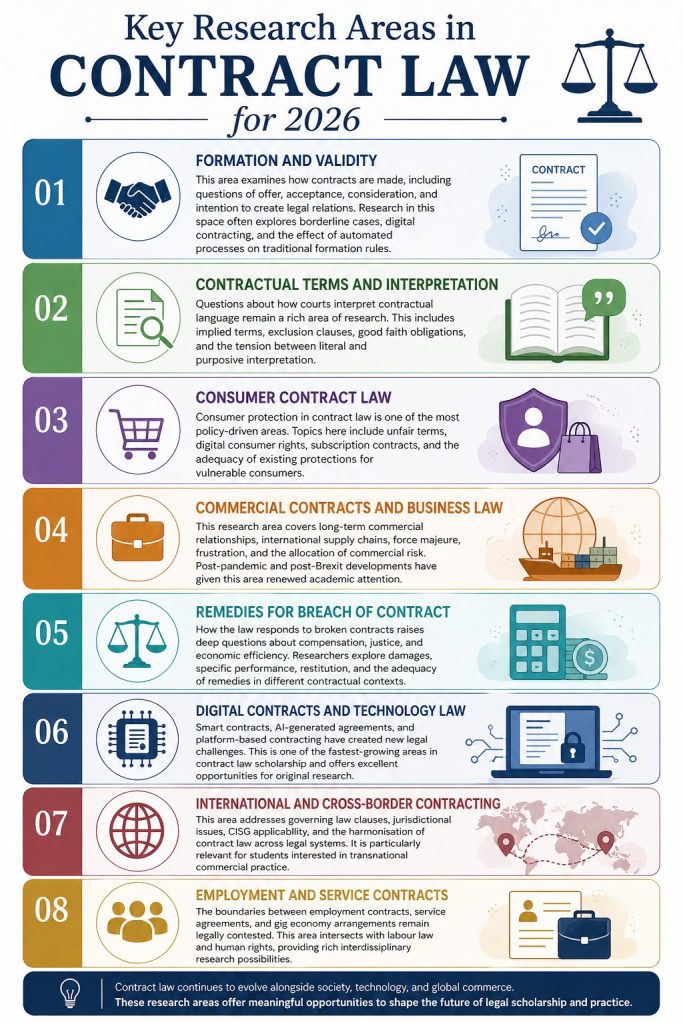
Before selecting a topic, it helps to understand the major research areas within contract law. These domains have developed over decades of legal scholarship and remain highly relevant to contemporary practice and policy.
Formation and Validity
This area examines how contracts are made, including questions of offer, acceptance, consideration, and intention to create legal relations. Research in this space often explores borderline cases, digital contracting, and the effect of automated processes on traditional formation rules.
Contractual Terms and Interpretation
Questions about how courts interpret contractual language remain a rich area of research. This includes implied terms, exclusion clauses, good faith obligations, and the tension between literal and purposive interpretation.
Consumer Contract Law
Consumer protection in contract law is one of the most policy-driven areas. Topics here include unfair terms, digital consumer rights, subscription contracts, and the adequacy of existing protections for vulnerable consumers.
Commercial Contracts and Business Law
This research area covers long-term commercial relationships, international supply chains, force majeure, frustration, and the allocation of commercial risk. Post-pandemic and post-Brexit developments have given this area renewed academic attention.
Remedies for Breach of Contract
How the law responds to broken contracts raises deep questions about compensation, justice, and economic efficiency. Researchers explore damages, specific performance, restitution, and the adequacy of remedies in different contractual contexts.
Digital Contracts and Technology Law
Smart contracts, AI-generated agreements, and platform-based contracting have created new legal challenges. This is one of the fastest-growing areas in contract law scholarship and offers excellent opportunities for original research.
International and Cross-Border Contracting
This area addresses governing law clauses, jurisdictional issues, CISG applicability, and the harmonisation of contract law across legal systems. It is particularly relevant for students interested in transnational commercial practice.
Employment and Service Contracts
The boundaries between employment contracts, service agreements, and gig economy arrangements remain legally contested. This area intersects with labour law and human rights, providing rich interdisciplinary research possibilities.
Sample Contract Law Dissertation Topics with Research Aims and Objectives
The following examples illustrate how a well-structured dissertation topic is constructed. Each includes a research aim and two to three objectives to guide the inquiry.
Sample Topic 1: The Legal Status of Smart Contracts Under English Law
Research Aim
To assess whether existing English contract law principles are adequate to govern smart contracts and to identify the reforms needed to address current legal gaps.
Research Objectives
- To analyse how formation requirements apply to self-executing smart contracts.
- To examine judicial and academic responses to the enforceability of smart contracts.
- To evaluate whether legislative intervention is required to resolve current uncertainties.
Sample Topic 2: Unfair Terms in Digital Consumer Contracts
Research Aim
To evaluate the effectiveness of the Consumer Rights Act 2015 in protecting consumers from unfair terms in digital service agreements.
Research Objectives
- To identify the types of terms most commonly challenged under the fairness test.
- To compare the UK approach with the EU’s Unfair Terms Directive post-Brexit.
- To recommend improvements to the current regulatory framework.
Sample Topic 3: Force Majeure and Commercial Contracts Post-Pandemic
Research Aim
To examine how courts have interpreted force majeure clauses in the wake of COVID-19 and assess the need for clearer statutory guidance.
Research Objectives
- To review judicial decisions on force majeure between 2020 and 2025.
- To compare the English approach with civil law jurisdictions.
- To propose a model force majeure clause for future commercial contracts.
Sample Topic 4: Implied Duty of Good Faith in English Contract Law
Research Aim
To investigate whether English law recognises a general implied duty of good faith in contractual performance and whether such recognition would benefit commercial parties.
Research Objectives
- To trace the historical resistance of English law to a general good faith obligation.
- To analyse recent cases where good faith arguments have succeeded or failed.
- To assess whether codification of good faith would improve commercial certainty.
Sample Topic 5: Contractual Liability of AI Systems in Commercial Agreements
Research Aim
To explore how contract law attributes liability when AI systems cause loss in the performance of commercial agreements.
Research Objectives
- To examine existing doctrines of agency and their applicability to AI actors.
- To analyse how liability is currently distributed between deployers, developers, and counterparties.
- To recommend a liability framework that addresses the distinctive features of AI contracting.
80 Contract Law Dissertation Topics for 2026
The following topics are organised by subfield and are designed to support undergraduate, master’s, and PhD-level research proposals. All topics are narrow in focus, academically sound, and aligned with current debates in contract law scholarship.
Formation, Offer, and Acceptance
- The legal effect of silence as acceptance in online contract formation under English law.
- Whether automated acceptance mechanisms satisfy the traditional intention to be bound test in commercial contracts.
- The adequacy of consideration doctrine in the context of software licensing agreements.
- Rethinking the postal rule in the age of instant electronic communication: a case for statutory reform.
- Capacity to contract and the protection of adults with cognitive impairments under English law.
- The validity of contracts formed through social media platforms: challenges to traditional offer and acceptance rules.
- Pre-contractual liability and the duty to negotiate in good faith: a comparative analysis of English and French law.
- The legal status of preliminary agreements and letters of intent in commercial negotiations.
- Click-wrap versus browse-wrap agreements: the enforceability of online terms and conditions under UK consumer law.
- Consideration and the enforcement of gratuitous promises: the case for reform of English contract law.
Contractual Terms, Interpretation, and Good Faith
- The evolution of implied terms in English contract law: from The Moorcock to Marks and Spencer v BNP Paribas.
- Literal versus purposive interpretation of commercial contracts: where do English courts draw the line?
- Whether a general implied duty of good faith should be recognised in English commercial contract law.
- The role of entire agreement clauses in restricting implied terms and pre-contractual representations.
- Penalty clauses and legitimate interests: revisiting Cavendish Square v Makdessi in long-term commercial agreements.
- The incorporation of standard terms by reference in high-value business-to-business contracts.
- Interpreting force majeure clauses in uncertain economic conditions: lessons from post-2020 litigation.
- The judicial treatment of exclusion clauses in business-to-business contracts after Photo Production v Securicor.
- Whether the objective test of contractual intention adequately protects parties from unjust outcomes.
- The legal significance of pre-contractual negotiations in interpreting ambiguous contract terms.
Consumer Contract Law and Fairness
- The fairness test under the Consumer Rights Act 2015: does it provide sufficient protection for digital consumers?
- Subscription traps and automatic renewal clauses: the adequacy of consumer protection law in the UK.
- Protecting vulnerable consumers in financial services contracts: the role of the Financial Conduct Authority and contract law.
- The enforcement gap in consumer contract law: why individual litigation fails to deter unfair business practices.
- Post-Brexit consumer contract law in the UK: divergence from EU standards and its implications for cross-border trade.
- Dark patterns in digital contracting: whether current consumer law adequately addresses manipulative design techniques.
- The adequacy of remedies available to consumers under the Consumer Rights Act 2015 in digital goods disputes.
- Algorithmic pricing and consumer contracts: whether variable pricing models create unfairness under existing law.
- The legal treatment of terms buried in lengthy standard-form consumer contracts: a case for mandatory disclosure.
- Consumer protection in buy-now-pay-later agreements: gaps in the current UK regulatory and contractual framework.
Commercial Contracts and Risk Allocation
- Frustration of contract in commercial leases: whether Canary Wharf v European Medicines Agency changed the law.
- Risk allocation in construction contracts: a critical analysis of NEC4 and JCT standard forms.
- Material adverse change clauses in merger and acquisition agreements: drafting and judicial interpretation.
- The enforceability of no-oral-modification clauses in English commercial contracts after MWB Business Exchange v Rock Advertising.
- Supply chain disruption and contractual liability: whether existing doctrines are adequate for global commercial relationships.
- The allocation of force majeure risk in energy contracts under English law.
- Price adjustment mechanisms in long-term commercial contracts: legal certainty versus commercial flexibility.
- Confidentiality obligations in commercial contracts: the boundary between contractual duty and equitable protection.
- Assignment of contractual rights in financial transactions: the effect of anti-assignment clauses.
- Performance bonds and demand guarantees: distinguishing autonomous obligations from contractual suretyship.
Remedies for Breach of Contract
- The adequacy of compensatory damages for breach of commercial contracts involving non-financial loss.
- Specific performance as a primary remedy: a case for expanding its availability in English contract law.
- Gain-based damages in contract law after One Step Support v Morris-Garner: scope and limitations.
- Contributory negligence in contract claims: whether the Law Reform Act 1945 should apply to all contractual breaches.
- Termination for breach and the elective theory of repudiation: practical consequences for commercial parties.
- Whether the duty to mitigate loss places an unfair burden on innocent parties in commercial contract disputes.
- The recovery of wasted expenditure in reliance damages: a principled basis or judicial discretion?
- Punitive damages for breach of contract: a critical assessment of the English law position and the case for reform.
- Liquidated damages clauses and penalty rule reform: assessing the commercial impact of the Supreme Court’s decision in Cavendish.
- Restitutionary remedies for unjust enrichment arising from failed contracts: where contract law ends and restitution begins.
Digital Contracts, Technology, and Artificial Intelligence
- Smart contracts and the requirements of English contract law: a doctrinal analysis of enforceability.
- Whether AI systems can be parties to contracts and the implications for contractual liability.
- The legal status of NFT purchase agreements and the contractual rights conferred on buyers.
- Platform liability for contracts concluded through algorithmic matching services under UK law.
- Data as consideration in digital service contracts: the legal treatment of personal data exchanges.
- Contractual regulation of AI-generated content: ownership, liability, and indemnification clauses.
- Electronic signatures and contract formation: whether current e-signature law is fit for purpose in 2026.
- The enforceability of terms of service agreements on social media platforms under English and EU law.
- Automated price matching and contract formation: whether algorithmic agreements meet the consensus requirement.
- Liability for defective code in software contracts: the interplay between product liability and contractual terms.
International and Cross-Border Contracting
- The applicability of the CISG to digital goods contracts: a critical analysis of Article 2 exclusions.
- Choice of law clauses in international commercial contracts and their enforceability post-Brexit.
- Harmonisation of contract law in ASEAN: prospects for a regional framework based on UNIDROIT Principles.
- The role of arbitration clauses in managing cross-border contractual disputes in the digital economy.
- Whether English contract law remains the preferred governing law for international commercial agreements after Brexit.
- Sanctions clauses in international contracts: the legal effect of performance obligations in sanctioned jurisdictions.
- The recognition of electronic contracts and digital signatures under international private law frameworks.
- Jurisdiction agreements and exclusive jurisdiction clauses in post-Brexit UK litigation.
- The UNIDROIT Principles 2016 as a model for reforming English contract law on hardship and changed circumstances.
- Cross-border consumer contracts and the adequacy of private international law protections for UK buyers.
Employment, Gig Economy, and Service Contracts
- Zero-hours contracts and the absence of mutuality of obligation: contractual protections for gig economy workers.
- The enforceability of post-termination restrictive covenants in employment contracts under English law.
- Whether platform workers have enforceable contractual rights against digital labour platforms under UK law.
- The distinction between employees, workers, and independent contractors: implications for contractual rights and protections.
- Implied duties of trust and confidence in employment contracts: their scope and limits after Malik v BCCI.
- Non-disclosure agreements in employment disputes: whether current contractual and regulatory frameworks protect victims of workplace misconduct.
- The contractual rights of freelancers in the creative industries: a critical analysis of standard industry agreements.
- Algorithmic management and employment contracts: whether automated performance monitoring breaches implied terms.
- The adequacy of contractual protections for agency workers compared to directly employed staff under UK law.
- Service contracts in the care sector: whether standard terms adequately protect both providers and recipients of personal care.
How to Select the Right Contract Law Dissertation Topic for Your Academic Level
Not every topic on this list will suit every student. Your choice should reflect your academic level, the scope of your programme, and the resources available to you.
For LLB Students
Undergraduate dissertations in contract law should focus on a well-defined legal question that can be explored through primary and secondary legal sources. Topics at this level work best when they engage with a specific area of doctrine, a particular piece of legislation, or a small group of landmark cases. Avoid topics that require extensive comparative or empirical research unless your programme supports this approach.
Contract law dissertation topics for undergraduate students work best when they are grounded in English law and connected to recent judicial developments. Topics 1, 9, 11, 27, and 34 on this list are strong starting points for LLB-level work.
For LLM Students
If you are exploring ideas for an LLM thesis in contract law, your research should demonstrate a higher level of critical engagement. Master’s-level work is expected to identify a genuine legal problem, engage critically with existing scholarship, and offer an original analytical contribution. Topics such as those dealing with smart contracts, good faith obligations, and post-Brexit consumer law tend to offer rich material at this level.
LLM students should look for topics where the law is genuinely uncertain or contested. Topics 13, 43, 51, 56, and 65 reflect current scholarly debates and offer real scope for original argumentation.
For PhD Students
Topics in contract law that are relevant for PhD students require a sustained original contribution to legal knowledge. Doctoral research in contract law often takes a theoretical, comparative, or empirical approach. Students at this level should aim to identify a gap in the academic literature, propose an innovative analytical framework, or challenge a dominant doctrinal position.
Areas such as AI and contractual liability, international contract law harmonisation, and the normative foundations of remedies doctrine offer particularly strong potential for PhD-level inquiry. Topics 52, 63, 69, and 80 are examples of areas with doctoral potential.
For GDL Students
Topics in contract law that are relevant for GDL students in the UK should be firmly grounded in English legal doctrine and accessible without requiring prior specialist knowledge. GDL dissertations are often shorter and more focused, making clarity of scope especially important. Topics that engage with formation, consumer protection, or standard-form contracts tend to work well for this qualification.
Conclusion
Contract law is a dynamic, contested, and profoundly relevant area of legal study. Whether you are writing an undergraduate dissertation, pursuing an LLM, or developing a PhD proposal, choosing the right topic is the foundation of your entire project. A well-chosen topic focuses your reading, sharpens your argument, and makes the writing process substantially more productive.
The 80 contract law dissertation topics in this guide cover the full range of the field, from classical doctrinal questions about offer and acceptance to emerging challenges in AI contracting and digital consumer protection. Each topic has been selected for its academic soundness, its 2026 relevance, and its potential to generate original, rigorous legal argument.
If you are still unsure where to begin, the best approach is to start with an area of contract law that you have genuinely engaged with during your studies, and then look for a current legal problem or unresolved debate within that area. Dissertation writing is most rewarding when the question genuinely interests you.
Students who need structured support in developing their topic into a full research proposal may find that accessing specialist dissertation topics in contract law guidance helps to bridge the gap between a general interest and a researchable question. Approach your dissertation with academic integrity, intellectual curiosity, and a clear sense of purpose, and you will be in a strong position to produce work that genuinely contributes to the field.
