


Nursing Dissertation Topics for 2026

Questions Students Are Asking
Students across academic forums and discussion platforms often feel uncertain when it comes to choosing a dissertation topic. The questions below reflect real concerns gathered from those conversations, and this post addresses each one clearly.
- How do I choose a nursing dissertation topic that is suitable for my academic level?
- What are some interesting nursing dissertation topics for 2026?
- What is the best topic for nursing research right now?
- What are some hot topics in nursing that I can base my dissertation on?
- Are there ideas for an undergraduate nursing research proposal that are not too broad?
- What topics work well for a master’s level nursing dissertation?
- How do I find a research topic for my PhD in nursing that is original and researchable?
Why Choosing the Right Nursing Dissertation Topic Matters
Selecting a dissertation topic is one of the most consequential decisions a nursing student will make during their academic journey. The topic you choose shapes your research methodology, determines the literature you engage with, and ultimately reflects your academic maturity. A poorly chosen topic can lead to unfocused writing, weak arguments, and limited contribution to the field.
Nursing, as a discipline, sits at the intersection of clinical practice, public health, psychology, and policy. This means there is no shortage of areas to explore, but it also means that without direction, students can quickly feel overwhelmed. A well-chosen topic allows you to contribute meaningfully to nursing knowledge while demonstrating your ability to conduct rigorous, structured research.
If you are currently struggling with topic selection, seeking online dissertation help from academic professionals can offer valuable early guidance. Starting with a focused, clearly scoped topic makes the entire research process more manageable and more rewarding.
Download Nursing Dissertation Topics PDF
Students who want a personalised list of nursing dissertation topics can receive a downloadable PDF curated by academic experts. This resource is tailored to your level of study and research interests. After completing a short form with your academic details and preferences, a specialist compiles a focused topic list suited to your specific research goals. This service is available to undergraduate, master’s, and doctoral students.
Key Research Areas in Nursing for 2026
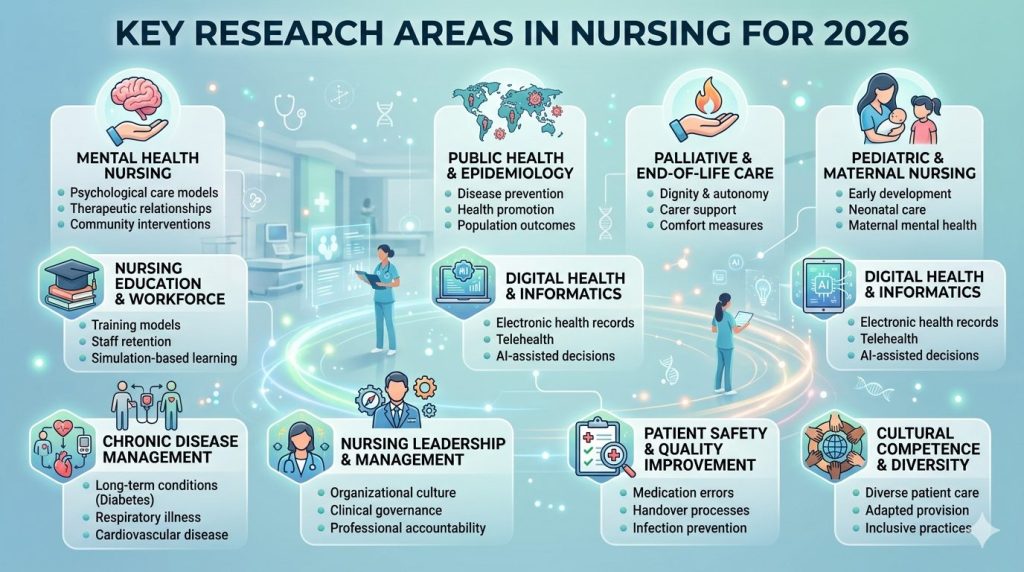
Nursing research in 2026 spans a broad and evolving range of subfields. Before choosing a topic, it helps to understand the key areas that are currently driving academic and clinical discussion. These areas reflect established domains within nursing scholarship and emerging directions in practice.
- Mental health nursing — examining psychological care models, therapeutic relationships, and community-based interventions
- Public health and epidemiology — exploring disease prevention, health promotion, and population-level outcomes
- Palliative and end-of-life care — investigating dignity, patient autonomy, and carer support frameworks
- Paediatric and maternal nursing — focusing on early childhood development, neonatal care, and maternal mental health
- Nursing education and workforce development — studying training models, staff retention, and simulation-based learning
- Digital health and nursing informatics — evaluating electronic health records, telehealth, and AI-assisted clinical decision-making
- Chronic disease management — addressing long-term conditions such as diabetes, cardiovascular disease, and respiratory illness
- Nursing leadership and management — exploring organisational culture, clinical governance, and professional accountability
- Patient safety and quality improvement — investigating medication errors, handover processes, and infection prevention
- Cultural competence and diversity in nursing — examining how care provision adapts to diverse patient populations
Understanding these areas allows you to position your dissertation within an active academic conversation and choose a topic that reviewers and examiners will find relevant and credible.
Five Example Dissertation Topics with Aims and Objectives
The following examples illustrate how a dissertation topic should be structured. Each includes a clear research aim and measurable objectives.
Example 1
Topic: The impact of nurse-led interventions on medication adherence in patients with Type 2 diabetes in community settings
Aim: To examine how nurse-led structured education programmes influence medication adherence among Type 2 diabetes patients in UK primary care.
Objectives:
- To identify the barriers and facilitators that affect medication adherence in community diabetes patients
- To evaluate the effectiveness of nurse-led education in improving adherence rates over a 12-month period
- To explore patients’ perspectives on the nurse-patient relationship in adherence behaviour
Example 2
Topic: Burnout and resilience among intensive care nurses following the COVID-19 pandemic: a mixed-methods study
Aim: To investigate the relationship between occupational burnout and resilience strategies among ICU nurses in post-pandemic NHS settings.
Objectives:
- To measure the prevalence of burnout among ICU nursing staff using validated tools
- To identify coping strategies and resilience-building factors reported by nurses
- To analyse how organisational support mechanisms moderate burnout outcomes
Example 3
Topic: Nursing students’ preparedness for end-of-life communication: gaps in undergraduate training
Aim: To assess whether current undergraduate nursing curricula adequately prepare students for end-of-life conversations with patients and families.
Objectives:
- To review existing undergraduate nursing curricula for end-of-life communication content
- To gather student perspectives on their confidence and readiness for such conversations
- To recommend curriculum improvements based on identified gaps
Example 4
Topic: The role of cultural competence training in reducing health disparities among Black and minority ethnic patients
Aim: To determine whether structured cultural competence training for nurses reduces disparities in care quality experienced by Black and minority ethnic patients.
Objectives:
- To compare patient satisfaction scores before and after cultural competence training is introduced
- To examine nurses’ self-reported confidence in delivering culturally responsive care
- To identify institutional factors that support or hinder training effectiveness
Example 5
Topic: Telehealth adoption in district nursing: challenges and opportunities for rural communities
Aim: To explore how district nurses in rural UK settings perceive and adopt telehealth technologies in their daily practice.
Objectives:
- To identify the technological and infrastructural barriers facing rural district nurses
- To assess patient outcomes associated with telehealth-delivered nursing care in rural contexts
- To provide evidence-based recommendations for rural telehealth policy development
80 Nursing Dissertation Topics for 2026
The following topics are organised by subfield. Each is designed to be focused, researchable, and appropriate for undergraduate, MSc, or PhD-level nursing research proposals.
Mental Health Nursing
- The effectiveness of trauma-informed care models in adult mental health inpatient units
- Peer support workers in acute mental health settings: impact on patient recovery outcomes
- Nurses’ experiences of managing patients with dual diagnosis in community mental health teams
- The role of de-escalation techniques in reducing physical restraint in psychiatric wards
- Mental health nurses’ attitudes towards self-harm in adolescent inpatient settings
- Implementing recovery-focused care plans in community mental health nursing practice
- The relationship between nurse staffing levels and patient safety incidents in psychiatric units
- Stigma in mental health nursing: how nurses’ beliefs influence therapeutic relationships
- Early intervention nursing models for first-episode psychosis in young adults
- The impact of reflective practice on compassion fatigue in mental health nursing staff
Palliative and End-of-Life Care
- Nurses’ experiences of providing spiritual care in palliative settings: a qualitative study
- Advance care planning and nursing advocacy: barriers to patient autonomy in NHS trusts
- The role of the specialist palliative care nurse in supporting family carers at home
- End-of-life communication skills training: does it change nursing practice?
- Comparing quality of death indicators in hospice versus hospital settings from a nursing perspective
- Nursing challenges in managing complex pain in cancer patients at end of life
- Cultural beliefs and their influence on nurses’ approach to end-of-life discussions
- The effectiveness of the Gold Standards Framework as a nursing tool in care homes
- Paediatric palliative care nursing: preparing children and families for anticipated death
- Nurse-led bereavement support programmes: outcomes for bereaved family members
Paediatric and Maternal Nursing
- Skin-to-skin contact and neonatal outcomes: evidence from neonatal intensive care nursing practice
- Nurse-led interventions to reduce anxiety in children undergoing surgical procedures
- Supporting breastfeeding in preterm infants: the role of the neonatal nurse
- Maternal mental health screening by health visitors: identifying gaps in early identification
- Play therapy as a nursing intervention for hospitalised school-age children
- The experiences of paediatric oncology nurses managing end-of-life care for children
- Postnatal depression and the effectiveness of nurse-led community support programmes
- Safe sleep education by health visitors: impact on sudden infant death syndrome rates
- Transition from paediatric to adult nursing care: experiences of young people with chronic illness
- Nurse-family partnership models and their impact on first-time mothers in deprived areas
Chronic Disease Management
- Self-management education for patients with chronic obstructive pulmonary disease: a nursing evaluation
- Nurse prescribing in the management of long-term conditions: patient outcomes and safety
- The effectiveness of motivational interviewing by nurses in improving lifestyle behaviour in cardiac patients
- Nursing interventions to improve glycaemic control in older adults with Type 2 diabetes in care homes
- Heart failure nurse specialists and hospital readmission rates: an evidence-based review
- The role of community nurses in supporting patients with multiple long-term conditions
- Fatigue management in multiple sclerosis: the contribution of specialist nursing interventions
- Asthma management in primary care: nurse-led clinics versus GP-led care outcomes
- Hypertension monitoring and nurse-led follow-up: reducing cardiovascular risk in primary care
- The impact of nurse-led weight management programmes on obesity-related comorbidities
Patient Safety and Quality Improvement
- The relationship between missed nursing care and adverse patient outcomes in acute settings
- Handover communication and patient safety: an evaluation of structured handover tools
- Medication administration errors in adult inpatient settings: causes and nursing interventions
- Falls prevention in older adult inpatient wards: effectiveness of nurse-led risk assessment tools
- Pressure ulcer prevention: an audit of nursing compliance with evidence-based protocols
- The impact of skill mix changes on patient safety outcomes in NHS wards
- Hospital-acquired infection rates and the role of nursing hand hygiene compliance
- Nurse-to-patient ratios and their relationship with patient mortality in acute medical wards
- Speaking up culture in nursing: barriers to raising safety concerns in NHS organisations
- Simulation-based training for nursing students: impact on clinical error reduction post-qualification
Nursing Education and Workforce Development
- The effectiveness of high-fidelity simulation in preparing student nurses for clinical placement
- Mentorship quality and its influence on nursing student attrition in the UK
- Transition shock in newly qualified nurses: causes, consequences, and support strategies
- Nursing workforce diversity and its relationship with culturally competent care delivery
- International nurse recruitment and its impact on team cohesion in NHS trusts
- The experiences of mature nursing students navigating academic and personal responsibilities
- Preceptorship programmes and their role in reducing newly qualified nurse turnover
- Clinical supervision and its influence on nursing practice standards in community settings
- Academic and practice gap in nursing education: student and mentor perspectives
- The influence of leadership styles on nursing student learning outcomes during placement
Digital Health and Nursing Informatics
- Nurses’ perceptions of electronic health record systems and their impact on documentation quality
- Telehealth consultations in district nursing: patient satisfaction and clinical outcome data
- The use of wearable technology in remote monitoring: implications for nursing assessment
- Artificial intelligence tools in clinical decision-making: nursing staff readiness and ethical concerns
- Digital health literacy among older patients and the implications for nursing-led education
- Mobile health applications in self-management of chronic conditions: the nurse’s role in guidance
- The impact of digital shift-handover tools on communication accuracy in acute nursing settings
- Cybersecurity awareness among nursing staff: risks and training needs in NHS environments
- Virtual reality in nursing education: a systematic review of effectiveness in skills training
- The ethical implications of AI-assisted triage systems from a nursing advocacy perspective
Public Health and Community Nursing
- Health visiting services and their impact on early childhood developmental outcomes
- School nursing and its role in identifying and supporting children with mental health needs
- The effectiveness of community nursing outreach programmes in reducing health inequalities
- Smoking cessation support delivered by community nurses: long-term patient outcomes
- Immunisation uptake and the role of the community nurse in building vaccine confidence
- Nurse-led sexual health clinics in urban areas: outcomes and patient experience
- Frailty identification in community nursing practice: tools, challenges, and outcomes
- The contribution of public health nurses to reducing childhood obesity in deprived communities
- Homelessness and nursing care: experiences of community nurses working with rough sleepers
- Social prescribing and the expanding role of community nurses in non-clinical intervention
Choosing a Topic That Fits Your Academic Level
Not every topic suits every level of study. Undergraduate students should focus on topics that are manageable within limited timeframes and require desk-based or small-scale primary research. A good example would be exploring nursing students’ attitudes towards a specific clinical issue or conducting a systematic review of existing evidence.
For MSc nursing dissertation topics, the expectation increases. Students at this level are expected to demonstrate critical analysis, theoretical engagement, and independent scholarly thinking. Topics should be more refined, with a clear gap in the existing literature.
Those looking for a research topic for a PhD in nursing must identify an original contribution to knowledge. This requires significant engagement with theory, methodology, and current debates in the field. A PhD topic should not simply replicate existing studies but extend them in a meaningful direction.
If you are still unsure about where to begin, professional dissertation topics in nursing are available through academic support services that can match your interests with current research priorities.
Conclusion
Choosing the right dissertation topic in nursing is not just an administrative task. It is an academic commitment that shapes the quality of your research, the strength of your argument, and the value of your contribution to the profession. The 80 nursing dissertation topics listed above represent a wide range of subfields and are designed to support students at every level of study.
Whether you are seeking interesting nursing dissertation topics to spark your curiosity, or looking for undergraduate nursing dissertation topics that are realistic and achievable, this post has aimed to provide both inspiration and structure. Topic selection should align with your academic level, available resources, and genuine interest in the subject matter.
Approach your dissertation with academic integrity, intellectual curiosity, and a willingness to engage critically with evidence. The nursing profession advances through rigorous research, and your dissertation is a meaningful part of that process.
