


Medicine Dissertation Topics for 2026

Questions Students Are Asking About Medicine Dissertation Topics
The following questions have been gathered from student forums, academic discussion groups, and higher education platforms. They reflect how real students think and search when they feel unsure about choosing the right dissertation topic in medicine.
- What are the best medicine dissertation topics for 2026 that align with current clinical and research trends?
- How do I choose a dissertation topic in medicine that is narrow enough to be researchable but broad enough to be significant?
- What are the latest research topics in medicine that supervisors and ethics boards are likely to approve?
- Are there dissertation topics in medicine suitable for undergraduate BSc students, or are most topics only for master’s and PhD level?
- How do I write a research aim and set clear objectives for a medicine dissertation?
- Where can I find a medicine dissertation topics PDF to explore ideas before meeting my supervisor?
- What research areas in medicine are most likely to attract funding and academic recognition in 2026?
If any of these questions reflect what you have been searching for, this post is written specifically for you.
Why Choosing the Right Dissertation Topic in Medicine Matters
A dissertation is not simply a long essay. It is a structured, evidence-based contribution to a field. In medicine, that responsibility carries extra weight because your research may influence clinical practice, public health policy, or patient outcomes. Choosing the right topic is therefore one of the most important decisions you will make during your academic journey.
Many students approach topic selection as a formality. In reality, the topic you choose will shape everything: your literature review, your methodology, your ethical considerations, and your final conclusions. A well-chosen topic gives your research focus, makes your argument stronger, and helps you maintain academic momentum throughout a challenging process.
The field of medicine is vast. It spans basic sciences, clinical research, public health, medical ethics, pharmacology, and health policy. Students who try to cover too much end up producing shallow research. Those who focus on a specific, well-defined problem tend to produce work that is more academically credible and more useful to practitioners.
This post is designed to help you navigate that process. It covers key research areas, offers structured topic examples with aims and objectives, and provides 80 unique dissertation topics in medicine for 2026-level research expectations.
Download Medicine Dissertation Topics PDF
Many students find it useful to review a curated list of dissertation topics before meeting their supervisor or writing their research proposal. A downloadable PDF containing a personalised selection of medicine dissertation topics, reviewed and curated by academic experts, is available to students who complete a short online form.
This PDF is intended to support your early planning process and help you identify research directions that match your academic level, whether you are completing an undergraduate BSc, a master’s programme, or a doctoral degree. The topics included are tailored to current academic expectations and reflect emerging research priorities in the field.
Key Research Areas in Medicine Students Can Explore
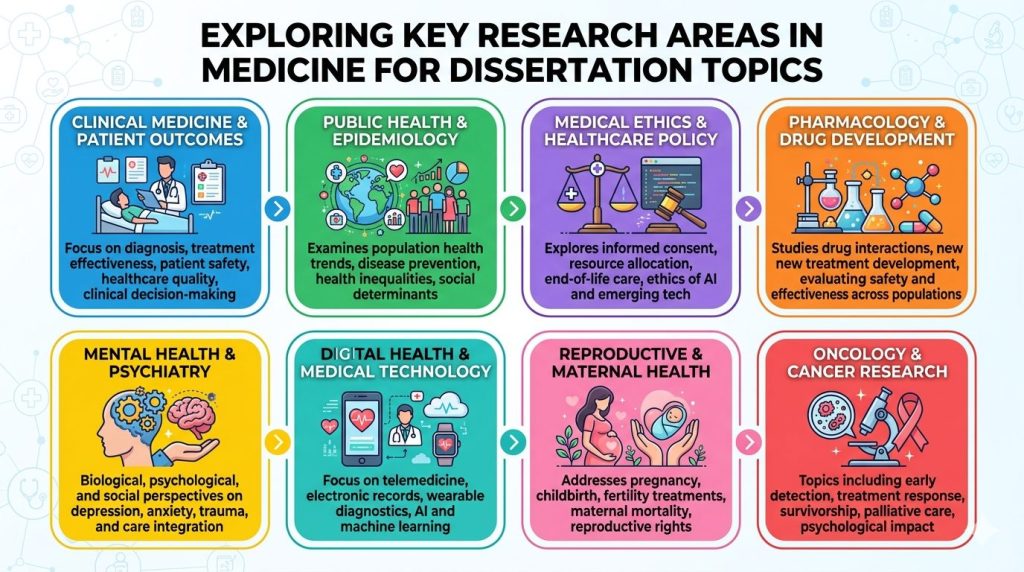
Before diving into specific dissertation topics, it helps to understand the established subfields within medicine where meaningful research is currently taking place. These are not invented trends. They are recognised domains within academic medicine, each with an active body of peer-reviewed literature and ongoing clinical or theoretical debate.
Clinical Medicine and Patient Outcomes This area covers the diagnosis, treatment, and management of disease in clinical settings. Research in this domain often focuses on treatment effectiveness, patient safety, clinical decision-making, and healthcare quality.
Public Health and Epidemiology This subfield examines population-level health trends, disease prevention, health inequalities, and the social determinants of health. It is particularly relevant for students interested in how policies and environments shape wellbeing.
Medical Ethics and Healthcare Policy Ethical questions in medicine are growing more complex as technology advances. Research here might explore informed consent, resource allocation, end-of-life care, or the ethics of artificial intelligence in diagnostics.
Pharmacology and Drug Development This area covers how drugs interact with the body, how new treatments are developed, and how existing medications are evaluated for safety and effectiveness across different populations.
Mental Health and Psychiatry Mental health research in medicine spans biological, psychological, and social perspectives. Current interest includes depression, anxiety, trauma, psychosis, and the integration of mental health into primary care.
Digital Health and Medical Technology The use of technology in medicine is reshaping how care is delivered. Research areas include telemedicine, electronic health records, wearable diagnostics, and the role of machine learning in clinical decision support.
Reproductive and Maternal Health This area addresses pregnancy, childbirth, reproductive rights, fertility treatment, and maternal mortality. Research here is both clinically significant and socially important.
Oncology and Cancer Research Cancer remains one of the most studied areas in medicine. Research topics may focus on early detection, treatment response, survivorship, palliative care, or the psychological impact of a cancer diagnosis.
Five Example Dissertation Topics with Aims and Objectives
The following examples are designed to help you understand how a well-structured dissertation topic in medicine is put together. Each includes a research aim and between two and three clear objectives.
Example 1: Antibiotic Resistance in Primary Care Settings
Research Aim: To examine the prescribing practices of general practitioners in relation to antibiotic stewardship and the development of antimicrobial resistance in community settings.
Research Objectives:
- To identify the most common patterns of antibiotic overprescription in primary care consultations.
- To evaluate the effectiveness of existing stewardship interventions in reducing unnecessary antibiotic use.
- To recommend evidence-based guidelines for improving prescribing behaviour among GPs.
Example 2: Mental Health Support for Junior Doctors
Research Aim: To investigate the mental health challenges faced by junior doctors during their foundation years and assess the adequacy of institutional support systems.
Research Objectives:
- To identify the primary psychological stressors reported by junior doctors in NHS trusts.
- To evaluate current wellbeing support programmes offered by healthcare institutions.
Example 3: Informed Consent in Emergency Medicine
Research Aim: To critically assess the process of obtaining informed consent from patients in emergency settings where standard consent procedures cannot always be followed.
Research Objectives:
- To examine how current legal and ethical frameworks apply to emergency consent scenarios.
- To identify gaps between policy guidelines and clinical practice in emergency departments.
- To propose a structured framework for improving ethical decision-making in time-critical situations.
Example 4: The Role of Diet in Type 2 Diabetes Management
Research Aim: To explore the effectiveness of dietary interventions in managing blood glucose levels among adult patients with type 2 diabetes in community health settings.
Research Objectives:
- To compare the outcomes of low-carbohydrate and Mediterranean dietary approaches in type 2 diabetes management.
- To assess patient adherence to dietary recommendations over a six-month period.
Example 5: Telemedicine and Rural Healthcare Access
Research Aim: To assess how the expansion of telemedicine services has affected healthcare access and patient satisfaction in rural communities in the United Kingdom.
Research Objectives:
- To compare patient outcomes in rural areas before and after the introduction of telemedicine consultations.
- To identify barriers to telemedicine adoption among elderly and low-income rural patients.
- To evaluate the clinical and economic sustainability of telemedicine models in underserved regions.
80 Medicine Dissertation Topics for 2026
The following dissertation topics are organised by subfield. They are suitable for BSc, MSc, and PhD research proposals and reflect the academic and clinical priorities of 2026. Students seeking online dissertation help can use these topics as a starting point for discussions with their supervisors.
Clinical Medicine and Patient Safety
- The impact of handover communication failures on patient safety outcomes in NHS hospitals.
- Reducing medication errors in elderly patients through pharmacist-led review programmes.
- The effectiveness of rapid response teams in preventing in-hospital cardiac arrests.
- Patient discharge planning and its role in reducing 30-day hospital readmissions.
- Clinical outcomes of nurse-led care models in managing chronic obstructive pulmonary disease.
- The influence of sleep deprivation on clinical decision-making among trainee doctors.
- Comparing open and laparoscopic surgical approaches in colorectal cancer resections.
- The role of early physiotherapy in post-operative recovery following hip replacement surgery.
- Evaluating the use of clinical checklists in reducing surgical site infections.
- Patient-reported outcomes in the management of chronic lower back pain.
Public Health and Epidemiology
- Health inequalities in cancer screening uptake among ethnic minority populations in the UK.
- The long-term public health consequences of childhood obesity in high-income countries.
- Evaluating the effectiveness of sugar-tax policies on reducing obesity rates in urban areas.
- Social determinants of cardiovascular disease among low-income communities in England.
- The role of vaccination hesitancy in the resurgence of preventable infectious diseases.
- Assessing the public health impact of food insecurity on maternal and child health outcomes.
- Urban air pollution and its association with respiratory hospital admissions in major cities.
- The effectiveness of community-based interventions in reducing tobacco use among adolescents.
- Alcohol consumption patterns and their correlation with liver disease incidence in the UK.
- The impact of climate change on the geographic spread of vector-borne diseases in Europe.
Medical Ethics and Healthcare Policy
- Ethical considerations in the use of predictive algorithms for patient triage in A&E departments.
- The moral obligations of healthcare professionals during public health emergencies.
- Research proposal topics in medical ethics for a PhD dissertation exploring organ donation consent models.
- End-of-life care decision-making and the ethical limits of physician authority.
- The ethics of genetic screening for hereditary conditions in children who cannot consent.
- Allocating scarce medical resources during pandemics: a comparative ethical analysis.
- Conscientious objection in medicine and its impact on patient access to reproductive health services.
- Ethical frameworks for integrating artificial intelligence into diagnostic medicine.
- Balancing patient confidentiality and public safety in cases of communicable disease.
- The role of medical professional bodies in shaping ethical standards for clinical research.
Pharmacology and Drug Development
- Drug-drug interactions in elderly patients prescribed five or more medications concurrently.
- The clinical effectiveness of biosimilar medicines compared to their reference biologics in rheumatology.
- Patient adherence to long-term antihypertensive medication regimens in primary care.
- Evaluating off-label prescribing practices in paediatric oncology.
- The pharmacological management of neuropathic pain in patients with type 2 diabetes.
- Resistance mechanisms to second-generation antiretroviral therapies in HIV-positive patients.
- The role of pharmacogenomics in personalising antidepressant treatment for patients with major depressive disorder.
- Opioid prescribing trends and their relationship with rates of dependency in post-surgical patients.
- Herbal supplement use among cancer patients and the risk of interactions with chemotherapy agents.
- The impact of regulatory changes on antibiotic prescribing behaviour in secondary care.
Mental Health and Psychiatry
- Medicine thesis topics for MSc students examining the effectiveness of CBT in treating health anxiety.
- Burnout and compassion fatigue among mental health nurses in community care settings.
- The relationship between childhood trauma and the onset of borderline personality disorder in adulthood.
- Barriers to mental health help-seeking behaviour among male university students in the UK.
- Comparing the outcomes of inpatient and community-based treatment for first-episode psychosis.
- The role of social media use in the development of eating disorders among adolescent females.
- Effectiveness of mindfulness-based cognitive therapy in preventing relapse in recurrent depression.
- Stigma and its effect on treatment adherence among patients with schizophrenia.
- The mental health implications of long-term unemployment among adults aged 25 to 50.
- Assessing the prevalence of post-traumatic stress disorder among emergency service workers.
Digital Health and Medical Technology
- The accuracy and clinical reliability of wearable devices for detecting atrial fibrillation.
- Patient attitudes towards sharing electronic health records with artificial intelligence systems.
- The effectiveness of mobile health applications in supporting self-management of type 1 diabetes.
- Machine learning in radiological imaging: a comparative analysis of diagnostic accuracy with human specialists.
- Cybersecurity risks in hospital information systems and their implications for patient data safety.
- Telemedicine consultations and their clinical equivalence to face-to-face appointments in dermatology.
- The role of electronic prescribing systems in reducing medication dispensing errors in hospital settings.
- Digital literacy barriers among elderly patients using NHS online appointment booking systems.
- The integration of point-of-care testing technology in rural general practice.
- Evaluating clinical outcomes following the introduction of robotic-assisted surgery in urology.
Reproductive and Maternal Health
- The association between maternal mental health disorders and adverse neonatal outcomes.
- Barriers to contraceptive access among young women in low-income urban communities.
- A critical analysis of maternal mortality rates and their relationship to antenatal care quality in England.
- The psychosocial impact of recurrent miscarriage on women and their partners.
- Gestational diabetes: evaluating the long-term metabolic risks for mother and child.
- Breastfeeding support interventions and their effectiveness in increasing exclusive breastfeeding rates.
- The impact of domestic violence on pregnancy outcomes and healthcare engagement.
- Fertility treatment decision-making among same-sex couples accessing assisted reproductive technologies.
- The relationship between antenatal anxiety and preterm birth in first-time mothers.
- Midwifery-led care models and their association with maternal and neonatal health outcomes.
Oncology and Cancer Research
- Research paper topics in medicine for students examining psychological distress in long-term cancer survivors.
- The effectiveness of lung cancer screening programmes using low-dose CT in high-risk populations.
- Health-related quality of life among patients receiving palliative chemotherapy for advanced colorectal cancer.
- Barriers to clinical trial participation among Black and Asian cancer patients in the UK.
- The role of patient navigation programmes in reducing delays between cancer diagnosis and treatment.
- Fatigue management strategies in patients undergoing radiotherapy for head and neck cancer.
- Comparing immunotherapy outcomes in non-small cell lung cancer by molecular subtype.
- The psychological impact of prophylactic mastectomy on BRCA-positive women.
- Nutritional support and its effect on treatment tolerance in patients with oesophageal cancer.
- Evaluating the cost-effectiveness of targeted therapies in the treatment of metastatic melanoma.
Conclusion
Choosing a dissertation topic in medicine is a significant academic undertaking. The 80 topics presented in this post span a wide range of subfields, from clinical practice and pharmacology to ethics and digital health, all grounded in what is most relevant and researchable in 2026.
A strong dissertation begins with a focused question, a clearly stated aim, and objectives that are achievable within the scope of your degree. Whether you are developing thesis research proposal ideas for BSc students at undergraduate level or exploring advanced questions for a doctoral thesis, the principle remains the same: specificity strengthens your research.
Use this post as a starting point, not a final answer. Discuss your shortlisted topics with your supervisor, review current literature, and consider the ethical dimensions of your chosen area before committing. The best dissertation topics are those that genuinely interest you and that contribute something meaningful to the field.
If you are still finding the process difficult, professional academic guidance is available through structured online dissertation help services that support students at every stage of the research process.
Approach your dissertation with curiosity, rigour, and confidence. The work is demanding, but the contribution you make, however focused, adds to a body of knowledge that ultimately serves patients and communities.
