


Cardiac Nursing Dissertation Topics for 2026
What Students Are Asking (From Forums and Academic Discussion Platforms)
Before diving into the content, here are some of the most common questions students have raised on academic forums, university discussion boards, and student support communities. These questions shaped everything covered in this post.
- What are the most relevant cardiac nursing dissertation topics for 2026?
- How do I choose a cardiac-related nursing research topic that suits my academic level?
- Are there dissertation topics in cardiac nursing that focus on current clinical challenges?
- What makes a good research aim and set of objectives for a nursing dissertation?
- Where can I find cardiac nursing topics for PhD research proposal development?
- Can I find affordable cardiac nursing dissertation writing services that are academically trustworthy?
- How narrow should my dissertation topic be, and how do I know if it is researchable?
If any of these questions reflect what you have been wondering, this post is written for you.
Introduction: Why Choosing the Right Dissertation Topic in Cardiac Nursing Matters
Selecting the right dissertation topic is one of the most important academic decisions a nursing student will make. In the field of cardiac nursing, this choice carries even greater weight. Cardiovascular disease remains the leading cause of death globally, and the nursing profession plays a central role in prevention, management, and rehabilitation. A well-chosen research topic gives students the chance to contribute meaningfully to a field that directly affects millions of lives.
Many students feel overwhelmed at this stage. They are unsure whether their ideas are academically viable, narrow enough, or relevant to current clinical practice. That confusion is completely normal. This post is designed to replace that uncertainty with clarity.
The following sections cover why topic selection in cardiac nursing matters, which research areas are currently active, how to structure a dissertation topic with clear aims and objectives, and a comprehensive list of 80 original dissertation topics in cardiac nursing for 2026. Whether you are at undergraduate, master’s, or doctoral level, you will find ideas here that match your academic ambitions.
If you find yourself needing personalised guidance beyond this post, exploring online dissertation help from qualified academic professionals can make a significant difference to the quality and focus of your research journey.
Download Cardiac Nursing Dissertation Topics PDF
Students looking for a more personalised resource can access a downloadable PDF containing a curated list of dissertation topics in cardiac nursing, compiled by experienced academic researchers. This PDF is designed to support topic selection at all levels, from undergraduate to doctoral study. Students receive this document after completing a short form, allowing the academic team to tailor the list to their specific area of interest and research level. The PDF is available at no cost and is sent directly to the student’s inbox.
Why Choosing the Right Dissertation Topic in Cardiac Nursing Matters
Cardiac nursing is not a single, uniform discipline. It spans acute care settings, community health, preventive medicine, rehabilitation, palliative support, pharmacological management, and patient education. The breadth of the field means there is no shortage of ideas, but that same breadth can make topic selection feel overwhelming.
Choosing a topic that is both relevant and researchable gives your dissertation academic strength from the very beginning. A poorly scoped topic, one that is either too broad or too vague, makes it harder to produce a focused literature review, a coherent methodology, and meaningful findings. A well-defined topic, on the other hand, allows you to build your argument clearly and demonstrate original thinking.
Cardiac-related nursing research topics that align with current NHS priorities, international cardiovascular guidelines, and emerging patient care models are particularly valued by academic supervisors. They also have greater potential to inform real-world nursing practice, which adds both academic and professional value to your work.
If you are unsure how to frame your research interests into a formal topic, reviewing examples of structured dissertation aims and objectives can be very useful. This post provides exactly that in the section below.
Key Research Areas in Cardiac Nursing for 2026
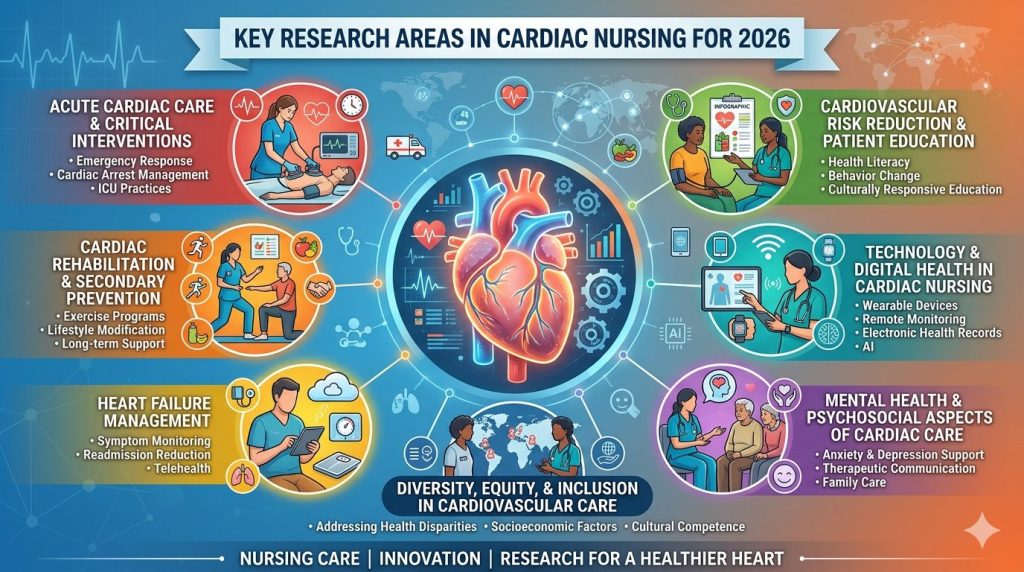
The landscape of cardiac nursing research continues to evolve. In 2026, several areas are receiving significant academic attention. Students looking for dissertation topics in cardiac nursing should consider the following research domains, each of which is grounded in established clinical literature and current healthcare priorities.
Acute Cardiac Care and Critical Interventions This area covers emergency nursing responses to myocardial infarction, cardiac arrest management, arrhythmia monitoring, and intensive care unit (ICU) nursing practices specific to cardiovascular patients.
Cardiac Rehabilitation and Secondary Prevention Research in this domain explores how nurses support patients after cardiac events, including exercise-based rehabilitation, lifestyle modification, medication adherence, and long-term follow-up care.
Heart Failure Management Heart failure is a growing public health concern. Research here focuses on symptom monitoring, hospital readmission reduction, telehealth interventions, self-management support, and palliative care integration.
Cardiovascular Risk Reduction and Patient Education Nurses are essential in identifying and addressing cardiovascular risk factors. Research topics here include health literacy, behaviour change interventions, and culturally responsive education strategies.
Technology and Digital Health in Cardiac Nursing Wearable devices, remote patient monitoring, electronic health records, and artificial intelligence are transforming how cardiac nurses deliver care. This is one of the fastest-growing research areas.
Mental Health and Psychosocial Aspects of Cardiac Care Anxiety, depression, and post-traumatic stress are common among cardiac patients. Nursing research in this area explores assessment tools, therapeutic communication, and integrated care models.
Diversity, Equity, and Inclusion in Cardiovascular Care Health disparities in cardiac outcomes across gender, ethnicity, and socioeconomic groups represent an important and growing area of nursing inquiry.
Five Example Dissertation Topics with Aims and Objectives
The following examples are designed to help you understand how a strong dissertation topic is structured. Each one includes a research aim and two to three clearly worded objectives.
Example 1 – Nurse-Led Heart Failure Clinics and Readmission Rates
Research Aim: To examine the effectiveness of nurse-led heart failure clinics in reducing 30-day hospital readmission rates among adult patients in the United Kingdom.
Research Objectives:
- To evaluate the clinical outcomes of patients attending nurse-led heart failure clinics compared to standard care.
- To identify the core nursing competencies associated with successful clinic-based heart failure management.
- To assess patient satisfaction and self-management confidence following nurse-led care.
Example 2 – Cardiac Nurses’ Experience of Moral Distress in Intensive Care
Research Aim: To explore the lived experiences of cardiac nurses working in intensive care units who encounter situations of moral distress.
Research Objectives:
- To identify the primary sources of moral distress reported by cardiac ICU nurses.
- To examine how moral distress affects clinical decision-making and nurse wellbeing.
- To evaluate existing institutional support mechanisms and their perceived effectiveness.
Example 3 – Patient Education and Medication Adherence Post-Myocardial Infarction
Research Aim: To investigate the impact of structured nurse-led patient education programmes on medication adherence in patients recovering from acute myocardial infarction.
Research Objectives:
- To assess current medication adherence rates among post-MI patients in hospital discharge settings.
- To compare the effectiveness of verbal education, written materials, and digital platforms in improving adherence.
- To identify patient-reported barriers to consistent medication use following hospital discharge.
Example 4 – Cultural Competence in Cardiac Nursing Practice
Research Aim: To evaluate how culturally competent nursing practice influences health outcomes among South Asian patients with coronary artery disease in the United Kingdom.
Research Objectives:
- To examine the relationship between cultural competence training and patient-reported care quality.
- To identify cultural factors that influence cardiovascular risk perception and help-seeking behaviour.
- To propose a framework for culturally responsive cardiac nursing in diverse urban communities.
Example 5 – Wearable Technology and Remote Cardiac Monitoring
Research Aim: To assess the role of wearable cardiac monitoring devices in supporting community-based nursing care for patients with atrial fibrillation.
Research Objectives:
- To evaluate patient experience and engagement with wearable monitoring technology in community settings.
- To examine the accuracy and clinical utility of wearable devices as reported in current nursing literature.
- To identify challenges nurses face in interpreting and acting on remote monitoring data.
80 Cardiac Nursing Dissertation Topics for 2026
The following topics have been organised by subfield and are suitable for undergraduate, master’s, and doctoral-level research. Each topic is original, narrowly focused, and grounded in current clinical and academic priorities.
Acute Cardiac Care and Emergency Nursing
- The role of cardiac nurses in reducing door-to-balloon time in patients presenting with ST-elevation myocardial infarction
- Nurses’ clinical decision-making during cardiac arrest resuscitation in emergency departments
- The effectiveness of early warning score systems in identifying deteriorating cardiac patients in acute care
- Nursing management of cardiogenic shock in intensive care: a systematic review of current protocols
- Patient outcomes following rapid response team activation for acute arrhythmia in hospital settings
- Triage accuracy in chest pain assessment: a comparison of nurse-led and physician-led protocols
- The influence of shift duration on cardiac nurses’ performance during emergency interventions
- Barriers to timely defibrillation in hospital cardiac arrest events: a nursing perspective
- Post-resuscitation care and the role of specialist cardiac nurses in improving neurological outcomes
- Nursing documentation accuracy in acute coronary syndrome management: a clinical audit framework
Heart Failure Management and Nursing Practice
- The effectiveness of nurse-led telephone follow-up programmes in reducing heart failure readmissions
- Self-monitoring practices among chronic heart failure patients: implications for nursing education
- Nursing assessment tools for early detection of acute decompensated heart failure in community settings
- The impact of structured discharge planning on 90-day outcomes in heart failure patients
- Remote monitoring via implantable cardiac devices and its implications for community cardiac nursing
- Patient-reported outcome measures in heart failure nursing: a critical evaluation of current tools
- Palliative care integration in advanced heart failure: nursing perspectives on end-of-life conversations
- Fluid restriction adherence in heart failure patients: nursing strategies for improving self-management
- The role of advanced nurse practitioners in managing stable heart failure in primary care
- Exploring the lived experiences of family carers supporting patients with chronic heart failure
Cardiac Rehabilitation and Secondary Prevention
- Exercise-based cardiac rehabilitation attendance rates and the role of nursing motivation strategies
- The effectiveness of home-based cardiac rehabilitation programmes for post-MI patients
- Nurse-led secondary prevention clinics and their impact on lipid management after coronary events
- Smoking cessation support in cardiac rehabilitation: evaluating nurse-led behavioural intervention models
- Digital cardiac rehabilitation platforms and nursing oversight: an evaluation of patient engagement
- Long-term medication adherence following cardiac rehabilitation completion: a nursing review
- The psychological outcomes of nurse-led cardiac rehabilitation programmes among women post-MI
- Cardiac rehabilitation referral disparities among ethnic minority populations: a nursing equity analysis
- Patient perceptions of goal-setting in nurse-led cardiac rehabilitation programmes
- The role of peer support and group-based nursing interventions in cardiac secondary prevention
Cardiovascular Risk and Patient Education
- Health literacy levels among hypertensive patients and their impact on self-care nursing outcomes
- Nurse-delivered dietary education and its influence on cholesterol reduction in outpatient settings
- The role of cardiac nurses in identifying undiagnosed hypertension in community pharmacy settings
- Motivational interviewing as a nursing tool for cardiovascular risk factor reduction
- Evaluating the effectiveness of nurse-led diabetes and cardiac risk reduction programmes
- Cultural influences on cardiovascular health-seeking behaviour: implications for nursing education
- The impact of brief nursing interventions on physical activity levels among patients at cardiovascular risk
- Nurses’ role in promoting anticoagulation adherence in patients with newly diagnosed atrial fibrillation
- Maternal cardiac health: nursing education programmes for women with peripartum cardiomyopathy
- Social prescribing and cardiac nursing: exploring community-based approaches to risk factor management
Technology and Digital Health in Cardiac Nursing
- Nurses’ perceptions of artificial intelligence tools in cardiac risk prediction and clinical support
- The use of electronic patient records in improving continuity of cardiac nursing care across settings
- Wearable electrocardiogram devices and their role in nurse-led community arrhythmia monitoring
- Telehealth consultations in post-discharge cardiac nursing care: patient satisfaction and clinical outcomes
- The integration of mobile health applications into cardiac nursing self-management education
- Nurses’ confidence and training needs in using remote cardiac monitoring platforms
- Ethical considerations of data privacy in wearable cardiac monitoring from a nursing perspective
- Predictive analytics in identifying high-risk heart failure patients: implications for nursing triage
- The role of virtual cardiac rehabilitation platforms in supporting patients with limited mobility
- Evaluating nurse-led digital health literacy programmes for elderly cardiac patients
Mental Health and Psychosocial Care in Cardiac Nursing
- Screening for depression in post-myocardial infarction patients: a review of nursing assessment practices
- The relationship between anxiety and self-care behaviour in patients with implantable cardiac defibrillators
- Nursing communication strategies for addressing cardiac patients’ fears about sudden death
- Post-traumatic stress disorder following cardiac arrest: nursing awareness and early intervention approaches
- The impact of nurse-patient therapeutic relationships on psychological recovery after open-heart surgery
- Loneliness and social isolation among elderly cardiac patients: a nursing community care perspective
- Mindfulness-based nursing interventions and their impact on quality of life in heart failure patients
- Nurses’ experiences of providing emotional support to families during acute cardiac events
- Sex differences in psychological responses to myocardial infarction: implications for cardiac nursing care
- Nursing support for patients with type D personality and coronary artery disease
Equity, Diversity, and Inclusion in Cardiac Nursing
- Gender disparities in the clinical presentation of acute coronary syndrome and implications for nursing triage
- Racial and ethnic differences in cardiac rehabilitation uptake: a nursing service evaluation
- The influence of socioeconomic deprivation on heart failure outcomes and nursing care access
- Culturally responsive communication in cardiac nursing for South Asian communities in the United Kingdom
- Nursing experiences of caring for LGBTQ+ patients with cardiovascular conditions in acute settings
- The impact of language barriers on cardiac nursing assessment accuracy in multilingual communities
- Rural-urban disparities in access to specialist cardiac nursing services: a policy analysis
- Addressing unconscious bias in cardiac nursing triage decisions: an educational needs assessment
- Disability-inclusive cardiac rehabilitation: barriers and facilitators from a nursing perspective
- The experiences of older women with coronary artery disease in nurse-led secondary prevention programmes
Pharmacology, Adherence, and Nurse Prescribing in Cardiac Care
- Non-adherence to beta-blockers following heart failure hospitalisation: patient and nursing perspectives
- The role of non-medical nurse prescribing in managing stable angina in primary care
- Polypharmacy and cardiac nursing: assessing patient understanding and medication safety in elderly populations
- Anticoagulation self-monitoring support: evaluating nurse-led education programmes for warfarin patients
- Nurses’ knowledge and confidence in recognising adverse drug reactions in cardiac patients
- Patient understanding of direct oral anticoagulants in atrial fibrillation: a nursing education gap analysis
- The effectiveness of medication reconciliation by cardiac nurses at hospital discharge
- Nurse-led lipid management clinics and their role in statin adherence post-myocardial infarction
- Diuretic self-titration programmes in heart failure: the role of nurse education and patient empowerment
- Nurses’ perspectives on prescribing challenges in complex cardiac patients with comorbid renal disease
How to Choose the Right Cardiac Nursing Dissertation Topic for Your Level
Not every topic on this list will suit every student. The right topic depends on your academic level, your clinical experience, and the research methods you feel confident using.
Undergraduate students should look for topics that can be addressed through a focused literature review or a small-scale qualitative study. Topics from the patient education, rehabilitation, or psychosocial sections often work well at this level.
Master’s students are expected to demonstrate greater analytical depth and may wish to explore comparative studies, systematic reviews, or service evaluations. Topics related to technology, equity, or nurse prescribing can offer excellent scope for a master’s dissertation.
Doctoral candidates, including those developing cardiac nursing topics for PhD research proposal submissions, are expected to produce original research that advances the evidence base. Topics with a strong theoretical framework, a longitudinal design potential, or a clear policy implication tend to work best at PhD level. Students at this level often benefit from working with a specialist supervisor and from accessing dissertation support throughout the research process.
If you are still unsure where to begin, seeking structured guidance early can save considerable time and stress later in your studies.
Conclusion: Moving Forward with Confidence in Cardiac Nursing Research
Choosing your dissertation topic is the beginning of an academic journey that has real professional consequences. In cardiac nursing, where patient outcomes depend on evidence-based practice, your research can genuinely contribute to better care. That is not a small thing.
This post has walked you through why topic selection matters, which research areas are currently shaping the field, how to structure a strong dissertation topic, and a wide selection of original ideas across eight distinct subfields. Whether you are drawn to acute care, digital health, psychosocial nursing, or medication management, there is a research direction here that fits your interests and your level.
The most important step now is to narrow your focus, speak with your academic supervisor, and begin reviewing the literature in your chosen area. A dissertation that starts with a clear, well-justified topic is far more likely to succeed than one built on a vague or unfocused question.
Academic writing support, including online dissertation help from experienced nursing specialists, is available for students who need additional guidance in structuring their proposal, developing their methodology, or refining their argument. Using that support is not a shortcut. It is a sensible, responsible approach to producing work that meets the highest academic standards.
