


Tort Law Dissertation Topics for 2026

What Students Are Asking About Tort Law Dissertations
The questions below have been gathered from student forums, academic discussion platforms, and university help boards. They reflect what real students search for when they feel stuck choosing a dissertation topic.
- What are the most relevant tort law dissertation topics for 2026?
- How do I find a good tort law topic for my LLB research proposal?
- Are there any current tort law research proposal ideas that are not overdone?
- What are the best thesis topics in tort law for an LLM degree in 2025 or 2026?
- Can I find tort law research paper topics for a master’s degree in the UK that still have room for original research?
- How narrow should my dissertation topic in tort law actually be?
- Which areas of tort law are most relevant for undergraduate versus PhD research?
If any of these questions sound familiar, this post was written for you. By the end, you will have a clear understanding of where tort law research is heading, what makes a strong dissertation topic, and which specific ideas are worth exploring at your level.
Why Choosing the Right Tort Law Dissertation Topic Matters
Choosing the right dissertation topic in tort law is one of the most important academic decisions you will make during your degree. Tort law sits at the intersection of everyday life and formal legal accountability. It governs everything from road traffic accidents to medical negligence, from defamatory social media posts to environmental harm caused by corporations.
A well-chosen topic allows you to demonstrate legal reasoning, engage with case law and statutory developments, and contribute meaningfully to ongoing academic debates. A weak or overly broad topic, on the other hand, makes every stage of your research harder than it needs to be.
Students who need structured guidance during this process often seek online dissertation help to refine their focus before committing to a research direction. Getting that support early can save considerable time and frustration later.
This post is designed to give you a clear, academically grounded starting point, whether you are at undergraduate, master’s, or doctoral level.
Download Tort Law Dissertation Topics PDF
If you would prefer a personalised selection of tort law dissertation topics curated by academic experts, you can request a downloadable PDF tailored to your level and area of interest. Students receive this resource after completing a short form, which helps the team understand your academic background and research focus. The PDF includes topic suggestions with brief research notes and is suitable for LLB, LLM, and PhD students.
Key Research Areas in Tort Law for 2026
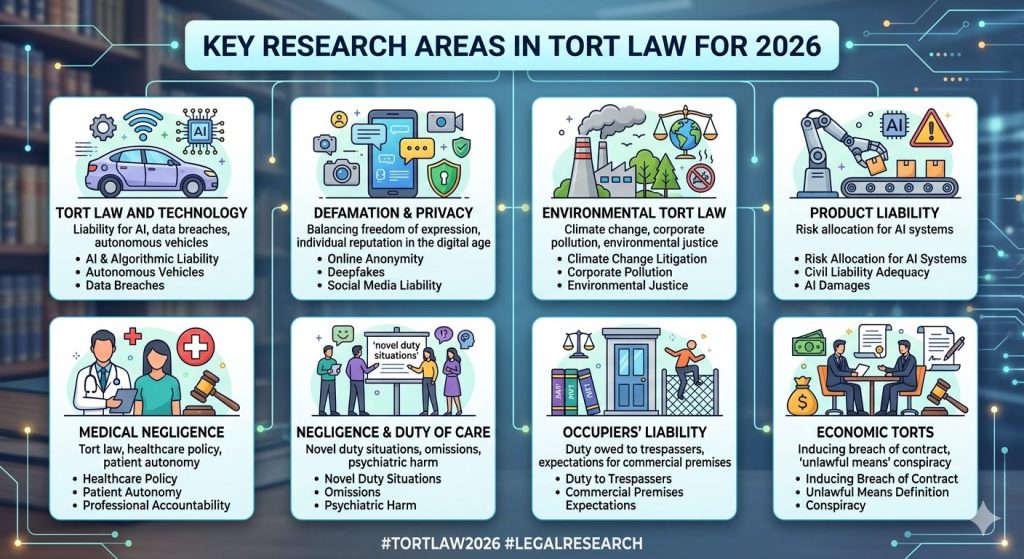
Before selecting a specific topic, it helps to understand the major research domains within tort law. Each of these areas contains ongoing academic debates, recent case law, and evolving statutory frameworks that make them suitable for original research.
Negligence and Duty of Care remains the most extensively litigated area of tort law, yet questions around novel duty situations, psychiatric harm, and omissions continue to generate significant academic attention.
Defamation and Privacy has transformed dramatically due to digital media, with courts and legislators struggling to balance freedom of expression against individual reputation and personal privacy rights.
Product Liability raises questions about the allocation of risk between manufacturers, retailers, and consumers, particularly as artificial intelligence and autonomous technology enter the market.
Occupiers’ Liability continues to evolve through case law, especially regarding the extent of duty owed to trespassers and the shifting expectations placed on occupiers of commercial premises.
Environmental Tort Law is gaining prominence as litigation around climate change, corporate pollution, and ecological harm grows both in frequency and legal complexity.
Medical Negligence intersects tort law with healthcare policy, patient autonomy, and professional accountability, offering rich territory for dissertation research.
Economic Torts including inducing breach of contract and unlawful means conspiracy are increasingly relevant in commercial and employment litigation.
Tort Law and Technology is one of the fastest-growing areas, raising questions about liability for algorithmic decision-making, data breaches, and autonomous vehicle accidents.
Five Example Dissertation Topics in Tort Law with Research Aims and Objectives
Understanding how a strong topic is structured academically will help you develop your own. Below are five examples, each with a research aim and two to three objectives.
Example 1: The Duty of Care for AI-Generated Harm in English Tort Law
Research Aim: To examine how the existing duty of care framework in English tort law applies to harms caused by artificial intelligence systems.
Objectives:
- To analyse the current legal tests for establishing a duty of care under English law
- To evaluate whether AI developers, deployers, or users should bear primary tortious liability
- To assess whether legislative reform is necessary to address gaps in the current framework
Example 2: Psychiatric Injury Claims and the Proximity Requirement in Negligence
Research Aim: To critically assess the legal and ethical justifications for imposing a proximity requirement on secondary victims claiming psychiatric injury.
Objectives:
- To trace the historical development of psychiatric injury claims in English tort law
- To examine whether the current distinction between primary and secondary victims remains defensible
- To propose reform options consistent with principles of fairness and legal coherence
Example 3: Corporate Liability for Environmental Harm Under English Tort Law
Research Aim: To evaluate the adequacy of private nuisance and the rule in Rylands v Fletcher as legal mechanisms for addressing corporate environmental harm.
Objectives:
- To examine the scope and limitations of private nuisance as applied to large-scale environmental damage
- To assess the declining relevance of the rule in Rylands v Fletcher in modern environmental litigation
- To consider whether a statutory environmental tort would better serve claimants
Example 4: Defamation Law and Social Media Platforms in the Post-Online Safety Act Era
Research Aim: To investigate how the Online Safety Act 2023 has altered the liability exposure of social media platforms under defamation law.
Objectives:
- To outline the pre-existing defamation liability framework for online intermediaries
- To analyse the key provisions of the Online Safety Act 2023 and their legal implications
- To assess whether the Act adequately balances platform accountability with freedom of expression
Example 5: The Standard of Care in Medical Negligence After Montgomery v Lanarkshire Health Board
Research Aim: To evaluate the impact of Montgomery v Lanarkshire Health Board [2015] on the standard of care applicable to medical professionals in consent-related negligence claims.
Objectives:
- To trace the development of informed consent doctrine from Bolam to Montgomery
- To analyse how courts have applied the Montgomery standard in subsequent decisions
- To assess whether the shift toward patient-centred consent has created greater legal uncertainty for clinicians
80 Tort Law Dissertation Topics for 2026
The following topics are organised by subfield. Each is designed to be narrow, researchable, and academically appropriate for undergraduate, master’s, or doctoral research. Students working on tort law dissertation topics at undergraduate level will find accessible entry points, while LLM and PhD candidates will find topics with sufficient theoretical depth.
Negligence and Duty of Care
- The expansion of duty of care to public authorities following Michael v Chief Constable of South Wales Police [2015]
- Omissions liability in English negligence law: is the current refusal to impose a general duty to act defensible?
- Psychiatric injury claims by emergency responders: should first responders receive a distinct legal framework?
- The three-stage Caparo test and its declining application in novel duty of care cases
- Negligence liability for pure economic loss caused by negligent misstatement in professional advice
- The rescuer doctrine in English tort law: current status and future direction
- Assumption of responsibility as an independent basis for duty of care in professional negligence claims
- The impact of PTSD recognition in modern medicine on secondary victim claims in negligence
- Duty of care owed by social media companies to users experiencing mental health harm
- Does the ‘fair, just and reasonable’ criterion introduce too much judicial discretion into negligence law?
Medical Negligence and Clinical Liability
- Applying the Montgomery standard of informed consent to surgical procedures involving significant aesthetic risk
- Causation difficulties in medical negligence: a critique of the material contribution to risk doctrine
- Clinical negligence liability for AI-assisted diagnostic errors in NHS settings
- The standard of care for junior doctors: should training status affect legal liability in medical negligence?
- Loss of chance in medical negligence claims: lessons from Gregg v Scott [2005]
- Patient autonomy and negligence liability in cases involving refusal of life-saving treatment
- Wrongful birth claims after Rees v Darlington Memorial Hospital NHS Trust [2003]: time for legislative intervention?
- Negligence liability for failures in mental health triage by NHS crisis teams
- The role of expert medical opinion in establishing breach of duty after Montgomery
- Telemedicine and remote consultations: how does negligence law adapt to digital healthcare delivery?
Defamation, Privacy, and Reputation
- The serious harm threshold under the Defamation Act 2013: judicial interpretation and practical impact
- Corporate defamation claims: should companies retain the right to sue for reputational damage?
- Defamation liability for algorithm-driven content amplification on social media platforms
- Misuse of private information as an emerging English tort: scope, development, and future
- The public interest defence in defamation: how effectively does section 4 of the Defamation Act 2013 protect investigative journalism?
- Online anonymity and the disclosure of defendant identity in defamation proceedings
- Reputation management through tort law: how adequate is the current framework for deepfake content?
- The interplay between defamation law and the right to privacy under Article 8 ECHR
- Harassment torts and their application to sustained online abuse campaigns
- Balancing data protection law and tort-based privacy claims after Lloyd v Google LLC [2021]
Product Liability and Consumer Protection
- Liability for defective AI-powered medical devices under the Consumer Protection Act 1987
- The development risks defence in product liability: is it still fit for purpose in the era of algorithmic products?
- Autonomous vehicles and the allocation of tortious liability between manufacturers, software developers, and users
- Post-Brexit divergence in product liability law: comparing UK and EU frameworks after 2024
- Product liability for addictive design in digital platforms and mobile applications
- Pharmaceutical product liability and the learned intermediary doctrine in English law
- Supply chain liability and the responsibility of retailers for defective third-party products
- The definition of ‘defect’ under the Consumer Protection Act 1987 in light of modern product complexity
- Liability for harm caused by smart home devices: a tort law analysis
- Vaccine liability and the inadequacy of the Vaccine Damage Payments Act 1979
Occupiers’ Liability and Premises Safety
- The duty owed to trespassers under the Occupiers’ Liability Act 1984: is the current standard coherent?
- Occupiers’ liability for criminal acts committed by third parties on commercial premises
- Liability for injuries sustained at temporary events and festivals: balancing occupier responsibility and visitor risk
- The impact of contributory negligence on occupiers’ liability claims by vulnerable claimants
- Occupiers’ liability and the regulation of escape rooms, adventure parks, and high-risk leisure facilities
- Virtual and augmented reality environments: does occupiers’ liability law apply to digital spaces?
- Responsibility of local authorities as occupiers of public parks and recreational land
- The distinction between visitors and trespassers in cases involving child claimants under the 1957 and 1984 Acts
- Liability for slipping and tripping accidents in retail environments: case law analysis and reform proposals
- Contractual exclusion of occupiers’ liability: the effectiveness of notice clauses after UCTA 1977
Environmental Tort Law
- Private nuisance as a vehicle for climate litigation: possibilities and limitations in English law
- The rule in Rylands v Fletcher after Cambridge Water Co v Eastern Counties Leather [1994]: is it obsolete?
- Corporate liability for transboundary environmental harm under English private law
- The public nuisance tort and its use in environmental pollution claims against industrial defendants
- Tort law remedies for long-latency environmental harm: problems of causation and limitation periods
- Locus standi in environmental nuisance claims: who can sue and why it matters
- Liability of water companies for sewage discharge under private nuisance and the rule in Rylands v Fletcher
- Environmental torts and the principle of intergenerational equity: a doctrinal analysis
- The adequacy of the statutory nuisance regime versus private law tort claims for residents affected by industrial sites
- Tortious liability for soil contamination: remediation costs, damages, and injunctions
Economic Torts and Commercial Disputes
- The tort of inducing breach of contract in the context of employment restrictive covenants
- Unlawful means conspiracy and its application to modern commercial litigation
- The economic tort of passing off and its evolving relevance in digital brand disputes
- Lawful act economic duress versus the tort of intimidation: how clear is the boundary?
- Tortious liability for negligent auditing: scope, causation, and limits on recovery for pure economic loss
- Liability of directors in tort for economic harm caused to third-party creditors during insolvency
- The tort of deceit in online marketplace fraud: causation, reliance, and remedies
- Trade union liability in economic tort law after the Trade Union Act 2016
- Interference with contractual relations by competitor businesses: the current state of the law
- The relationship between unfair competition and economic torts in English law
Tort Law and Emerging Technology
- Algorithmic decision-making and negligence liability: who is responsible when an AI causes harm?
- Data breach litigation as a developing area of the tort of misuse of private information
- Drone-related injuries and the application of the rule in Rylands v Fletcher to unmanned aerial vehicles
- Liability for harm caused by generative AI outputs: gaps in the current English tort framework
- The role of tort law in regulating facial recognition technology used by private sector actors
- Cyberbullying, online harassment, and the limits of existing English tort remedies
- Tortious liability for bias in automated employment screening tools
- Smart contract failures and tort law: what remedies exist when code causes financial harm?
- Negligence liability for cyber attacks facilitated by inadequate platform security
- The intersection of tort law and bioethics: liability for non-consensual genetic data use
How to Choose the Right Topic from This List
Browsing 80 tort law research proposal ideas can feel overwhelming. Here is a simple way to narrow it down.
Start by identifying which subfield interests you most. Then ask whether the topic connects to a recent case, statute, or social development that you already know something about. A topic you are genuinely curious about will sustain your motivation through months of research.
Next, consider your academic level. Undergraduate students should focus on topics that have a clear body of case law and academic commentary. LLM candidates can engage more deeply with doctrinal criticism and comparative analysis. PhD researchers should look for topics where the existing literature leaves genuine gaps.
Students pursuing topics in tort law for an LLM dissertation will benefit from choosing areas where English law is unsettled, where judicial reasoning is contested, or where legislative reform is actively being debated. These conditions create the conditions for original scholarly contribution.
If you remain unsure after working through this list, structured dissertation help from a qualified academic can help you align your interests with a topic that is both feasible and academically rigorous.
Conclusion
Tort law is one of the most dynamic and practically significant areas of legal study. Its principles shape how courts resolve disputes between individuals, corporations, and public bodies. For students, this breadth is both an opportunity and a challenge.
The 80 topics in this post represent directions where tort law is actively developing, where academic debate continues, and where original research remains possible. Whether you are preparing a tort law research proposal for your LLB, completing a master’s dissertation, or developing a PhD thesis, the most important step is choosing a topic that is focused, feasible, and academically meaningful.
Approach your dissertation with the same rigour you bring to legal analysis. Read widely, question assumptions, and stay connected to the case law and statutory developments shaping your chosen area. Your dissertation is not just an academic exercise; it is your contribution to a living legal conversation.
