


Property Law Dissertation Topics for 2026

Questions Students Are Asking About Property Law Dissertations
Students across academic forums and discussion platforms frequently raise questions like these when they begin their dissertation journey. These questions reflect real concerns gathered from undergraduate Facebook groups, Reddit threads, postgraduate WhatsApp communities, and university student forums.
- What is the best topic for a property law dissertation in 2026?
- How do I find a topic for my property law dissertation that is original and researchable?
- What is a perfect dissertation title in property law for a master’s student?
- Are there property law dissertation topics for undergraduate students in the UK that are manageable at that level?
- Which property law research paper ideas are relevant to today’s legal landscape?
- What property law thesis topics are suitable for PhD students who want to contribute to academic literature?
- How do I narrow a broad area like landlord and tenant law into a focused dissertation title?
- What emerging trends in property law should my 2026 dissertation reflect?
These are not unusual worries. Most students feel this way when they start. This post addresses every one of these questions with clarity and practical guidance.
Why Choosing the Right Property Law Dissertation Topic Matters
Selecting the right dissertation topic is one of the most consequential academic decisions a student will make. In property law, this choice shapes the depth of your legal analysis, the sources you engage with, and the contribution your work makes to the field.
Property law sits at the intersection of constitutional principles, human rights obligations, economic policy, and social justice. A well-chosen topic allows you to demonstrate legal reasoning, engage with statute and case law, and situate your argument within broader debates about land ownership, housing access, and rights enforcement.
A vague or overly broad topic leads to unfocused research. A topic that is too narrow may leave you with insufficient material to sustain a full dissertation. The sweet spot is a focused, arguable, and researchable question that fits your academic level.
Students seeking online dissertation help often discover too late that their original topic was either too ambitious or already extensively covered. Choosing carefully from the outset saves considerable time and academic stress.
Download Property Law Dissertation Topics PDF
Many students find it helpful to have a curated resource they can refer to throughout their research planning. After completing a short form, students can receive a downloadable PDF containing a personalised list of property law dissertation topics, selected by academic experts according to the student’s level, research interest, and institutional requirements. This resource is designed to support students who want structured, expert-guided topic suggestions rather than browsing general lists alone.
Key Research Areas in Property Law for 2026
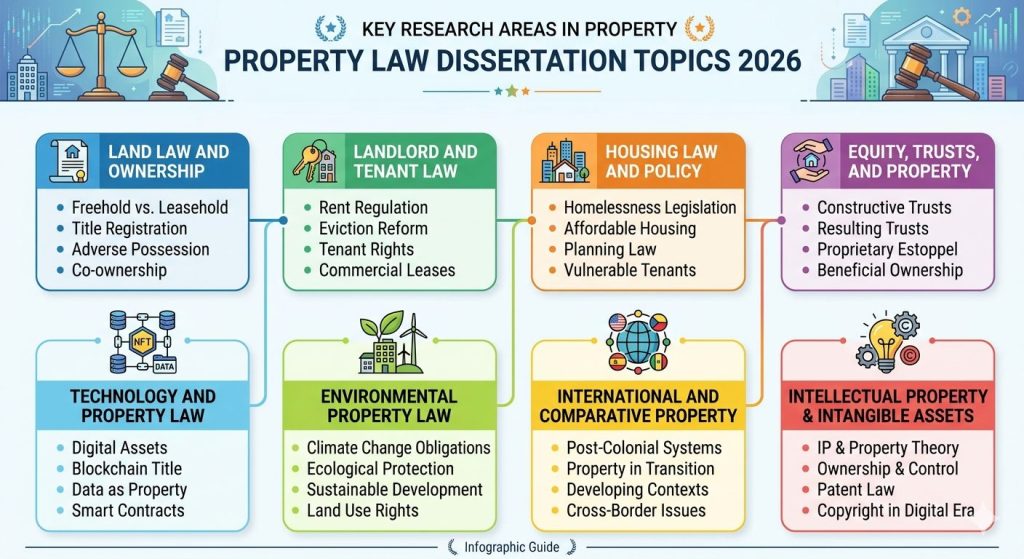
Before selecting a topic, it helps to understand the main subfields within property law. Each area carries active debates, recent legislative changes, and gaps in academic literature that make strong research questions possible.
Land Law and Ownership
This area covers freehold and leasehold estates, adverse possession, title registration, and the legal status of co-owned land. It remains foundational to any property law curriculum.
Landlord and Tenant Law
Residential and commercial tenancy law has evolved considerably. Rent regulation, eviction reform, and tenant rights have moved to the centre of policy discussions globally.
Housing Law and Policy
This area bridges law and social policy. It includes homelessness legislation, affordable housing obligations, planning law, and the rights of vulnerable tenants.
Intellectual Property and Intangible Assets
While traditionally distinct from land law, intellectual property intersects with property theory in debates about ownership, control, and alienability of intangible things.
Environmental Property Law
This growing area addresses how land use rights interact with environmental obligations, climate change legislation, and ecological protection duties.
International and Comparative Property Law
Comparative research explores how different legal systems protect or restrict property rights, particularly in post-colonial, transitional, and developing contexts.
Equity, Trusts, and Property
Constructive trusts, resulting trusts, and proprietary estoppel raise complex questions about beneficial ownership, particularly in domestic and commercial relationships.
Technology and Property Law
Digital assets, blockchain title registration, and data as property are emerging concerns that are beginning to attract serious academic attention.
Five Example Dissertation Topics with Aims and Objectives
Example 1: Leasehold Reform in England and Wales
Research Aim: To critically evaluate the effectiveness of the Leasehold and Freehold Reform Act 2024 in addressing long-standing inequities in the English leasehold system.
Objectives:
- To analyse the historical development of leasehold tenure and the grievances that prompted legislative reform.
- To assess the extent to which the 2024 Act addresses ground rent abuse, lease extension costs, and service charge transparency.
- To evaluate whether further statutory reform is necessary to achieve substantive leasehold abolition.
Example 2: Adverse Possession and Human Rights Compatibility
Research Aim: To examine whether the adverse possession regime under the Land Registration Act 2002 is compatible with Article 1 Protocol 1 of the European Convention on Human Rights.
Objectives:
- To trace the development of adverse possession doctrine from common law to statutory reform.
- To analyse the proportionality of extinguishing a paper owner’s title through adverse possession.
- To compare the English approach with adverse possession regimes in other jurisdictions.
Example 3: Constructive Trusts and Cohabiting Couples
Research Aim: To assess whether the common intention constructive trust adequately protects the property rights of unmarried cohabitants upon relationship breakdown.
Objectives:
- To review the development of constructive trust doctrine in the context of shared homes.
- To evaluate the impact of key cases on the position of cohabitants without express agreements.
- To consider whether statutory reform along the lines of the Law Commission’s 2007 proposals would produce fairer outcomes.
Example 4: Planning Law and Affordable Housing Obligations
Research Aim: To critically assess the effectiveness of Section 106 agreements as a mechanism for delivering affordable housing in England.
Objectives:
- To examine the legal and policy framework governing planning obligations and affordable housing requirements.
- To evaluate the extent to which viability assessments undermine affordable housing delivery.
- To consider whether alternative mechanisms, such as a community infrastructure levy, would produce better outcomes.
Example 5: Blockchain Technology and Land Registration
Research Aim: To explore the legal implications of using blockchain technology for land title registration in the United Kingdom.
Objectives:
- To explain how distributed ledger technology operates and how it differs from existing Land Registry systems.
- To identify the legal challenges of treating a blockchain record as conclusive title.
- To assess whether existing property law frameworks require statutory amendment to accommodate blockchain registration.
80 Property Law Dissertation Topics for 2026
The topics below are organised by subfield. They are designed to be narrow, original, and suitable for undergraduate, master’s, or PhD-level research proposals. Use them as starting points and refine them to fit your specific institution’s requirements.
Land Law and Ownership
- The doctrine of adverse possession under the Land Registration Act 2002: a proportionate interference with property rights?
- The legal treatment of flying freeholds in English law: an outdated framework in need of reform?
- Overriding interests and the risk they pose to registered title: an analysis of Schedule 3 of the Land Registration Act 2002.
- The presumption of resulting trust in joint legal ownership: does Stack v Dowden remain fit for purpose?
- Electronic conveyancing and the future of paper title deeds: a critical assessment of HM Land Registry’s digital ambitions.
- Co-ownership disputes under the Trusts of Land and Appointment of Trustees Act 1996: how effectively does the court balance competing interests?
- The enforceability of positive covenants in English land law: why the current position is commercially unsatisfactory.
- Easements by prescription and the doctrine of lost modern grant: is this legal fiction justified in twenty-first century land law?
- Proprietary estoppel as a mechanism for protecting informal property expectations: coherence or contradiction?
- The impact of the Law Commission’s 2023 consultation on modernising the land registration framework.
Landlord and Tenant Law
- The Renters (Reform) Bill and the abolition of Section 21 no-fault evictions: will tenants actually be better protected?
- Rent control legislation in Scotland under the Housing (Scotland) Act 2022: a model for England and Wales?
- The legal position of tenants in the private rented sector during public health emergencies: lessons from COVID-19.
- Service charge transparency and leaseholder rights: a critical analysis of the Leasehold and Freehold Reform Act 2024.
- The fitness for human habitation standard under the Homes (Fitness for Human Habitation) Act 2018: an effective remedy for tenants?
- Retaliatory eviction and tenant enforcement rights: how adequate is the current legal framework?
- Commercial lease renegotiation during economic downturns: the limits of contractual hardship doctrine.
- The regulation of short-term lets through platforms such as Airbnb: property law implications for local communities.
- Rent arrears and the proportionality of possession proceedings against social housing tenants in England.
- Ground rent reform under the Leasehold Reform (Ground Rent) Act 2022: a landmark reform or a missed opportunity?
Housing Law and Social Policy
- The right to a safe home: does English housing law adequately reflect obligations under the UN Committee on Economic, Social and Cultural Rights?
- Overcrowding standards in the private rented sector: are legal definitions still fit for purpose?
- The duty to accommodate homeless persons under Part VII of the Housing Act 1996: how effectively is it enforced?
- Intentional homelessness and the fairness of the local authority duty to inquire.
- Allocations policy and equality law: do social housing schemes comply with the Equality Act 2010?
- Supported housing and the regulatory gap: how does the law protect residents in care-related housing?
- Planning obligations and affordable housing contributions: the role of viability assessments in undermining policy targets.
- The right to buy and its impact on social housing stock in England: a property law perspective.
- Temporary accommodation and the human rights of homeless families: an analysis of local authority obligations.
- Property law and the gig economy: how does the legal concept of home apply to mobile workers?
Environmental Property Law
- Statutory nuisance and the duty to remedy environmental harm on land: an adequate mechanism for protecting communities?
- Flood risk and landowner liability: does English property law provide sufficient protection for riparian landowners?
- The legal treatment of rewilding projects under English planning and property law frameworks.
- Green belt land and development pressure: how do property rights and planning restrictions interact?
- Carbon credits and land rights: can landowners encumber land to support net zero commitments?
- Compulsory purchase and environmental regeneration: is there an adequate framework for acquiring contaminated land?
- Biodiversity net gain obligations under the Environment Act 2021: implications for landowners and developers.
- The legal status of trees and hedgerows on private land: protection, liability, and removal rights.
- Noise pollution from development sites and the adequacy of existing property law remedies.
- Water rights and riparian ownership in England: is the framework coherent in the context of climate change?
Equity, Trusts, and Property
- The common intention constructive trust after Kernott v Jones: has the Supreme Court created more uncertainty than it resolved?
- Resulting trusts and the presumption of advancement: should the presumption be abolished?
- Proprietary estoppel and unconscionability: is the doctrine sufficiently principled as a property remedy?
- Secret trusts and the policy of allowing intention to override formality: a justified exception?
- The Rochefoucauld v Boustead principle and oral trusts of land: how far does equity extend beyond statutory formality?
- Equitable accounting between co-owners of land: is the current approach fair and consistent?
- Beneficial interests under bare trusts and the practical problems for third-party creditors.
- The enforceability of family property arrangements outside the formal legal framework.
- Discretionary trusts over land and the rights of beneficiaries: effectiveness under the TOLATA 1996 regime.
- The role of conscience in constructive trust doctrine: can a subjective concept support predictable outcomes?
Intellectual Property and Intangible Property
- Data as property: can personal data be treated as intangible property under English law?
- Intellectual property rights and digital inheritance: does the law address digital assets on death adequately?
- Non-fungible tokens as property: how do NFTs fit within legal categories of personal property?
- The property status of software licences: owned, rented, or something else entirely?
- Domain names and trademark rights: analysis of the UDRP and its relationship with property law.
- Protection of trade secrets as intangible property in a post-Brexit framework.
- Confidential information and property: can breach of confidence function as a property right?
- Cryptocurrency and the definition of property under English law: lessons from Bitcoin.
- Artificial intelligence-generated works and copyright ownership: who owns machine-created outputs?
- The property dimensions of plant variety rights under the Plant Varieties Act 1997.
International and Comparative Property Law
- Land reform and property rights in post-apartheid South Africa: a constitutional assessment.
- Indigenous land rights in Australia and the legacy of Mabo v Queensland.
- Expropriation and compensation under the European Convention on Human Rights: consistency in Strasbourg jurisprudence.
- Forced displacement and property rights in international humanitarian law.
- Restitution of property confiscated under Nazi rule: a comparative European analysis.
- Land titling programmes in developing economies: evidence from sub-Saharan Africa.
- Compulsory acquisition law in Commonwealth jurisdictions: a comparison of compensation standards.
- Gender and land rights in South Asia: protection of women’s inheritance rights in India.
- Foreign investment and property rights restrictions in the UK: national security and land ownership.
- Property rights in post-conflict reconstruction: lessons from Kosovo, Bosnia, and Iraq.
Technology, Digital Assets, and Property Law
- Blockchain land registries and indefeasibility: does distributed ledger technology strengthen title?
- Smart contracts and conveyancing: can automation replace traditional property transfers?
- Digital twins of real property: who owns virtual representations of physical buildings?
- Aerial drones and property rights: implications for airspace ownership.
- Autonomous vehicles and property rights in public and private roads.
- The Internet of Things in residential property: privacy obligations and landlord liability.
- Digital mortgage platforms and consumer protection in automated lending.
- Virtual property in the metaverse: do legal frameworks offer meaningful protection?
- Artificial intelligence in property valuation: liability and legal implications for mortgage lending.
- Satellite data and remote sensing imagery over private land: property law implications.
How to Choose the Right Property Law Dissertation Topic for Your Level
Topic selection should reflect your academic level. Undergraduate dissertations typically require a focused doctrinal analysis of a specific legal issue. The research should demonstrate your ability to identify a legal problem, analyse primary and secondary sources, and reach a reasoned conclusion.
Master’s dissertations, including LLM and MA programmes, demand a higher degree of critical engagement. Property law research paper ideas for MSc students should reflect current debates in legal scholarship, engage with comparative materials where appropriate, and situate the argument within broader theoretical frameworks.
PhD dissertations must make an original contribution to knowledge. Property law thesis topics for PhD students should address genuine gaps in academic literature, develop a sustained theoretical argument, and engage with interdisciplinary methods where relevant.
If you are still unsure where to begin, seeking online dissertation help from subject-specialist tutors or academic writing services can help you move from a general interest in property law to a well-defined, academically sound research question.
Conclusion
Property law is one of the most dynamic and socially significant areas of legal study. In 2026, students have access to a rich landscape of research opportunities, from leasehold reform and tenant rights to blockchain title registration and international land justice.
Choosing a dissertation topic is not simply a procedural step. It is an expression of intellectual curiosity, academic ambition, and scholarly responsibility. The strongest topics emerge when students engage honestly with the literature, identify genuine gaps or debates, and commit to a question they genuinely want to answer.
Whether you are working on property law dissertation topics for undergraduate students in the UK or developing a doctoral research proposal, the principles remain the same: be specific, be original, and be grounded in the law as it actually stands.
The 80 topics in this post are designed to give you a strong starting point. Use them as inspiration, adapt them to your academic context, and discuss them with your supervisor before committing to a final research question. A well-chosen topic, combined with disciplined research and careful argumentation, is the foundation of every successful property law dissertation.
