


Maritime Law Dissertation Topics for 2026

Questions Students Are Asking About Maritime Law Dissertations
The questions below come from student forums, academic discussion boards, and law school communities. They reflect how real students think when choosing a dissertation topic in maritime law.
- How do I pick a maritime law dissertation topic that is both original and academically strong?
- What are the best dissertation topics in maritime law for an LLB student in 2026?
- Can I find a maritime law dissertation topics PDF with ready-made topic ideas?
- What research areas in maritime law are supervisors currently interested in?
- How is a dissertation topic in maritime law different from a general research essay?
- What research proposal topics are suitable for an LLM in international maritime law?
- Are there research paper topics in maritime law for PhD students focused on emerging legal issues?
- Which maritime law dissertation topics 2025 are still relevant going into 2026?
These questions appear repeatedly, and this post is designed to answer them in a structured and academically responsible way.
Why the Right Maritime Law Dissertation Topic Matters
Choosing a dissertation topic in maritime law is not simply an administrative step. It shapes the entire direction of your research, influences your methodology, and determines how your work contributes to legal scholarship. Maritime law sits at the intersection of international trade, environmental regulation, human rights, and commercial practice. A topic that is too broad will result in superficial analysis. A topic that lacks current relevance may fail to engage your academic committee or contribute meaningfully to the field.
For undergraduate students, the challenge is narrowing a vast legal area into something manageable. For those pursuing an LLM in international maritime law, supervisors expect theoretical depth and comparative legal analysis. For PhD researchers, the expectation is an original contribution that advances scholarly debate. Understanding this distinction early helps you avoid common pitfalls, such as choosing a topic that has been over-researched or that lacks sufficient academic sources.
Students who invest time in selecting a well-framed maritime law dissertation topic tend to produce stronger proposals, clearer research questions, and more coherent final dissertations. If you are feeling uncertain, you are not alone. Many students benefit from structured guidance or online dissertation help at this early stage to ensure their topic is both viable and intellectually rewarding.
Download Maritime Law Dissertation Topics PDF
For students who want a personalised and curated list of maritime law dissertation topics, a downloadable PDF is available. This resource is prepared by experienced academic professionals who understand the standards required at undergraduate, LLM, and PhD levels. The PDF is sent to students after they complete a short form requesting basic details about their academic level and research interests. The form helps academic experts tailor the topic list to your specific needs, ensuring the suggestions are relevant, current, and supervisor-approved in quality.
Key Research Areas in Maritime Law for 2026
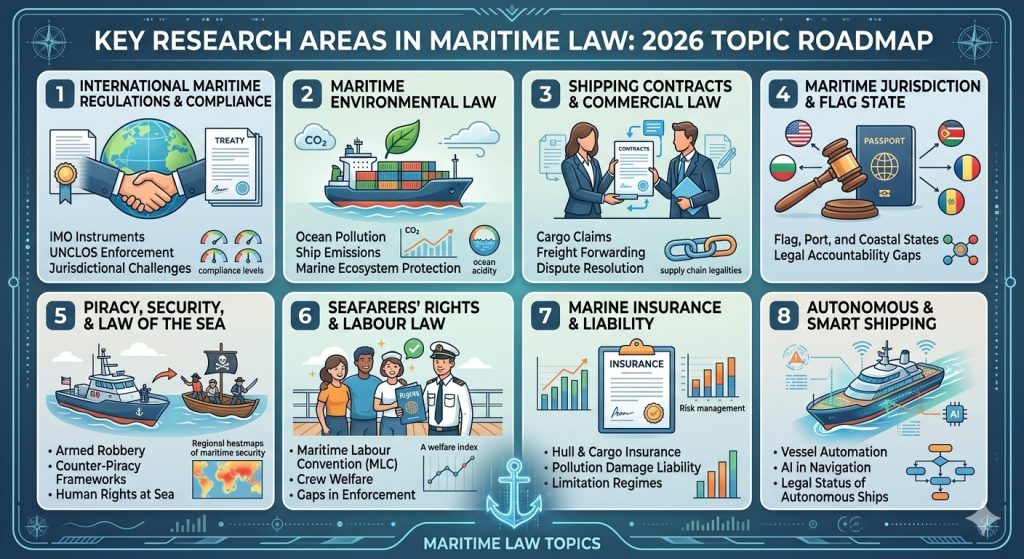
Before selecting a topic, it helps to understand the major domains within maritime law. These areas represent where most dissertation research currently takes place, and they reflect the legal, regulatory, and commercial realities of the global shipping industry.
International Maritime Regulations and Compliance This area examines how international conventions such as the UN Convention on the Law of the Sea (UNCLOS) and the International Maritime Organisation (IMO) instruments are implemented, enforced, and challenged across jurisdictions.
Maritime Environmental Law Given growing concerns about ocean pollution, ship emissions, and marine ecosystem protection, this area is receiving considerable attention from both academics and regulators.
Shipping Contracts and Commercial Maritime Law This includes charterparties, bills of lading, cargo claims, freight forwarding agreements, and the resolution of commercial disputes in international shipping.
Maritime Jurisdiction and Flag State Responsibilities Research here explores how jurisdiction is allocated between flag states, port states, and coastal states, and where legal gaps create accountability problems.
Piracy, Security, and the Law of the Sea This area analyses armed robbery at sea, the legal frameworks for counter-piracy operations, and the human rights implications of maritime security enforcement.
Seafarers’ Rights and Labour Law at Sea The Maritime Labour Convention 2006 and related instruments protect seafarers. Research in this area often examines gaps in enforcement and crew welfare in practice.
Marine Insurance and Liability Legal issues around hull insurance, cargo insurance, liability for environmental damage, and limitation of liability regimes form the core of this research area.
Autonomous and Smart Shipping Emerging legal questions around vessel automation, artificial intelligence in navigation, and the legal status of autonomous ships are attracting increasing scholarly interest.
Five Example Dissertation Topics with Research Aims and Objectives
Understanding how a well-structured dissertation topic looks in practice can make a significant difference when you are developing your own proposal.
Example 1: Flag State Jurisdiction and Accountability Gaps in International Shipping
Research Aim: To evaluate whether the current flag state system adequately ensures legal accountability for maritime violations in international waters.
Research Objectives:
- To analyse the legal obligations of flag states under UNCLOS and IMO conventions
- To identify documented cases where flag state enforcement has failed
- To propose reforms to strengthen accountability without undermining flag state sovereignty
Example 2: The Legal Treatment of Seafarer Mental Health Under the Maritime Labour Convention 2006
Research Aim: To examine whether existing maritime labour law adequately protects the mental health of seafarers during extended periods at sea.
Research Objectives:
- To assess the scope of seafarer welfare provisions under MLC 2006
- To evaluate how port state control inspections address mental health risks
- To compare national implementation practices across three major flag states
Example 3: Carbon Emissions Regulation and Shipping: Legal Challenges of IMO’s 2050 Strategy
Research Aim: To critically assess the legal enforceability of the IMO’s 2050 greenhouse gas reduction strategy within the framework of international environmental law.
Research Objectives:
- To outline the legal structure of IMO’s 2050 GHG strategy and its binding instruments
- To examine the tension between environmental targets and freedom of navigation principles
- To evaluate the role of regional schemes such as the EU Emissions Trading System in supplementing IMO rules
Example 4: Liability for Cargo Loss Caused by Autonomous Vessel Navigation
Research Aim: To determine how existing maritime liability frameworks apply when cargo damage occurs due to decisions made by autonomous navigation systems.
Research Objectives:
- To review the current liability regime under the Hague-Visby Rules and Rotterdam Rules
- To identify the legal gaps created by AI-driven navigation decisions
- To propose a framework for attributing liability in autonomous shipping incidents
Example 5: Piracy and Human Rights: Legal Obligations During Counter-Piracy Operations
Research Aim: To assess whether naval forces conducting counter-piracy operations in the Horn of Africa comply with international human rights obligations.
Research Objectives:
- To identify the applicable international human rights instruments during maritime interdictions
- To evaluate case law and international tribunal decisions related to piracy detention
- To recommend minimum legal standards for the treatment of suspected pirates at sea
80 Maritime Law Dissertation Topics for 2026
The following topics are organised by subfield. Each one is narrow, original, and suitable for undergraduate, master’s, or PhD research in 2026. Students seeking further guidance may also benefit from structured online dissertation help when developing these ideas into formal research proposals.
Flag State Jurisdiction and Port State Control
- The effectiveness of port state control in enforcing MARPOL violations: a comparative study of Paris MOU and Tokyo MOU
- Flag state discretion and selective enforcement: how open registries undermine maritime compliance
- Legal obligations of flag states when ships are stateless or operate under disputed flags
- Port state jurisdiction over foreign-flagged vessels involved in crew abandonment cases
- The role of classification societies in flag state oversight and their legal accountability
- Dual registries and bareboat chartering: legal complications for flag state responsibility
- How port state inspections address cyber security vulnerabilities in commercial shipping
- Flag state sovereignty versus environmental enforcement: where UNCLOS draws the line
- The legal effect of IMO Resolution A.1070(28) on port state control inspection frameworks
- Accountability of open registries: an analysis of Panama, Liberia, and the Marshall Islands
Maritime Environmental Law
- The legal adequacy of MARPOL Annex VI in addressing sulphur emissions from international shipping
- Ballast water management and the Ballast Water Management Convention: enforcement gaps across port states
- Arctic shipping routes and the Polar Code: legal obligations for vessel operators in ice-covered waters
- Liability for underwater noise pollution caused by commercial shipping under international law
- The legal framework for the removal of ghost fishing gear under international maritime law
- Climate litigation and shipping companies: whether private actors can be held liable for maritime GHG contributions
- Legal gaps in addressing microplastic pollution from shipping operations under MARPOL
- The role of the International Tribunal for the Law of the Sea in enforcing marine environmental protections
- Ship recycling and the Hong Kong Convention: legal barriers to ratification and enforcement
- Compensation for marine environmental damage caused by sunken wrecks under the Nairobi Wreck Removal Convention
Shipping Contracts and Commercial Maritime Law
- Force majeure clauses in charterparties: legal interpretation post-pandemic and in the context of climate disruptions
- The legal effect of electronic bills of lading on cargo claims under the Hague-Visby Rules
- Demurrage disputes and time bar clauses: a comparative analysis of English and US maritime law
- Deviation clauses in voyage charterparties and their impact on carrier liability
- Legal risks in freight forwarding contracts when multiple transport modes cross different legal regimes
- The enforceability of exclusion clauses in maritime contracts of carriage under English law
- Dead freight claims: legal standards for proving a charterer’s failure to supply agreed cargo
- Safe port warranties in time charterparties: recent judicial interpretations and commercial implications
- The legal position of slot charter agreements within the existing framework of maritime transport law
- Consequential loss claims in commercial shipping: the boundaries of recoverable damages under English law
Marine Insurance and Limitation of Liability
- The legal interpretation of “perils of the sea” under the Institute Cargo Clauses and its evolution in recent case law
- Hull and machinery insurance disputes arising from autonomous vessel incidents: who bears the risk?
- Limitation of shipowner liability under the 1976 LLMC Convention and whether current caps remain adequate
- Legal challenges in marine cargo insurance when artificial intelligence systems make loading decisions
- The duty of disclosure in marine insurance after the Insurance Act 2015: impact on commercial shipping policies
- War risks clauses in marine insurance and their application during geopolitical conflicts affecting shipping lanes
- Protection and indemnity club rules on crew liability: legal adequacy in cases of mass crew abandonment
- Legal treatment of constructive total loss in the context of damaged autonomous vessels
- The role of the Salvage Convention 1989 in determining salvage awards for environmentally sensitive operations
- Cyber risk exclusions in marine insurance policies and the adequacy of current market clauses
Seafarers’ Rights and Maritime Labour Law
- Repatriation rights under the Maritime Labour Convention 2006: gaps in enforcement and state practice
- The legal rights of seafarers in cases of unlawful detention by foreign port authorities
- Minimum wage standards for seafarers: legal analysis of MLC 2006 provisions and national implementation
- The right to medical care at sea: how MLC 2006 compares to international human rights standards
- Seafarer abandonment and financial security requirements: legal obligations of shipowners and flag states
- Collective bargaining agreements in international shipping: enforceability across multiple jurisdictions
- Legal protections for seafarers who report environmental violations under whistleblower frameworks
- Mental health and duty of care for seafarers: how current maritime law fails to address psychological wellbeing
- The legal status of seafarers during criminalisation: how port states prosecute crew members following incidents
- Recruitment and placement agency regulation under MLC 2006: accountability gaps and reform proposals
Piracy, Maritime Security, and the Law of the Sea
- The legal definition of piracy under Article 101 of UNCLOS and its practical limitations in modern incidents
- Private maritime security companies and the use of lethal force: legal accountability under international law
- Human rights compliance during naval counter-piracy operations in the Gulf of Aden
- The legal treatment of Somali pirate suspects transferred to third-party states for prosecution
- Maritime terrorism versus piracy: how different legal frameworks apply and where they overlap
- The right of hot pursuit under UNCLOS and its application to drug trafficking interdictions at sea
- Legal gaps in addressing piracy in the Gulf of Guinea under existing regional and international frameworks
- Flags of convenience and their relationship to piracy vulnerability in high-risk shipping areas
- Maritime security zones and their legality under international law: lessons from contested exclusive economic zones
- The legal framework for protecting ships and crew from non-state armed groups operating in territorial waters
Autonomous and Smart Shipping Law
- Legal personhood and autonomous vessels: whether unmanned ships can be parties to contracts of carriage
- Allocation of navigational liability when an AI system causes a collision at sea
- The Collision Regulations (COLREGS) and autonomous ships: are current rules adequate for machine-driven navigation?
- Cybersecurity obligations of shipowners under international maritime law and IMO Resolution MSC-FAL.1/Circ.3
- Data ownership and privacy rights in smart shipping: legal challenges of continuous vessel monitoring
- Remote-controlled vessels and the legal qualification of “master” under existing maritime conventions
- The application of general average principles to incidents involving autonomous vessel decision-making
- Legal treatment of software malfunctions as a cause of cargo damage under current liability regimes
- IMO’s regulatory framework for maritime autonomous surface ships: legal gaps and future reform priorities
- Satellite communication systems in shipping and the legal obligations arising from cybersecurity failures
International Trade, Sanctions, and Shipping Law
- The legal effect of unilateral economic sanctions on charterparty performance obligations
- Dark fleet shipping and the evasion of international sanctions: legal mechanisms for enforcement
- Trade sanctions on Russian oil and the legal implications for tanker operators and insurers
- The legal relationship between OFAC sanctions compliance and P&I club cover for affected voyages
- Port state refusal of access based on political sanctions: legal justification under international law
- The role of letters of credit in maritime trade and the legal risks of documentary fraud
- Legal obligations of shipping companies when cargo is linked to sanctioned entities but ownership is unclear
- Trade route disruptions caused by geopolitical conflict: legal remedies available to cargo owners and charterers
- The lawfulness of secondary sanctions applied to non-US shipping companies under international trade law
- Legal challenges of conducting due diligence on beneficial ownership in multi-flag shipping groups
Conclusion
Selecting the right maritime law dissertation topic is one of the most consequential decisions you will make during your academic programme. The field is rich, evolving rapidly, and full of legal questions that have not yet been fully answered. Whether you are writing a thesis on environmental regulations, seafarers’ rights, autonomous shipping, or international trade sanctions, what matters most is choosing a topic that is specific, researchable, and genuinely connected to current legal debates.
This post has offered a structured overview of research areas, five detailed topic examples with aims and objectives, and 80 original topics suitable for 2026 research. The intention is not to make the decision for you, but to equip you with the knowledge and vocabulary to make it confidently.
Approach your dissertation with academic integrity, a clear research question, and a realistic methodology. Work closely with your supervisor, engage with primary legal sources, and allow your interest in the subject to guide your choice. A well-chosen topic gives you the academic foundation to produce research that is both credible and genuinely worthwhile.
