


Labor Law Dissertation Topics for 2026

Questions Students Are Asking (From Forums and Academic Discussion Platforms)
Students across university forums and academic communities frequently share their concerns about choosing a dissertation topic in labour law. The following questions reflect the real worries and genuine curiosity of students at different levels of study:
- How do I choose a labour law dissertation topic that is relevant and achievable?
- What are the best dissertation topics in labor law for LLB students in the UK?
- Which labor law research paper topics are suitable for postgraduate research?
- How do I find thesis topics in labor law for PhD candidates that are original enough?
- Are there research proposal ideas for labor law for LLM students focused on 2026 trends?
- What labor law project topics for BPTC students are academically appropriate?
- How narrow should my labour law dissertation topic be?
- Can I find a labor law dissertation topics PDF with expert-curated suggestions?
If any of these questions sound familiar, this post was written with you in mind.
Introduction: Why Your Choice of Dissertation Topic in Labour Law Matters
Choosing the right dissertation topic is one of the most important academic decisions a law student will make. In labour law, this decision carries particular weight. The field sits at the intersection of social justice, economic policy, and legal doctrine. It evolves quickly in response to political shifts, court decisions, and global changes in how people work.
A poorly chosen topic can lead to a dissertation that lacks focus, originality, or academic contribution. A well-chosen topic, on the other hand, gives you a clear research direction, helps you engage with credible sources, and makes your work stand out to examiners and future employers alike.
This post is designed to take the pressure off that decision. Whether you are completing an LLB, an LLM, or a PhD, you will find structured guidance, academic topic examples, and a comprehensive list of 80 original labour law dissertation topics relevant to the academic expectations of 2026.
Download Labour Law Dissertation Topics PDF
Many students find it helpful to have a curated list of dissertation topics they can review offline, share with supervisors, or annotate as they narrow down their focus. A downloadable PDF containing a personalised selection of labour law dissertation topics, compiled by academic experts, is available for students who complete a short form. The topics in the PDF are matched to academic level and research interest, making it easier to begin the proposal stage with confidence
Why Choosing the Right Dissertation Topic in Labour Law Matters
Labour law is not a static field. It responds to economic pressure, political reform, and technological disruption in real time. A dissertation topic that was groundbreaking five years ago may already be well-covered in the literature. Equally, a topic that sounds broad or obvious may fail to meet the academic expectations of your university’s research committee.
At the undergraduate level, examiners look for clarity, structure, and a demonstrated understanding of legal principles. At master’s level, they expect critical analysis and a clear gap in the existing literature. PhD candidates must demonstrate original contribution to knowledge, which requires even greater precision in topic selection.
When you choose a topic that is too wide, your dissertation risks becoming a summary rather than a piece of research. When you choose a topic that is too narrow without sufficient academic literature, you may struggle to build a convincing argument. The ideal dissertation topic sits in the middle: focused enough to be manageable, broad enough to be meaningful.
If you are feeling unsure about where to begin, seeking online dissertation help from an academic support service early in your studies can give you a clearer sense of what is expected at your level.
Key Research Areas in Labour Law for 2026
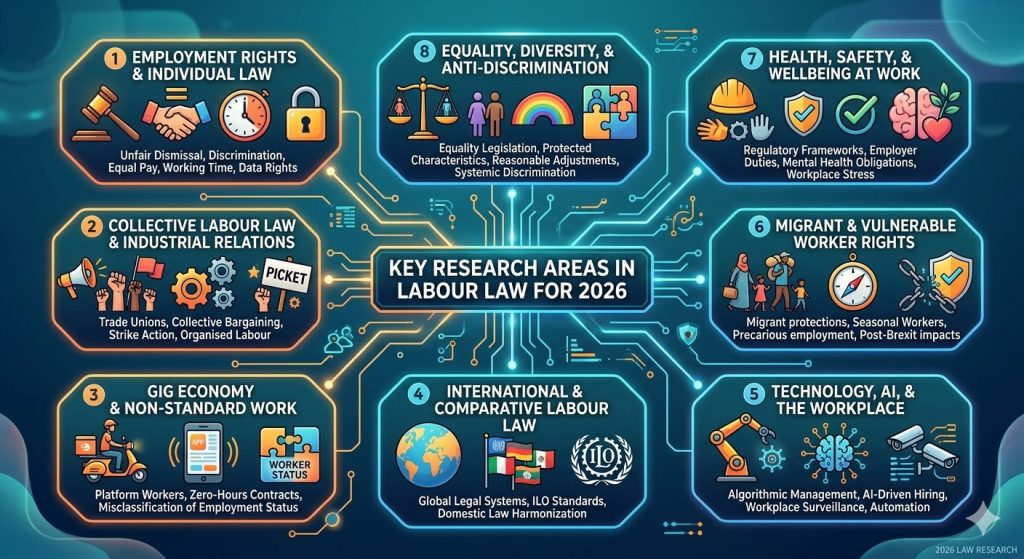
Before exploring individual dissertation topics, it helps to understand the main subfields and academic domains within labour law where research is currently active. These areas are grounded in established legal scholarship and reflect the directions that courts, legislatures, and international bodies are currently moving in.
Employment Rights and Individual Labour Law This area covers the legal relationship between individual workers and employers. It includes unfair dismissal, discrimination, equal pay, working time, and employee data rights.
Collective Labour Law and Industrial Relations Research in this area examines trade unions, collective bargaining, strike action, and the legal frameworks that govern organised labour.
Gig Economy and Non-Standard Work This is one of the fastest-growing areas of legal research. It explores how existing law applies to platform workers, zero-hours contracts, and the misclassification of employment status.
International and Comparative Labour Law This area looks at how different legal systems approach labour rights, and how international bodies such as the International Labour Organisation shape domestic law.
Technology, Artificial Intelligence, and the Workplace Research in this area examines algorithmic management, AI-driven hiring, workplace surveillance, and the legal implications of automation.
Migrant and Vulnerable Worker Rights This area focuses on the legal protections available to migrant workers, seasonal workers, and those in precarious employment, including how those protections have changed post-Brexit.
Health, Safety, and Wellbeing at Work Legal research here covers regulatory frameworks, employer duties, mental health obligations, and the evolving law on workplace stress.
Equality, Diversity, and Anti-Discrimination Law This area examines how equality legislation operates in practice, including protected characteristics, reasonable adjustments, and systemic discrimination.
Five Example Dissertation Topics with Research Aims and Objectives
The following examples show how a strong dissertation topic is structured academically. Each includes a clear research aim and two to three focused research objectives.
Example 1 – Gig Economy and Worker Classification
Topic: The Legal Status of Platform Workers in the UK: A Critical Examination of Worker Classification Post-Uber BV v Aslam
Research Aim: To critically analyse the legal status of gig economy workers in the UK following the Supreme Court ruling in Uber BV v Aslam [2021] and assess whether current employment law provides adequate protection.
Research Objectives:
- To examine the three-tier classification system under the Employment Rights Act 1996 and its application to platform workers.
- To evaluate the adequacy of the Uber judgment in resolving classification ambiguity for app-based workers.
- To identify legislative reform proposals that could provide greater clarity and worker protection.
Example 2 – Algorithmic Management and Employment Rights
Topic: Algorithmic Management and the Right to Explanation: Legal Gaps in UK Employment Law
Research Aim: To investigate the extent to which existing UK employment law addresses employer use of algorithmic management systems and whether workers have adequate rights to transparency.
Research Objectives:
- To define algorithmic management and identify its common applications in UK workplaces.
- To assess the intersection of data protection law and employment law in the context of automated decision-making.
- To recommend how the law should be developed to protect workers from opaque algorithmic practices.
Example 3 – Collective Bargaining in the Post-Brexit Era
Topic: Trade Union Rights and Collective Bargaining After Brexit: An Evaluation of Legal Continuity and Divergence
Research Aim: To examine how Brexit has affected the legal framework for collective bargaining and trade union rights in the UK.
Research Objectives:
- To identify which EU-derived labour law protections were retained through the European Union (Withdrawal) Act 2018.
- To assess any legislative divergence from EU standards since 2021.
- To evaluate the implications of divergence for workers in cross-border employment contexts.
Example 4 – Workplace Mental Health and Employer Duties
Topic: Mental Health in the Workplace: Are UK Employers Meeting Their Legal Obligations?
Research Aim: To assess the adequacy of UK health and safety legislation in addressing employer duties regarding worker mental health.
Research Objectives:
- To examine the statutory and common law duties imposed on employers in relation to workplace stress and mental health.
- To evaluate reported enforcement activity by the Health and Safety Executive in mental health-related cases.
- To consider whether legislative reform is needed to strengthen mental health protections at work.
Example 5 – Migrant Workers and Exploitation
Topic: Legal Protections for Migrant Agricultural Workers in England: Gaps, Failures, and Reform
Research Aim: To critically evaluate the legal framework protecting migrant agricultural workers in England from labour exploitation.
Research Objectives:
- To examine the current legal framework, including the Modern Slavery Act 2015 and the National Minimum Wage Act 1998.
- To identify structural gaps that leave seasonal and migrant workers vulnerable to exploitation.
- To propose reforms that would improve enforcement and accountability in the agricultural sector.
80 Labour Law Dissertation Topics for 2026
The topics below are organised by subfield. They are suitable for undergraduate, master’s, and doctoral research. Each is designed to be specific, researchable, and academically grounded.
Employment Status and Worker Classification
- The tripartite classification of employment status in the UK: time for legislative simplification?
- Bogus self-employment in the construction industry: enforcement failures under UK labour law.
- Worker status in the care sector: legal ambiguity and its consequences for low-paid workers.
- The impact of Uber BV v Aslam on ride-sharing workers across EU member states: a comparative analysis.
- Zero-hours contracts and worker vulnerability: is the current legal framework sufficient?
- Employment status of freelancers under IR35: taxation, labour rights, and legal coherence.
- The legal implications of misclassifying workers as independent contractors in the creative industries.
- Redefining the personal scope of labour law: lessons from Canada and Australia for UK reform.
- Employment status in the digital media sector: content creators, influencers, and the law.
- The adequacy of tribunal remedies for misclassified workers under the Employment Rights Act 1996.
Gig Economy and Platform Work
- Platform accountability and worker protection: evaluating the EU Platform Work Directive from a UK perspective.
- Algorithmic termination and procedural fairness: do gig workers have a right to challenge dismissal?
- The role of ratings and feedback systems in gig platforms: legal implications for worker treatment.
- Income instability and gig work: legal mechanisms for income smoothing and pay transparency.
- The gig economy and pension rights: how platform workers are excluded from retirement savings law.
- Food delivery platforms and health and safety obligations: liability in the event of injury.
- The application of the Working Time Regulations 1998 to platform workers post-Uber.
- National minimum wage enforcement for gig workers: gaps in HMRC inspection and prosecution.
- Portable benefits models for gig economy workers: lessons from Belgium and France.
- Labour law project topics for BPTC students: examining unfair dismissal rights for occasional platform workers.
Artificial Intelligence, Surveillance, and the Digital Workplace
- AI-driven recruitment and discrimination: how automated screening tools reproduce bias.
- The right to explanation under UK GDPR and its application to AI-based employment decisions.
- Workplace surveillance through wearable technology: where does monitoring end and control begin?
- Legal accountability for algorithmic performance management in logistics and warehousing.
- The use of AI tools for monitoring remote workers: data protection, trust, and employment law.
- Predictive policing of worker behaviour: profiling, prediction, and the limits of employer power.
- Facial recognition in the workplace: proportionality and legality under UK employment law.
- The legality of emotion-detection software in employee evaluation processes.
- Collective rights and algorithmic management: can trade unions negotiate over AI systems?
- Automation displacement and legal responsibility: employer duties when technology eliminates roles.
Equality, Discrimination, and Diversity Law
- Menopause and the Equality Act 2010: a legal analysis of protection for menopausal employees.
- Structural racism in hiring practices: the limits of indirect discrimination law in the UK.
- Caste discrimination and the Equality Act: legislative inaction and its human rights implications.
- The gender pay gap reporting regime: does mandatory disclosure change employer behaviour?
- Intersectionality in UK discrimination law: why single-axis analysis fails marginalised workers.
- Reasonable adjustments for neurodivergent employees: adequacy of the disability discrimination framework.
- Long Covid as a disability under the Equality Act: evolving law and employer obligations.
- Religious expression in the workplace: balancing Article 9 ECHR rights with employer policies.
- Sexual harassment law reform in the UK: assessing the Worker Protection Act 2023.
- Age discrimination and mandatory retirement: lessons from Ireland and Australia for UK reform.
Collective Labour Law and Industrial Relations
The right to strike and essential services: proportionality under the Strikes (Minimum Service Levels) Act 2023.
- Trade union recognition in the gig economy: legal barriers and reform proposals.
- Secondary action and the right to collective solidarity: a human rights critique of UK law.
- The decline of collective bargaining coverage in the UK: structural causes and legal responses.
- Works councils and information and consultation rights in the UK: an underused legal tool.
- The Trades Union Congress and non-union representation: comparative legal analysis.
- Picketing law in the digital age: can online campaigns constitute lawful strike action?
- Anti-union practices by employers: legal remedies and enforcement gaps in UK law.
- Transnational collective bargaining in multinational companies: jurisdictional challenges.
- The right to organise in the public sector: legal constraints on civil service union activity.
Migrant Workers, Vulnerable Workers, and Labour Exploitation
- Post-Brexit seasonal agricultural worker schemes: legal protections and documented failures.
- Forced labour in global supply chains: corporate liability under UK and international law.
- The Modern Slavery Act 2015 and its effectiveness in prosecuting labour traffickers.
- Care visa workers and tied employment: vulnerability, exploitation, and the immigration-labour law nexus.
- Child labour in informal economies: international law obligations and domestic enforcement.
- Domestic workers excluded from standard employment protections: a human rights critique.
- Recruitment fees and debt bondage: legal reform proposals for the hospitality and care sectors.
- Access to justice for undocumented migrant workers: fear, enforcement, and the employment tribunal.
- Labour exploitation in the nail bar industry: sectoral enforcement and legal accountability.
- The role of trade unions in protecting migrant workers: from advocacy to collective bargaining.
Health, Safety, and Wellbeing at Work
- Employer liability for work-related stress: the standard of care after Hatton v Sutherland.
- Mental health and the Health and Safety at Work Act 1974: are current duties fit for purpose?
- Burnout as an occupational hazard: legal recognition and employer obligations under UK law.
- Heat stress in outdoor workplaces: the absence of maximum temperature legislation in the UK.
- HSE enforcement trends post-pandemic: are inspections and prosecutions adequate deterrents?
- Lone worker safety obligations: legal gaps in existing health and safety frameworks.
- The duty to make reasonable adjustments for workers with mental health conditions.
- Night shift work and health risks: employer obligations and the Working Time Regulations 1998.
- Chemical exposure in cleaning and manufacturing: enforcement gaps and worker compensation.
- The legal framework for occupational disease claims: procedural barriers for affected workers.
International and Comparative Labour Law
- ILO Conventions and domestic implementation: how effectively does the UK comply?
- Labour standards in free trade agreements: enforceable commitments or diplomatic rhetoric?
- Comparative analysis of minimum wage legislation: UK, Germany, and the United States.
- The Social Charter of the Council of Europe and its role in shaping UK employment law.
- Labour rights and climate policy: just transition obligations for workers in fossil fuel industries.
- A comparative analysis of whistleblower protection laws in the UK, EU, and Canada.
- The right to disconnect: comparative legal frameworks and the case for UK legislation.
- Child labour and the United Nations Sustainable Development Goals: progress and accountability.
- Supply chain due diligence laws in Germany and France: lessons for post-Brexit UK legislation.
- Universal basic income and the future of employment law: conceptual and legal implications.
How to Choose a Labour Law Dissertation Topic
One of the most common questions students ask is how to choose a labour law dissertation topic that is both achievable and academically meaningful. The answer comes down to four considerations.
Relevance: Your topic should respond to a genuine legal question or a gap in the current literature. It should not simply repeat what has already been written.
Feasibility: You must be able to access sufficient primary and secondary sources within your research period. This is particularly important for comparative studies that rely on international materials.
Academic fit: Your topic must match your level of study. An LLB dissertation does not require original contribution to knowledge. An LLM or PhD dissertation does.
Personal interest: You will spend months with this topic. Choosing something you find genuinely interesting will sustain your motivation through difficult stages of the research.
Students pursuing dissertation topics in labor law at the LLM level should also consider the theoretical framework they wish to apply. Whether you adopt a doctrinal, socio-legal, feminist, or critical race theory approach, your methodology must be clearly justified.
Research Methodology Guidance for Labour Law Dissertations
Methodology is often an afterthought for students, but it is central to the academic quality of your dissertation. Labour law research primarily relies on doctrinal methodology, meaning the systematic analysis of statutes, case law, and legal commentary. However, many contemporary topics benefit from a socio-legal approach that incorporates empirical evidence, policy analysis, and social science research.
For topics involving surveillance technology, gig work, or workplace wellbeing, you may wish to supplement doctrinal analysis with qualitative data from reports by bodies such as the Advisory, Conciliation and Arbitration Service (ACAS), the Trades Union Congress, or parliamentary select committees. Always check with your supervisor before integrating empirical methods, as your institution may have specific requirements for research ethics approval.
Conclusion: Moving Forward with Confidence
Selecting a dissertation topic in labour law requires careful thought, but it should not be a source of paralysis. The field is rich, evolving, and deeply connected to real issues affecting working people across the UK and around the world. Whether you are drawn to platform work regulation, discrimination law, international labour standards, or the impact of artificial intelligence on employment, there is meaningful and original research to be done.
The 80 labor law research paper topics in this post are designed to give you a structured starting point. They cover the full scope of labour law as an academic discipline and reflect the legal debates and policy questions that matter most in 2026.
Use this list as a foundation, not a final answer. Discuss your shortlisted topics with your supervisor, review the existing literature, and narrow your focus until you have a topic that is genuinely yours. A well-chosen, well-argued dissertation in labour law can make a real contribution to legal scholarship and to your own professional development.
If you need additional support at any stage of the process, professional online dissertation help is available from academic specialists who understand the standards your institution expects.
