


Intellectual Property Law Dissertation Topics for 2026

Questions Students Are Asking About IP Law Dissertations
The following questions have been gathered from student forums, academic discussion platforms, and university help communities. They reflect the real concerns students have when choosing a dissertation topic in intellectual property law.
- What are the most relevant IP law dissertation topics for 2026?
- How do I choose intellectual property law dissertation ideas that are academically strong?
- What are some hot topics in intellectual property law right now?
- Are there IP law dissertation topics suitable for undergraduate level?
- What thesis topics on intellectual property rights work well for a PhD dissertation?
- Can I find dissertation ideas for an MA in intellectual property law in the UK that are still under-researched?
- What IP law research proposal topics are appropriate for an LLM thesis?
- How narrow should my dissertation topic be in intellectual property law?
If you have asked any of these questions, this post is written for you. It covers everything from topic selection guidance to 80 original dissertation ideas you can use straight away.
Why Choosing the Right Intellectual Property Law Dissertation Topic Matters
Intellectual property law is one of the most dynamic and contested areas of legal study today. It sits at the intersection of commerce, creativity, technology, and human rights. Choosing the right dissertation topic in this field is not just about picking something that sounds interesting. It is about demonstrating academic rigour, engaging with real-world legal debates, and contributing something meaningful to an evolving field.
A well-chosen topic allows you to showcase your ability to apply legal theory to practical problems. It signals to your supervisors and examiners that you understand the field deeply and that you can position your research within the wider academic conversation. A vague or overly broad topic, on the other hand, makes it much harder to develop a coherent argument or produce focused research objectives.
Students who seek online dissertation help early in the process often find that topic selection is the most underestimated part of the dissertation journey. Getting it right from the start saves significant time and improves the quality of your final submission.
Download Intellectual Property Law Dissertation Topics PDF
Many students find it helpful to have a curated, personalised list of dissertation topics they can refer to throughout their research planning. A downloadable PDF containing a handpicked selection of IP law dissertation topics, reviewed and organised by academic experts, is available to students who complete a short request form. The list is tailored to your academic level and research interests, making it easier to shortlist topics that genuinely fit your goals.
Key Research Areas in Intellectual Property Law
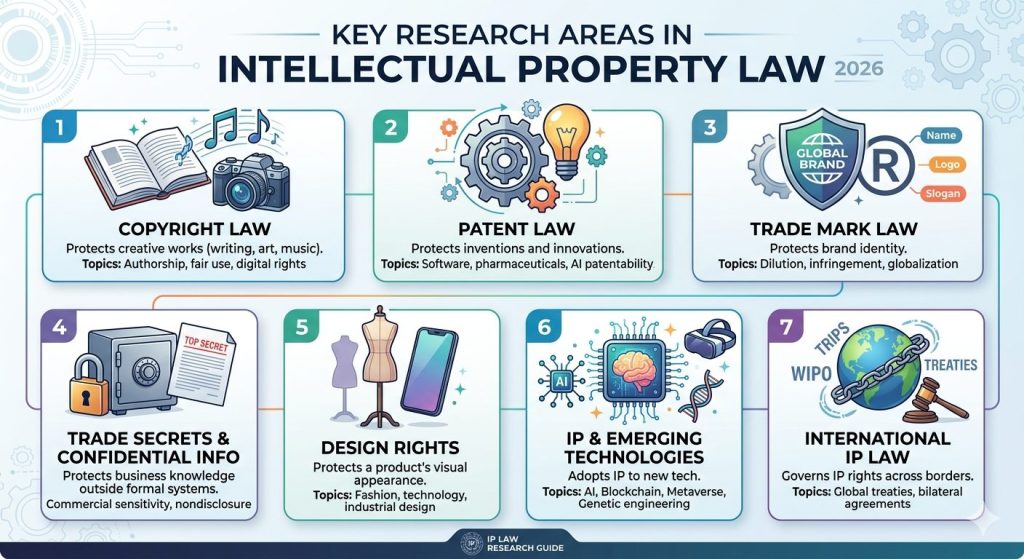
Before exploring individual topics, it helps to understand the main research areas within IP law. These are well-established academic domains that continue to generate active scholarly debate.
Copyright Law covers the protection of original creative works, including literary, artistic, musical, and digital content. Research in this area often examines issues of authorship, fair use, and the challenges posed by digital reproduction.
Patent Law focuses on the protection of inventions and technological innovations. Current debates centre on software patents, pharmaceutical patents, and the patentability of AI-generated inventions.
Trade Mark Law deals with the protection of brand identity, including logos, names, and slogans. Researchers explore issues of dilution, infringement, and the globalisation of trade mark protection.
Trade Secrets and Confidential Information examines how businesses protect commercially sensitive knowledge outside the formal IP registration system.
Design Rights cover the visual appearance of products and are particularly relevant in fashion, technology, and industrial design.
IP and Emerging Technologies is a rapidly growing research area that addresses how existing IP frameworks respond to artificial intelligence, blockchain, genetic engineering, and the metaverse.
International IP Law looks at how IP rights operate across borders, including the role of treaties such as TRIPS, WIPO conventions, and bilateral trade agreements.
Five Example Dissertation Topics With Aims and Objectives
The following five examples demonstrate how a strong dissertation topic is structured. Each includes a research aim and two to three clearly defined objectives.
Example 1: AI-Generated Works and Copyright Ownership
Topic: Who Owns the Copyright in AI-Generated Creative Works? A Critical Analysis of UK Law
Aim: To examine the adequacy of current UK copyright law in addressing ownership questions arising from AI-generated content.
Objectives:
- To analyse the legal definition of authorship under the Copyright, Designs and Patents Act 1988 in relation to AI systems
- To evaluate how courts and regulators in the UK and EU have approached AI authorship disputes
- To propose a framework for legislative reform that balances creator incentives with technological advancement
Example 2: Pharmaceutical Patent Extensions and Public Health
Topic: Evergreening Strategies in Pharmaceutical Patents: A Threat to Access to Medicines in Developing Countries?
Aim: To critically assess how pharmaceutical companies use patent extension strategies and the implications for access to affordable medicines.
Objectives:
- To identify the key evergreening techniques used by pharmaceutical companies under international patent law
- To assess the effectiveness of TRIPS flexibilities in protecting public health interests
- To compare the regulatory responses of India, South Africa, and the European Union
Example 3: Trade Mark Dilution in the Digital Economy
Topic: Trade Mark Dilution in the Age of Social Media Influencers: Gaps in EU and UK Legal Frameworks
Aim: To investigate how trade mark dilution law applies to influencer marketing and brand misuse on social media platforms.
Objectives:
- To define the concept of trade mark dilution under EU and UK law post-Brexit
- To examine how courts have handled dilution claims arising from social media content
- To assess whether current legal provisions are sufficient to protect brand owners in digital environments
Example 4: Data and IP Overlap
Topic: Is Data a New Form of Intellectual Property? Examining Legal Protection Frameworks in the UK and EU
Aim: To explore whether existing IP frameworks adequately protect data as a commercially valuable asset.
Objectives:
- To analyse the treatment of data under database rights, trade secret law, and copyright
- To evaluate the limitations of current IP doctrines when applied to structured datasets
- To assess whether a standalone data ownership right is necessary and proportionate
Example 5: Indigenous Knowledge and IP Protection
Topic: Protecting Indigenous Cultural Expressions Through Intellectual Property Law: A Comparative Study
Aim: To evaluate the effectiveness of existing and proposed IP mechanisms in protecting the cultural heritage of indigenous communities.
Objectives:
- To identify the limitations of conventional IP law in recognising communal and intergenerational ownership
- To analyse WIPO’s Intergovernmental Committee proposals on traditional knowledge and cultural expressions
- To compare national legislative approaches in Australia, New Zealand, and South Africa
80 Intellectual Property Law Dissertation Topics for 2026
The following 80 topics are organised by subfield. Each is narrow, researchable, and aligned with current academic and legal debates. They are suitable for undergraduate, master’s, and PhD-level research proposals.
Copyright Law Dissertation Topics
- The Future of Authorship: Can AI Systems Qualify as Authors Under UK Copyright Law?
- Streaming Platforms and Copyright Infringement: Are Existing Safe Harbour Provisions Still Fit for Purpose?
- User-Generated Content and Copyright on TikTok: Legal Gaps in Platform Responsibility
- Parody as a Defence in UK Copyright Law: Balancing Free Expression and Creator Rights
- The Impact of the EU Digital Single Market Directive on Online Content Sharing Platforms
- Orphan Works and the Problem of Untraced Rights Holders: Reform Proposals for UK Law
- Copyright Duration and the Public Domain: Are Existing Term Limits Justified?
- Ghost-Writing Agreements and Copyright Ownership: An Under-Examined Legal Problem
- Moral Rights in the Digital Age: Are UK Provisions Adequate for Online Creators?
- The Three-Step Test in International Copyright Law: Consistency or Conflict?
Patent Law Dissertation Topics
- Patenting CRISPR Gene-Editing Technology: Ethical and Legal Tensions in UK and US Law
- Software Patents After Alice Corp v CLS Bank: Has the US Supreme Court Gone Too Far?
- Compulsory Licensing During Public Health Emergencies: Lessons From COVID-19 Vaccine Patents
- Patent Thickets in the Semiconductor Industry: Competition Law Responses in the EU
- Standard Essential Patents and FRAND Licensing: Resolving Disputes in 5G Technology
- The Patentability of Artificial Intelligence Inventions: A Comparative Analysis of EPO and USPTO Guidelines
- Green Technology Patents and Climate Change Mitigation: Does IP Law Support or Hinder the Energy Transition?
- Patent Trolls and Non-Practising Entities: Evaluating Reform Efforts in the United States
- Biosimilars, Patent Cliffs, and Market Entry: A European Perspective
- Utility Models as an Alternative to Patents: Are They Relevant for UK Innovation Policy?
Trade Mark Law Dissertation Topics
- Non-Traditional Trade Marks: The Legal Status of Sound, Colour, and Smell Marks in the UK
- Trade Mark Squatting in the Metaverse: How Should Brands Be Protected in Virtual Worlds?
- The Geographical Indications Framework Post-Brexit: Protecting UK Food and Drink Products
- Keyword Advertising and Trade Mark Infringement: An Analysis of Google AdWords Litigation
- Celebrity Names as Trade Marks: Personality Rights and Brand Protection in UK Law
- Trade Mark Enforcement Against Counterfeit Goods on E-Commerce Platforms: Is EU Regulation Effective?
- Honest Concurrent Use as a Defence in Trade Mark Law: Practical Limitations in the UK
- The Relationship Between Trade Mark Law and Freedom of Speech: A Human Rights Perspective
- Shape Marks and Functionality: When Does a Product Shape Qualify for Trade Mark Protection?
- The Impact of Brexit on UK-EU Trade Mark Registration and Enforcement
Design Rights Dissertation Topics
- Protecting Fashion Designs Through IP Law: Why Traditional Mechanisms Fall Short
- Unregistered Community Design Rights Post-Brexit: The UK’s Continuing Global Design Challenge
- Spare Parts and Design Rights: The Repair Clause Debate in EU and UK Law
- Computer-Generated Designs and Ownership: Gaps in Current Design Rights Legislation
- Design Rights vs Copyright: Addressing the Overlap in UK Law for Industrial Products
- 3D Printing and Design Protection: Can IP Law Keep Up With Additive Manufacturing?
- Protecting User Interface Designs: The Case for Stronger IP Rights in Digital Products
- Traditional Craft Designs and Sui Generis Protection: A Study of West African Textile Industries
- Semiconductor Topographies and IP Protection: Relevance in the Era of Advanced Chip Design
- Cross-Border Enforcement of Design Rights in Southeast Asian Markets
IP and Emerging Technologies
- NFTs and Intellectual Property: Do Non-Fungible Tokens Create New Forms of Ownership?
- Deepfakes and Copyright: Legal Accountability for AI-Generated Audiovisual Content
- Blockchain-Based IP Registries: Can Distributed Ledger Technology Reform Copyright Registration?
- The Metaverse as an IP Jurisdiction: How Should Rights Be Assigned in Virtual Spaces?
- Generative AI and Training Data: Does Scraping Copyrighted Content Constitute Infringement?
- Digital Twins and IP Protection: Ownership Issues in Industrial IoT Applications
- Autonomous Vehicles and Patent Strategy: IP Competition Among Major Automotive and Tech Companies
- The Internet of Things and Trade Secrets: Protecting Embedded Software in Connected Devices
- Open Source Licensing in the Age of Commercial AI: A Legal Analysis of Apache, MIT, and GPL Compliance
- Quantum Computing Patents: Race to Protect Foundational Technology in a Nascent Industry
International and Comparative IP Law
- TRIPS Flexibilities and Access to Medicines: A Critical Review of WTO Dispute Settlement
- IP Provisions in Free Trade Agreements: The Impact of CPTPP on Australian Copyright Law
- China’s IP Enforcement Reforms: Progress and Persistent Challenges for Foreign Rights Holders
- The Belt and Road Initiative and IP Standards: Risks for European Rights Holders
- Traditional Knowledge Protection Under WIPO: Why Current Proposals Remain Insufficient
- Piracy in the Global South: IP Law as a Tool of Economic Dominance or Development?
- EU-UK IP Law Divergence Post-Brexit: Implications for Rights Holders Operating in Both Jurisdictions
- Harmonisation of Copyright Law Within ASEAN: Barriers and Opportunities
- Cross-Border Patent Litigation: The Role of the Unified Patent Court in Europe
- Biopiracy and the Nagoya Protocol: Protecting Genetic Resources in International IP Law
IP, Competition Law, and Innovation Policy
- Abuse of Dominance Through Patent Accumulation: Competition Law Responses in the EU and UK
- Compulsory Licensing as a Competition Law Remedy: Lessons From IMS Health and Microsoft Cases
- IP Rights and Market Foreclosure: Does Pharmaceutical Sector Patent Strategy Harm Innovation?
- Open Innovation and IP Strategy: How Tech Companies Manage Patent Portfolios for Competitive Advantage
- The Role of IP Law in Supporting Small and Medium Enterprises in the UK Creative Economy
- Intellectual Property and Startup Ecosystems: Does Patent Protection Encourage or Discourage Venture Investment?
- IP Licensing and Vertical Restraints: Competition Law Scrutiny of Exclusive Licensing Agreements
- Platform Market Power and IP Exploitation: The Case of App Store Policies and Developer Rights
- Regulatory Approvals and Patent Term Adjustment: Balancing Incentives and Generic Competition
- IP-Backed Financing and Collateralisation: Legal Challenges for IP as a Business Asset
IP Ethics, Human Rights, and Social Justice
- IP Rights and the Right to Education: Copyright Law as a Barrier to Knowledge Access in Africa
- Gender and IP: Why Women Inventors Remain Underrepresented in Patent Systems
- Open Access Publishing and Copyright: Academic Institutions as Rights Holders vs Knowledge Sharers
- Disability Rights and Copyright Exceptions: The Marrakesh Treaty in UK and EU Implementation
- Climate Justice and Green IP: Should Environmental Technologies Be Excluded From Patent Protection?
- Indigenous Data Sovereignty and IP Law: Reconceptualising Ownership in the Digital Age
- Cultural Heritage, Museums, and Copyright: Who Controls Access to Digitised Public Domain Works?
- Biocolonialism and Plant Variety Rights: IP Law and the Exploitation of Agricultural Biodiversity
- Hate Speech, Trade Marks, and the First Amendment: Comparing US and UK Approaches to Offensive Marks
- IP Law and Global Health Equity: A Critical Assessment of Vaccine Patent Waivers During Pandemics
How to Choose the Right IP Law Dissertation Topic for Your Level
Choosing a topic that matches your academic level is one of the most important decisions you will make. Students looking for topics in intellectual property law for a BSc research paper should focus on topics that allow descriptive and analytical engagement with existing law, rather than requiring extensive theoretical innovation. Topics from the copyright, trade mark, or design rights sections above are often well suited to undergraduate work.
For those pursuing dissertation ideas for an MA in intellectual property law in the UK, the expectation shifts toward critical analysis, comparative methodology, and engagement with academic debate. Topics from the international IP law and emerging technologies sections offer rich opportunities for this level of inquiry.
At PhD level, the expectation is original contribution to knowledge. Topics in the ethics and social justice section, or topics examining the intersection of IP with AI and competition law, tend to generate strong PhD proposals because they engage with unresolved doctrinal and normative questions.
Regardless of your level, a strong dissertation topic will always be specific, researchable, and connected to current academic and legal debates. If you are still uncertain, seeking structured online dissertation help from a qualified academic adviser can make a significant difference to the quality of your final proposal.
Conclusion
Intellectual property law is a rich and rapidly evolving field that offers students enormous scope for original, meaningful dissertation research. The 80 topics and structured examples provided in this post are designed to give you a clear starting point, whether you are writing at undergraduate, master’s, or PhD level.
Topic selection should never be rushed. The best dissertations are built on focused, well-defined research questions that sit firmly within the existing scholarly debate. The key is to begin with a genuine intellectual curiosity about a problem in the law, then narrow your focus until the topic is specific enough to be managed within your word count and timeframe.
As you move forward with your research, remember that a good dissertation is not about covering everything. It is about saying something precise, well-evidenced, and academically credible about a specific legal question. The field of intellectual property law has no shortage of such questions in 2026.
Approach your dissertation with confidence, intellectual honesty, and a commitment to academic rigour, and you will be well placed to produce work that genuinely contributes to the field.
