


Family Law Dissertation Topics for 2026

What Students Are Asking About Family Law Dissertations
The following questions have been gathered from student forums, academic discussion platforms, and university help communities. They reflect the genuine concerns students have when they begin searching for the right dissertation topic.
- How do I pick a family law dissertation topic that is both original and academically strong?
- Which topic is best for a family law dissertation at master’s or LLM level?
- What are the most relevant family law research paper topics for 2026?
- Are there dissertation topics on family law suitable for PhD-level research?
- What unique family law thesis topics can I explore that have not been overdone?
- How do I know if my chosen topic aligns with current legal developments and judicial trends?
- Can I get dissertation topics in family law for LLM students that are already structured with aims and objectives?
If you have asked yourself any of these questions, this post is written specifically for you.
Why Choosing the Right Family Law Dissertation Topic Matters
Family law sits at the intersection of personal life and public policy. It covers some of the most emotionally complex and socially significant areas of legal practice, including marriage, divorce, child custody, adoption, domestic abuse, and reproductive rights. Choosing the right dissertation topic in this field is not just an academic exercise; it is a decision that shapes how deeply you engage with the law, how relevant your research becomes, and how confidently you enter the legal profession.
A well-chosen topic demonstrates that you understand how current legal frameworks respond to real human situations. It shows your examiners that your research contributes something meaningful to existing scholarship. If you feel overwhelmed at this stage, that is entirely normal. Students often struggle not because they lack ideas, but because they are unsure how to evaluate those ideas against academic standards.
This post walks you through the key research areas within family law, provides structured topic examples, and offers 80 original dissertation topics to help you move forward with clarity and confidence. If you need more tailored guidance, many students also benefit from seeking online dissertation help to refine their chosen topic with expert academic support.
Download Family Law Dissertation Topics PDF
Many students find it helpful to have a curated, structured list of topics they can review offline and share with their supervisors. A downloadable PDF of family law dissertation topics, personalised to your academic level and research interest, is available through a short academic preference form. The list is prepared by subject-matter experts and is regularly updated to reflect legal developments and current judicial trends. Students who complete the form receive a PDF tailored to whether they are studying at undergraduate, LLM, or PhD level.
Key Research Areas in Family Law
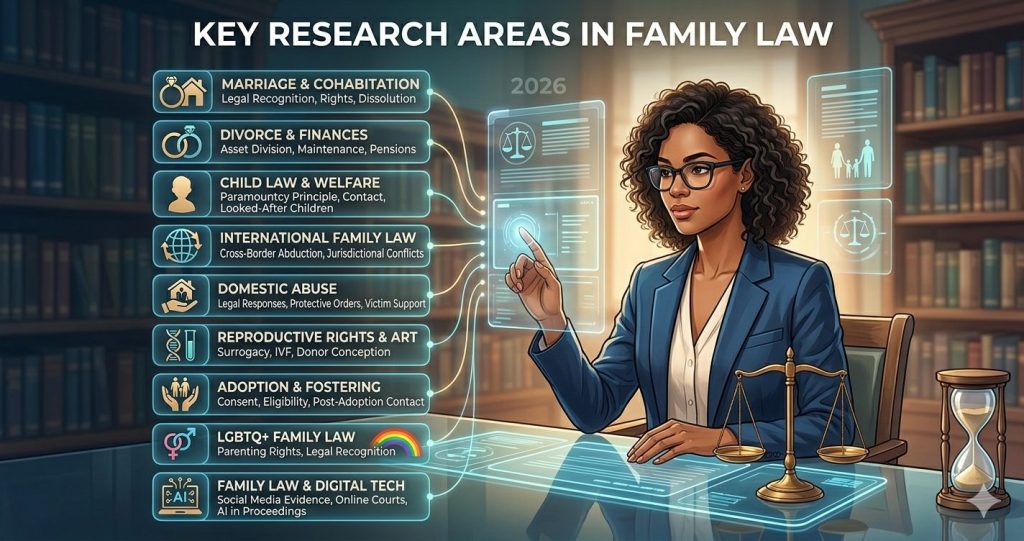
Before diving into specific topics, it helps to understand the major subfields that make up family law as an academic discipline. These areas are well established across UK, US, and international legal scholarship, and they offer a wide range of dissertation possibilities.
- Marriage, civil partnership, and cohabitation law — covering legal recognition, rights, and dissolution
- Divorce and financial remedies — including asset division, spousal maintenance, and pension sharing
- Child law and welfare — centred on the paramountcy principle, contact orders, and looked-after children
- International family law — including cross-border abduction, forum shopping, and jurisdictional conflicts
- Domestic abuse and protective legislation — examining legal responses, protective orders, and victim support
- Reproductive rights and assisted reproduction — covering surrogacy, IVF, donor conception, and parental rights
- Adoption and fostering law — exploring consent, eligibility, and post-adoption contact
- LGBTQ+ family law — including same-sex parenting rights, legal recognition, and international inconsistencies
- Family law and digital technology — examining social media evidence, online courts, and AI in family proceedings
These areas continue to evolve rapidly, which makes family law one of the most dynamic and intellectually rewarding fields for legal research.
Five Example Dissertation Topics With Aims and Objectives
Understanding how a strong dissertation topic is structured is just as important as selecting the right subject. Below are five examples showing how to frame a topic with a clear research aim and focused objectives.
Example 1 — Cohabitation Rights in England and Wales
Research Aim: To examine whether current English law adequately protects cohabiting couples upon relationship breakdown.
Research Objectives:
- To analyse the legal framework governing cohabiting couples in England and Wales
- To compare this framework with cohabitation law in Scotland and selected European jurisdictions
- To assess calls for legislative reform and evaluate proposed models for change
Example 2 — The Paramountcy Principle and Parental Alienation
Research Aim: To evaluate how English courts apply the paramountcy principle in cases involving alleged parental alienation.
Research Objectives:
- To review judicial decisions involving parental alienation claims in England and Wales
- To examine the psychological evidence used in family court proceedings
- To assess whether the current legal approach consistently prioritises the child’s best interests
Example 3 — Surrogacy Law and Parental Orders in the UK
Research Aim: To critically analyse the legal gaps in UK surrogacy law and evaluate the impact on intended parents and surrogates.
Research Objectives:
- To outline the current statutory framework governing commercial and altruistic surrogacy
- To identify the legal risks faced by surrogates and intended parents under existing law
- To evaluate the Law Commission’s 2023 surrogacy reform proposals
Example 4 — Domestic Abuse and Financial Abuse Recognition in Divorce Proceedings
Research Aim: To assess the extent to which financial abuse is recognised and addressed in English divorce law.
Research Objectives:
- To examine the definition and forms of financial abuse within the Domestic Abuse Act 2021
- To evaluate how family courts treat financial abuse evidence in ancillary relief proceedings
- To compare the English approach with approaches in Australia and Canada
Example 5 — International Child Abduction and Hague Convention Effectiveness
Research Aim: To evaluate the effectiveness of the 1980 Hague Convention on the Civil Aspects of International Child Abduction in contemporary family disputes.
Research Objectives:
- To examine the operation of the Convention’s return mechanism
- To identify jurisdictions where enforcement is inconsistent or politically contested
- To assess proposed reforms to strengthen cross-border child protection
80 Family Law Dissertation Topics for 2026
The following 80 topics are original, academically sound, and focused on narrow, researchable questions. They are organised by subfield and numbered in fixed ranges for easy navigation.
Marriage, Cohabitation, and Civil Partnership Law
- The legal status of unmarried cohabiting couples in England and Wales: is reform overdue?
- How does the law treat domestic partnerships differently from civil marriages in the UK?
- A comparative analysis of cohabitation rights in Scotland and England following relationship breakdown
- Should English law recognise informal marriage agreements made in religious ceremonies?
- The legal consequences of void and voidable marriages: gaps in judicial consistency
- How pre-nuptial agreements are treated in English law: judicial discretion versus contractual certainty
- The declining rate of marriage in England and Wales: legal implications for property and inheritance
- Civil partnership conversion rights after the Civil Partnerships, Marriages and Deaths Act 2019: a critical review
- Legal recognition of polygamous marriages contracted abroad: how UK courts respond
- How cohabitation contracts can protect unmarried couples: legal enforceability and practical limitations
- Divorce Law and Financial Remedies
- The no-fault divorce reform under the Divorce, Dissolution and Separation Act 2020: two years on
- How pension sharing orders are calculated in long-marriage divorce cases: consistency and fairness
- Spousal maintenance in England: is the law still fit for purpose in a two-income household?
- The treatment of business assets in divorce proceedings: judicial discretion and predictability
- How courts approach non-matrimonial property claims in high-net-worth divorce cases
- The impact of short marriages on financial remedy awards: a critical analysis
- Clean break orders in divorce: protecting one party at the expense of ongoing fairness?
- Financial remedies for victims of domestic abuse: are current provisions adequate?
- Cryptocurrency and hidden assets in divorce proceedings: evidentiary and enforcement challenges
- How judges assess standard of living in financial remedy cases following long marriages
Child Law and the Welfare Principle
- Applying the paramountcy principle in cases of serious parental conflict: judicial trends
- How English courts balance contact rights of fathers against safeguarding concerns
- The legal response to parental alienation in England: is it consistently recognised?
- Cafcass recommendations and judicial compliance in contested child arrangements cases
- How looked-after children’s wishes are considered in care proceedings under the Children Act 1989
- Special guardianship orders versus adoption: which better serves long-term child welfare?
- Child abduction within England and Wales: the limitations of existing enforcement mechanisms
- How courts determine residence disputes when both parents live in different school catchment areas
- The rights of grandparents to apply for contact orders: reform considerations
- Unaccompanied asylum-seeking children and access to family law protections in the UK
Domestic Abuse and Family Law
- The Domestic Abuse Act 2021 and its impact on family court practice in England and Wales
- How non-fatal strangulation is treated in protective order applications following legislative reform
- Financial abuse as a form of coercive control: recognition and legal remedies in divorce law
- Stalking protection orders and their interaction with family proceedings: a gap analysis
- The effectiveness of domestic violence perpetrator programmes within family court orders
- How the family court treats allegations of domestic abuse made during contested custody proceedings
- Refuge access and housing law for domestic abuse survivors: legislative alignment and gaps
- Legal aid cuts and their impact on domestic abuse victims navigating family court proceedings
- Coercive control in elder care relationships: how family law responds
- Digital abuse, online harassment, and the limits of non-molestation orders
International Family Law
- Forum shopping in international divorce cases: how courts respond to competing jurisdictions
- The recognition of foreign divorce decrees in England and Wales post-Brexit
- How Brexit has affected jurisdictional rules in cross-border child custody disputes
- The effectiveness of the 1980 Hague Child Abduction Convention in cases involving non-signatory states
- Muslim divorce and its recognition in English law: a comparative and conflict-of-laws analysis
- International surrogacy arrangements and parental order applications in England and Wales
- Transnational forced marriage: legal responses and international cooperation frameworks
- Jurisdictional challenges in cross-border financial remedy proceedings following Brexit
- The role of EU Regulations in cross-border family disputes before and after the UK’s withdrawal
- How English courts handle child welfare cases with a connection to countries without Hague Convention membership
Reproductive Rights and Assisted Reproduction
- The legal parenthood framework for donor-conceived children in the UK: gaps and inconsistencies
- Commercial surrogacy abroad and the enforceability of surrogacy agreements in English law
- Should the UK legalise paid surrogacy? Evaluating the Law Commission’s 2023 reform proposals
- Posthumous reproduction and legal parenthood: how English law manages fertilisation after death
- Donor anonymity and the rights of donor-conceived adults to access identity information
- Legal recognition of embryo agreements made before relationship breakdown
- How the law balances bodily autonomy and embryo rights in disputes between former partners
- Gestational surrogacy and the legal position of birth mothers in England
- The regulation of egg freezing for social reasons: ethical, legal, and policy considerations
- Access to assisted reproduction for single parents and same-sex couples: legal equality in practice
LGBTQ+ Family Law
- Same-sex adoption rights in the UK: how legal equality translates into practice
- Legal parenthood for children born to same-sex couples through donor conception: ongoing uncertainties
- Surrogacy and same-sex parenting: legal gaps in the recognition of intended parents
- How transgender individuals navigate divorce and civil partnership dissolution in England and Wales
- Legal recognition of same-sex relationships in jurisdictions with no formal partnership framework
- How family courts address religious objections to same-sex parenting in contact disputes
- The impact of the Gender Recognition Act 2004 on family law proceedings involving transgender parents
- International recognition of same-sex marriages solemnised in the UK
- How UK immigration law interacts with same-sex family reunion applications
- Non-binary legal recognition and its implications for family law proceedings in England
Technology, Digital Evidence, and the Future of Family Law
- The use of social media evidence in child arrangement proceedings: admissibility and judicial approach
- Online family courts following the COVID-19 pandemic: accessibility and due process concerns
- Artificial intelligence in predicting family court outcomes: opportunities and ethical risks
- Digital asset division in divorce proceedings: how courts value and distribute cryptocurrency
- Deepfake evidence and its implications for family law proceedings
- How smart home device data is used as evidence in domestic abuse and child custody cases
- The digital right to be forgotten and its conflict with family court transparency obligations
- Remote mediation in family disputes: effectiveness, access, and safeguarding considerations
- Online parenting coordination: legal status and enforceability of agreements reached through digital platforms
- Biometric data and surveillance technology in the enforcement of child contact orders
How to Pick a Family Law Dissertation Topic
Many students ask: how do I pick a family law dissertation topic that will genuinely impress examiners? The answer is always the same: start with a legal problem, not just a subject. The best dissertation topics in family law identify a gap, a tension, or an unanswered question in existing law or scholarship.
Here are some practical steps to guide your decision.
Start with what interests you. If you are genuinely curious about a topic, your research will be more sustained and more insightful. A dissertation is a long journey, and intellectual investment matters.
Look at recent case law and legislation. Family law in the UK has seen significant change in recent years, from the no-fault divorce reforms to the Domestic Abuse Act 2021 and ongoing debates around surrogacy. Current legal developments are rich ground for original research.
Narrow your focus. The most common mistake students make is choosing a topic that is too broad. Instead of “domestic abuse and family law,” consider “the treatment of financial abuse in ancillary relief proceedings following the Domestic Abuse Act 2021.” A narrower topic allows deeper analysis.
Check existing scholarship. Before committing to a topic, review recent academic journals such as the Child and Family Law Quarterly, the Journal of Social Welfare and Family Law, and the International Journal of Law, Policy and the Family. This will help you identify gaps in current literature that your dissertation can address.
If you are unsure about topic selection or feel you need more structured guidance, speaking with an academic adviser or accessing professional online dissertation help early in the process can save significant time and stress.
Conclusion
Selecting the right dissertation topic in family law is one of the most important decisions you will make during your academic journey. The field is vast, evolving rapidly, and directly connected to some of the most pressing social and legal questions of our time. The 80 family law dissertation topics in this post are designed to help you move from confusion to clarity, and from a vague interest to a focused research question.
Whether you are completing an undergraduate dissertation, an LLM, or a PhD, the principles remain the same: choose a topic that is narrow, researchable, and grounded in a genuine legal problem. Make sure your research aim is clear, and ensure your objectives are achievable within your word count and timeframe.
Family law matters because people matter. Your dissertation is an opportunity to contribute, however modestly, to better legal understanding in an area that affects real lives. Approach it with intellectual honesty, academic rigour, and the confidence that comes from being properly prepared.
