


Immigration Law Dissertation Topics for 2026

80 Research-Ready Ideas for LLB, GDL, BPTC & Postgraduate Students
Questions Students Are Asking Right Now
The questions below were gathered from student forums, academic discussion groups, and university Q&A boards. They reflect what students genuinely struggle with when choosing a dissertation topic in immigration law.
- What are some good topics about immigration law for my final-year dissertation?
- How do I choose a dissertation topic in immigration law that is narrow enough to be researched properly?
- What are the best immigration law dissertation topics for 2026 that are still under-researched?
- Are there dissertation topics on immigration law for LLB students that do not require extensive comparative work?
- I am looking for immigration law research paper ideas for my GDL project. Where do I start?
- Can I write about immigration law in a BPTC thesis? What topics work at that level?
- Which immigration law research areas are courts and policymakers actively engaging with right now?
Selecting the right dissertation topic is one of the most consequential decisions you will make as a law student. In a field as dynamic and politically contested as immigration law, the choice becomes even more significant. Immigration law sits at the intersection of constitutional principles, human rights obligations, geopolitical pressures, and everyday human experience. A well-chosen topic does not merely satisfy a degree requirement. It positions your research within living debates that courts, governments, and international bodies are actively navigating.
This post is designed to help you move from confusion to clarity. Whether you are completing an LLB, progressing through a GDL, preparing a BPTC thesis, or undertaking postgraduate research, the guidance here will help you identify a topic that is academically rigorous, genuinely researchable, and relevant to where the field is heading in 2026.
Download Immigration Law Dissertation Topics PDF
Students who want a personalised list of dissertation topics curated by academic experts in immigration and public law can access a downloadable PDF version of this resource. The PDF is prepared based on your academic level and research interests. Students receive it after completing a short form, making it easy to start your topic selection process with expert guidance already in hand.
Why Choosing the Right Dissertation Topic in Immigration Law Matters
Immigration law is not a static body of rules. It reflects political will, judicial interpretation, and shifting social values. Choosing a poorly defined or overly broad topic can leave your dissertation without a clear argument or contribution. Choosing one that is too narrow or obscure may leave you without enough academic literature to draw on meaningfully.
A strong dissertation topic in immigration law should do three things. It should address a real legal question or gap. It should be scoped so that your argument can be developed within your word count. And it should connect to contemporary debates, whether that means recent case law, legislative reform, international treaty obligations, or comparative legal analysis.
Students who invest time in topic selection at the outset tend to write more confident, better-structured dissertations. If you are feeling uncertain, accessing online dissertation help from qualified legal academics can significantly sharpen your research focus before you begin drafting.
Key Research Areas in Immigration Law You Can Explore
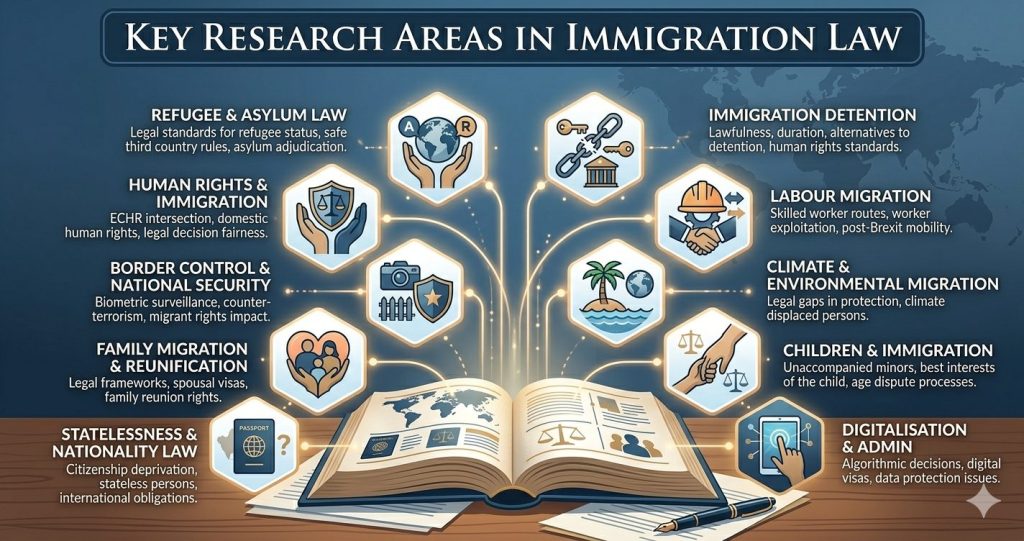
Immigration law covers a wide spectrum of legal disciplines. Below are the main research areas that form the backbone of dissertation topics in immigration law at undergraduate and postgraduate level.
- Refugee and Asylum Law: Legal standards for refugee status determination, safe third country rules, and procedural fairness in asylum adjudication.
- Human Rights and Immigration: The intersection of the European Convention on Human Rights, domestic human rights legislation, and immigration decisions.
- Border Control and National Security: Biometric surveillance, counter-terrorism powers, and their effect on migrant rights.
- Family Migration and Reunification: Legal frameworks governing spousal visas, family reunion rights, and income thresholds.
- Statelessness and Nationality Law: Deprivation of citizenship, stateless persons, and international obligations.
- Immigration Detention: Lawfulness, duration, alternatives to detention, and human rights standards.
- Labour Migration: Skilled worker routes, exploitation of undocumented workers, and post-Brexit labour mobility.
- Climate and Environmental Migration: Legal gaps in protection for those displaced by climate events.
- Children and Immigration: Unaccompanied minors, best interests of the child, and age dispute processes.
- Digitalisation and Immigration Administration: Algorithmic decision-making, digital visas, and data protection issues.
Five Example Dissertation Topics with Research Aims and Objectives
The examples below show how a broad area of interest can be developed into a structured, academically viable dissertation topic. Each includes a research aim and supporting objectives to illustrate what a strong proposal looks like.
1. The Legality of Offshore Asylum Processing under International Refugee Law
Research Aim: To critically evaluate whether offshore asylum processing arrangements comply with the non-refoulement principle and other obligations under the 1951 Refugee Convention.
- Examine the non-refoulement principle and its extraterritorial application in international law.
- Analyse the UK Rwanda policy and comparable schemes in Australia and Denmark against international standards.
- Assess how domestic courts and international bodies have responded to offshore processing arrangements.
2. Algorithmic Decision-Making in UK Visa Applications: A Human Rights Critique
Research Aim: To assess whether the use of algorithmic tools in UK immigration decisions is compatible with Article 8 ECHR and the right to a fair hearing.
- Identify the extent and nature of algorithmic tools used in UK immigration administration.
- Evaluate how transparency and explainability requirements apply to automated immigration decisions.
- Propose a rights-compliant framework for algorithmic accountability in immigration contexts.
3. Immigration Detention and Mental Health: A Legal Accountability Gap
Research Aim: To examine whether current UK legal frameworks adequately protect the mental health of immigration detainees in line with Article 3 ECHR.
- Review the statutory and common law duties owed to detainees with mental health conditions.
- Analyse reported cases and inspectorate findings on mental health provision in immigration removal centres.
- Compare the UK approach with standards developed under the UN Standard Minimum Rules for the Treatment of Prisoners.
4. Post-Brexit Free Movement Alternatives: EU Settlement Scheme and Its Legal Limitations
Research Aim: To critically examine whether the EU Settlement Scheme adequately protects the acquired rights of EU nationals living in the United Kingdom.
- Trace the legal basis of acquired rights under the Withdrawal Agreement and its domestic implementation.
- Identify categories of EU nationals who face legal vulnerability under the scheme as implemented.
- Evaluate judicial review outcomes and their impact on scheme administration.
5. Climate Displacement and the Limits of Refugee Law: The Case for a New Legal Instrument
Research Aim: To examine whether existing international refugee and human rights law adequately protects persons displaced by climate change, and whether a new legal framework is necessary.
- Assess the applicability of the 1951 Refugee Convention definition to climate-displaced persons.
- Review key cases before domestic and international bodies involving climate and displacement claims.
- Evaluate proposals for a dedicated international legal instrument for climate migrants.
80 Immigration Law Dissertation Topics for 2026
The topics below are organised by subfield. Each is original, narrowly scoped, and suitable for submission at undergraduate, master’s, or doctoral level depending on your approach and depth of analysis. Students working on LLB final-year projects, GDL assessments, or postgraduate research proposals will find relevant options across all sections. Where additional guidance would help, online dissertation help from specialist immigration law academics can assist you in refining any of these further.
Refugee and Asylum Law
- The non-refoulement principle in an era of externalised asylum processing: a critical legal analysis.
- Credibility assessment in asylum claims: how UK tribunals evaluate subjective fear and its legal implications.
- Safe third country designations following the UK Supreme Court’s Rwanda ruling: legal consequences and reform.
- Gender-based persecution and the refugee definition: progress and remaining gaps in UK asylum law.
- The internal protection alternative doctrine: fairness or obstruction in UK asylum decisions?
- Sexual orientation asylum claims and the standard of proof applied by UK immigration tribunals.
- Persecution by non-state actors: inconsistencies in UK and EU asylum jurisprudence.
- The application of the 1951 Refugee Convention to stateless Palestinians: a legal examination.
- Exclusion clauses under Article 1F of the Refugee Convention: their use and misuse in UK proceedings.
- Temporary protection status in Europe: a durable solution or a legal delay tactic?
Human Rights and Immigration
- The right to family life under Article 8 ECHR and immigration enforcement: where does proportionality end?
- Derogation from human rights obligations in migration emergencies: a lawful response or an evasion?
- The UK’s proposed withdrawal from the ECHR: consequences for immigration law and asylum claimants.
- Article 3 ECHR and deportation to countries with systemic torture: the threshold of real risk in UK courts.
- Human trafficking victims and immigration status: gaps in the UK National Referral Mechanism.
- The right to an effective remedy under Article 13 ECHR in immigration removal proceedings.
- Undocumented migrants and access to healthcare: a human rights analysis of UK policy.
- The hostile environment policy and its compatibility with international human rights obligations.
- Immigration enforcement and the right to liberty under Article 5 ECHR: a proportionality analysis.
- Children’s rights in family separation cases arising from immigration enforcement action.
Immigration Detention
- Indefinite immigration detention and the rule of law: the case for a statutory time limit in UK law.
- Bail conditions as an alternative to detention: effectiveness and legal safeguards in the UK system.
- The use of fast-track detention procedures in asylum cases: fairness and access to justice concerns.
- Detention of victims of torture: how far does the Adults at Risk policy actually protect vulnerable people?
- Judicial oversight of immigration detention decisions: is the current review mechanism adequate?
- Privately managed immigration removal centres and accountability under public law.
- Solitary confinement practices in immigration detention: a human rights analysis.
- The detention of stateless persons: legal challenges and unresolved status in UK law.
- Immigration detention during public health emergencies: lessons from the COVID-19 period.
- Pregnant women in immigration detention: legal protections and their enforcement in practice.
Border Control, Security, and Technology
- Biometric data collection at UK borders: data protection compliance and migrant rights.
- Automated facial recognition at borders: legality, bias, and human rights concerns.
- The use of predictive analytics in immigration risk profiling: a legal critique.
- Electronic travel authorisations and their impact on visa-free nationals’ access to the UK.
- Drone surveillance at sea borders: legality under international maritime and human rights law.
- The role of immigration officers’ discretion in border control and judicial accountability.
- Pushbacks at sea and state responsibility under the European Convention on Human Rights.
- Counter-terrorism powers and their application to migrants and asylum seekers: a proportionality review.
- Social media screening in immigration decisions: privacy rights and legal standards.
- The digital border: eVisa rollout and the legal implications of a paperless immigration system in the UK.
Labour Migration and Economic Rights
- The UK Skilled Worker visa route post-Brexit: does it meet the economic needs of the health and care sector?
- Exploitation of undocumented migrant workers: the limits of labour law protection in the UK.
- Seasonal agricultural workers and labour rights: assessing the UK Seasonal Worker visa scheme.
- The salary threshold for skilled worker visas: a barrier to equality or a necessary standard?
- Domestic workers on overseas domestic worker visas: legal vulnerability and reform proposals.
- Student visa to work visa transitions: legal pathways and barriers for international graduates in the UK.
- The points-based immigration system and its impact on social care workforce shortages.
- Sponsorship licence revocation and its consequences for migrant workers: a legal analysis.
- Wage theft and immigration enforcement: can improved legal coordination better protect migrant workers?
- The global talent visa: accessibility, criteria, and fairness in its current legal design.
Family Migration and Reunification
- The financial requirement for spousal visas in the UK: a proportionate restriction or a class-based barrier?
- Family reunion rights for recognised refugees in the UK: legal gaps and reform proposals.
- The best interests of the child in deportation decisions involving a British citizen child.
- Surrogacy arrangements and immigration law: legal parentage, citizenship, and nationality complications.
- Transnational families and immigration control: how UK policy affects the right to family life.
- Domestic abuse and immigration status: the Domestic Violence Concession and its limitations.
- The five-year route to settlement and its impact on long-term family migration planning.
- Grandparents and extended family members under UK immigration rules: inadequacy of existing provisions.
- Unmarried partners and immigration law: the legal treatment of cohabiting couples seeking family visas.
- Bereaved partners and immigration status: rights and vulnerabilities following a sponsor’s death.
Statelessness and Nationality Law
- Citizenship deprivation and the right to nationality: proportionality analysis under UK law.
- Statelessness and the right to a nationality under Article 15 UDHR: how far does UK law comply?
- Automatic acquisition of British citizenship by descent: gaps and inequalities in the current legal framework.
- The legal status of the Windrush generation descendants: ongoing vulnerabilities and reform.
- Dual nationality and British citizenship: the legal consequences of acquiring a second nationality.
- Stateless children born in the UK: the acquisition of nationality and legal entitlement to registration.
- The deprivation of citizenship on national security grounds: due process and judicial review.
- Good character requirements in British naturalisation: a racially disparate impact?
- Post-Brexit British overseas nationals: nationality rights, travel entitlements, and legal clarity.
- Foundlings and abandoned children: nationality law provisions and their adequacy in UK law.
Climate Migration, Children, and Emerging Issues
- Climate change and internal displacement: does international law have a coherent legal response?
- Pacific Island climate migrants and legal protection gaps under the 1951 Refugee Convention.
- Unaccompanied asylum-seeking children in the UK: legal duties, age dispute, and best interests.
- The Dubs Amendment and the resettlement of vulnerable child refugees: outcomes and legal accountability.
- Trafficking of unaccompanied minors and the child-specific duty of care under UK immigration law.
- Age assessment disputes in asylum cases involving young people: the legal standard and its application.
- Environmental migrants and the non-refoulement principle: an emerging area of international law.
- The UNHCR’s role in domestic asylum systems: advisory authority versus legal accountability.
- Immigration law and persons with disabilities: reasonable adjustments, accessibility, and legal rights.
- The right to seek asylum in a digitalised border environment: procedural access, technology, and fairness.
Conclusion
Immigration law offers a genuinely rich and urgent landscape for dissertation research in 2026. The field spans human rights, constitutional law, international obligations, administrative law, and social policy. That breadth is both an opportunity and a challenge for students at every level.
The most important step you can take right now is to choose a topic that genuinely interests you, that is scoped narrowly enough to produce a clear argument, and that connects to current legal debates. Use the 80 immigration law dissertation topics 2026 listed in this post as a starting point. Read around your shortlisted areas, review recent case law, and look at current parliamentary or governmental consultations that may shape the legal landscape over the coming year.
A dissertation written with intellectual curiosity and academic discipline will always stand out. You do not need to solve every problem in immigration law. You need to identify one meaningful legal question and pursue it with rigour, honesty, and care. The topics and examples in this post are designed to help you do exactly that.
Approach your dissertation with confidence. The guidance is here, the research areas are live and significant, and your contribution to this field genuinely matters.
