


Neonatal Nursing Dissertation Topics for 2026

Questions Students Are Asking About Neonatal Nursing Dissertation Topics
The following questions were gathered from student forums, academic discussion boards, and online communities where nursing students share their concerns about dissertation and research proposal writing. If you have been feeling unsure about where to begin, these questions likely reflect your own thoughts.
- What are the most relevant neonatal nursing dissertation topics for 2026?
- How do I find hot topics in neonatal nursing that will impress my supervisor?
- What neonatal research topics are suitable for a master’s-level dissertation?
- Where can I find a reliable list of dissertation topics in neonatal nursing?
- How do I narrow down my research ideas in neonatal nursing for an MSc dissertation?
- What are the new research topics in neonatology that align with current clinical priorities?
- Can I find a neonatal nursing topic for my research proposal that is both original and feasible?
- What neonatal research topics for 2025 and beyond are considered academically strong?
This post answers all of these questions in a clear, structured way, helping you move from confusion to confidence.
Introduction: Why Your Dissertation Topic in Neonatal Nursing Matters
Choosing the right dissertation topic is one of the most important academic decisions you will make during your nursing studies. In neonatal nursing, this choice carries particular significance. Neonatal care sits at the intersection of clinical urgency, ethical complexity, and rapid scientific advancement. The decisions made in neonatal intensive care units (NICUs) affect some of the most vulnerable patients imaginable: premature infants, critically ill newborns, and families navigating deeply uncertain moments.
A well-chosen topic shows your supervisor, your institution, and the broader academic community that you understand the field, respect its complexity, and are ready to contribute meaningfully to it. It also makes your research journey far more manageable, because you are working on something you understand and care about.
This post presents 80 original, academically sound neonatal nursing dissertation topics for 2026, organised by subfield. It also explains how to structure a strong research aim and objectives, and it outlines the key research areas that currently shape the discipline. Whether you are looking for topics for an undergraduate thesis in neonatal nursing, a master’s-level investigation, or a doctoral proposal, this guide covers all three levels.
If you would like personalised guidance beyond what this post offers, accessing online dissertation help from academic professionals can make a significant difference, particularly during the early stages of topic selection and proposal development.
Download Neonatal Nursing Dissertation Topics PDF
A downloadable PDF containing a personalised list of neonatal nursing dissertation topics, curated by academic experts with backgrounds in neonatal care and nursing research, is available to students. This resource is designed to support students at all academic levels, from undergraduate through to doctoral study.
The PDF is provided after students complete a short form, allowing the academic team to tailor topic suggestions to the student’s specific level of study, research interests, and institutional requirements. No promotional pressure is involved; the resource exists purely to support informed academic decision-making.
Why Choosing the Right Neonatal Nursing Topic Matters
Neonatal nursing is one of the most specialised areas within healthcare. It demands both technical clinical knowledge and an understanding of the psychosocial dimensions of newborn care, including family-centred practice, ethical decision-making, and multidisciplinary collaboration. When students choose dissertation topics that are too broad, too outdated, or misaligned with their academic level, they often struggle to produce focused, credible research.
A well-defined topic does several things at once. It sets a manageable scope for your investigation. It demonstrates awareness of current gaps in the literature. It signals to your academic supervisor that you have engaged seriously with the discipline. And it makes your final submission far more coherent and persuasive.
The neonatal research topics that tend to perform best at dissertation level are those that respond to real clinical challenges, build on existing evidence, and address gaps that other researchers have identified. Topics rooted in lived clinical experience, current NHS or WHO guidelines, or emerging evidence in neonatology are especially strong choices.
Key Research Areas Within Neonatal Nursing
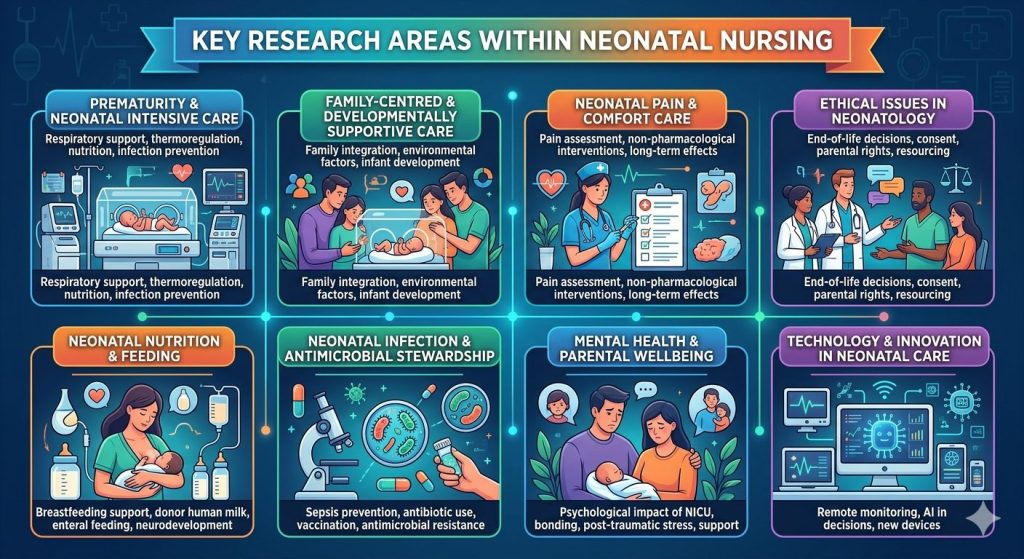
Before selecting a topic, it helps to understand the major research areas within neonatal nursing. These are the domains where academic literature is most active, where clinical practice is evolving most quickly, and where student research can make a genuine contribution.
Prematurity and neonatal intensive care: Research in this area covers the clinical management of preterm infants, including respiratory support, thermoregulation, nutrition, and infection prevention.
Family-centred and developmentally supportive care: This domain examines how families are integrated into care delivery and how environmental and relational factors influence infant development and outcomes.
Neonatal pain and comfort care: Research here explores pain assessment tools, non-pharmacological interventions, and the long-term effects of pain exposure in neonates.
Ethical issues in neonatology: Topics in this area address end-of-life decisions, consent, parental rights, resourcing, and the ethical frameworks applied in NICU environments.
Neonatal nutrition and feeding: This area covers breastfeeding support, donor human milk, enteral feeding, and the role of nutrition in long-term neurodevelopmental outcomes.
Neonatal infection and antimicrobial stewardship: Research focuses on sepsis prevention, antibiotic use, vaccination, and the growing problem of antimicrobial resistance in neonatal settings.
Mental health and parental wellbeing: This domain investigates the psychological impact of NICU admission on parents and siblings, including post-traumatic stress, bonding, and the effectiveness of psychological support interventions.
Technology and innovation in neonatal care: Topics here examine remote monitoring, artificial intelligence in clinical decision support, and the use of new devices in NICU environments.
Each of these areas contains multiple layers of investigation. Students can approach them from clinical, sociological, ethical, policy, or educational angles depending on their interests and academic level.
Five Example Dissertation Topics With Research Aims and Objectives
Understanding what a well-structured dissertation topic looks like academically will help you apply the same thinking to your own selection. The following five examples demonstrate how a topic, aim, and objectives relate to one another.
Example 1
Topic: The effectiveness of kangaroo mother care in reducing neonatal hypothermia in preterm infants in UK NICUs
Aim: To evaluate the clinical effectiveness of kangaroo mother care as a thermal regulation intervention for preterm neonates in the United Kingdom.
Objectives:
- To review current evidence on kangaroo mother care and its role in thermoregulation among preterm infants
- To identify barriers and facilitators to implementation in UK NICU settings
- To assess the consistency of kangaroo mother care protocols across NHS trusts
Example 2
Topic: Parental experiences of receiving a palliative care diagnosis for their newborn: a qualitative exploration
Aim: To explore the lived experiences of parents whose newborns have received a palliative or life-limiting diagnosis within a neonatal setting.
Objectives:
- To understand how parents describe their emotional and informational needs during diagnosis
- To identify the communication practices of neonatal nurses that parents found most supportive
- To explore how early palliative care planning affected parents’ perceptions of control and involvement
Example 3
Topic: Neonatal nurses’ perceptions of pain assessment tools for preverbal infants: a mixed-methods study
Aim: To examine how neonatal nurses perceive and apply standardised pain assessment tools in their clinical practice.
Objectives:
- To identify which pain assessment tools are most commonly used in UK NICUs and the rationale behind their selection
- To explore nurses’ confidence and training in using these tools across different gestational age groups
- To assess whether current tool usage aligns with national and international neonatal pain management guidelines
Example 4
Topic: The role of donor human milk in reducing necrotising enterocolitis risk in very low birth weight infants
Aim: To synthesise current evidence on the association between donor human milk feeding and necrotising enterocolitis incidence in very low birth weight neonates.
Objectives:
- To review randomised controlled trials comparing donor human milk and formula feeding outcomes
- To assess the quality and consistency of evidence across published systematic reviews
- To evaluate the implications of current findings for clinical feeding guidelines in neonatal units
Example 5
Topic: NICU nurses’ experiences of moral distress when caring for extremely premature infants at the threshold of viability
Aim: To explore the sources and impact of moral distress experienced by neonatal nurses caring for infants born at 22 to 24 weeks gestation.
Objectives:
- To identify the clinical situations most frequently associated with moral distress in neonatal nursing
- To explore how nurses manage moral distress in the absence of formal institutional support
- To examine the relationship between moral distress, burnout, and staff retention in UK NICUs
80 Neonatal Nursing Dissertation Topics for 2026
The following topics are organised by subfield to help you identify the area that aligns most closely with your interests and academic level. All topics are original, non-repetitive, and designed to meet current 2026 research expectations. These represent some of the most relevant and hot topics in neonatal nursing today.
Prematurity and NICU Clinical Care
- Oxygen saturation targeting strategies and their association with retinopathy of prematurity in preterm neonates: a systematic review
- The impact of delayed cord clamping on haematological outcomes in infants born before 32 weeks gestation
- Nurse-led weaning protocols for respiratory support in moderate-to-late preterm infants: a comparative analysis
- The relationship between admission hypothermia and short-term mortality in very preterm infants in UK NICUs
- Incidence and risk factors of intraventricular haemorrhage in infants born at less than 28 weeks: a retrospective cohort study
- Non-invasive ventilation versus invasive mechanical ventilation in extremely low birth weight infants: outcomes and nurse workload
- Surfactant therapy delivery methods and short-term pulmonary outcomes in preterm neonates: a literature review
- Skin-to-skin contact for thermoregulation in infants born before 28 weeks gestation: barriers to implementation in level 3 NICUs
- Nurse staffing ratios and neonatal clinical outcomes in UK intensive care units: an exploratory analysis
- The association between antenatal corticosteroid administration timing and neonatal respiratory outcomes in very preterm births
Neonatal Nutrition and Feeding Practices
- The effect of early enteral feeding initiation on growth outcomes in extremely preterm infants: a systematic review
- Lactation support interventions for mothers of NICU-admitted infants: a qualitative meta-synthesis
- Donor human milk banking provision and equity of access across NHS neonatal networks
- Parenteral nutrition duration and its association with cholestasis in neonates weighing less than 1500 grams
- The role of fortified breast milk in supporting head circumference growth in premature infants: evidence from randomised trials
- Nurse attitudes towards promoting breastfeeding among mothers with substance use disorders in neonatal settings
- Nasogastric versus orogastric tube feeding in preterm infants: outcomes, complications, and nurse preference
- Tongue-tie and breastfeeding difficulty in term neonates: assessing clinical assessment practices across UK maternity units
- Enteral feeding intolerance in preterm infants: a scoping review of definitions, measurement, and management
- The impact of neonatal nurses’ breastfeeding knowledge and training on exclusive breastfeeding rates at discharge
Neonatal Pain and Comfort Management
- Validation of the Neonatal Infant Pain Scale in infants born before 26 weeks gestation: a critical appraisal
- Sucrose versus breastfeeding as analgesia for routine heel lance procedures in full-term neonates: a comparative review
- The long-term neurodevelopmental consequences of repeated procedural pain exposure in premature infants
- Neonatal nurses’ knowledge, attitudes, and practices in pain assessment and management: a cross-sectional survey
- Non-pharmacological comfort strategies for neonates undergoing central line insertion: evidence and clinical feasibility
- Music therapy as a pain management adjunct in neonatal intensive care: a systematic review of randomised trials
- The effect of facilitated tucking on procedural pain responses in preterm infants: a critical literature review
- Parental involvement in neonatal pain management: current practice, barriers, and family perspectives
- Opioid prescribing trends for neonatal procedural pain in UK NICUs: a ten-year retrospective analysis
- The relationship between skin-to-skin contact and pain biomarker responses during blood sampling in neonates
Family-Centred and Developmentally Supportive Care
- The effectiveness of family integrated care models on parental confidence and breastfeeding rates in UK NICUs
- Fathers’ experiences of involvement in the care of their premature infant in a neonatal unit: a phenomenological study
- Implementation fidelity of the NIDCAP programme across NHS neonatal units: a narrative review
- Environmental noise levels in NICUs and their association with neonatal neurodevelopmental outcomes
- The impact of sibling visitation policies on family wellbeing and infection rates in neonatal intensive care
- Cultural sensitivity in neonatal family-centred care: experiences of Black, Asian, and minority ethnic families in UK NICUs
- Parent education programme design in neonatal units: a gap analysis between current provision and evidence-based recommendations
- The role of peer support networks in reducing parental anxiety following NICU discharge
- Discharge readiness perceptions among parents of preterm infants: a mixed-methods study
- Neonatal nurses’ experiences of supporting bereaved parents in family-centred end-of-life care
Ethical Issues in Neonatal Nursing
- Ethical challenges in resuscitation decision-making for infants born at 22 weeks gestation: nurse and physician perspectives
- Parental autonomy versus clinical judgement in neonatal treatment decisions: a case-based ethical analysis
- The use of do-not-resuscitate orders in neonatal intensive care: consistency, communication, and family involvement
- Neonatal nurses’ experiences of moral distress in end-of-life care situations: a qualitative study
- Equity of access to neonatal intensive care in England: a geographical and socioeconomic analysis
- Nurse advocacy in neonatal settings: how nurses describe and enact their advocacy role in ethically complex cases
- The ethics of treating extremely premature infants: an analysis of international threshold of viability guidelines
- Withdrawal of life-sustaining treatment in neonatal intensive care: nurses’ emotional and professional experiences
- Informed consent processes in neonatal research: a review of ethical frameworks and parental experience literature
- Neonatal organ donation practices and the role of the neonatal nurse in supporting families through the donation process
Neonatal Infection and Antimicrobial Stewardship
- Central line-associated bloodstream infection rates and prevention bundle compliance in UK NICUs: a multi-site audit
- Nurse-led early warning systems for neonatal sepsis: an evaluation of detection accuracy and response time
- The impact of probiotic supplementation on late-onset sepsis rates in very low birth weight infants: a systematic review
- Antimicrobial stewardship programme implementation in neonatal units: a qualitative exploration of nurse participation
- Hand hygiene compliance among neonatal healthcare workers and its relationship to healthcare-associated infection rates
- Coagulase-negative staphylococcal infections in preterm neonates: risk factors, outcomes, and nursing management
- The role of silver-containing dressings in central venous catheter site infection prevention in neonates
- Parent participation in infection control practices during NICU visitation: a mixed-methods evaluation
- Early-onset versus late-onset neonatal sepsis: a comparative review of clinical presentations, risk factors, and nurse-led assessment tools
- Carbapenem-resistant organism colonisation in neonatal units: nursing staff knowledge, attitudes, and infection control practices
Mental Health and Parental Wellbeing
- Post-traumatic stress disorder prevalence among mothers following NICU admission of their preterm infant: a systematic review
- Paternal mental health during neonatal intensive care admission: a neglected area in perinatal nursing research
- Neonatal nurses’ confidence and training in identifying and responding to parental mental health difficulties
- The effectiveness of psychoeducation interventions in reducing anxiety in parents of NICU-admitted neonates
- Attachment formation between parents and preterm infants: the role of neonatal nursing support in early bonding
- Peer-to-peer support programmes for NICU parents: a review of design, delivery, and psychological outcomes
- Compassion fatigue and burnout among neonatal nurses: prevalence, contributing factors, and institutional responses
- The effect of structured communication interventions on parental anxiety during ward rounds in neonatal units
- Parental experiences of receiving news of a neonatal brain injury: implications for communication practice in NICU nursing
- Sibling adjustment following discharge of a premature infant from a neonatal unit: a literature review
Technology, Innovation, and Future Directions in Neonatal Care
- Artificial intelligence tools for early detection of sepsis in neonates: a critical evaluation of current evidence
- The use of point-of-care ultrasound by neonatal nurses: scope of practice, training requirements, and safety considerations
- Remote patient monitoring technology for post-discharge preterm infants: a systematic review of clinical and family outcomes
- Electronic health records and neonatal nursing documentation: barriers to implementation and impact on clinical communication
- Wearable continuous monitoring devices in neonates: accuracy, safety, and clinical utility compared to conventional monitoring
- 3D printing applications in neonatal care: current uses, limitations, and future clinical potential
- Virtual reality interventions for parents of NICU-admitted infants: a scoping review of feasibility and acceptability
- Telemedicine consultations in neonatal care networks: impact on transfer rates, clinical outcomes, and parental experience
- Simulation-based training for neonatal resuscitation: comparing high-fidelity and low-fidelity models on nurse competency outcomes
- The application of machine learning algorithms in predicting neonatal morbidity in preterm populations: implications for nursing assessment
How to Choose the Right Topic From This List
Looking through 80 new research topics in neonatology can feel overwhelming rather than helpful if you do not have a framework for choosing. Here is a practical way to narrow things down.
First, consider your academic level. Undergraduate dissertations typically require a focused literature review or a small primary study. Master’s projects can support more complex mixed-methods or multi-site designs. PhD proposals must identify an original gap and justify a substantial research contribution.
Second, consider your access. If your dissertation requires primary data collection, you need access to a NICU, clinical staff, or families who are willing to participate. If access is limited, a systematic review, scoping review, or secondary analysis of existing data may be more realistic.
Third, think about your supervisor’s expertise. Your supervisor will guide your methodology and engage most productively with topics they know well. Where possible, align your topic with their research interests.
Finally, consider passion. Dissertations take months. The students who produce the strongest work are those who genuinely care about the question they are asking. Look through the subfields in this post and notice which ones make you lean forward.
Students who want structured support choosing between options often benefit from working with specialists who offer online dissertation help, particularly when topic selection needs to happen quickly and the stakes are high.
Conclusion
Neonatal nursing is a field where research directly shapes the lives of the most vulnerable patients in any healthcare system. A well-chosen dissertation topic in this area is not simply an academic requirement. It is an opportunity to engage seriously with clinical questions that matter, contribute to a literature that influences practice, and develop skills that will stay with you throughout your professional career.
This post has presented 80 original, academically credible neonatal research topics suitable for undergraduate, master’s, and doctoral levels, alongside five fully structured examples showing how a topic, aim, and objectives work together. It has also outlined the major research areas within neonatal nursing and provided practical advice on selecting a topic that suits your level, access, and interests.
The best dissertations come from students who have taken time to understand the field, chosen a topic that responds to a genuine gap, and approached their research with honesty and academic integrity. You are already doing that by engaging seriously with your topic selection. The next step is to commit to a direction, consult your supervisor early, and build a research proposal that reflects your best thinking.
You are more capable of producing excellent neonatal nursing research than you may currently believe.
