


Public Health Nursing Dissertation Topics for 2026

What Students Are Asking About Public Health Nursing Dissertations
Students across university forums and academic discussion platforms regularly ask questions that reflect real confusion about where to begin with their dissertations. The following questions have been gathered from those conversations and represent the most common concerns students share when searching for direction.
- Which topic is best for research in public health nursing at the undergraduate level?
- What are the most relevant public health nursing dissertation topics for 2026?
- How do I find topics in public health nursing that are suitable for an MSc dissertation?
- Are there research topics in public health nursing for a PhD dissertation that align with current global health priorities?
- Where can I find a public health nursing dissertation topics PDF to help me get started?
- What makes a dissertation topic academically strong at the master’s or postgraduate level?
- How do I narrow down my public health research topic for undergraduates without making it too broad?
If any of these questions sound familiar, this post is written for you.
Why Choosing the Right Dissertation Topic in Public Health Nursing Matters
Choosing the right dissertation topic is one of the most important academic decisions a student makes. In public health nursing, this decision carries even more weight because the field sits at the intersection of clinical practice, community health, policy, and social determinants of wellbeing.
A well-chosen topic does more than satisfy academic requirements. It positions your research within real-world health challenges, demonstrates your ability to think critically, and contributes meaningfully to nursing knowledge. Students who choose topics that are too broad often struggle to maintain focus. Those who choose topics that are too narrow may find it difficult to gather enough evidence or data.
The year 2026 brings fresh challenges and opportunities for public health nursing research. Issues such as post-pandemic health system recovery, workforce wellbeing, digital health transformation, health equity, and the evolving role of community nurses are all demanding rigorous academic attention. Selecting a topic that connects your academic interests to these contemporary issues helps you produce a dissertation that is both relevant and impactful.
Whether you are looking for topics in public health nursing for your undergraduate thesis, or you are a doctoral candidate searching for a gap in the literature, the sections below will support you in making a confident, informed choice.
If you are feeling overwhelmed at this stage, many students find it helpful to seek online dissertation help early in the process, especially when trying to align topic ideas with their institution’s research requirements.
Download Public Health Nursing Dissertation Topics PDF
Many students find it useful to have a curated reference document they can review offline, annotate, and share with their supervisors. A downloadable PDF containing a personalised list of public health nursing dissertation topics, compiled by academic subject specialists, is available upon request.
The PDF is prepared based on your level of study and area of interest within the field. Students receive it after completing a short information form, which helps ensure the topics included are matched to your academic stage and research focus. This resource is particularly useful for students who are in the early stages of topic selection and want expert guidance without commitment.
Key Research Areas in Public Health Nursing for 2026
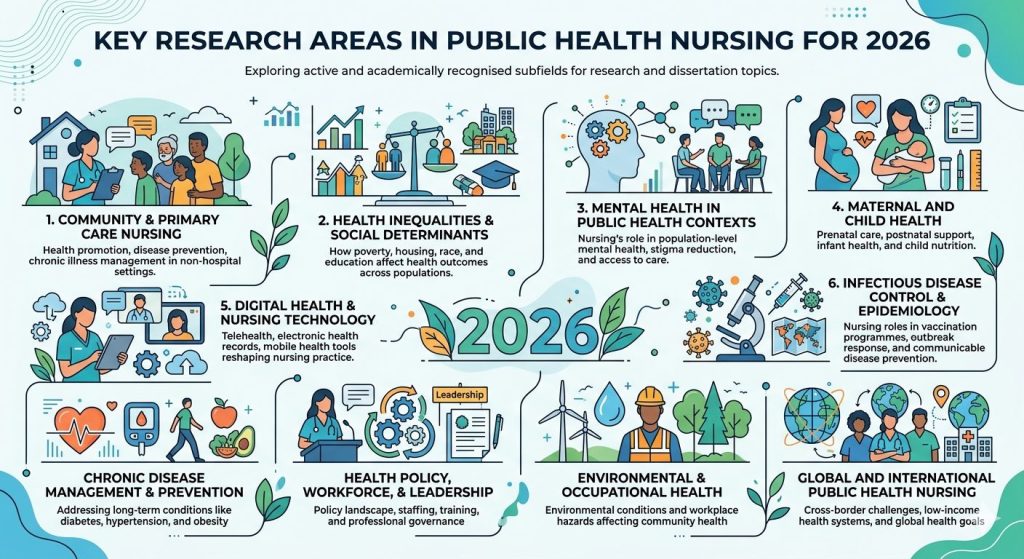
Public health nursing is a broad discipline. Before selecting a specific dissertation topic, it helps to understand the established research domains within the field. The following areas represent active and academically recognised subfields where meaningful research is currently taking place.
- Community and primary care nursing — Focuses on health promotion, disease prevention, and chronic illness management in non-hospital settings.
- Health inequalities and social determinants — Examines how factors such as poverty, housing, race, and education affect health outcomes across populations.
- Mental health in public health contexts — Explores the role of nursing in addressing population-level mental health needs, stigma, and access to care.
- Maternal and child health — Covers prenatal care, postnatal support, infant health, and child nutrition from a nursing perspective.
- Digital health and nursing technology — Looks at how telehealth, electronic health records, and mobile health tools are reshaping nursing practice.
- Infectious disease control and epidemiology — Studies nursing’s role in vaccination programmes, outbreak response, and communicable disease prevention.
- Chronic disease management and prevention — Addresses long-term conditions such as diabetes, hypertension, and obesity through a public health lens.
- Health policy, workforce, and leadership — Examines the policy landscape shaping public health nursing, including staffing, training, and professional governance.
- Environmental and occupational health — Investigates how environmental conditions and workplace hazards affect community health.
- Global and international public health nursing — Considers cross-border health challenges, health systems in low-income countries, and the contribution of nursing to global health goals.
Five Example Dissertation Topics with Aims and Objectives
The following examples are designed to show how a well-structured dissertation topic looks at the academic level. Each example includes a clear research aim and two to three research objectives to help you understand how to frame your own topic.
Example 1: Mental Health Support in School Nursing
Topic: The role of school nurses in identifying and supporting adolescents with anxiety disorders in secondary education settings in England.
Research Aim: To examine how school nurses identify early signs of anxiety in adolescents and the strategies they use to provide or facilitate appropriate support.
Research Objectives:
- To explore school nurses’ experiences and confidence in conducting mental health assessments among secondary school students.
- To identify the referral pathways used by school nurses when managing adolescent anxiety.
- To assess the barriers and enablers school nurses face in delivering effective mental health support.
Example 2: Health Inequalities in Ethnic Minority Communities
Topic: Exploring public health nurses’ understanding of culturally sensitive care in reducing cardiovascular disease risk among South Asian communities in urban UK settings.
Research Aim: To investigate how public health nurses adapt their practice to address cardiovascular disease risk factors within South Asian communities.
Research Objectives:
- To evaluate the cultural competence training received by public health nurses working with South Asian populations.
- To explore patient perspectives on the cultural appropriateness of nursing interventions.
- To identify best practice recommendations for culturally responsive cardiovascular health promotion.
Example 3: Digital Health Literacy Among Older Adults
Topic: Assessing the impact of digital health literacy programmes delivered by community nurses on medication adherence among older adults with multiple long-term conditions.
Research Aim: To determine whether digital health literacy interventions led by community nurses improve medication adherence in older adults managing multiple chronic illnesses.
Research Objectives:
- To identify the key components of effective digital health literacy programmes for older adults.
- To measure changes in medication adherence before and after programme participation.
- To explore older adults’ attitudes towards digitally delivered health information and nurse-led education.
Example 4: Maternal Mental Health in Postnatal Care
Topic: The effectiveness of health visitor-led postnatal mental health screening in identifying postpartum depression among first-time mothers in rural communities.
Research Aim: To evaluate the effectiveness of current postnatal screening tools used by health visitors to detect postpartum depression in first-time mothers residing in rural areas.
Research Objectives:
- To assess the reliability and accessibility of postnatal mental health screening tools used in rural health visiting services.
- To explore the experiences of first-time mothers in rural areas when engaging with health visitor support.
- To identify gaps in postnatal mental health care provision in rural settings and recommend improvements.
Example 5: Vaccination Uptake and Public Health Nursing
Topic: Understanding the influence of public health nurse communication strategies on childhood vaccination uptake in ethnically diverse urban communities.
Research Aim: To explore how communication approaches used by public health nurses affect parental decision-making around childhood vaccination in diverse urban areas.
Research Objectives:
- To analyse the communication techniques used by public health nurses during vaccination consultations.
- To explore parental attitudes towards vaccination and the role of nurse-led information in shaping those attitudes.
- To identify strategies that improve vaccination uptake across culturally and linguistically diverse communities.
80 Public Health Nursing Dissertation Topics for 2026
The following dissertation topics are organised by subfield. Each topic is original, narrowly focused, and suitable for undergraduate, master’s, or PhD research in 2026. These are not generic suggestions; they reflect current gaps, debates, and priorities within public health nursing research.
Community and Primary Care Nursing
- The role of community nurses in supporting adults with type 2 diabetes to self-manage their condition in rural England.
- Exploring the impact of nurse-led smoking cessation programmes on long-term quit rates in deprived urban communities.
- Community nursing interventions for reducing hospital readmission rates among elderly patients with heart failure.
- The effectiveness of nurse-led hypertension clinics in improving blood pressure control in primary care settings.
- Assessing the role of district nurses in supporting palliative care for patients choosing to die at home.
- Exploring barriers faced by community nurses in delivering preventive care to homeless populations in city centres.
- The contribution of practice nurses to early identification of frailty in patients aged over 65 in general practice.
- Evaluating nurse-facilitated weight management programmes for adults with obesity in community health centres.
- The role of community nurses in coordinating care for patients with complex social and clinical needs post-discharge.
- Exploring how community nursing supports men’s engagement with preventive health services in rural settings.
Health Inequalities and Social Determinants of Health
- Public health nurses’ understanding of food insecurity as a determinant of poor health outcomes in low-income families.
- Examining the impact of housing instability on the health of children, from a community nursing perspective.
- The role of public health nursing in addressing racial health disparities in cardiovascular disease management.
- Exploring how public health nurses navigate cultural and linguistic barriers when working with refugee communities.
- Understanding the relationship between educational attainment and chronic disease self-management in community nursing populations.
- The experiences of public health nurses working in areas of high socioeconomic deprivation in post-industrial towns.
- Examining nurse-led outreach programmes designed to reduce health inequalities among Gypsy, Roma, and Traveller communities.
- The role of public health nurses in supporting single-parent households to access preventive health services.
- Exploring how income inequality shapes health-seeking behaviours and community nursing engagement in urban settings.
- Assessing the effectiveness of place-based public health nursing models in reducing health inequalities across socially deprived wards.
Mental Health and Public Health Nursing
- School nurses’ experiences of supporting students with self-harm behaviours in secondary schools in Wales.
- The role of public health nurses in reducing mental health stigma within South Asian communities in the UK.
- Exploring the impact of peer support models, facilitated by community nurses, on recovery outcomes in adults with depression.
- Nurse-led mental health first aid training in workplaces and its effect on employee wellbeing in the NHS.
- Assessing the role of health visitors in identifying postnatal depression in fathers during the first year of parenthood.
- The impact of COVID-19 on the mental health of community nurses and implications for occupational health support.
- Exploring the integration of mental health screening into routine public health nursing practice for adults with chronic physical illness.
- The effectiveness of brief intervention techniques used by community nurses to reduce alcohol misuse in adults with anxiety.
- Public health nurses’ experiences of supporting individuals discharged from psychiatric wards into community settings.
- Examining the use of trauma-informed care approaches by school nurses working with children in kinship care.
Maternal, Child, and Reproductive Health
- Health visitors’ experiences of supporting mothers from Black and minority ethnic backgrounds with breastfeeding in the first six weeks postpartum.
- The role of school nurses in delivering relationships and sex education to young people with learning disabilities.
- Exploring public health nurses’ approaches to identifying domestic abuse during antenatal and postnatal contacts.
- The effectiveness of health visitor-led weaning support programmes on infant nutrition outcomes at six months.
- Community nurses’ experiences of supporting teenage mothers to develop parenting confidence in the first year.
- Examining the accessibility of reproductive health services for women with physical disabilities from a public health nursing lens.
- The contribution of health visitors to identifying developmental delay in children under two during routine assessments.
- Assessing the role of community nurses in reducing rates of unplanned teenage pregnancy through health education.
- Public health nursing support for women experiencing recurrent miscarriage and its impact on emotional wellbeing.
- Exploring how public health nurses support families navigating neonatal intensive care unit discharge and transition to home.
Infectious Disease Control and Epidemiology
- Public health nurses’ experiences of managing tuberculosis contact tracing in urban communities with high migrant populations.
- The effectiveness of nurse-led human papillomavirus vaccination programmes in schools with low uptake rates.
- Exploring parental vaccine hesitancy and the strategies public health nurses use to improve childhood immunisation rates.
- The role of public health nurses in managing sexually transmitted infection outbreaks in university student populations.
- Assessing the contribution of community nurses to COVID-19 vaccine equity programmes in ethnically diverse communities.
- Nurse-led infection prevention education for adults with learning disabilities living in supported accommodation.
- Exploring the role of occupational health nurses in managing influenza vaccination campaigns in NHS trusts.
- Public health nurses’ experiences of delivering harm reduction advice to people who inject drugs in outreach settings.
- The role of travel health nurses in promoting pre-travel vaccination among international students studying in the UK.
- Assessing the impact of antimicrobial stewardship education delivered by community nurses on antibiotic use behaviours in rural populations.
Chronic Disease Management and Prevention
- The effectiveness of nurse-led self-management education programmes for adults newly diagnosed with chronic obstructive pulmonary disease.
- Exploring the role of community nurses in supporting adherence to antiretroviral therapy among adults living with HIV in urban settings.
- Public health nurses’ experiences of delivering cancer screening awareness campaigns in communities with low participation rates.
- The role of practice nurses in supporting patients with atrial fibrillation to reduce their stroke risk through lifestyle change.
- Nurse-led falls prevention programmes for community-dwelling older adults and their impact on hospitalisation rates.
- Exploring community nurses’ use of motivational interviewing to support behaviour change in adults with prediabetes.
- The contribution of public health nurses to improving oral health outcomes in children under five through community programmes.
- Assessing nurse-led approaches to managing chronic pain in patients with fibromyalgia in primary care settings.
- The role of community nursing in supporting adults with asthma to achieve better inhaler technique and symptom control.
- Exploring how public health nurses support patients with chronic kidney disease in managing diet, lifestyle, and medication adherence.
Digital Health and Technology in Nursing Practice
- Community nurses’ experiences of using telehealth platforms to deliver wound care advice to patients in remote rural areas.
- The impact of electronic patient records on the quality and continuity of care delivered by public health nurses in integrated care systems.
- Exploring patient attitudes towards nurse-delivered health information via mobile applications in managing long-term conditions.
- Assessing the digital literacy of community nurses and its relationship to the uptake of health technology tools in practice.
- The role of wearable health technology in supporting community nurses to monitor patients with heart failure remotely.
- Exploring the ethical implications of artificial intelligence-assisted decision support tools for public health nursing practice.
- Nurse-led digital health education programmes and their effectiveness in reducing emergency department attendance among older adults.
- Assessing how social media is used by public health nurses to deliver health promotion messages to young adults.
- The impact of video consultations on nurse-patient therapeutic relationships in community nursing services post-pandemic.
- Exploring community nurses’ experiences of implementing digital care planning tools in complex case management.
Health Policy, Workforce, and Leadership
- Exploring the experiences of newly qualified public health nurses transitioning into specialist community nursing roles in NHS England.
- The impact of staffing shortages on the quality of care delivered by district nursing teams in rural areas.
- Assessing the effectiveness of mentorship programmes in retaining community nurses in the first five years of practice.
- Public health nurses’ perceptions of their professional identity and autonomy within integrated care board structures.
- The role of nurse leadership in shaping health promotion strategy at the local authority level in England.
- Exploring the experiences of internationally educated nurses working in public health nursing roles in the UK.
- The impact of continuing professional development provision on public health nurses’ confidence in evidence-based practice.
- Assessing how public health nursing policy in Northern Ireland differs from that in England and its implications for practice.
- The experiences of public health nurses working within multidisciplinary teams in primary care networks established since 2020.
- Exploring the relationship between nurse autonomy, job satisfaction, and retention in community nursing teams across NHS trusts.
How to Choose the Right Topic from This List
With 80 options in front of you, the next step is narrowing down to the topic that fits your academic level, your access to data or participants, and your personal interest. Here is how to approach that process.
Consider your level of study. Undergraduate dissertations typically involve a smaller scope, often a literature review or a focused qualitative study. Master’s dissertations are expected to involve independent analysis, a defined methodology, and a contribution to knowledge. PhD dissertations must demonstrate an original contribution to the field. Choose a topic that matches the expectations of your programme.
Think about feasibility. Can you realistically access the participants, datasets, or documents needed to complete your research? Topics involving NHS professionals, community participants, or patient records require ethical approval, which takes time. Plan accordingly.
Align with your interests. A dissertation takes months to complete. You will stay more motivated and produce better work if your topic genuinely interests you. Look through the list and note which topics spark your curiosity.
Talk to your supervisor. Before finalising your topic, discuss your ideas with your academic supervisor. They can advise on scope, methodology, and existing literature in the area.
If you are still unsure, seeking professional online dissertation help from experienced academic advisors can save you time and ensure you start on the right path.
Conclusion
Choosing a dissertation topic in public health nursing is a significant step, and it deserves careful thought. The topics and examples in this post are designed to support students at every level, from those working on their first undergraduate thesis to doctoral candidates developing an original research proposal.
Public health nursing in 2026 is a dynamic and evolving field. The most meaningful research will connect real-world health challenges with rigorous academic inquiry. Whether your interest lies in maternal health, digital technology, health inequalities, or workforce policy, there is a research question here that can become your dissertation.
Approach this process with confidence. Your topic does not have to be perfect from the start. It needs to be focused, feasible, academically grounded, and meaningful to you. Use this post as a starting point, speak with your supervisor, and take it one step at a time.
