


Cyber Law Dissertation Topics for 2026

Questions Students Are Asking (From Forums and Academic Discussion Platforms)
Before diving into the main content, here is a collection of questions that students commonly raise on academic forums, Reddit threads, and university discussion boards when they are searching for the right dissertation topic in cyber law.
- What are the most relevant cyber law dissertation topics for 2026?
- How do I find dissertation topics in cyber law that are suitable for my level of study?
- Are there any cyber law topics for my LLM programme that focus on emerging digital threats?
- What research paper topics in cyber law work well for LLB students?
- Can I find dissertation topics in cyber law for my LPC that are both practical and academically strong?
- How do I narrow down my topic so it is researchable within my university’s word count?
- What areas of cyber law are considered cutting-edge for postgraduate research in 2026?
These questions reflect exactly what this post addresses. Whether you are at undergraduate, master’s, or PhD level, you will find clear guidance, structured topic examples, and a comprehensive list of 80 original dissertation topics across key subfields.
Why Choosing the Right Cyber Law Dissertation Topic Matters
Cyber law sits at a unique crossroads between technology, criminal justice, human rights, and international governance. Unlike more settled areas of law, it evolves constantly. New legislation appears, courts interpret existing statutes in unexpected ways, and new digital threats challenge frameworks that were designed for a different era.
Choosing the right dissertation topic in this field is not simply a task of picking something that sounds interesting. It is about identifying a question that is academically defensible, currently relevant, and connected to real legal debates happening in courts, parliaments, and policy institutions around the world.
A well-chosen topic demonstrates that you understand the landscape of the discipline and are capable of contributing meaningfully to it. A poorly chosen topic, by contrast, can leave you without enough academic literature, overwhelmed by scope, or submitting a piece that fails to meet your university’s expectations.
This post aims to take the confusion out of that process.
Download Cyber Law Dissertation Topics PDF
Students who want a more personalised set of dissertation topics can access a downloadable PDF prepared by academic subject specialists. The PDF contains a curated list of topics organised by academic level and research interest area, making it easier to match a topic to your programme requirements. You can receive the PDF by completing a short form where you share your area of interest and level of study. This allows the academic team to tailor the selection to your specific needs.
Key Research Areas in Cyber Law You Can Explore
Cyber law is a broad field, but it is possible to map it into established research domains. These areas are grounded in current academic literature, active legislative reform, and ongoing judicial developments. When you begin thinking about dissertation topics in cyber law, it helps to locate yourself within one of these subfields first.
Data Protection and Privacy Law This area covers the legal frameworks governing how personal data is collected, stored, shared, and deleted. The General Data Protection Regulation (GDPR) remains a global benchmark, though its interpretation and enforcement continue to develop. Comparative research across jurisdictions is particularly productive here.
Cybercrime and Digital Criminal Law This subfield examines legislation addressing hacking, online fraud, identity theft, ransomware, and other criminal activities carried out through digital means. There is growing research interest in how domestic criminal law keeps pace with transnational cybercrime.
Intellectual Property in the Digital Environment Copyright infringement, digital piracy, software patents, and the ownership of AI-generated content all fall within this space. With the rapid growth of generative AI, this area is particularly active for postgraduate researchers.
Platform Liability and Content Regulation Legal questions around how social media platforms, search engines, and other intermediaries are held responsible for harmful or unlawful content represent one of the most contested areas of current cyber law research.
Cybersecurity Law and Critical Infrastructure This area looks at the legal obligations placed on organisations and governments to protect digital systems from attack. National security law, sector-specific regulatory frameworks, and international cyber norms all feature prominently.
Artificial Intelligence and Algorithmic Governance The legal status, accountability, and regulation of AI systems is a rapidly expanding area. Questions around automated decision-making, AI liability, and algorithmic bias connect cyber law directly to fundamental rights and administrative law.
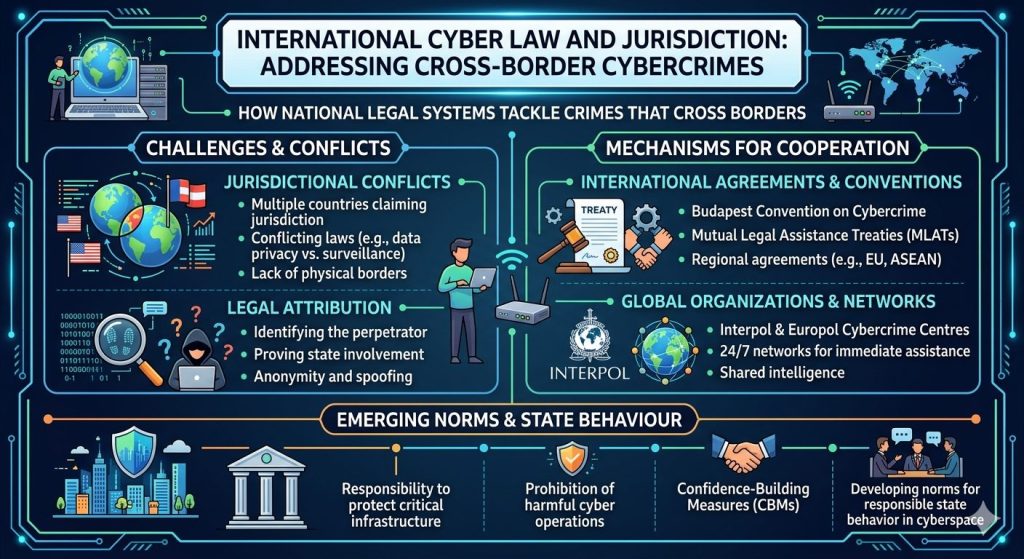
International Cyber Law and Jurisdiction How do national legal systems address crimes that cross borders? This area explores jurisdictional conflicts, international cooperation, and the emerging body of norms governing state behaviour in cyberspace.
Five Example Dissertation Topics with Aims and Objectives
Understanding how a dissertation topic is constructed academically is just as important as choosing the right subject area. Below are five examples to demonstrate the level of specificity, academic grounding, and structural clarity that examiners expect.
Example 1: GDPR Enforcement Across EU Member States
Research Aim: To examine inconsistencies in the enforcement of GDPR across EU member states and their implications for data subject rights.
Objectives:
- To compare enforcement decisions and penalties issued by data protection authorities in at least four EU jurisdictions between 2021 and 2025.
- To identify structural and institutional factors that contribute to enforcement disparities.
- To assess whether current mechanisms are adequate to ensure uniform protection of personal data across the EU.
Example 2: Criminal Liability for Ransomware Attacks
Research Aim: To evaluate the adequacy of UK criminal law in addressing ransomware as a distinct category of cybercrime.
Objectives:
- To analyse existing offences under the Computer Misuse Act 1990 and assess their application to ransomware conduct.
- To compare the UK legislative approach with frameworks in the United States and Germany.
- To recommend legislative reforms that would address current gaps in the law.
Example 3: AI-Generated Content and Copyright Ownership
Research Aim: To determine how existing copyright law in the UK addresses ownership of content produced entirely by artificial intelligence systems.
Objectives:
- To examine the concept of authorship under the Copyright, Designs and Patents Act 1988 in relation to AI-generated works.
- To review recent judicial and legislative developments in the EU and United States on the same question.
- To propose a doctrinal framework that could resolve the authorship problem without requiring fundamental legislative overhaul.
Example 4: Platform Liability for Terrorist Content Online
Research Aim: To critically assess the legal obligations of online platforms under EU and UK law to remove terrorist content and the implications for freedom of expression.
Objectives:
- To evaluate the scope of duties imposed by the EU Terrorist Content Online Regulation and the UK Online Safety Act 2023.
- To examine case law from the European Court of Human Rights concerning online expression and platform responsibility.
- To assess whether current frameworks strike an appropriate balance between security and fundamental rights.
Example 5: Jurisdiction in Transnational Cybercrime Cases
Research Aim: To analyse the legal principles governing jurisdiction in criminal proceedings involving cybercrime offences that span multiple countries.
Objectives:
- To review the application of territorial, nationality, and effects-based principles of jurisdiction to cyber offences.
- To examine how mutual legal assistance treaties (MLATs) function in practice for cybercrime investigations.
- To identify reforms needed to address the jurisdictional gaps that allow offenders to exploit legal boundaries.
80 Cyber Law Dissertation Topics for 2026
The following topics are organised under meaningful subfield headings. Each topic is specific, researchable, and aligned with current academic and legal debates. They are suitable across undergraduate, LLB, LPC, LLM, and PhD levels.
Data Protection and Privacy Law
- The right to be forgotten under GDPR: judicial interpretations and their limits in the UK post-Brexit era.
- Cross-border data transfers after Schrems II: how EU-US data flows are adapting to new legal constraints.
- Consent as a lawful basis for processing biometric data: a critical analysis of regulatory guidance in the UK and EU.
- Data subject access requests and corporate compliance: assessing patterns in organisational responses to SAR obligations.
- Children’s privacy online: a comparative analysis of the UK Age Appropriate Design Code and equivalent frameworks internationally.
- Health data processing under GDPR Article 9: balancing medical research needs with individual privacy rights.
- Privacy by design as a legal obligation: are organisations achieving meaningful compliance or procedural box-ticking?
- Workplace surveillance and employee privacy rights: the impact of remote working on legal protections under UK data protection law.
- Data breach notification requirements: comparing legislative thresholds across the EU, UK, and Australia.
- The legal status of inferred personal data: how regulatory frameworks treat data derived from behavioural profiling.
Cybercrime and Digital Criminal Law
- The Computer Misuse Act 1990 and unauthorised access: is the existing framework adequate for modern hacking offences?
- Ransomware as extortion: evaluating whether existing UK criminal offences capture the full range of ransomware conduct.
- Online fraud and identity theft: assessing the effectiveness of the Fraud Act 2006 in tackling digital deception.
- Criminalising the possession of cyberweapons: a doctrinal and policy analysis of UK and international approaches.
- Dark web markets and criminal liability: how courts attribute responsibility for transactions on anonymous platforms.
- State-sponsored cyberattacks: whether international law provides adequate accountability mechanisms.
- Social engineering and phishing: legal responses to non-technical forms of cybercrime in the UK and EU.
- Revenge pornography and image-based abuse: evaluating the adequacy of UK criminal law following the Online Safety Act 2023.
- Cryptoasset fraud: how financial crime legislation applies to theft and manipulation within blockchain ecosystems.
- Sexting among minors and criminalisation: a critical analysis of how law enforcement policy balances child protection with proportionality.
Intellectual Property in the Digital Environment
- Copyright subsistence in AI-generated music: examining ownership questions under UK and EU law.
- Software patents and the exclusion of mental acts: how UK and European Patent Office case law draws the boundary.
- Digital exhaustion of copyright: whether the first sale doctrine should apply to downloaded content in the UK.
- NFTs and intellectual property rights: what ownership of a non-fungible token actually confers under copyright law.
- Training AI systems on copyrighted works: a legal analysis of the text and data mining exception in the CDPA 1988.
- Online piracy enforcement through website blocking orders: effectiveness and proportionality under UK law.
- Platform liability for user-uploaded infringing content: a comparative analysis of Article 17 DSM Directive and UK law.
- Trademark protection in the metaverse: how virtual goods and brand identity intersect with existing registration frameworks.
- Moral rights in digital art: the adequacy of protection for digital creators under the CDPA 1988.
- Open source licensing and contractual enforceability: an analysis of how courts interpret GPL and Creative Commons terms.
Platform Liability and Content Regulation
- The Online Safety Act 2023 and duty of care obligations: a critical evaluation of the regulatory model adopted by the UK.
- Algorithmic amplification and platform liability: should recommendation systems attract legal responsibility for harmful content?
- Defamation on social media: how Section 5 of the Defamation Act 2013 applies to user-generated content platforms.
- Hate speech regulation online: comparing the EU Digital Services Act and UK approaches to removing unlawful content.
- End-to-end encryption and lawful access: evaluating the legal debate between privacy and law enforcement capability.
- Age verification requirements for adult content: the legal framework under the Online Safety Act and its enforcement challenges.
- Notice and action regimes for illegal content: how platform obligations differ across the EU, UK, and United States.
- Intermediary liability for misinformation: whether current EU and UK frameworks are adequate to address false health content.
- The regulation of online political advertising: how transparency obligations interact with data protection and electoral law.
- Platform responsibility for radicalisation content: a legal analysis of removal obligations and procedural safeguards.
Cybersecurity Law and Critical Infrastructure
- The Network and Information Systems (NIS2) Directive: how the expanded scope changes cybersecurity obligations for UK-adjacent businesses.
- Legal obligations of directors for organisational cybersecurity: an analysis under UK company law and sector regulation.
- Cyber incident reporting requirements: comparing obligations for critical infrastructure operators in the UK, EU, and United States.
- Cyber insurance and contractual risk allocation: how policy terms are evolving in response to ransomware and nation-state threats.
- The legal framework governing penetration testing and ethical hacking in the UK: where the law permits and where it does not.
- Vulnerability disclosure programmes and legal protection for security researchers: the adequacy of current UK law.
- Supply chain cybersecurity obligations: how legal frameworks impose responsibility on organisations for third-party risk.
- Critical infrastructure attacks as acts of war: applying international humanitarian law to destructive cyber operations.
- Sector-specific cybersecurity regulation in financial services: evaluating DORA and its implications for UK financial institutions.
- Legal accountability for cyber incidents caused by misconfiguration: negligence, contract, or regulatory breach?
Artificial Intelligence and Algorithmic Governance
- The EU AI Act and its classification of high-risk AI systems: implications for legal practice and compliance in 2026.
- Automated decision-making under GDPR Article 22: the right to explanation and its practical limitations.
- AI liability frameworks: whether existing product liability law is adequate to address harm caused by autonomous systems.
- Algorithmic bias and discrimination law: how the Equality Act 2010 applies to AI-driven employment decisions.
- Legal personhood for AI systems: a doctrinal analysis of whether existing legal categories can accommodate AI agency.
- Facial recognition technology and human rights: evaluating the proportionality of police use under UK law.
- Deepfakes and the law: how existing criminal and civil remedies address identity manipulation through AI-generated video.
- Regulating generative AI in legal services: professional conduct obligations for solicitors using AI-assisted drafting tools.
- AI and judicial decision-making: the admissibility and reliability of risk assessment tools in UK criminal courts.
- The right to human oversight of AI decisions in public administration: a legal analysis under UK administrative law.
International Cyber Law and Jurisdiction
- The Budapest Convention on Cybercrime and its continuing relevance as the global framework for international cooperation.
- Jurisdictional conflicts in transnational data breach cases: how courts resolve competing claims over enforcement authority.
- State responsibility for private hacker groups: applying the ILC Articles on State Responsibility to cyber proxy actors.
- Mutual legal assistance treaties and cybercrime investigations: how the US CLOUD Act changes international access to data.
- The Tallinn Manual and the legality of cyber operations below the threshold of armed conflict.
- Sovereignty in cyberspace: examining whether territorial principles of international law apply coherently to digital infrastructure.
- Bilateral cybersecurity agreements: evaluating whether intergovernmental frameworks effectively deter state-level cyber aggression.
- Extradition of cybercriminals: how dual criminality requirements create enforcement gaps in transnational cases.
- Cyber sanctions regimes: examining the legal basis and effectiveness of targeted sanctions in response to cyber operations.
- Internet governance and the multi-stakeholder model: how ICANN’s legal structure mediates between state and corporate interests.
Emerging and Interdisciplinary Topics
- The regulation of smart contracts: how existing contract law principles apply to self-executing blockchain agreements.
- Legal frameworks for the Internet of Things: how product liability, data protection, and cybersecurity obligations intersect for connected devices.
- Digital identity systems and legal accountability: who is responsible when a government-issued digital identity is compromised?
- Cyber law and climate technology: the legal risks of cyberattacks targeting renewable energy infrastructure.
- The legal treatment of zero-day vulnerabilities: should government stockpiling of exploits attract legal constraints?
- Cyber law implications of quantum computing: how emerging decryption capabilities challenge existing legal protections for encrypted communications.
- The right to digital access as a human right: a doctrinal analysis of how international human rights law addresses internet shutdowns.
- Cyberlaw and healthcare systems: legal liability for ransomware attacks on NHS digital infrastructure.
- Online dispute resolution and access to justice: evaluating whether ODR mechanisms meet the procedural fairness standards required by law.
- Legal responses to social media impersonation: how identity fraud, defamation, and harassment law applies to fake accounts.
How to Choose the Right Topic for Your Academic Level
Not every topic in this list is equally appropriate for every student. The level at which you are studying shapes what your dissertation needs to achieve.
If you are writing an undergraduate dissertation, your topic should be focused and bounded. You need enough literature to write critically but a narrow enough question to answer it properly within your word count. Topics in established areas such as GDPR enforcement or platform liability tend to work well at this level.
If you are pursuing an LLM and searching for cyber law topics for your LLM programme, your examiner will expect a higher degree of originality and theoretical engagement. Topics involving comparative analysis, legislative reform proposals, or engagement with international law frameworks are well suited to postgraduate work.
PhD-level research must make an original contribution to knowledge. This typically means identifying a genuine gap in existing literature and building a sustained argument across a much larger body of work. Topics involving AI governance, international jurisdiction, or the intersection of cyber law with constitutional or human rights principles offer strong foundations for doctoral research.
Students looking for research paper topics in cyber law for LLB students should focus on doctrinal analysis of specific statutes or cases rather than broad policy critique. If you are working on dissertation topics in cyber law for your LPC, you may want to ground your research in practical legal scenarios and client-focused analysis rather than purely theoretical argument.
If you are finding the process overwhelming, seeking online dissertation help from qualified academic mentors can make a significant difference to your focus and confidence at this stage.
Conclusion
Cyber law is one of the most intellectually demanding and practically important fields available to law students today. The topics covered in this post span a wide range of legal questions, from data protection enforcement and cybercrime liability to AI governance and international jurisdiction. Each of these areas connects directly to real debates playing out in courts, parliaments, and regulatory bodies right now.
Choosing a dissertation topic is not just an administrative task. It is your first genuine act of academic scholarship. The topic you choose signals to your examiner what you understand about the field, what questions you think matter, and how seriously you approach the research process.
Use this post as a starting point, not an endpoint. Read widely, speak to your supervisor early, and be honest about which areas genuinely interest you. Passion for your subject does not replace rigour, but it does make the long process of writing a dissertation far more sustainable.
Approach your cyber law dissertation with intellectual curiosity, methodological care, and the confidence that the field genuinely needs good legal thinkers. The 80 topics listed here are a resource to help you get started, and the rest is yours to build.
