


EU Law Dissertation Topics for 2026: 80 Family Law Research Ideas for Undergraduate, LLM, and PhD Students

Questions Students Are Asking About Family Law Dissertations
The following questions have been gathered from student forums, academic discussion boards, and online communities where law students regularly share their concerns about dissertation research.
- How do I pick a Family Law dissertation topic that stands out?
- Which topic is best for a Family Law dissertation at master’s level?
- What are the most relevant EU Law dissertation topics for 2026?
- Can I write about cross-border family disputes for my LLM dissertation?
- What dissertation topics in Family Law are suitable for LLM students in 2026?
- Are there dissertation topics on Family Law for PhD students that focus on human rights?
- How do I narrow down a broad topic like parental rights into something researchable?
- What areas of family law are under-researched and worth exploring?
If any of these questions sound familiar, you are in the right place. This post is written to help you move from confusion to clarity, step by step.
Why Choosing the Right Family Law Dissertation Topic Matters
Choosing a strong dissertation topic is one of the most important academic decisions you will make. A well-chosen topic gives your research a clear direction, helps you meet your academic level’s expectations, and increases the quality of your final submission.
Family law sits at the intersection of private life, public policy, and human rights. It covers areas from child custody and divorce to surrogacy, domestic abuse, and cross-border family disputes. The field is constantly evolving in response to social change, new legislation, and developments within the European Union’s legal framework.
Students who invest time in selecting a focused, researchable topic tend to produce stronger dissertations. They know what they are arguing, what evidence they need, and how to structure their analysis. If you are struggling to find the right starting point, seeking online dissertation help from academic professionals early in the process can save you weeks of uncertainty.
This post provides you with 80 carefully developed dissertation topics, structured guidance on research areas, and practical examples to help you move forward with confidence.
Download Family Law Dissertation Topics PDF
A downloadable PDF version of these Family Law dissertation topics is available for students who want a curated, expert-reviewed list they can refer to offline. The PDF is put together by academic specialists with backgrounds in EU law, comparative family law, and legal research methodology.
Students can receive this personalised PDF by completing a short academic intake form. The form helps ensure the topics you receive are matched to your level of study, area of interest, and institutional expectations.
Key Research Areas in EU and Family Law for 2026
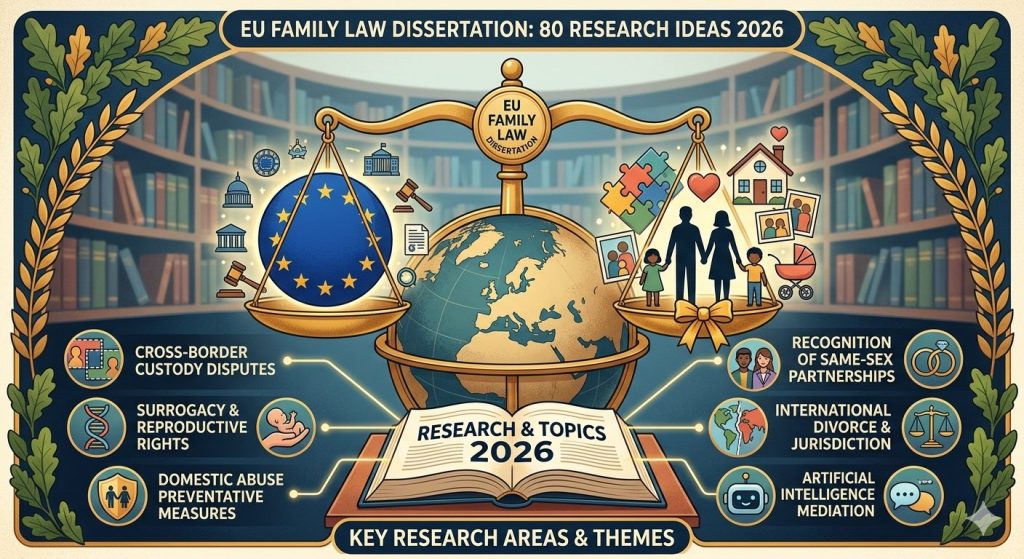
Before selecting a topic, it helps to understand the major research domains within EU and family law. These areas reflect current scholarly debate, legislative change, and real-world legal challenges.
Child Law and Parental Rights
This area explores questions around parental responsibility, child custody in international divorces, the rights of children in legal proceedings, and the application of the UN Convention on the Rights of the Child within EU member states.
Cross-Border Family Disputes and EU Regulations
With freedom of movement across the EU, family law increasingly operates across national borders. Research in this area looks at how EU regulations such as Brussels IIb govern jurisdiction, recognition of judgments, and the enforcement of orders across member states.
Domestic Violence and Legal Protection Frameworks
This domain examines how national and EU law protect victims of domestic abuse, the effectiveness of protection orders, and the legal barriers that survivors face in different jurisdictions.
Marriage, Civil Partnership, and Divorce Law
Comparative research in this area considers how different EU member states approach marriage validity, cohabitation rights, no-fault divorce, and the financial consequences of relationship breakdown.
Assisted Reproduction and Surrogacy Law
This is a rapidly developing area of law. Research topics here often examine the legal parenthood of children born through surrogacy, the rights of egg and sperm donors, and the inconsistency of national laws across the EU.
Child Abduction and International Family Law
The 1980 Hague Convention on international child abduction remains central to this area. Researchers explore how EU law interacts with international frameworks and where gaps in protection exist.
Family Law and Human Rights
Article 8 of the European Convention on Human Rights, which protects the right to family life, underpins much of modern family law. Research in this area connects legal doctrine with fundamental rights principles.
Five Example Dissertation Topics with Research Aims and Objectives
These examples are provided to help you understand how to structure a dissertation topic academically. Each example includes a clear aim and two to three focused objectives.
Example 1: Cross-Border Parental Responsibility Under Brussels IIb
Research Aim: To critically evaluate how Brussels IIb has reformed cross-border parental responsibility disputes within the EU.
Objectives:
- To assess the procedural changes introduced by Brussels IIb compared to Brussels IIa.
- To analyse how courts in selected EU member states have applied the new provisions.
- To identify remaining gaps in the regulation’s approach to child welfare.
Example 2: Surrogacy and Legal Parenthood in EU Member States
Research Aim: To examine the inconsistency of surrogacy laws across EU member states and their impact on legal parenthood.
Objectives:
- To compare the legal frameworks governing surrogacy in France, Germany, and Spain.
- To evaluate how courts resolve parenthood disputes arising from cross-border surrogacy.
- To assess whether EU-level harmonisation is legally and politically feasible.
Example 3: Domestic Abuse and the Istanbul Convention in EU Law
Research Aim: To analyse the effectiveness of the Istanbul Convention in strengthening domestic abuse protections across the EU.
Objectives:
- To review the implementation of the Istanbul Convention by EU member states.
- To examine case law from the European Court of Human Rights related to domestic violence.
- To propose recommendations for closing legislative gaps in protection frameworks.
Example 4: No-Fault Divorce Reform and Its Legal Implications
Research Aim: To evaluate the legal and social implications of no-fault divorce reform with reference to recent legislative changes in England, Wales, and selected EU countries.
Objectives:
- To outline the historical context of fault-based divorce and the rationale for reform.
- To compare no-fault divorce implementation across multiple jurisdictions.
- To assess the impact of reform on financial remedy proceedings and child arrangements.
Example 5: The Right to Family Life Under Article 8 ECHR in Deportation Cases
Research Aim: To critically examine how Article 8 of the ECHR is balanced against immigration control in family deportation cases.
Objectives:
- To review the jurisprudence of the European Court of Human Rights on Article 8 and deportation.
- To assess how UK and EU courts apply proportionality in family deportation decisions.
- To evaluate whether current legal standards adequately protect the rights of children in such cases.
80 Family Law and EU Law Dissertation Topics for 2026
The topics below are suitable for undergraduate, LLM, and PhD students. They are organised by subfield and numbered in sequential ranges for easy navigation. These are designed to be narrow, researchable, and academically relevant for 2026.
Child Custody and Parental Responsibility
- How do EU courts determine habitual residence in international child custody disputes?
- The impact of parental alienation on custody decisions in English family courts.
- Comparing shared parenting models across France, Germany, and Sweden.
- How do family courts balance a child’s wishes against their welfare in custody proceedings?
- The role of CAFCASS in shaping parental responsibility outcomes in England and Wales.
- How Brussels IIb changes enforcement of parental responsibility orders across member states.
- Parental responsibility for unmarried fathers: a comparative study of EU member states.
- How do courts assess the risk of harm in relocation applications involving children?
- The influence of attachment theory on judicial decisions in custody cases.
- Child-inclusive mediation in parental disputes: legal frameworks and practical outcomes.
Domestic Violence and Legal Protections
- The effectiveness of non-molestation orders in protecting domestic abuse survivors in England.
- How does EU law address coercive control as a form of domestic abuse?
- Comparing criminal justice responses to domestic abuse across five EU member states.
- The Istanbul Convention and its influence on legislative reform in Eastern EU states.
- Legal barriers faced by migrant women accessing domestic abuse protections in the UK.
- How do family courts handle domestic abuse allegations in contested child arrangements?
- The adequacy of legal aid provision for domestic abuse survivors in family proceedings.
- Digital stalking and harassment: gaps in EU legal frameworks for victim protection.
- Honour-based violence and the law: comparing prosecution outcomes across EU jurisdictions.
- The effectiveness of domestic violence disclosure schemes in safeguarding at-risk individuals.
Divorce, Financial Remedies, and Cohabitation
- How has the Divorce, Dissolution and Separation Act 2020 changed financial remedy proceedings?
- The legal position of cohabiting couples on relationship breakdown in England and Wales.
- Comparing matrimonial property regimes across EU member states after Brexit.
- How do courts approach financial claims where one spouse has hidden assets?
- The impact of prenuptial agreements on financial remedy outcomes in English law.
- Child maintenance enforcement: assessing the effectiveness of the Child Maintenance Service.
- Pension sharing in divorce: how adequately does the law protect financially weaker spouses?
- A comparative analysis of cohabitation rights reform in Ireland, Scotland, and England.
- How do courts apply the sharing principle in high-net-worth divorce cases?
- The legal recognition of domestic contributions in financial remedy proceedings.
Cross-Border Family Law and EU Regulations
- How does Brussels IIb improve cooperation between EU member states in family disputes?
- Jurisdiction challenges in international divorce proceedings involving non-EU nationals.
- Enforcing contact orders across EU borders: a critical analysis of current mechanisms.
- The impact of Brexit on cross-border family law proceedings between the UK and EU.
- How do EU regulations address the recognition of same-sex marriages contracted abroad?
- Maintenance obligations across borders: the operation of the EU Maintenance Regulation.
- How do national courts resolve conflicts between EU regulations and domestic family law?
- International family relocation: balancing parental rights and children’s welfare in EU courts.
- The role of central authorities in cross-border child abduction cases under the Hague Convention.
- EU succession law and its interaction with cross-border family property disputes.
Surrogacy, Assisted Reproduction, and Legal Parenthood
- Legal parenthood in commercial surrogacy arrangements: an EU comparative analysis.
- How do English courts respond to parenthood disputes arising from international surrogacy?
- The rights of egg and sperm donors in EU fertility law: an evolving framework.
- Regulating altruistic surrogacy in the UK: is the current framework fit for purpose?
- Donor anonymity and the right to genetic identity in EU member states.
- Legal recognition of pre-birth parentage orders for intended parents in surrogacy cases.
- How should the EU address the legal status of children born from unregulated surrogacy?
- The use of artificial intelligence in fertility clinics and its legal implications for parenthood.
- Posthumous reproduction and the legal rights of children born after a parent’s death.
- Comparative regulation of embryo storage and ownership disputes across EU jurisdictions.
Child Abduction and International Protection
- How effectively does the 1980 Hague Convention protect children in cross-border abduction cases?
- Grave harm exceptions under the Hague Convention: how courts apply them in practice.
- Parental child abduction and the right to family life under Article 8 ECHR.
- How Brussels IIb strengthens mechanisms for returning abducted children within the EU.
- The role of mediation in resolving international parental abduction disputes.
- Child abduction cases involving non-Hague Convention states: legal challenges and solutions.
- How do courts weigh a child’s objection to return in Hague Convention proceedings?
- Domestic violence and the grave harm defence in cross-border abduction cases.
- The impact of Covid-19 on Hague Convention proceedings and child return timelines.
- Cultural and religious considerations in international child abduction judgments.
Family Law and Human Rights
- How does Article 8 ECHR apply in cases involving children placed in care?
- The right to family life and immigration detention: a critical analysis of EU case law.
- LGBTQ+ families and the right to recognition under EU and ECHR frameworks.
- How do courts balance freedom of religion with child welfare in family proceedings?
- The right to family reunification for refugees under EU law.
- Forced marriage and the role of law in protecting individuals’ right to consent.
- The legal rights of grandparents to contact with grandchildren under UK and EU law.
- How does EU law protect the rights of children with disabilities in family proceedings?
- The right to identity: how family law addresses unknown paternity and donor conception.
- Corporate liability and family rights: how employment law intersects with parental leave protections.
Marriage, Civil Partnership, and Emerging Family Structures
- Legal recognition of polyamorous relationships: where does EU family law stand?
- How do EU member states treat marriages contracted under Islamic law?
- Same-sex parenting and legal parenthood: a comparative study across EU jurisdictions.
- The legal consequences of void and voidable marriages in English family law.
- How civil partnership law has evolved post-same-sex marriage legalisation in the UK.
- The rights of step-parents in child arrangement proceedings.
- Legal protection for de facto families across EU member states.
- How do courts approach religious ceremonies that do not meet legal marriage requirements?
- Assessing the legal recognition of customary marriages within the EU.
- The evolving legal definition of the family unit: implications for EU social and family law.
How to Pick a Family Law Dissertation Topic
Students often ask how to pick a Family Law dissertation topic that is both manageable and academically meaningful. Here is a practical approach.
Start with an area, not a question. Choose a subfield that genuinely interests you, such as child law, domestic abuse, or surrogacy. From there, you can narrow your focus.
Think about what is changing. Family law is always evolving. New legislation, court judgments, and policy debates create fresh research opportunities. Looking at recent reform proposals is a strong starting point.
Consider your academic level. Dissertation topics in Family Law for LLM students typically require deeper comparative or doctrinal analysis than undergraduate topics. PhD students are expected to make an original contribution to legal knowledge.
Narrow your scope deliberately. A topic like “child custody law” is too broad. A topic like “how courts in England and Wales apply the welfare checklist in relocation disputes” is focused and researchable.
Check for existing literature. You want enough scholarly material to engage with, but also a gap your research can fill. If every angle of a topic is exhausted, consider a related but under-explored perspective.
If you are unsure where to begin, consulting academic resources or seeking online dissertation help from experienced legal researchers can help you clarify your ideas faster.
Conclusion
Selecting the right dissertation topic is not just a formality. It shapes the quality of your research, the clarity of your argument, and the confidence with which you complete your degree.
This post has presented 80 original, narrowly focused dissertation topics across core areas of EU and family law. Whether you are working on an undergraduate project, preparing dissertation topics on Family Law for PhD students, or completing an LLM thesis, the ideas here are designed to match the expectations of 2026 academic research.
The best topic is one that you can defend intellectually, research rigorously, and engage with honestly. Use this list as a starting point, refine your ideas with your supervisor, and approach your work with the academic integrity it deserves.
Legal scholarship advances when students ask the right questions. Your dissertation is your opportunity to contribute to that process.
