


Human Rights Law Dissertation Topics for 2026

Questions Students Are Asking About Human Rights Law Dissertations
The following questions have been gathered from student forums, academic discussion boards, and university support platforms. They reflect the real concerns students face when choosing a dissertation topic in Human Rights Law.
- What are the most relevant Human Rights Law dissertation topics for 2026?
- How do I pick a Human Rights Law dissertation topic that is academically strong?
- What are suitable Human Rights Law dissertation topics for an undergraduate student?
- Which topics in Human Rights Law work well for a PhD dissertation?
- Are there Human Rights Law project topics in the UK for a BA dissertation?
- What are the current research trends shaping Human Rights Law thesis topics in 2025 and beyond?
- How do I narrow down a broad idea into a focused dissertation title?
- Can I get Human Rights Law dissertation topics as a PDF to review offline?
If you have asked yourself any of these questions, this post is written for you. It covers everything you need to move from uncertainty to a clear, academically grounded dissertation topic.
Why Choosing the Right Human Rights Law Dissertation Topic Matters
Choosing a dissertation topic in Human Rights Law is one of the most important academic decisions you will make during your degree. Human rights as a legal discipline sits at the intersection of international law, constitutional law, political theory, and social justice. It evolves rapidly in response to global crises, legal reform, and shifting power structures.
A well-chosen topic allows you to contribute meaningfully to a field that affects real people in real ways. Whether you are exploring refugee rights, digital surveillance, or climate displacement, your research has the potential to engage with live legal debates. Students who pick vague or overly broad topics often struggle to build a coherent argument. Students who pick sharp, clearly scoped topics tend to produce stronger dissertations and receive better supervision support.
The purpose of this post is to give you an honest, structured overview of the field and present 80 original Human Rights Law dissertation topics that are ready to research in 2026.
Download Human Rights Law Dissertation Topics PDF
Many students find it helpful to review topic lists offline or share them with their supervisors early in the planning process. A downloadable PDF containing a personalised selection of Human Rights Law dissertation topics, curated by academic experts, is available for students at all levels. You can access your copy by completing a short academic preferences form, after which the PDF is sent directly to you. This resource is particularly useful during initial supervisor meetings and research proposal drafting.
Key Research Areas in Human Rights Law
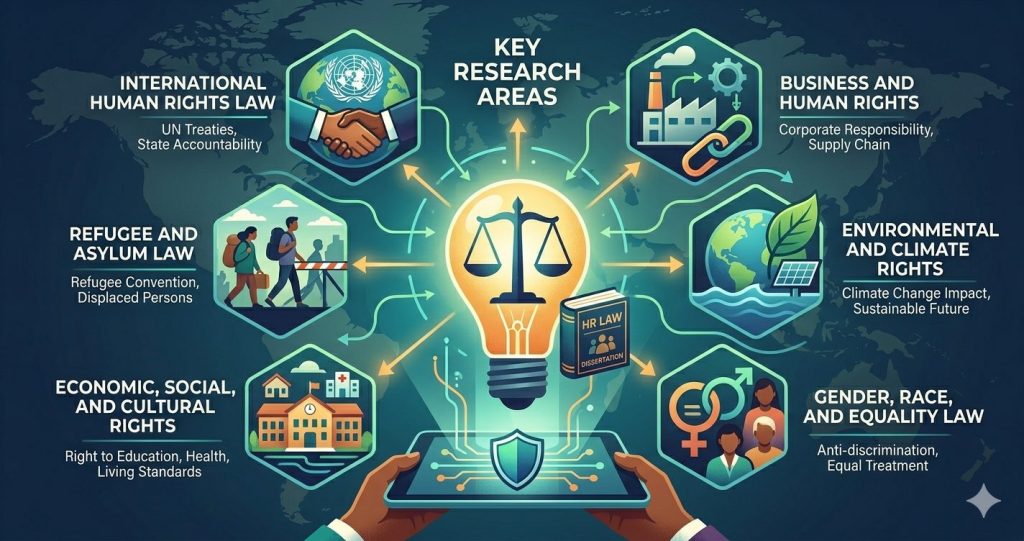
Before exploring specific topics, it helps to understand the core subfields within Human Rights Law. These are the established academic domains where most dissertation research is conducted.
International Human Rights Law
This area covers the frameworks created by United Nations treaties, regional human rights conventions, and customary international law. Research often focuses on enforcement mechanisms, state accountability, and treaty body effectiveness.
Refugee and Asylum Law
This subfield examines the legal protection of displaced persons under domestic and international frameworks. Topics here often engage with the 1951 Refugee Convention, border policies, and statelessness.
Economic, Social, and Cultural Rights
This area addresses rights to education, housing, health, and an adequate standard of living. It explores how these rights are justiciable and how states are held accountable for their progressive realisation.
Digital Rights and Surveillance
Emerging rapidly as a significant research area, this subfield looks at how privacy, freedom of expression, and data protection intersect with state and corporate power in digital environments.
Gender, Race, and Equality Law
This domain analyses how discrimination operates within legal systems and how equality law is applied across different identities, particularly in employment, criminal justice, and family law.
Environmental and Climate Rights
This growing area of Human Rights Law examines how environmental degradation and climate change affect the enjoyment of fundamental rights, including the right to life, health, and a clean environment.
Business and Human Rights
This subfield engages with corporate responsibility, supply chain accountability, and the UN Guiding Principles on Business and Human Rights. It explores how non-state actors are increasingly held to human rights standards.
Five Example Dissertation Topics with Research Aims and Objectives
Understanding how a dissertation topic is structured academically is just as important as selecting the right subject. The five examples below demonstrate how a focused topic, a clear research aim, and well-defined objectives work together.
Example 1: Statelessness and the Right to Nationality
Research Aim: To examine the legal gaps in international frameworks that leave stateless persons without effective protection of their right to nationality.
Research Objectives:
- To analyse the existing international legal instruments addressing statelessness, including the 1954 and 1961 Conventions
- To evaluate the limitations of current enforcement mechanisms in addressing long-term statelessness
- To identify reforms that could improve the legal protection of stateless persons in contemporary state practice
Example 2: Digital Surveillance and the Right to Privacy in the UK
Research Aim: To critically assess the compatibility of the UK’s surveillance legislation with Article 8 of the European Convention on Human Rights.
Research Objectives:
- To evaluate the legal framework governing state surveillance under the Investigatory Powers Act 2016
- To examine relevant case law from the European Court of Human Rights on privacy and surveillance
- To assess whether existing safeguards are sufficient to protect individuals from disproportionate interference
Example 3: Corporate Accountability and Forced Labour in Global Supply Chains
Research Aim: To investigate the effectiveness of international and domestic legal mechanisms in addressing forced labour within multinational supply chains.
Research Objectives:
- To review the UN Guiding Principles on Business and Human Rights in the context of supply chain regulation
- To analyse the UK Modern Slavery Act 2015 and its practical application
- To identify gaps between legal obligations and corporate compliance in high-risk industries
Example 4: Climate Displacement and the Limits of Refugee Law
Research Aim: To examine whether existing refugee law adequately protects individuals displaced by the effects of climate change.
Research Objectives:
- To analyse the definition of “refugee” under the 1951 Convention in light of climate-induced displacement
- To evaluate recent domestic court decisions and their treatment of climate refugees
- To propose legal reforms that would extend protection to climate-displaced persons
Example 5: Children’s Rights in Armed Conflict
Research Aim: To assess the legal protection available to children affected by armed conflict under international humanitarian and human rights law.
Research Objectives:
- To examine obligations under the UN Convention on the Rights of the Child and its Optional Protocol on Armed Conflict
- To analyse the accountability mechanisms available when children’s rights are violated during conflict
- To evaluate the effectiveness of international criminal law in prosecuting crimes against children
80 Human Rights Law Dissertation Topics for 2026
The following topics are organised by subfield and are suitable for undergraduate, master’s, and PhD research. Each topic is designed to be narrow, researchable, and academically relevant for 2026-level expectations. If you need support narrowing any of these further, online dissertation help from academic professionals can guide you through the process.
International Human Rights Law and Treaty Systems
- The effectiveness of the UN Human Rights Council’s Universal Periodic Review in promoting state compliance
- The role of reservations to human rights treaties and their impact on international obligations
- Derogation clauses in human rights treaties and their misuse during public health emergencies
- The justiciability of economic and social rights under UN treaty bodies
- The impact of non-state actors on the development of customary international human rights law
- Regional human rights systems compared: Africa, Europe, and the Americas
- The accountability gap in the UN Security Council’s engagement with human rights crises
- How human rights treaty monitoring bodies respond to systematic violations
- The relationship between international humanitarian law and human rights law in conflict zones
- Extraterritorial obligations of states under international human rights law
Refugee Law and Forced Displacement
- The protection of climate-displaced persons under current international refugee law
- Statelessness among the Rohingya and the failure of international legal mechanisms
- Non-refoulement and its application to asylum seekers at sea
- Safe third country agreements and their compatibility with the 1951 Refugee Convention
- Gender-based persecution and the legal definition of a particular social group in refugee law
- The legal status of internally displaced persons under international law
- Pushback policies at European borders and their compatibility with human rights obligations
- Child asylum seekers and the application of the best interests principle in UK courts
- Statelessness and the right to nationality in post-conflict societies
- Refugee rights and access to healthcare during public health emergencies
Digital Rights, Surveillance, and Privacy
- Artificial intelligence in predictive policing and the right to non-discrimination
- Biometric surveillance in public spaces and its compatibility with ECHR Article 8
- The right to be forgotten and its application across jurisdictions after Brexit
- Government access to encrypted communications and the balance with privacy rights
- Social media censorship and freedom of expression under international human rights frameworks
- Algorithmic decision-making in welfare systems and the right to an effective remedy
- Data retention laws and the European Court of Human Rights
- The human rights implications of facial recognition technology in policing
- Digital identity systems and exclusion: a human rights analysis
- Cyber warfare and state obligations under international human rights law
Gender, Race, and Equality Rights
- Structural racism in criminal justice systems and human rights accountability in the UK
- The legal recognition of non-binary gender identities under European human rights law
- Femicide as a human rights violation: adequacy of state response in international law
- Intersectionality in anti-discrimination law: limits of single-axis frameworks
- Caste-based discrimination and international human rights obligations
- Equal pay litigation and the limitations of domestic equality law in the UK
- Religious accommodation in the workplace and Article 9 of the ECHR
- The human rights dimensions of reproductive autonomy following Dobbs v Jackson
- Discrimination against persons with disabilities in criminal sentencing
- Racial profiling in counter-terrorism law and the right to equality
Economic, Social, and Cultural Rights
- The right to housing and homelessness policy in England: a human rights critique
- Socioeconomic rights in the UK and the case for a British Bill of Rights
- The right to education and exclusion of children with special educational needs
- Food insecurity as a human rights issue in high-income countries
- Minimum wage legislation and the progressive realisation of economic rights
- The justiciability of the right to health in domestic courts
- Cultural rights of indigenous communities under international law
- Austerity measures and their compatibility with international human rights obligations
- Access to justice as a socioeconomic right: barriers for low-income litigants in the UK
- The human right to water and its recognition in domestic legal systems
Environmental and Climate Rights
- The right to a clean, healthy, and sustainable environment in international law post-2022
- Climate litigation and its contribution to the development of human rights norms
- Intergenerational equity and the rights of future generations in environmental law
- Environmental defenders and the protection of human rights activists in resource-rich states
- The duty of states to regulate corporate contributions to climate change
- Small island developing states and the right to life in the context of sea level rise
- Environmental racism and the disproportionate impact of pollution on marginalised communities
- The human rights implications of carbon offsetting schemes
- Biodiversity loss as a human rights concern under emerging international frameworks
- Domestic courts and climate obligations: lessons from Urgenda and beyond
Business and Human Rights
- The limitations of the UK Modern Slavery Act 2015 in addressing supply chain abuses
- Mandatory human rights due diligence legislation in Europe and its extraterritorial reach
- The accountability of multinational corporations for human rights violations abroad
- The role of National Contact Points in enforcing the OECD Guidelines for Multinational Enterprises
- Investor-state dispute settlement and its chilling effect on human rights regulation
- Human rights obligations in the fast fashion industry
- Tech companies and complicity in authoritarian surveillance: a human rights analysis
- The effectiveness of voluntary corporate social responsibility frameworks
- Land grabbing, dispossession, and the human rights of rural communities
- Artificial intelligence development companies and emerging human rights responsibilities
Children’s Rights and Vulnerable Groups
- Child poverty in the UK and state obligations under the UN Convention on the Rights of the Child
- The rights of unaccompanied migrant children at European borders
- Age assessment procedures for asylum-seeking children and the right to a fair process
- Online child exploitation and the adequacy of legal protections in the UK
- The criminalisation of children and the minimum age of criminal responsibility
- Children in armed conflict: accountability gaps in international criminal law
- The rights of children born to incarcerated parents under human rights law
- Child marriage as a human rights violation: the gap between law and practice
- The best interests of the child principle and family reunification in immigration law
- Mental health rights of young people in the UK and state obligations under the ECHR
How to Pick a Human Rights Law Dissertation Topic
Choosing between 80 well-developed options can still feel overwhelming. Here is a practical approach to narrowing down your choice.
Start with the subfield, not the title. Identify which area of Human Rights Law genuinely interests you. If you find yourself reading articles about climate litigation or digital surveillance in your own time, those areas are worth exploring.
Match the topic to your academic level. Undergraduate dissertations benefit from a clearly defined domestic or regional focus. Master’s dissertations should engage critically with legal doctrine and policy. PhD research requires an original contribution to knowledge, which means identifying a genuine gap in existing legal scholarship.
Check for existing literature. A researchable topic has enough academic material to engage with but is not so saturated that adding something new is impossible. Search databases such as Westlaw, HeinOnline, and JSTOR early in your planning.
Consult your supervisor. No list of topics, however carefully curated, replaces a conversation with your academic supervisor. Share your shortlist early and ask which topics align with departmental expertise. Students who seek online dissertation help from qualified professionals during the proposal stage often report feeling significantly more confident moving forward.
Narrow before you write. The most common mistake in dissertation topic selection is remaining too broad. A topic like “refugee law and human rights” is a field, not a research question. Something like “the legal treatment of LGBTQ+ asylum claims in UK tribunals post-2019” is a research question.
Conclusion
Human Rights Law is one of the most dynamic and socially significant fields of legal study available to students today. From digital rights to climate displacement, from corporate accountability to children’s protection, the discipline continues to expand in response to real-world developments.
The 80 dissertation topics presented in this post represent original, academically grounded starting points for 2026 research. They are designed to help you move from a vague interest in human rights to a specific, defensible, and researchable topic.
Choosing wisely at this stage sets the tone for your entire dissertation. A clear topic leads to a coherent research question, which leads to a structured argument, which leads to a stronger final submission. That process begins here, with an honest reflection on what aspect of Human Rights Law you want to understand more deeply.
Approach your dissertation with curiosity, academic integrity, and confidence. The field needs engaged, thoughtful researchers, and your work has the potential to contribute to it in a meaningful way.
