


Medical Law Dissertation Topics for 2026

Questions Students Are Asking About Medical Law Dissertations
The following questions have been gathered from student forums, academic discussion boards, and higher education Q&A platforms. They reflect the real concerns students face when choosing dissertation topics in medical law.
- What are the most relevant medical law dissertation topics for 2026 that will impress my supervisor?
- How do I find medical law dissertation ideas that are narrow enough to research but broad enough to write 10,000 words on?
- Are there good medical law dissertation topics for PhD students that connect with current NHS or global health policy debates?
- Where can I find medical law dissertation topics in the UK that align with LLB, LLM, or GDL research expectations?
- What makes a strong medical law thesis topic for an LLM research project?
- Can I get a medical law research proposal for LLB students that covers patient rights or clinical negligence?
- What are some medical law project topics for GDL level research that are both academically sound and practically relevant?
If any of these questions sound familiar, this post has been written with you in mind. It will walk you through the landscape of medical law as an academic discipline, explain what makes a strong dissertation topic, and provide 80 carefully selected topics to help you move forward with confidence.
Why Choosing the Right Medical Law Dissertation Topic Matters
Medical law sits at the intersection of healthcare practice, ethics, human rights, and legal regulation. It is one of the most dynamic and socially significant areas of legal study. Choosing the right topic is not simply a procedural step. It shapes your entire research journey, determines the quality of the argument you can build, and signals to your academic panel that you understand the contemporary challenges facing healthcare law.
A poorly chosen topic can leave you struggling for sources, chasing arguments that go nowhere, or writing a dissertation that feels disconnected from real-world legal debates. On the other hand, a well-chosen topic gives you direction, keeps you motivated, and demonstrates scholarly awareness. Students who need guidance at any stage of this process often seek online dissertation help to ensure their topic is framed correctly before they begin writing.
The topics that perform well academically in 2026 are those that engage with current developments. Think about artificial intelligence in clinical decision-making, post-Brexit healthcare regulation, evolving patient autonomy frameworks, and ongoing debates around end-of-life care. These are not just trending themes. They are areas where the law is genuinely unsettled, which means there is genuine space for original argument and analysis.
Download Medical Law Dissertation Topics PDF
Many students prefer to review their options offline or share a shortlist with their supervisor before committing to a topic. A downloadable PDF containing a personalised list of medical law dissertation topics, curated by academic experts with backgrounds in law and healthcare policy, is available for students at all levels including LLB, LLM, GDL, and PhD.
After completing a short form with a few academic details, students receive the PDF directly. The list is tailored to the student’s level and area of interest, making it a practical resource for those who want expert input during the topic selection stage.
Key Research Areas in Medical Law
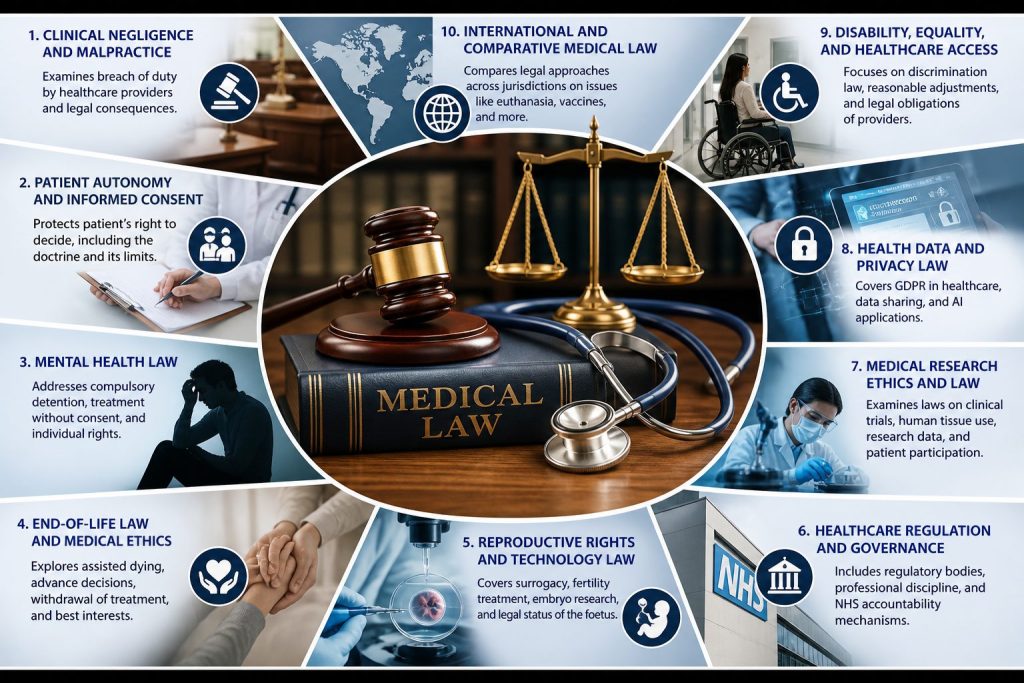
Before selecting a topic, it helps to understand the major subfields within medical law. These are established academic domains, each containing rich research possibilities.
Clinical Negligence and Malpractice: This area examines when healthcare providers fall below the standard of care owed to patients, and what the legal consequences are. It involves tort law principles applied to a clinical context.
Patient Autonomy and Informed Consent: This covers how the law protects a patient’s right to make decisions about their own body, including the legal doctrine of informed consent and its limits.
Mental Health Law: This field addresses the legal frameworks governing compulsory detention, treatment without consent, and the rights of individuals with psychiatric conditions.
End-of-Life Law and Medical Ethics: Topics here explore assisted dying, advance decisions, the withdrawal of treatment, and the role of best interests decisions.
Reproductive Rights and Technology Law: This area covers surrogacy, fertility treatment, embryo research, and the legal status of the foetus.
Healthcare Regulation and Governance: This includes how regulatory bodies such as the GMC and CQC operate, professional discipline, and NHS accountability mechanisms.
Medical Research Ethics and Law: This field examines the legal rules governing clinical trials, the use of human tissue, data in research, and patient participation.
Health Data and Privacy Law: This area has grown significantly due to digitalisation, covering GDPR compliance in healthcare, data sharing, and artificial intelligence applications.
Disability, Equality, and Healthcare Access: Topics here look at discrimination law in healthcare, reasonable adjustments, and the legal obligations of NHS trusts.
International and Comparative Medical Law: This area examines how different jurisdictions approach similar problems, such as euthanasia regulation or vaccine law, providing a comparative analytical lens.
Five Example Dissertation Topics with Aims and Objectives
Understanding how a dissertation topic is structured will help you frame your own idea effectively. The following examples demonstrate how a broad interest becomes a focused, researchable dissertation.
Example 1: Informed Consent in Emergency Medicine
Research Aim: To examine whether the current legal framework governing informed consent adequately protects patient autonomy in emergency medical situations in England and Wales.
Objectives:
- To analyse the legal standard of informed consent established in Montgomery v Lanarkshire Health Board [2015] and its application in emergency contexts.
- To evaluate the adequacy of the Mental Capacity Act 2005 in protecting unconscious patients in emergency settings.
- To assess whether legislative reform is needed to address the gap between clinical practice and legal expectation in emergency care.
Example 2: AI-Assisted Diagnosis and Clinical Liability
Research Aim: To determine how existing clinical negligence law can be applied when artificial intelligence tools contribute to a misdiagnosis in the NHS.
Objectives:
- To identify the legal challenges in attributing liability when an AI diagnostic tool fails to detect a condition correctly.
- To examine whether the Bolam and Bolitho standards remain appropriate for evaluating AI-assisted clinical decisions.
- To consider whether new legislation is required to create a distinct liability framework for AI in healthcare.
Example 3: The Legal Status of Advance Decisions in England
Research Aim: To critically assess the legal effectiveness of advance decisions to refuse treatment under the Mental Capacity Act 2005.
Objectives:
- To examine the formal validity requirements for advance decisions and the challenges these create in practice.
- To evaluate judicial interpretation of advance decisions in cases involving life-sustaining treatment.
- To consider whether the current legislative framework sufficiently respects patient autonomy at end of life.
Example 4: Surrogacy Law Reform in the United Kingdom
Research Aim: To evaluate whether the current legal framework governing surrogacy in the UK adequately protects the rights of all parties involved.
Objectives:
- To analyse the limitations of the Surrogacy Arrangements Act 1985 in the context of contemporary surrogacy practices.
- To examine the recommendations of the Law Commission’s 2023 report and their implications for legislative reform.
- To compare the UK’s approach with international models of surrogacy regulation.
Example 5: Mental Health Detention and Human Rights Compliance
Research Aim: To assess whether the Mental Health Act 1983 (as amended) is compatible with Article 5 and Article 8 of the European Convention on Human Rights.
Objectives:
- To examine the criteria for compulsory detention and whether they meet the proportionality standard under the ECHR.
- To analyse recent case law in which detained patients have successfully challenged their treatment under human rights law.
- To evaluate the extent to which the proposed Mental Health Act reform will strengthen ECHR compliance.
80 Medical Law Dissertation Topics for 2026
The following 80 topics are organised by subfield. Each topic is designed to be narrow enough to be researchable within a dissertation word limit, while remaining academically significant. These are suitable for undergraduate, master’s, and doctoral research proposals.
Clinical Negligence and Medical Liability
- The application of the Montgomery standard to cases involving risks that patients did not specifically ask about in NHS outpatient settings.
- Whether vicarious liability principles are adequate to hold NHS trusts accountable for negligent acts by locum doctors.
- The role of causation in clinical negligence claims following delayed cancer diagnosis in England and Wales.
- How courts determine the standard of care for junior doctors in NHS training programmes.
- The legal implications of the Bolam test in cases involving contested evidence from expert medical witnesses.
- Whether the current limitation period under the Limitation Act 1980 is appropriate for victims of long-term medical negligence.
- The legal consequences of inadequate surgical record-keeping for clinical negligence litigation.
- How the duty of candour obligation under the Health and Social Care Act 2008 affects clinical negligence outcomes.
- Whether apology legislation would reduce the volume of clinical negligence claims brought against NHS trusts.
- The extent to which NHS Resolution data reflects systemic failures in clinical negligence prevention across NHS England.
Artificial Intelligence, Technology, and Healthcare Law
- How liability should be attributed when an AI system used in radiology produces a false negative result that leads to patient harm.
- Whether the UK’s existing product liability framework under the Consumer Protection Act 1987 is adequate for AI medical devices.
- The ethical and legal implications of using predictive AI algorithms to triage patients in emergency departments.
- How data protection law under the UK GDPR governs the training of AI models on NHS patient records.
- The legal challenges of obtaining meaningful informed consent when AI tools are involved in clinical decision-making.
- Whether AI-generated clinical documentation is admissible as evidence in medical negligence proceedings.
- How regulatory frameworks for medical devices should be adapted to account for continuously learning AI systems.
- The responsibilities of NHS trusts when deploying AI diagnostic tools that have not been validated on diverse patient populations.
- Legal accountability gaps when AI systems in mental health support applications provide harmful advice.
- How international medical law frameworks are responding to the deployment of autonomous surgical robots.
Patient Autonomy and Informed Consent
- Whether the Montgomery judgment has been consistently applied by courts in cases involving patients with limited health literacy.
- The legal adequacy of verbal consent processes in routine NHS surgical procedures following Montgomery.
- How informed consent law applies to participants in early-phase clinical trials where risk data is incomplete.
- The extent to which language barriers undermine the legal validity of informed consent in NHS hospitals.
- How the law protects patient autonomy when a healthcare professional disagrees with a competent patient’s treatment refusal.
- Whether digital consent platforms used by NHS trusts meet the legal requirements established by Montgomery.
- The adequacy of consent law for patients with fluctuating capacity under the Mental Capacity Act 2005.
- How courts have balanced patient autonomy and clinical judgement in cases involving Jehovah’s Witness patients refusing blood transfusions.
- The legal implications of using decision aids to support patient choice in elective surgery consultations.
- Whether children’s developing autonomy is adequately recognised under the Gillick competence test in contemporary clinical settings.
End-of-Life Law and Assisted Dying
- A critical analysis of whether the current law on assisted dying in England and Wales is compatible with Article 8 ECHR following Nicklinson.
- How clinicians legally navigate best interests decisions for patients in a prolonged disorder of consciousness.
- The legal and ethical tensions between advance decisions and best interests assessments under the Mental Capacity Act 2005.
- Whether the Terminally Ill Adults (End of Life) Act, if enacted, adequately protects vulnerable patients from coercion.
- How Scottish law approaches withdrawal of clinically assisted nutrition and hydration compared with the law in England.
- The legal framework governing palliative sedation in England and whether it requires clearer statutory guidance.
- How DNACPR decisions are made lawfully and whether current NHS guidance is consistent with legal requirements.
- Whether the Court of Protection is an effective mechanism for resolving end-of-life disputes between families and clinicians.
- The legal implications of a patient expressing a wish to die to a healthcare professional under current English law.
- How comparative analysis of assisted dying models in Belgium and Canada can inform potential law reform in the UK.
Mental Health Law
- Whether the criteria for detention under Section 2 of the Mental Health Act 1983 comply with the proportionality principle under Article 5 ECHR.
- How the inherent jurisdiction of the High Court has been used to fill gaps in the Mental Health Act 1983 framework.
- The adequacy of legal safeguards for patients subject to Community Treatment Orders in England and Wales.
- Whether the proposed Mental Health Act reforms will meaningfully reduce racial disproportionality in compulsory detention rates.
- The legal status of advance statements made by individuals with schizophrenia regarding their future psychiatric treatment.
- How deprivation of liberty safeguards under the Mental Capacity Act 2005 interact with mental health detention powers.
- Whether current mental health law adequately addresses the needs of autistic individuals who are detained in psychiatric units.
- The legal and ethical implications of using coercive interventions, including physical restraint, in inpatient psychiatric settings.
- How the law governs capacity assessments for detained patients who refuse medication for a physical health condition.
- Whether Tribunal processes under the Mental Health Act 1983 provide meaningful access to justice for detained patients.
Reproductive Rights and Technology Law
- Whether the legal framework governing surrogacy in the UK adequately protects the welfare and rights of surrogate mothers.
- The legal implications of post-mortem reproduction using stored gametes following the death of a partner in England.
- How the Human Fertilisation and Embryology Act 2008 addresses the rights of donor-conceived children to access their genetic origins.
- The extent to which UK abortion law, including the Abortion Act 1967, respects the reproductive autonomy of women.
- How the law regulates the selection of embryos on genetic grounds and whether current limits are ethically justified.
- The legal status of embryos created through IVF in the context of relationship breakdown and disputes over future use.
- Whether the regulation of mitochondrial donation under the Human Fertilisation and Embryology (Mitochondrial Donation) Regulations 2015 is legally adequate.
- How UK law responds to the phenomenon of transnational commercial surrogacy and the parental orders that follow.
- The legal consequences of reproductive negligence in fertility clinics, including wrongful implantation of the wrong embryo.
- Whether the current legal framework adequately protects the rights of single men seeking parenthood through surrogacy.
Health Data, Privacy, and Digital Health Law
- How NHS data-sharing agreements for research purposes comply with the principles of the UK GDPR.
- The legal implications of secondary use of patient data by private technology companies contracted by the NHS.
- Whether current legal frameworks provide adequate protection against re-identification risks in anonymised health datasets.
- How patients can exercise their rights of access and erasure under data protection law in relation to NHS medical records.
- The lawfulness of continuous health monitoring through wearable devices under UK data protection and medical device regulation.
- Whether the NHS App’s data handling practices comply with the legal standards expected of a data controller under UK GDPR.
- The legal risks of using patient data collected through NHS digital tools to train commercial artificial intelligence models.
- How cross-border health data transfers between the UK and EU are governed following Brexit and the UK adequacy decision.
- The legal adequacy of cybersecurity obligations imposed on NHS trusts that process sensitive health data.
- Whether the use of facial recognition technology in NHS hospital settings is lawful under the UK’s biometric data rules.
Healthcare Regulation, Governance, and Professional Accountability
- Whether the General Medical Council’s fitness-to-practise procedures adequately protect patients while ensuring procedural fairness for doctors.
- How the Care Quality Commission enforces fundamental standards under the Health and Social Care Act 2008 following high-profile NHS failures.
- The legal implications of NHS whistleblower protections following the Public Interest Disclosure Act 1998 in clinical settings.
- Whether NHS trusts are legally liable for inadequate staffing levels that contribute to patient harm.
- How integrated care systems established under the Health and Care Act 2022 affect legal accountability in NHS commissioning.
- The extent to which public inquiries, such as the Ockenden Review, influence legal reform in maternity care regulation.
- Whether the Fit and Proper Persons Requirement for NHS senior managers provides an effective governance mechanism.
- How medical practitioners can be held legally accountable for providing unproven treatments in private practice.
- The legal framework governing overseas-qualified doctors registering with the GMC in a post-Brexit regulatory environment.
- Whether existing legal mechanisms are sufficient to address systemic failures in GP referral practices that delay specialist treatment.
Conclusion
Medical law is one of the richest and most consequential areas of legal research available to students in 2026. The topics in this post reflect the real tensions between advancing medicine, evolving technology, shifting policy landscapes, and the enduring principles of human rights and patient dignity. Choosing a topic wisely means choosing one that speaks to a genuine legal problem, where analysis can add something of scholarly value.
Whether you are working on a medical law research proposal for LLB students or crafting a detailed medical law thesis topic for an LLM research project, the most important thing is to select a question you can genuinely engage with at depth. A strong dissertation is not about covering everything. It is about saying something meaningful and well-argued about one carefully defined legal issue.
Use the topics and examples in this post as a starting point. Speak with your supervisor early. Read widely before narrowing your focus. And approach your dissertation as an opportunity to contribute to an important and evolving area of law. The challenges facing healthcare law today are significant, and the legal scholarship produced by students like you plays a role in shaping how they are understood and resolved.
