


Child Health Nursing Dissertation Topics for 2026

Students frequently share their confusion about dissertation topic selection on academic forums, Reddit communities, and university discussion boards. The questions below reflect what real students are asking as they begin their research journey in child health nursing.
- What are the best child health nursing dissertation topics for 2026 that are still researchable?
- Which child health nursing research topics suit a master’s-level student with limited clinical access?
- How do I choose a dissertation topic in child health nursing that is both original and academically sound?
- Are there any new research topics in child health nursing related to mental health or digital technology?
- What child health nursing thesis topics are appropriate for a PhD-level research proposal?
- Can I find a list of child health nursing dissertation topics sorted by subfield or research area?
- Which topics in child health nursing are currently trending in UK academic journals?
Why Child Health Nursing Dissertation Topics Matter in 2026
Choosing the right dissertation topic is one of the most important academic decisions a nursing student will make. In child health nursing, this decision carries extra weight because the field directly affects the health, wellbeing, and development of children from birth through adolescence. A well-chosen topic reflects the student’s understanding of clinical realities, current policy challenges, and the evolving needs of paediatric care.
In 2026, the field sits at a fascinating intersection of public health reform, mental health awareness, technological innovation, and post-pandemic recovery. Students who align their research with these real-world priorities are more likely to produce impactful, publication-worthy work. Whether you are writing at undergraduate, master’s, or PhD level, the foundation of a strong dissertation always begins with a clearly focused and academically justified topic.
If you are feeling overwhelmed about where to start, you are not alone. Many students reach out for online dissertation help at precisely this stage, wanting guidance on how to narrow their focus without losing academic rigour. This post is designed to support that process from start to finish.
Download Child Health Nursing Dissertation Topics PDF
Students who want a personalised selection of dissertation topics can access a curated PDF prepared by academic experts in child health nursing. This resource is available after completing a short form, through which experts tailor the topic list to your academic level, research interests, and institutional requirements. The PDF offers a practical starting point for students at any stage of the dissertation planning process.
Key Research Areas in Child Health Nursing
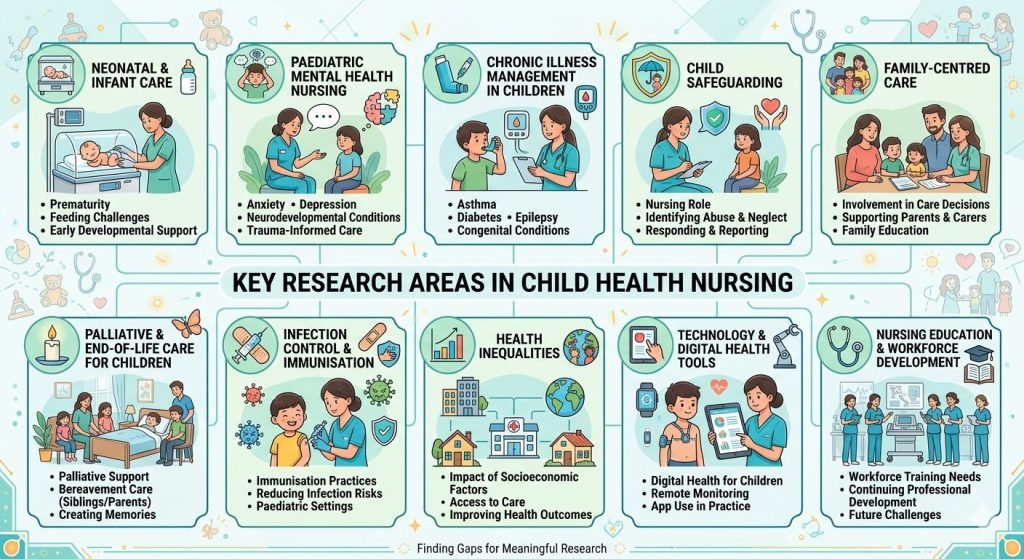
Child health nursing is a broad discipline that encompasses clinical, psychological, social, and policy-driven dimensions of paediatric care. Understanding the key research areas helps students identify where their interests naturally align and where the academic literature currently has gaps worth exploring.
- Neonatal and infant care, including prematurity, feeding challenges, and early developmental support
- Paediatric mental health nursing, covering anxiety, depression, neurodevelopmental conditions, and trauma-informed care
- Chronic illness management in children, such as asthma, diabetes, epilepsy, and congenital conditions
- Child safeguarding and the nursing role in identifying and responding to abuse or neglect
- Family-centred care and the involvement of parents and carers in clinical decision-making
- Palliative and end-of-life care for children, including sibling and parental bereavement support
- Infection control and immunisation practices in paediatric settings
- Health inequalities and the impact of socioeconomic factors on children’s health outcomes
- Technology and digital health tools in paediatric nursing practice
- Nursing education and workforce development in child health settings
Each of these areas contains numerous potential dissertation topics. The most successful dissertations tend to focus on one clearly defined question within a single area rather than trying to cover multiple themes simultaneously.
Five Example Child Health Nursing Research Topics with Aims and Objectives
The following examples demonstrate how a strong dissertation topic is structured. Each includes a research aim and two to three clearly stated objectives. These models can help students understand how to move from a broad interest to a focused, researchable question.
1. The Role of Play Therapy in Managing Procedural Anxiety in Hospitalised Children Aged 4 to 10
Research Aim: To evaluate how structured play therapy interventions reduce procedural anxiety in school-age children receiving inpatient care.
Objectives:
- To identify play therapy approaches currently used in NHS paediatric wards
- To assess children’s self-reported anxiety levels before and after play therapy sessions
- To examine nursing staff perceptions of the effectiveness of play therapy in clinical settings
2. Nurses’ Experiences of Delivering Mental Health Support to Adolescents in Acute Paediatric Settings
Research Aim: To explore the challenges and strategies that child health nurses encounter when providing mental health care to adolescent patients in non-specialist acute settings.
Objectives:
- To document the types of mental health presentations commonly encountered by nurses in paediatric wards
- To identify the training gaps reported by nurses working with adolescent mental health needs
- To explore nurses’ recommendations for improving mental health support pathways in acute care
3. Parental Involvement in the Care of Critically Ill Neonates: A Qualitative Exploration
Research Aim: To understand how parents of critically ill neonates experience involvement in care decisions within neonatal intensive care units.
Objectives:
- To explore parents’ perceptions of being included or excluded from clinical decision-making
- To examine the communication strategies used by NICU nurses to support parental involvement
- To identify factors that facilitate or hinder effective family-centred care in neonatal settings
4. The Effectiveness of Digital Health Apps in Supporting Self-Management Among Adolescents with Type 1 Diabetes
Research Aim: To evaluate the impact of NHS-approved digital health applications on glycaemic control and self-management behaviours in adolescents aged 13 to 18 with type 1 diabetes.
Objectives:
- To review the available evidence on digital app use in paediatric diabetes management
- To assess adolescent engagement with app-based monitoring tools over a six-month period
- To determine the relationship between app usage frequency and HbA1c outcomes
5. Childhood Vaccine Hesitancy and the Role of Community Child Health Nurses in Building Parental Trust
Research Aim: To investigate the strategies that community child health nurses use to address vaccine hesitancy and improve immunisation uptake among hesitant families.
Objectives:
- To identify the most common reasons cited by parents for hesitancy towards childhood vaccination
- To explore the communication techniques child health nurses use when engaging with hesitant families
- To assess whether nurse-led education sessions improve vaccination rates in targeted communities
80 Child Health Nursing Dissertation Topics for 2026
The following 80 dissertation topics are organised by subfield and are suitable for undergraduate, master’s, and PhD-level research. Each topic is narrowly focused, academically credible, and aligned with current directions in child health nursing research. Students are encouraged to select a topic that resonates with their clinical experience, academic interests, and available resources.
Neonatal Nursing and Infant Care
- 1. Skin-to-skin contact and its effect on pain response in premature neonates during heel-stick procedures
- 2. Nurses’ perceptions of family-centred care implementation in level 3 neonatal intensive care units
- 3. The impact of noise reduction protocols on sleep quality and weight gain in preterm infants
- 4. Breastfeeding support provided by NICU nurses and its relationship to long-term breastfeeding duration
- 5. Developmental care practices and their influence on neurological outcomes in very low birth weight infants
- 6. Parental anxiety during NICU admission and the effectiveness of nurse-led psychological support interventions
- 7. The role of music therapy in reducing physiological stress markers in neonates undergoing mechanical ventilation
- 8. Kangaroo mother care and its effect on thermoregulation in late preterm infants in low-resource settings
- 9. Discharge readiness assessment tools used in NICUs and their predictive validity for re-admission rates
- 10. The experiences of fathers during their infant’s NICU admission and the adequacy of nursing support received
Paediatric Mental Health Nursing
- 11. Child health nursing thesis topics exploring nurses’ competency in identifying early signs of paediatric depression in primary care
- 12. The effectiveness of trauma-informed care training for nurses working with children who have experienced domestic violence
- 13. Barriers to timely CAMHS referral from acute paediatric settings and the nursing role in navigating them
- 14. Nurses’ experiences of managing self-harm incidents among adolescents admitted to general paediatric wards
- 15. The relationship between autism spectrum disorder diagnosis delay and paediatric nursing assessment practices
- 16. Social prescribing as a nursing intervention for children experiencing loneliness and poor mental wellbeing
- 17. Compassion fatigue among child health nurses working with young people in crisis: a qualitative exploration
- 18. The impact of inpatient eating disorder care on nursing staff emotional burden and professional identity
- 19. How child health nurses communicate diagnoses of anxiety disorder to children aged 8 to 12 and their families
- 20. School nursing interventions for children with ADHD and their influence on classroom engagement and family coping
Chronic Illness Management in Children
- 21. Nurse-led asthma education programmes and their effect on emergency department attendance rates in children
- 22. Transition from paediatric to adult services for young people with cystic fibrosis: the nursing role in care continuity
- 23. Insulin management adherence in children with type 1 diabetes and the effectiveness of peer-support nursing models
- 24. The psychosocial impact of living with juvenile idiopathic arthritis on school-age children and nursing support strategies
- 25. Medication adherence challenges in children with epilepsy and the role of community child health nurses
- 26. Paediatric obesity management programmes led by clinical nurse specialists and their long-term effectiveness
- 27. Sleep disturbance in children with sickle cell disease and the nursing interventions that improve sleep outcomes
- 28. The role of specialist nurses in supporting children with congenital heart disease during hospital-to-home transitions
- 29. Nutritional assessment practices used by paediatric nurses in children with inflammatory bowel disease
- 30. Child health nurses’ role in reducing hospital-acquired complications in children receiving long-term immunosuppressive therapy
Child Safeguarding and Nursing Practice
- 31. Nurses’ confidence and competence in recognising physical indicators of child abuse in emergency departments
- 32. The impact of mandatory safeguarding training on nurses’ reporting behaviour in paediatric outpatient settings
- 33. Disclosure of abuse by children during nursing assessments and how nurses respond in practice
- 34. The role of the named nurse for safeguarding in coordinating multi-agency child protection plans
- 35. Challenges experienced by community nurses in identifying fabricated or induced illness in children
- 36. Cultural competence in safeguarding assessments: how child health nurses approach diverse family structures
- 37. The nursing role in supporting children who have experienced female genital mutilation within NHS settings
- 38. Electronic documentation systems and their influence on safeguarding referral accuracy and timeliness
- 39. Exploitation and county lines: child health nurses’ awareness of modern slavery indicators in adolescent patients
- 40. Re-referral patterns in child safeguarding and whether earlier nursing intervention could reduce repeat risk
Family-Centred Care and Parental Involvement
- 41. How child health nurses negotiate care decisions with parents who hold views conflicting with clinical recommendations
- 42. The experiences of single parents navigating their child’s chronic illness care within the NHS nursing system
- 43. Language barriers and family-centred care: how paediatric nurses support non-English-speaking parents
- 44. The role of grandparents as primary carers in paediatric settings and nursing approaches to inclusive care
- 45. Parental presence during invasive procedures in paediatric care and its influence on child distress and recovery
- 46. Sibling inclusion in family-centred care planning and the nursing support available to healthy siblings
- 47. Divorce and co-parenting conflict in paediatric settings: how child health nurses maintain a child-first approach
- 48. The emotional needs of parents of children with terminal illness and the adequacy of nursing support pathways
- 49. Parental sleep deprivation while caring for a hospitalised child and its impact on nursing communication practices
- 50. New research topics in child health nursing focused on digital communication tools that enhance nurse-to-parent information sharing
Paediatric Palliative and End-of-Life Care
- 51. How child health nurses communicate prognosis to children aged 6 to 12 with life-limiting conditions
- 52. The bereavement support offered to siblings after the death of a child in a paediatric palliative care setting
- 53. Nurses’ moral distress when caring for children at the end of life in acute rather than hospice settings
- 54. Advance care planning for children with complex needs and the nursing role in facilitating difficult conversations
- 55. The use of narrative medicine techniques by paediatric palliative care nurses to support child and family coping
- 56. Cultural and religious considerations in paediatric end-of-life care and their influence on nursing practice
- 57. The effectiveness of children’s hospice outreach nursing teams in reducing unplanned hospital admissions
- 58. Nurses’ experiences of providing care continuity across home, hospice, and hospital in complex paediatric cases
- 59. Spiritual care provision by child health nurses in palliative settings and the training required to deliver it effectively
- 60. Parental grief after neonatal death in hospital: an evaluation of nursing bereavement support protocols
Immunisation, Infection Control, and Public Health Nursing
- 61. Child health nursing thesis ideas for UK students exploring vaccination uptake in areas with historically low coverage
- 62. Nurse-led immunisation clinics and their impact on HPV vaccine completion rates in secondary schools
- 63. The influence of social media on parental vaccine decision-making and nursing strategies for countering misinformation
- 64. Infection prevention practices in paediatric outpatient settings and their effectiveness in reducing nosocomial infection
- 65. Community child health nurses and their role in managing tuberculosis contact tracing in paediatric populations
- 66. Group B streptococcal infection prevention: an evaluation of antenatal and neonatal nursing practice
- 67. School nurses and the management of meningococcal disease outbreaks: preparedness and response capacity
- 68. Antibiotic stewardship in paediatric wards and the nursing contribution to prescribing culture change
- 69. Respiratory syncytial virus prevention in high-risk infants and the adequacy of current nursing guidance
- 70. The role of health visiting nurses in improving uptake of the six-in-one primary vaccination schedule
Technology, Health Inequalities, and Workforce Development
- 71. Telehealth consultations in community child health nursing and their effectiveness for families in rural areas
- 72. The use of wearable monitoring technology in paediatric wards and implications for nursing observation practice
- 73. Child health nursing research thesis topics investigating artificial intelligence tools in early developmental screening
- 74. Health inequalities in child asthma outcomes across socioeconomic groups and the nursing advocacy role
- 75. The impact of food insecurity on children’s health in the UK and how school nurses identify and respond to it
- 76. Refugee children’s access to child health nursing services in the UK and barriers experienced by their families
- 77. Retention of child health nurses in the NHS post-pandemic: factors influencing job satisfaction and career longevity
- 78. Simulation-based training for paediatric emergency nursing and its impact on clinical decision-making confidence
- 79. The experiences of newly qualified child health nurses during their preceptorship period in specialist paediatric settings
- 80. Diversity and inclusion in child health nursing education and its influence on culturally competent graduate practice
Conclusion: Choosing Your Dissertation Topic with Confidence
Selecting a dissertation topic in child health nursing is a process that deserves time, reflection, and academic guidance. The 80 topics presented in this post cover a wide range of subfields, from neonatal nursing and safeguarding to palliative care and digital health, giving students at every level a solid foundation to begin their research planning.
The most important principle in topic selection is focus. A narrow, clearly defined question is far more manageable and academically rewarding than a broad ambition that cannot be addressed within the scope of a single dissertation. Students should also consider whether their topic can be supported by available literature, ethical approval processes, and data sources relevant to their institution.
Child health nursing research topics in 2026 are shaped by some of the most pressing healthcare challenges of our time. Students who approach their dissertation with genuine curiosity, academic integrity, and a commitment to improving outcomes for children and families will find the process both intellectually enriching and professionally rewarding.
If you are at an early stage and still building your research direction, take your time to review the topic categories in this post, reflect on your clinical experiences, and consult your supervisor about feasibility. The right topic is one that you can commit to, that the literature can support, and that contributes meaningfully to the wider field of child health nursing.
