


Community Health Nursing Dissertation Topics for 2026

Questions Students Are Asking Right Now
The questions below have been gathered from student forums, academic discussion groups, and higher education communities where nursing students share their struggles around dissertation research. If any of these feel familiar, this post was written with you in mind.
- How do I choose a potential dissertation topic related to Community Health Nursing that is original and academically strong?
- What are some trending research proposal ideas in Community Health Nursing for 2026?
- What are the best nursing dissertation topics in public health nursing for a master’s student?
- Are there research topics in Community Health Nursing in the UK that are still underexplored?
- What thesis topics are appropriate for PhD students in Community Health Nursing?
- Can I find a list of research topics in Community Health Nursing that are narrow enough to be feasible?
- Are there community health project ideas for nursing students at undergraduate level that supervisors will approve?
- How do I know if my dissertation topic is too broad or too vague?
Introduction
Choosing a dissertation topic in Community Health Nursing is one of the most important academic decisions you will make during your studies. The topic you select shapes your entire research journey, from your literature review to your methodology and your final conclusions. A strong topic reflects not only your academic interests but also the real-world challenges facing communities, health systems, and nursing practice today.
Community Health Nursing sits at the intersection of clinical care, public policy, social determinants of health, and preventive medicine. This makes it a rich and dynamic field for research, but it also means that students can feel overwhelmed by the sheer number of directions they could take. Whether you are looking for community research topics for nursing students at the undergraduate level or thesis topics for PhD students in Community Health Nursing, this post offers structured guidance, worked examples, and 80 original dissertation topics to help you move forward with confidence.
If you have already started searching for online dissertation help, you are not alone. Many students reach this point feeling uncertain. This post is designed to give you clarity.
Download Community Health Nursing Dissertation Topics PDF
Before exploring the full list of topics, it is worth knowing that students can receive a downloadable PDF containing a personalised selection of Community Health Nursing dissertation topics. This PDF is curated by academic specialists with direct experience in nursing research and higher education. Students can access it after completing a short academic preferences form, which allows the experts to tailor topic suggestions to the student’s level of study, area of interest, and institutional requirements. This is especially useful for students who want guidance beyond a general list.
Why Your Dissertation Topic in Community Health Nursing Matters
Selecting the right dissertation topic is not simply a formality. It is a foundational academic decision that affects the quality of your research, your motivation throughout the process, and the contribution your work makes to the nursing profession.
Community Health Nursing is a field driven by real human need. Research in this area has the potential to influence how communities access healthcare, how health inequalities are addressed, and how nursing roles evolve in response to public health challenges. A well-chosen topic allows you to contribute meaningfully to this conversation.
From an academic standpoint, your dissertation topic must be narrow enough to be researchable within your timeframe, broad enough to produce sufficient literature for review, and relevant to current debates in nursing and public health. It must also align with the level of study you are undertaking. Undergraduate topics tend to focus on specific practice areas or local community contexts. Master’s dissertations often explore policy implications or practice-based evidence. PhD-level research is expected to generate original knowledge and theoretical contribution.
Understanding these expectations early saves considerable time and prevents the frustration of reformulating your topic after supervision begins.
Key Research Areas in Community Health Nursing
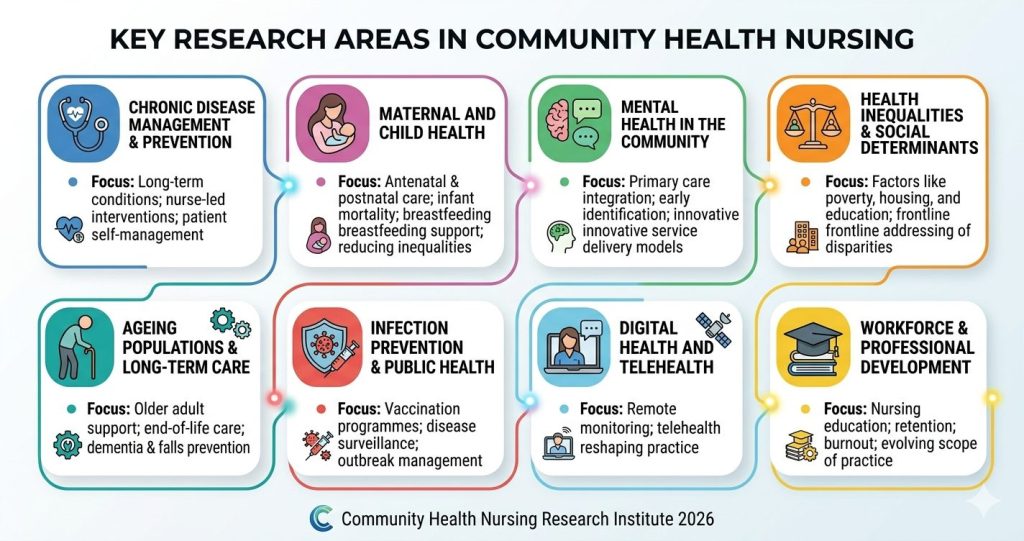
Community Health Nursing encompasses a wide range of subfields and intersecting disciplines. When exploring a list of research topics in Community Health Nursing, it helps to understand the main thematic areas from which strong dissertation topics typically emerge.
Chronic Disease Management and Prevention This area focuses on how community nurses support patients with long-term conditions such as diabetes, hypertension, and respiratory illness outside of hospital settings. Research here often examines nurse-led interventions, patient self-management, and healthcare utilisation.
Maternal and Child Health Topics in this area address antenatal and postnatal care in community settings, infant mortality, breastfeeding support, and the role of health visitors. There is growing interest in health inequalities affecting mothers from marginalised communities.
Mental Health in the Community With increasing demand for community-based mental health services, this area includes research on integration between primary care and mental health, the role of community nurses in early identification, and service delivery models.
Health Inequalities and Social Determinants Research in this area examines how factors such as poverty, housing, education, and ethnicity affect health outcomes. Community nurses are often at the frontline of addressing these disparities.
Ageing Populations and Long-Term Care With an ageing global population, research into how community nursing services support older adults, including end-of-life care, dementia, and falls prevention, remains critically important.
Infection Prevention and Public Health This area grew significantly following the COVID-19 pandemic and includes vaccination programmes, disease surveillance, and the community nurse’s role in outbreak management.
Digital Health and Telehealth An emerging and rapidly growing area examining how digital tools, remote monitoring, and telehealth platforms are reshaping community nursing practice.
Workforce and Professional Development Research in this area looks at nursing education, retention, burnout, and the evolving scope of practice for community nurses.
Five Example Dissertation Topics With Aims and Objectives
To understand how a dissertation topic should be constructed, the following five examples demonstrate how to frame a topic with a clear aim and supporting objectives. These examples are written to reflect realistic, academically appropriate research proposals.
Example 1
Topic: The Role of Community Nurses in Supporting Type 2 Diabetes Self-Management Among South Asian Adults in Urban UK Settings
Research Aim: To explore how community nurses facilitate self-management behaviours in South Asian adults diagnosed with Type 2 diabetes, and to identify barriers to effective nurse-patient engagement.
Research Objectives:
- To examine existing evidence on culturally sensitive diabetes education delivered by community nurses in the UK.
- To identify the perceived barriers and enablers of self-management reported by South Asian patients with Type 2 diabetes.
- To assess how community nursing practice could be adapted to improve health outcomes for this population group.
Example 2
Topic: Exploring Community Health Nurses’ Experiences of Identifying Postnatal Depression in First-Time Mothers During Home Visits
Research Aim: To investigate how community nurses identify and respond to signs of postnatal depression during routine home visits with first-time mothers.
Research Objectives:
- To review current evidence on postnatal depression screening tools used in community nursing settings.
- To explore community nurses’ lived experiences and confidence in identifying postnatal depression.
- To evaluate the adequacy of referral pathways available to community nurses when postnatal depression is suspected.
Example 3
Topic: Telehealth Adoption in Community Nursing: Barriers and Facilitators Among Older Adults With Multiple Long-Term Conditions
Research Aim: To assess the extent to which telehealth adoption in community nursing effectively supports older adults living with multiple chronic conditions, and to identify factors that hinder or support engagement.
Research Objectives:
- To review the literature on telehealth models used in community nursing for older adult populations.
- To identify patient-reported barriers to telehealth engagement among older adults with complex health needs.
- To explore the perspectives of community nurses on the integration of telehealth into their practice.
Example 4
Topic: Community Nurse-Led Interventions for Reducing Hospital Readmissions Among Patients With Chronic Obstructive Pulmonary Disease
Research Aim: To evaluate the effectiveness of community nurse-led post-discharge interventions in reducing unplanned hospital readmissions in patients with chronic obstructive pulmonary disease (COPD).
Research Objectives:
- To identify and appraise evidence on nurse-led COPD management models operating in community settings.
- To determine which intervention components are most consistently associated with reduced readmission rates.
- To recommend improvements to existing community-based COPD care pathways based on findings.
Example 5
Topic: The Impact of Housing Instability on Community Nursing Engagement: A Study of Homeless Adults in Urban Centres
Research Aim: To examine how housing instability affects the ability of community nurses to establish therapeutic relationships and deliver consistent care to homeless adults.
Research Objectives:
- To explore the current evidence base on community nursing practice with homeless and unstably housed populations.
- To identify the challenges community nurses face in maintaining continuity of care with this population.
- To assess how community nursing models could be adapted to better address the health needs of homeless adults.
80 Community Health Nursing Dissertation Topics for 2026
The following topics are organised by subfield to help you navigate by area of interest. Each topic is original, academically grounded, and suitable for 2026-level research. Many of these have relevance for students researching community research topics for nursing students at undergraduate, master’s, or PhD level.
Chronic Disease Management in Community Settings
- The effectiveness of community nurse-led medication adherence programmes for patients with hypertension in rural areas.
- Exploring the role of community nurses in supporting weight management interventions for adults with obesity-related comorbidities.
- Self-management support for patients with Type 2 diabetes: a comparison of nurse-led and peer-led community models.
- Community nursing approaches to managing heart failure in patients transitioning from acute to primary care.
- The influence of cultural beliefs on chronic disease self-management behaviours among migrant populations receiving community nursing support.
- Assessing the effectiveness of nurse-led asthma action plans in reducing emergency department admissions among children.
- Community nurse involvement in supporting patients with atrial fibrillation to adhere to anticoagulation therapy.
- Patient experiences of nurse-led structured education for Type 1 diabetes management in community settings.
- The role of community nurses in preventing diabetic foot complications through early identification and patient education.
- Evaluating nurse-led fatigue management programmes for patients with multiple sclerosis in community care.
Mental Health and Psychological Wellbeing
- Community nurses’ experiences of providing emotional support to carers of individuals with dementia.
- The effectiveness of community-based mental health liaison nursing in reducing psychiatric hospital admissions.
- Exploring barriers to mental health help-seeking behaviour among young men in community nursing catchment areas.
- Community nurses’ confidence and competence in identifying anxiety disorders during routine home visits.
- The role of community nursing in supporting recovery-oriented care for adults with schizophrenia.
- Stigma as a barrier to community mental health engagement: nurses’ perspectives and practice responses.
- Nurse-led psychoeducation programmes for families of individuals with bipolar disorder: a community-based analysis.
- Examining the relationship between social isolation and mental health deterioration in older adults known to community nursing services.
- The impact of community nurse check-ins on depression outcomes in adults living with chronic physical illness.
- Exploring the role of school nursing in identifying and referring children with emerging mental health difficulties.
Maternal, Child, and Family Health
- Community health visitors’ experiences of supporting teenage mothers during the first year of parenthood.
- Postnatal depression screening in community settings: a review of current tools and nurse confidence levels.
- Exploring the role of community nurses in improving breastfeeding rates among low-income mothers.
- The effectiveness of family nurse partnership programmes in supporting vulnerable first-time mothers.
- Community nursing support for fathers during the perinatal period: current evidence and practice gaps.
- Health visitor interventions for reducing infant obesity risk in the first twelve months of life.
- Community nurse involvement in identifying and responding to domestic abuse during antenatal home visits.
- The role of community nursing in reducing childhood immunisation refusal in vaccine-hesitant families.
- Experiences of community nurses working with asylum-seeking mothers in the UK perinatal period.
- An exploration of how community nurses support parents of premature infants following hospital discharge.
geing, Dementia, and End-of-Life Care
- The role of community nurses in preventing falls and fall-related injuries among older adults living at home.
- Nurse-led dementia case management: evaluating outcomes for patients and carers in community settings.
- Community nurses’ experiences of communicating end-of-life care preferences with patients who lack mental capacity.
- Assessing the adequacy of palliative care training among community nursing teams in rural UK regions.
- The effectiveness of community nursing visits in enabling older adults to remain living at home for longer.
- Community nurses’ perceptions of their role in advance care planning conversations with older adults.
- Exploring carer burnout among family members of older adults receiving community nursing support.
- The impact of frailty identification programmes led by community nurses on hospital admission rates.
- Community nursing support for older adults with sensory impairments: identifying unmet needs and service gaps.
- Experiences of community nurses providing end-of-life care in urban versus rural settings.
Health Inequalities and Social Determinants of Health
- The relationship between socioeconomic deprivation and access to community nursing services in urban areas.
- How do community nurses address health literacy barriers when working with low-income patients?
- Exploring ethnic health inequalities in community nursing caseloads: challenges and practice implications.
- The role of community nursing in addressing food insecurity among patients with chronic health conditions.
- Housing as a determinant of health: how community nurses identify and respond to poor living conditions.
- Community nurses’ awareness and application of the NHS Core20PLUS5 framework in daily practice.
- Barriers to community nursing engagement experienced by Gypsy, Roma, and Traveller communities.
- Exploring health inequalities experienced by LGBTQ+ adults in community nursing environments.
- The role of community health nurses in reducing the impact of digital exclusion on health outcomes for older adults.
- How community nurses identify and support patients affected by adverse childhood experiences (ACEs).
Infection Prevention, Vaccination, and Public Health
- Community nurses’ role in improving seasonal influenza vaccination uptake among adults with long-term conditions.
- The impact of the COVID-19 pandemic on community nursing practice: a retrospective qualitative study.
- Exploring vaccine hesitancy in community nursing populations and nurse-led strategies to address it.
- Community nursing involvement in antimicrobial stewardship: current practice and education needs.
- Wound infection prevention in community settings: an evaluation of current nurse-led protocols.
- The effectiveness of community nurse-led tuberculosis contact tracing programmes in high-prevalence areas.
- Exploring community nurses’ experiences of managing patients with catheter-associated urinary tract infections at home.
- Community nursing practice in responding to seasonal norovirus outbreaks in care home environments.
- The role of community health nursing in supporting national screening programmes for bowel and cervical cancer.
- How community nursing services contributed to COVID-19 vaccination delivery in underserved communities.
Digital Health, Telehealth, and Technology in Practice
- Community nurses’ attitudes towards and experiences of using electronic patient records in daily practice.
- Telehealth consultations for community nursing: patient satisfaction and clinical outcomes across age groups.
- The effectiveness of remote blood pressure monitoring programmes supervised by community nursing teams.
- Exploring digital health literacy among community nurses and its impact on technology adoption.
- Patient experiences of video consultations replacing community nursing home visits post-pandemic.
- Artificial intelligence tools in community nursing assessment: opportunities, risks, and ethical considerations.
- Community nurses’ experiences of using wearable technology data to monitor patients with chronic heart failure.
- How nurse-led online health education platforms influence self-care behaviour in patients with diabetes.
- Barriers and enablers to telehealth adoption in community nursing services serving older rural populations.
- Examining the equity implications of shifting community nursing consultations to digital platforms.
Workforce, Education, and Professional Development
- Exploring the causes and consequences of burnout among community nurses in NHS primary care networks.
- The impact of preceptorship programmes on newly qualified community nurses’ confidence and clinical competence.
- Community nurses’ perceptions of their professional autonomy and scope of practice following NHS restructuring.
- How community nursing students experience the transition from academic learning to placement-based practice.
- Retention challenges in community nursing: a qualitative analysis of nurses leaving primary care settings.
- The effectiveness of clinical supervision in supporting the mental health and resilience of community nurses.
- Community nurse educators’ experiences of developing culturally competent curricula for nursing students.
- The role of advanced nurse practitioners in reshaping community nursing service delivery models.
- How continuing professional development opportunities influence career satisfaction among experienced community nurses.
- Exploring the impact of staffing shortages on the quality and safety of community nursing care delivery.
How to Choose the Right Community Health Nursing Dissertation Topic
Selecting from a list of research topics in Community Health Nursing is only the first step. Once you have identified a topic that interests you, you need to assess whether it is academically viable. The following considerations will help you make a confident decision.
Assess the scope of your topic. A good dissertation topic is specific enough to be manageable but broad enough to support a meaningful literature review. Avoid topics that are too narrow to produce enough published evidence and too broad to answer within word count limits.
Check for existing literature. Before committing to a topic, search databases such as CINAHL, PubMed, and MEDLINE. If you find a rich body of literature, your topic has strong foundations. If the evidence is very sparse, consider whether that is a research gap worth exploring or a sign that the topic lacks academic traction.
Align with your level of study. Undergraduate dissertations typically focus on reviewing evidence and drawing practice implications. Master’s dissertations often involve primary research or critical policy analysis. PhD students are expected to contribute original knowledge to the field.
Consider ethical feasibility. Research involving patients, vulnerable populations, or sensitive health data requires ethical approval. Make sure your topic is one you can pursue within your institution’s ethical framework and within your study timeline.
Talk to your supervisor early. Your dissertation supervisor is your most valuable academic resource. Sharing two or three topic ideas in an early meeting will allow them to guide you towards the most feasible and academically appropriate choice. Students who access online dissertation help alongside supervisor guidance often feel better prepared for this conversation.
Conclusion
Choosing a Community Health Nursing dissertation topic for 2026 is both a challenge and an opportunity. The field is evolving rapidly, driven by changes in public health priorities, advances in digital care delivery, growing awareness of health inequalities, and the continued development of community nursing as a specialist and autonomous profession.
The 80 topics in this post reflect a wide range of subfields and research directions. They have been designed to be academically sound, narrowly focused, and relevant to the current landscape of community health nursing in the UK and beyond. Whether you are at undergraduate, master’s, or PhD level, there is a topic in this list that can be shaped into a strong dissertation proposal.
The most important step you can take now is to begin. Narrow your interests, read around a few topic areas, and engage with your supervisor as early as possible. A well-chosen dissertation topic gives you a solid academic foundation, keeps you motivated throughout the research process, and ultimately produces work that contributes to the nursing profession in a meaningful way.
Research in Community Health Nursing matters. The questions you ask in your dissertation today can shape how communities are cared for tomorrow.
