


Critical Care Nursing Dissertation Topics for 2026

What Students Are Asking About Critical Care Nursing Dissertations
These questions have been gathered from student forums, academic discussion groups, and higher education platforms. They reflect the real concerns students face when trying to choose a focused and relevant dissertation topic in critical care nursing.
- How do I choose a dissertation topic for Critical Care Nursing that is both original and academically appropriate?
- What are some good research topics in Critical Care Nursing that are relevant in 2026?
- What Critical Care Nursing issue should I do my dissertation on if I am at undergraduate level?
- Are there Critical Care Nursing dissertation topics for undergraduate students that are different from master’s or PhD topics?
- What recent research topics in critical care nursing are universities currently prioritising?
- Where can I find ideas for my dissertation in Critical Care Nursing that are narrow enough to research?
- How do I know if my chosen topic is suitable for a research proposal?
If any of these questions feel familiar, this post is written with you in mind.
Why Choosing the Right Dissertation Topic in Critical Care Nursing Matters
Choosing a dissertation topic is one of the most consequential academic decisions a nursing student will make. In critical care nursing, where the stakes of clinical practice are especially high, your research topic must do more than fulfil a university requirement. It must contribute meaningfully to an area of practice that affects patient survival, staff wellbeing, and healthcare system resilience.
A well-chosen topic gives your research direction and purpose. It ensures you are asking a question that is answerable within your timeframe, supported by existing literature, and grounded in real clinical challenges. A poorly chosen topic, on the other hand, can lead to unfocused writing, methodological difficulties, and a dissertation that lacks academic impact.
If you are feeling uncertain about where to begin, seeking online dissertation help from experienced academic mentors can provide early-stage guidance that saves considerable time later. The sections below are designed to help you understand the field, explore research areas, and ultimately select a topic with confidence.
Download Critical Care Nursing Dissertation Topics PDF
Students who want a tailored list of dissertation topics in critical care nursing can access a downloadable PDF prepared by academic subject specialists. This resource includes a curated selection of topics suited to different degree levels and research interests. The PDF is made available to students after they complete a short form, allowing the team to personalise the topic list based on the student’s level of study and area of focus.
Key Research Areas in Critical Care Nursing
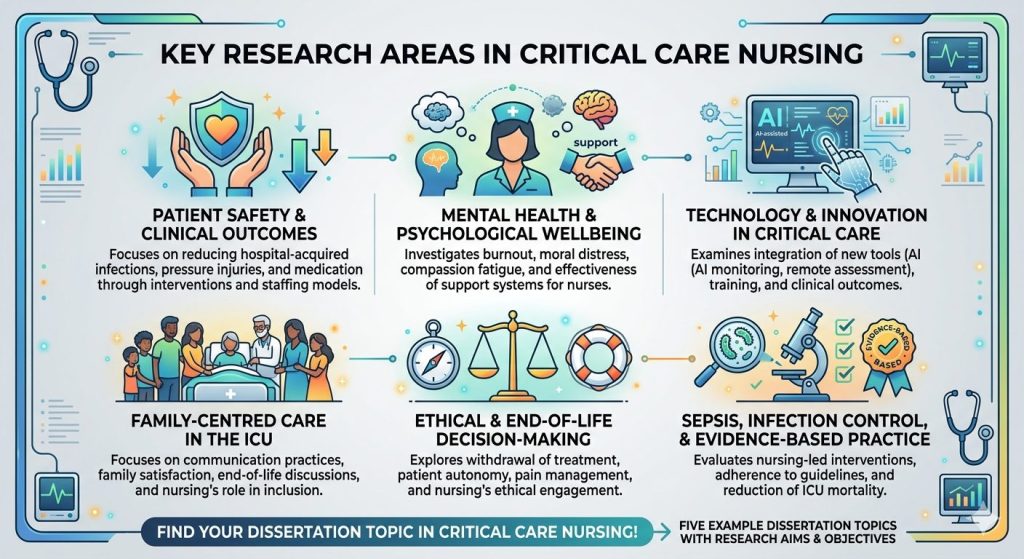
Critical care nursing as a field covers a wide range of clinical, organisational, and ethical dimensions. Students exploring critical care nursing research topics will find that the field broadly falls into the following established research domains.
Patient Safety and Clinical Outcomes
This area examines how nursing interventions, staffing models, and clinical protocols affect patient outcomes in intensive care units (ICUs) and high-dependency settings. Research in this domain typically focuses on reducing preventable harm, including hospital-acquired infections, pressure injuries, and medication errors.
Mental Health and Psychological Wellbeing of Critical Care Nurses
The emotional and psychological burden on nurses working in critical care environments is a growing concern. Research in this area investigates burnout, moral distress, compassion fatigue, and the effectiveness of organisational support systems.
Technology and Innovation in Critical Care
From artificial intelligence-assisted monitoring to remote patient assessment, technology is transforming critical care nursing. Research topics in this area examine how new tools are integrated into practice, the training required, and whether digital innovations improve clinical outcomes.
Family-Centred Care in the ICU
There is increasing recognition that patients in critical care settings benefit from the involvement of family members in care decisions. Research in this domain looks at communication practices, family satisfaction, end-of-life discussions, and the role of nurses in facilitating inclusive care.
Ethical and End-of-Life Decision-Making
Critical care nurses frequently engage with complex ethical questions, including withdrawal of treatment, patient autonomy, and the management of pain at the end of life. This research domain draws on both clinical and philosophical frameworks.
Sepsis, Infection Control, and Evidence-Based Practice
Sepsis remains one of the leading causes of ICU mortality. Research in this area evaluates nursing-led interventions, the implementation of evidence-based guidelines, and barriers to adherence in real clinical settings
Five Example Dissertation Topics with Research Aims and Objectives
The following examples illustrate how a strong critical care nursing dissertation topic is structured. Each includes a clear aim and two to three supporting objectives.
Example 1: Nurse-to-Patient Ratios and ICU Mortality
Research Aim: To examine the relationship between nurse-to-patient staffing ratios and patient mortality rates in adult intensive care units in NHS England.
Objectives:
- To review existing literature on staffing ratios and patient outcomes in critical care settings.
- To analyse staffing data from NHS trusts alongside publicly available mortality statistics.
- To identify staffing thresholds associated with significantly higher patient risk.
Example 2: Burnout Among Critical Care Nurses Post-Pandemic
Research Aim: To explore the long-term psychological impact of the COVID-19 pandemic on burnout levels among critical care nurses in the United Kingdom.
Objectives:
- To assess levels of burnout among critical care nurses using validated measurement tools.
- To identify organisational and personal factors that predicted higher burnout rates.
- To evaluate whether existing wellbeing support programmes have been effective.
Example 3: Family Communication During End-of-Life Care in the ICU
Research Aim: To investigate how critical care nurses communicate with families of patients during end-of-life care, and what barriers exist to effective communication.
Objectives:
- To explore nurses’ perceptions of their role in end-of-life family communication.
- To identify communication barriers reported by nurses and family members in ICU settings.
- To recommend evidence-based strategies for improving family communication practices.
Example 4: Use of Artificial Intelligence Tools in ICU Patient Monitoring
Research Aim: To evaluate nursing staff attitudes towards AI-assisted monitoring systems in intensive care units and the perceived impact on clinical decision-making.
Objectives:
- To identify the AI monitoring tools currently in use across critical care units in the UK.
- To explore nurses’ confidence in, and concerns about, relying on AI-generated patient data.
- To assess the training needs associated with implementing AI monitoring in practice.
Example 5: Sepsis Recognition and Nursing Response Time
Research Aim: To examine how early sepsis recognition by critical care nurses affects response times and patient survival outcomes.
Objectives:
- To review current sepsis screening protocols in use within adult ICUs.
- To evaluate the correlation between time-to-treatment and mortality in nurse-identified sepsis cases.
- To identify factors that delay sepsis recognition in critical care environments.
80 Critical Care Nursing Dissertation Topics for 2026
The following dissertation topics are organised by subfield. All topics are original, researchable, and appropriate for undergraduate, master’s, or PhD-level proposals in 2026.
Patient Safety and Clinical Quality
- The impact of nursing handover communication on patient safety incidents in adult ICUs.
- Frequency and causes of medication administration errors in critical care units in the UK.
- The role of early warning scores in reducing cardiac arrest incidence in ICU patients.
- Nurse-led pressure injury prevention protocols and their effectiveness in long-term ventilated patients.
- Central line-associated bloodstream infections and the influence of nursing compliance with insertion bundles.
- Evaluating the accuracy of nurses’ clinical judgement in identifying patient deterioration without electronic monitoring.
- Falls prevention strategies in step-down units and their application to post-ICU patients.
- The relationship between documentation quality and adverse event rates in critical care settings.
- Nursing shift length and its association with clinical errors in intensive care environments.
- The effectiveness of standardised nursing checklists in reducing ventilator-associated pneumonia rates.
Staffing, Workload, and Workforce Issues
- How nurse-to-patient ratios in NHS ICUs compare with international benchmarks and their effect on outcomes.
- Temporary staffing and bank nurse deployment in critical care: implications for continuity of care.
- The relationship between ICU nurse workload and patient readmission rates within 48 hours.
- Retention strategies for experienced critical care nurses in NHS trusts post-2020.
- The effect of mandatory overtime on clinical performance and patient safety in intensive care.
- How charge nurse leadership style influences team performance in critical care environments.
- Exploring the impact of skill mix on nursing-sensitive outcomes in adult ICUs.
- Graduate nurse transition programmes in critical care: challenges and recommendations.
- Perceptions of newly qualified nurses about entering critical care immediately after registration.
- The role of preceptorship in reducing early attrition among critical care nursing staff.
Psychological Wellbeing and Mental Health of Nurses
- Moral distress experiences among critical care nurses during resource-limited scenarios.
- Compassion fatigue prevalence and its predictors among paediatric ICU nurses.
- The effectiveness of peer support programmes in reducing burnout among ICU nurses.
- Post-traumatic stress disorder rates among critical care nurses following pandemic surges.
- The relationship between night shift frequency and psychological health in ICU nursing staff.
- Mindfulness-based interventions for stress reduction among adult critical care nurses.
- How organisational culture in ICUs influences nurses’ willingness to report moral distress.
- Gender differences in the experience of occupational stress among critical care nurses.
- The impact of debriefing practices on emotional recovery after traumatic patient deaths in the ICU.
- Sleep quality and its relationship with psychological resilience among intensive care nursing staff.
Technology, Innovation, and Digital Nursing Practice
- Critical care nurses’ confidence in using AI-assisted clinical decision support tools in practice.
- The role of wearable patient monitoring technology in reducing alarm fatigue in ICUs.
- Telehealth and remote ICU monitoring: nursing staff perspectives on patient safety implications.
- Electronic health record usability and its impact on documentation time in critical care.
- Evaluating nurse training needs for robotic-assisted procedures in high-dependency units.
- Digital literacy levels among critical care nurses and implications for technology adoption.
- The use of predictive analytics in ICU nursing: accuracy, trust, and barriers to implementation.
- Virtual reality simulation in critical care nurse training: outcomes compared to traditional methods.
- Nurses’ perceptions of patient privacy when using AI diagnostic tools in critical care settings.
- The impact of point-of-care testing technology on nursing workflow in adult ICUs.
Sepsis, Infection Control, and Evidence-Based Practice
- Barriers to nurses’ adherence to sepsis bundles in under-resourced hospital settings.
- How nursing education on sepsis recognition affects time-to-antibiotic administration in ICUs.
- The role of critical care nurses in antimicrobial stewardship programmes.
- Nurse-initiated sepsis screening protocols and their impact on ICU mortality.
- Hand hygiene compliance rates among critical care staff and environmental factors that influence them.
- Catheter-associated urinary tract infections in ICUs: the role of nursing protocols in prevention.
- The effectiveness of nurse-led infection control audits in reducing hospital-acquired infections.
- Evaluating the implementation fidelity of evidence-based care bundles in NHS critical care units.
- Nurses’ knowledge of multidrug-resistant organism management in intensive care environments.
- The impact of contact precaution policies on nursing workflow and patient psychological wellbeing.
Family-Centred Care and Communication
- Family presence during resuscitation in the ICU: nursing attitudes and institutional policies.
- The experience of family members who participate in daily care rounds in adult ICUs.
- Cultural barriers to family-centred care in ethnically diverse critical care populations.
- How nurses communicate prognosis to families of patients with prolonged ICU admissions.
- The effect of structured family meetings on decision-making confidence among next of kin.
- Family satisfaction with ICU nursing care and its association with bereavement outcomes.
- Nurses’ perceptions of family involvement in care planning for ventilated patients.
- Communication barriers between critical care nurses and non-English-speaking families.
- The impact of open visiting policies on family wellbeing and nursing workload in ICUs.
- Nurse-facilitated family diaries and their effect on patient and family psychological recovery.
End-of-Life Care and Ethical Practice
- Nurses’ experiences of withdrawing life-sustaining treatment in adult intensive care settings.
- The role of critical care nurses in facilitating advance care planning discussions.
- Ethical conflicts experienced by nurses when patient wishes and family preferences differ.
- Pain and symptom management at the end of life in the ICU: a nursing practice review.
- How palliative care integration into the ICU affects nursing practice and patient outcomes.
- The experience of nurses caring for patients who die unexpectedly in high-dependency units.
- Cultural and religious considerations in end-of-life decision-making in critical care nursing.
- Do-not-resuscitate decisions in ICUs: nurses’ involvement, understanding, and ethical perspectives.
- Nurses’ self-reported preparedness for end-of-life conversations in critical care environments.
- The impact of dedicated palliative care training on end-of-life nursing confidence in ICUs.
Education, Training, and Professional Development
- Simulation-based education and its effectiveness in preparing nurses for critical care practice.
- The role of continuing professional development in maintaining competency among ICU nurses.
- Nurse-led quality improvement initiatives in critical care: barriers and enablers to implementation.
- Mentorship relationships and their influence on professional identity in early-career ICU nurses.
- The effectiveness of clinical supervision in supporting reflective practice in critical care nursing.
- How critical care nursing curricula in UK universities align with current ICU competency frameworks.
- The impact of post-registration critical care courses on nurses’ clinical performance and confidence.
- Inter-professional education in ICU settings and its effect on collaborative nursing practice.
- Nurses’ perspectives on mandatory simulation training for advanced airway management.
- The relationship between nursing academic qualifications and patient outcomes in UK critical care units.
How to Select the Right Topic from This List
With 80 options available, it can still feel overwhelming to choose one. Here are a few practical principles to guide your selection.
Consider your clinical experience. Topics that connect to placements or areas you have worked in tend to produce more grounded and authentic dissertations.
Check the available literature. A good topic needs enough existing research to build a literature review, but not so much that there is nothing new to contribute.
Match the scope to your level. Undergraduate dissertations typically focus on a single setting or population. Master’s and PhD topics require a broader evidence base or a more complex methodological approach.
Think about feasibility. If your topic requires access to NHS patient data or ethics approval that takes months to secure, ensure your timeline allows for it.
Students who are still uncertain after reviewing the list above are encouraged to access professional online dissertation help to get personalised academic guidance from specialists in the field.
Conclusion
Critical care nursing is a demanding and highly specialised field, and the dissertation you produce at this stage of your academic journey is an opportunity to make a genuine contribution to nursing knowledge. Whether you are drawn to patient safety, end-of-life ethics, technological innovation, or the psychological wellbeing of nursing staff, there is a meaningful and researchable topic available to you.
The most important thing is to begin with curiosity and to narrow your focus with academic rigour. A good dissertation topic is not the broadest idea you can think of; it is the most focused, relevant, and well-justified question you can articulate. Use the examples, subfields, and topic lists in this post as a starting point, and allow your own clinical and academic interests to guide your final choice.
Approach your dissertation with integrity, patience, and the confidence that comes from knowing your topic is grounded in real-world significance. The field of critical care nursing needs the next generation of practitioner-researchers, and your dissertation is one of the first steps in becoming one.
