


Allergy and Immunology Nursing Dissertation Topics for 2026

Questions Students Ask About Dissertation Topics in Allergy and Immunology Nursing
The following questions have been gathered from student forums, academic discussion boards, and university help platforms. They reflect the real concerns of nursing students who are trying to select a focused and researchable dissertation topic in allergy and immunology nursing.
- How do I choose a dissertation topic for allergy and immunology nursing that is narrow enough to research properly?
- What are the most current and researchable thesis topics for graduate students in the field of allergy and immunology?
- What dissertation topics related to immunotherapy in allergy and immunology nursing are worth exploring in 2026?
- Are there any good undergraduate dissertation topics in allergy and immunology nursing that are not too broad?
- What topics for my dissertation in allergy and immunology nursing will stand out at master’s or PhD level?
- How do I know if my dissertation idea fits within the current research priorities of the NHS or global health bodies?
Introduction
Choosing the right dissertation topic is one of the most important decisions you will make as a nursing student. In allergy and immunology nursing, this decision carries even more weight because the field is growing rapidly. Allergic conditions now affect hundreds of millions of people worldwide, and nurses are at the frontline of assessment, patient education, and long-term care management.
Whether you are working towards an undergraduate degree, a master’s qualification, or a doctoral research programme, your dissertation topic will shape your academic contribution to this field. A well-chosen topic gives your research a clear purpose, makes your methodology easier to plan, and helps you produce work that genuinely matters to clinical practice.
This post presents 80 original, academically sound, and forward-looking dissertation topics in allergy and immunology nursing. It is designed to help you move from confusion to confidence, and from a broad idea to a focused, researchable question.
Download Allergy and Immunology Nursing Dissertation Topics PDF
Students who need a personalised list of dissertation topics curated specifically for their degree level and research interest can request a downloadable PDF. This resource is prepared by academic experts in nursing and allergy-related disciplines. It contains a structured selection of topics suitable for undergraduate, master’s, and PhD proposals, along with brief guidance on how to develop each one into a full research question. Students can receive this PDF by completing a short online form with details about their academic level and area of focus.
Why Dissertation Topics in Allergy and Immunology Nursing Matter
Allergy and immunology nursing sits at the intersection of science, patient care, and public health policy. Nurses who specialise in this field do far more than administer medications. They educate patients, manage long-term treatment plans, coordinate with multidisciplinary teams, and support individuals living with chronic conditions that significantly affect their quality of life.
Selecting a focused dissertation topic in this area allows you to contribute meaningfully to a body of knowledge that is still developing. Conditions such as severe asthma, anaphylaxis, atopic dermatitis, and food allergies are not only common but are also increasing in prevalence. Research into how nurses can improve patient outcomes in these areas has direct implications for NHS service delivery, clinical guidelines, and public health strategy.
If you are unsure where to begin, seeking online dissertation help from a qualified academic adviser can be a practical first step. A professional perspective can help you refine a broad interest into a focused, workable research question.
Key Research Areas in Allergy and Immunology Nursing
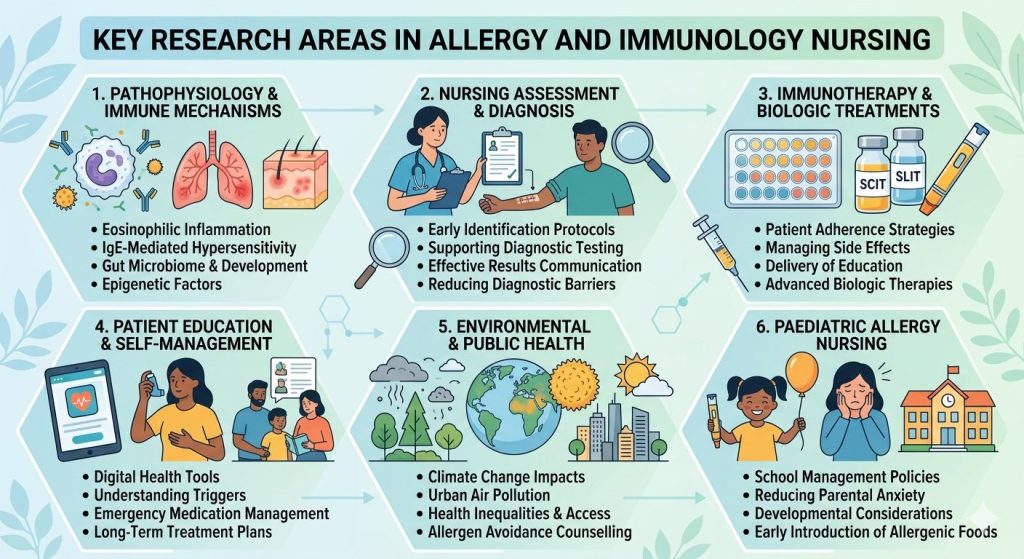
Before exploring specific dissertation ideas, it helps to understand the key domains where current research is being conducted. These areas reflect established academic and clinical priorities rather than passing trends.
Pathophysiology and immune response mechanisms remain central to understanding allergic disease. Research here explores how the immune system responds abnormally to otherwise harmless substances and what drives conditions such as eosinophilic inflammation or IgE-mediated hypersensitivity.
Nursing assessment and clinical diagnosis is another active area, particularly around the role nurses play in identifying allergic conditions early, supporting diagnostic testing, and communicating results to patients in a meaningful way.
Immunotherapy and biologic treatments are transforming the management of severe allergic disease. Nursing research in this domain explores how nurses support patient adherence, manage side effects, and deliver education around subcutaneous and sublingual immunotherapy.
Patient education and self-management is a growing field, especially as digital health tools become more widely used. Nurses are central to helping patients understand their triggers, manage emergency medications, and maintain treatment adherence over the long term.
Environmental and public health factors connect allergy nursing to broader societal issues, including climate change, urban air pollution, and health inequalities. Research in this area examines how external conditions shape allergy prevalence and how nursing practice can adapt.
Paediatric allergy nursing deserves its own focus, as children with allergies face specific challenges related to school management, parental anxiety, and developmental considerations.
Five Example Dissertation Topics With Research Aims and Objectives
Understanding how a dissertation topic is structured academically can help you develop your own. Below are five examples, each with a clear research aim and two to three supporting objectives.
Example 1
Topic: The Role of Nurses in Supporting Patient Adherence to Subcutaneous Immunotherapy for Allergic Rhinitis in UK NHS Settings
Research Aim: To examine how nursing interventions influence patient adherence to subcutaneous immunotherapy in adults with allergic rhinitis.
Objectives:
- To identify the barriers patients face in maintaining adherence to subcutaneous immunotherapy schedules.
- To evaluate the impact of nurse-led educational programmes on patient adherence rates.
- To explore the perspectives of allergy nurses on best practice strategies for adherence support.
Example 2
Topic: Examining the Impact of Climate Change on the Nursing Management of Seasonal Allergic Conditions in Urban UK Populations
Research Aim: To assess how changing environmental conditions affect the prevalence and nursing management of seasonal allergies in urban areas of the United Kingdom.
Objectives:
- To review the evidence linking climate-related changes in pollen seasons to increased allergy consultations.
- To analyse how allergy nursing practice guidelines in the UK have responded to environmental shifts.
- To identify the educational needs of allergy nurses in relation to environmental health literacy.
Example 3
Topic: Nurse-Led Anaphylaxis Training in Primary Schools: A Mixed-Methods Evaluation
Research Aim: To evaluate the effectiveness of nurse-led training programmes for school staff in the recognition and management of anaphylaxis.
Objectives:
- To measure changes in school staff knowledge and confidence following nurse-delivered anaphylaxis training.
- To explore the experiences of school nurses in designing and delivering emergency allergy training.
- To compare training outcomes between urban and rural school settings.
Example 4
Topic: Psychosocial Impact of Food Allergies on Adolescents and the Role of Allergy Nursing in Providing Holistic Support
Research Aim: To investigate the emotional and social challenges experienced by adolescents living with severe food allergies and to examine the contribution of nursing care to their wellbeing.
Objectives:
- To identify the most common psychosocial difficulties reported by adolescents with severe food allergies.
- To evaluate the effectiveness of nurse-led peer support groups for this population.
- To explore how allergy nurses integrate mental health considerations into routine clinical care.
Example 5
Topic: Inequalities in Allergy Services Across NHS Regions: A Nursing Workforce Perspective
Research Aim: To explore how regional variation in NHS allergy service provision affects nursing roles, patient access, and clinical outcomes.
Objectives:
- To map the variation in allergy specialist nursing provision across different NHS trusts.
- To investigate how service inequalities affect patient outcomes in underserved areas.
- To recommend evidence-based strategies for nursing workforce development in allergy services.
80 Dissertation Topics in Allergy and Immunology Nursing for 2026
The following topics are organised by subfield and numbered in fixed ranges. Each topic is original, researchable, and suitable for undergraduate, master’s, or PhD-level research proposals in 2026.
Fundamentals of Allergy and Immunology Nursing
- The evolving role of specialist allergy nurses in NHS multidisciplinary teams: a qualitative study of current practice.
- Reviewing the adequacy of allergy and immunology content in pre-registration nursing curricula across UK universities.
- Comparing the scope of allergy nursing practice between NHS England and devolved health services in Scotland and Wales.
- Barriers to the implementation of evidence-based allergy guidelines in community nursing settings.
- The contribution of advanced practice nurses to long-term condition management in adult allergy clinics.
- Exploring the professional identity of allergy and immunology specialist nurses in the UK.
- How nursing leadership influences the quality of care in dedicated NHS allergy units.
- The impact of staffing levels on patient outcomes in allergy and immunology nursing departments.
- Integrating allergy awareness into general practice nursing: a needs assessment study.
- Collaborative working between allergy nurses and immunologists: exploring models of effective interprofessional practice.
Pathophysiology of Allergic Diseases
- The role of nurse education in helping patients understand the IgE-mediated mechanisms underlying their allergic disease.
- Nursing assessment of eosinophilic inflammation in patients with severe asthma: current evidence and practice gaps.
- Exploring the relationship between early childhood infections and atopic sensitisation: implications for health visiting practice.
- The impact of the gut microbiome on allergy development and what it means for nursing health promotion strategies.
- How chronic stress alters immune function in patients with allergic conditions: a review of evidence for nursing practice.
- Assessing patient understanding of the pathophysiology of anaphylaxis and its implications for self-management.
- Genetic predisposition to allergy and its relevance to nursing history-taking and risk stratification.
- The link between vitamin D deficiency and atopic disease: nursing opportunities for patient guidance.
- Examining how obesity influences the severity of allergic asthma and what nurses can do to address this within clinical settings.
- Reviewing the evidence on epigenetic factors in allergy development and their relevance to family-centred nursing care.
Assessment and Diagnosis in Allergy Nursing
- The role of allergy nurses in facilitating timely skin prick testing in outpatient settings: a service evaluation.
- Assessing patient anxiety related to allergy diagnostic procedures and the effectiveness of nursing preparation strategies.
- Evaluating the accuracy of nurse-completed allergy history assessments in primary care compared to specialist nurse assessment.
- Identifying barriers to early allergy diagnosis among Black, Asian, and Minority Ethnic populations in the UK.
- The role of digital triage tools in supporting allergy nurses to prioritise patients for specialist review.
- Nurse-led structured history-taking in suspected drug hypersensitivity: a review of protocols and outcomes.
- Evaluating the clinical usefulness of component-resolved diagnostics in allergy nursing practice.
- Improving the detection of occupational allergy in nursing assessment: a review of current tools and evidence.
- The use of oral food challenge protocols in paediatric allergy nursing: safety, consent, and patient experience.
- Examining variation in allergy diagnostic referral rates from general practice nurses across UK regions.
Management of Allergic Reactions and Anaphylaxi
- Evaluating the effectiveness of nurse-led anaphylaxis action plans in reducing emergency hospital admissions.
- Exploring the training needs of community nurses in the recognition and first-line management of anaphylaxis.
- Patient and carer confidence in using epinephrine auto-injectors: a mixed-methods study of nurse-delivered training.
- Developing a nurse-led post-anaphylaxis follow-up pathway: evidence and implementation challenges.
- The impact of nurse-led allergy care bundles on outcomes in patients with a history of severe systemic reactions.
- Examining the factors that delay epinephrine administration in anaphylaxis and how nursing training can address them.
- Assessing the adequacy of anaphylaxis management protocols in NHS ambulatory care nursing settings.
- A qualitative exploration of the experiences of patients living with the daily threat of anaphylaxis and the nursing support they value most.
- Occupational anaphylaxis in healthcare settings: nursing prevention strategies and risk management approaches.
- Evaluating whether nurse-led allergy passport programmes improve safety outcomes for patients with complex allergic profiles.
Immunotherapy Approaches in Allergy Treatment
- Patient-reported outcomes following nurse-delivered subcutaneous allergen immunotherapy for house dust mite allergy.
- Comparing adherence rates to sublingual immunotherapy versus subcutaneous immunotherapy: the role of nursing support.
- Exploring how nurses communicate the risks and benefits of allergen immunotherapy to patients with varying health literacy levels.
- The lived experience of adults undergoing biologic therapy for severe eosinophilic asthma: a phenomenological nursing study.
- Nurse-led shared decision-making in allergen immunotherapy: a review of current evidence and patient preferences.
- Assessing the impact of telephonic nurse follow-up on adherence to sublingual immunotherapy in allergic rhinoconjunctivitis.
- Examining the nursing workforce implications of expanding allergen immunotherapy services in NHS allergy clinics.
- Barriers and facilitators to nurse prescribing in allergy and immunology: a qualitative study within UK specialist services.
- Dissertation topic related to immunotherapy in allergy and immunology nursing: exploring patient experience during rush immunotherapy protocols.
- The role of nursing documentation in monitoring long-term outcomes following allergen immunotherapy completion.
Patient Education and Counselling in Allergy Care
- Evaluating the effectiveness of structured nurse-led education programmes for adults newly diagnosed with asthma.
- Digital health tools for allergy self-management: a review of patient engagement outcomes and nursing implications.
- Nurse-led group education for parents of children with multiple food allergies: a qualitative evaluation of participant experience.
- Assessing the readability and accessibility of written allergy education materials provided in NHS clinics.
- The role of motivational interviewing techniques in nurse-led allergy counselling for non-adherent patients.
- Examining how nurses tailor allergy education for patients from diverse cultural and linguistic backgrounds.
- The contribution of social media platforms to patient education in allergy care: opportunities and risks for nursing practice.
- Evaluating the effectiveness of nurse-led discharge education in reducing readmission rates following acute allergic episodes
Environmental Factors and Allergy Nursing
- Examining how prolonged pollen seasons linked to climate change are reshaping seasonal allergy nursing workloads in the UK.
- The relationship between household indoor allergens and poorly controlled asthma: nursing assessment and environmental counselling.
- Air pollution and respiratory allergy prevalence in UK urban areas: what should nursing education programmes include?
- Nursing roles in allergen avoidance counselling for patients with occupational exposure to latex, flour, or animal dander.
- Exploring the impact of housing conditions on allergy outcomes in children and the role of community nursing.
- The effect of dietary changes and ultra-processed food consumption on allergy risk: implications for nursing health promotion.
- Assessing patient awareness of outdoor allergen triggers and the role of nursing in environmental health education.
- How nurses can support patients in navigating allergen labelling changes following post-Brexit food regulation shifts.
Paediatric Allergy and Immunology Nursing
- School-based anaphylaxis management: examining the role of school nurses in policy implementation and staff training.
- Parental anxiety and protective behaviours in families of children with severe peanut allergy: a nursing support needs analysis.
- The impact of early introduction of allergenic foods on allergy development: what do parents understand and how do nurses guide them?
- Examining the transition from paediatric to adult allergy services: the role of specialist nurses in supporting young people.
- Nurse-led assessment of atopic march progression in children: identifying opportunities for early intervention.
- Exploring the emotional burden on parents managing a child’s anaphylaxis risk at school and in social settings.
Quality of Life, Ethics, and Emerging Issues
- The impact of chronic urticaria on patient quality of life and the effectiveness of nurse-led psychological support interventions.
- Examining health inequalities in access to specialist allergy nursing services across socioeconomic groups in the UK.
- Ethical considerations in nurse-led decisions about allergen immunotherapy candidacy: balancing risk, benefit, and patient autonomy.
- The psychological impact of a new severe allergy diagnosis on adult patients and the role of allergy nurses in early support.
- Evaluating whether nurse-led peer mentoring programmes improve self-efficacy in patients with poorly controlled allergic asthma.
- Exploring patient perspectives on the use of artificial intelligence in allergy symptom tracking and what this means for nursing practice.
- The role of allergy nursing in addressing vaccine hesitancy among patients with a history of allergic reactions to vaccine components.
- Assessing the readiness of UK allergy nursing services to manage rising rates of food allergy in adults.
How to Choose the Right Dissertation Topic for Allergy and Immunology Nursing
Many students feel unsure about where to start, and that uncertainty is completely normal. When you are deciding on topics for your dissertation in allergy and immunology nursing, consider the following questions to guide your thinking.
First, ask yourself what area of nursing practice genuinely interests you. A dissertation is a long commitment, and your motivation will matter throughout the research process. Second, consider whether your topic is narrow enough to be researchable within the time and word count you have. Broad topics such as “nursing and allergies” will not give your research a clear direction, whereas a topic focused on nurse-led education for epinephrine auto-injector use among newly diagnosed adults has clear boundaries.
Third, think about the level of access you have to data, participants, or clinical settings. Some research designs require ethics approval and participant recruitment, while others work from published literature alone. Choosing a design that fits your available resources will strengthen your proposal significantly.
If you are at master’s or doctoral level and need more tailored support, online dissertation help from a specialist academic service can help you refine your topic and build a solid research framework before you begin writing.
Conclusion
Dissertation topics in allergy and immunology nursing offer students a genuine opportunity to contribute to a field that affects millions of people and continues to evolve quickly. From immunotherapy adherence to paediatric allergy management, from environmental health to ethical considerations in clinical decision-making, there is no shortage of meaningful and researchable questions.
The 80 topics presented in this post are designed to help you understand what good dissertation topics look like at each level of study. They are focused, academically sound, and grounded in current clinical and research priorities. Whichever topic you choose, approach your dissertation with curiosity, rigour, and a genuine interest in improving nursing practice. That combination of qualities is what distinguishes excellent research from work that simply meets the minimum requirements.
Your dissertation is your opportunity to think independently, engage critically with evidence, and make a lasting academic contribution. Take the time to choose your topic carefully, and then commit to it fully.
