


Forensic Nursing Dissertation Topics for 2026

The questions below have been gathered from student forums, university discussion boards, and academic support communities. They reflect real concerns that nursing students face when choosing a dissertation topic in forensic nursing.
- What are the top dissertation topics of forensic nursing that are relevant for 2026?
- How do I choose a dissertation topic for Forensic Nursing that matches my academic level?
- Are there forensic nursing dissertation topics suitable for BSc, Master’s, and PhD levels?
- What forensic nursing dissertation topics are most relevant to NHS practice?
- Where can I find forensic nursing dissertation topics PDF resources curated by experts?
- What emerging research areas should I explore for a PhD research topic in forensic nursing?
Introduction: Why Forensic Nursing Dissertation Topics Matter
Forensic nursing sits at the intersection of clinical care, legal process, and social justice. It is a discipline that has grown considerably over the past two decades, and universities now expect dissertation research in this field to reflect that complexity. Choosing the right dissertation topic is not simply a procedural step. It shapes the entire direction of your academic work and signals to examiners that you understand both the clinical and legal dimensions of the field.
For students at undergraduate, master’s, and doctoral levels, the challenge is finding a topic that is narrow enough to be researchable, broad enough to contribute meaningfully to the field, and current enough to reflect 2026-level academic expectations. Whether you are exploring trauma-informed care in custodial settings, the evidentiary standards applied to sexual assault examinations, or the mental health needs of incarcerated populations, the right starting point makes all the difference.
Students who feel uncertain about where to begin often benefit from online dissertation help, which can provide structured guidance and expert feedback during the early planning stages. This post is designed to give you a strong academic foundation before you reach that stage.
Download Forensic Nursing Dissertation Topics PDF
A personalised PDF containing a curated list of forensic nursing dissertation topics, compiled by academic experts with experience in healthcare, law, and nursing research, is available to students. The PDF is tailored to your academic level and research interest area.
Students receive their personalised topic list after completing a short online form. The form gathers basic information about your study level and area of interest so that the experts can match you with the most suitable and up-to-date topics. This resource is particularly helpful if you are working on a formal research proposal and need guidance that goes beyond a general topic list.
Why Choosing the Right Dissertation Topic in Forensic Nursing Matters
Forensic nursing is not a subject where generic topics tend to perform well academically. Examiners expect students to demonstrate an awareness of current legislative frameworks, evidence-based clinical practice, and the ethical tensions specific to working at the interface of healthcare and the criminal justice system.
A well-chosen topic allows you to develop a clear research question, justify your methodology, and produce findings that are relevant to real-world practice. A vague or overly broad topic, on the other hand, risks producing a dissertation that lacks focus and fails to meet the academic standards required for higher-level study.
Forensic nursing dissertation topics that are linked to NHS practice tend to carry particular weight in the UK context. Dissertation topics in forensic nursing with a clear NHS relevance demonstrate that you understand the operational environment in which forensic nurses work, from sexual assault referral centres (SARCs) to high-security mental health units.
Your topic choice also signals your long-term research interests to potential supervisors, funding bodies, and employers. For students considering academic careers, selecting a topic that aligns with emerging research directions within the field can strengthen your profile significantly.
Key Research Areas in Forensic Nursing for 2026
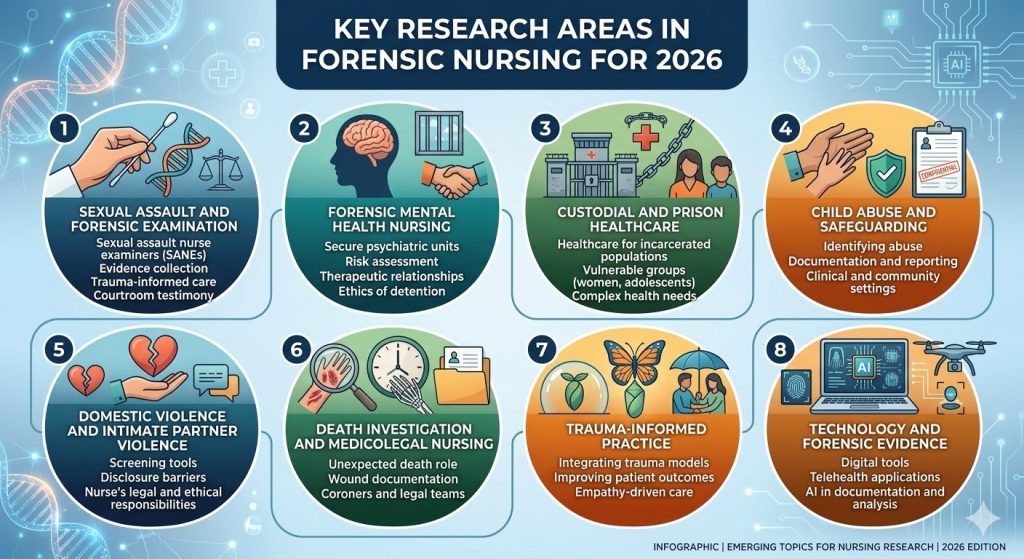
Before selecting a specific dissertation topic, it helps to understand the established subfields within forensic nursing. Each of these areas carries a rich body of existing literature and offers meaningful scope for original research.
- Sexual assault and forensic examination: Covers the clinical role of sexual assault nurse examiners (SANEs), evidence collection, trauma-informed care, and courtroom testimony.
- Forensic mental health nursing: Focuses on care delivery in secure psychiatric units, risk assessment, therapeutic relationships, and the ethics of detention.
- Custodial and prison healthcare: Examines healthcare delivery for incarcerated populations, including vulnerable groups such as women, adolescents, and those with complex needs.
- Child abuse and safeguarding: Investigates the forensic nurse’s role in identifying, documenting, and reporting child abuse within clinical and community settings.
- Domestic violence and intimate partner violence: Explores screening tools, disclosure barriers, and the nurse’s legal and ethical responsibilities.
- Death investigation and medicolegal nursing: Covers the nurse’s role in unexpected death, wound documentation, and communication with coroners and legal teams.
- Trauma-informed practice: A growing research area that examines how trauma-informed models can be integrated into forensic nursing to improve patient outcomes.
- Technology and forensic evidence: Looks at emerging digital tools, telehealth applications, and the use of artificial intelligence in evidence documentation and analysis.
Five Example Forensic Nursing Dissertation Topics with Aims and Objectives
The following five examples illustrate how a well-structured dissertation topic is developed in forensic nursing. Each includes a research aim and two to three focused objectives to help you understand what a strong academic framework looks like.
Example 1: Trauma-Informed Care in Sexual Assault Referral Centres
Research Aim: To evaluate the extent to which trauma-informed care principles are integrated into the clinical practice of sexual assault nurse examiners (SANEs) working within NHS-funded SARCs in England.
- To identify the trauma-informed care training currently provided to SANE practitioners across NHS-commissioned SARCs.
- To assess survivor perceptions of whether their clinical interactions felt safe, respectful, and non-coercive.
- To recommend practice improvements that align SARC care delivery with current national trauma-informed guidelines.
Example 2: Risk Assessment Tools in Forensic Mental Health Units
Research Aim: To examine the reliability and clinical utility of structured professional judgement tools used by forensic mental health nurses in medium-secure settings within the United Kingdom.
- To compare the predictive validity of HCR-20 and START risk assessment tools in a forensic inpatient context.
- To explore how nursing staff are trained to administer and interpret these tools in practice.
- To identify gaps between risk assessment findings and nursing care plan development.
Example 3: Disclosure of Domestic Violence in Emergency Departments
Research Aim: To explore the barriers that prevent victims of intimate partner violence from disclosing abuse to nursing staff during emergency department visits.
- To identify structural, cultural, and interpersonal barriers to domestic violence disclosure in emergency settings.
- To assess the confidence levels of emergency nurses when using validated domestic violence screening tools.
Example 4: Mental Health of Women in Prison
Research Aim: To investigate the mental health needs of women held in custodial settings in the UK and the adequacy of nursing responses within the prison environment.
- To map the prevalence of diagnosed and undiagnosed mental health conditions among women in English prisons.
- To evaluate the role of forensic nurses in mental health triage and ongoing care within prison healthcare units.
- To recommend policy-level changes that could improve parity of care between prison and community mental health services.
Example 5: Digital Forensic Evidence in Nursing Documentation
Research Aim: To evaluate the integration of digital documentation tools in forensic nursing practice and their impact on the accuracy and admissibility of clinical evidence.
- To compare paper-based and digital evidence documentation approaches in terms of accuracy and legal admissibility.
- To assess forensic nurse perceptions of digital tool reliability and ease of use in time-sensitive clinical situations.
80 Forensic Nursing Dissertation Topics for 2026
The following list presents 80 original, academically sound, and research-ready dissertation topics in forensic nursing. They are organised by subfield and suitable for undergraduate, master’s, and PhD-level research proposals. Each topic reflects current academic expectations and 2026-level research priorities.
Sexual Assault and SANE Practice
1. The impact of SANE-led sexual assault examinations on victim reporting rates within NHS-commissioned services.
2. Compassion fatigue among sexual assault nurse examiners in England: prevalence, risk factors, and organisational responses.
3. Barriers to forensic evidence collection in cases involving male victims of sexual assault within SARC settings.
4. A critical analysis of consent processes during forensic medical examinations for sexual assault survivors.
5. The role of the SANE practitioner as an expert witness in Crown Court proceedings: a qualitative exploration.
6. Delayed disclosure in sexual assault cases and its implications for forensic evidence integrity and clinical care.
7. Cross-cultural considerations in forensic nursing practice during sexual assault examinations.
8. The effect of nurse-led debrief sessions on psychological outcomes for sexual assault survivors post-examination.
9. Evaluating the adequacy of post-examination follow-up care provided by SANEs in community health settings.
10. Standardisation of sexual assault evidence collection kits across NHS SARCs: challenges and opportunities.
Forensic Mental Health Nursing
11. The therapeutic alliance between forensic mental health nurses and patients detained under the Mental Health Act 1983: an exploratory study.
12. Burnout and moral distress in nurses working in high-secure forensic psychiatric settings in England.
13. Deprivation of liberty safeguards and the nursing response in forensic mental health care.
14. Recovery-oriented practice in medium-secure units: how forensic nurses conceptualise and promote patient recovery.
15. The use of de-escalation techniques by forensic mental health nurses in acute psychiatric crises.
16. Nurses’ experiences of caring for patients who have committed violent offences: a phenomenological inquiry.
17. Dual diagnosis in forensic mental health settings: the challenges of co-occurring substance use and mental illness for nursing care.
18. Restrictive practices in forensic psychiatric units and the role of the nurse in minimising their use.
19. How forensic mental health nursing competencies are assessed and maintained across NHS trusts in England.
20. Patient perspectives on involvement in forensic mental health nursing care planning in medium-secure settings.
Prison and Custodial Healthcare
21. The role of forensic nurses in managing chronic physical health conditions among the adult male prison population in England and Wales.
22. Suicide and self-harm prevention strategies in custodial settings: evaluating the nurse-led ACCT process.
23. Healthcare access inequalities for prisoners from Black and minority ethnic backgrounds: a forensic nursing perspective.
24. Nursing care for elderly prisoners with dementia: ethical challenges and practical limitations in custodial environments.
25. The mental health needs of remand prisoners and the adequacy of nursing assessments at the point of reception.
26. Transition planning from prison to community mental health services: the nurse’s role in continuity of care.
27. Forensic nurses’ experiences of moral injury in custodial healthcare settings: a narrative inquiry.
28. Infection control practices among nurses working within prison healthcare settings post-COVID-19.
29. Substance misuse treatment in prisons: how forensic nurses integrate harm reduction into custodial care.
30. Delivering trauma-informed nursing care to male prisoners with histories of childhood abuse.
Child Abuse and Safeguarding
31. Forensic nurses’ recognition and documentation of physical child abuse injuries in emergency paediatric settings.
32. The nurse’s role in multi-agency safeguarding hubs (MASH): perspectives from forensic nursing practitioners.
33. Fabricated or induced illness in children: challenges in forensic nursing assessment and inter-professional collaboration.
34. Forensic nursing documentation standards in child sexual abuse cases and their admissibility in family court proceedings.
35. Mandatory reporting of child abuse in England: how forensic nurses navigate professional obligations and confidentiality.
36. The emotional impact on nurses involved in child death investigations: a qualitative study.
37. Forensic assessment of bruising in non-mobile infants: clinical competence among paediatric nursing staff.
38. Online child sexual exploitation: the emerging role of the forensic nurse in identifying and supporting affected young people.
39. Improving referral pathways from emergency departments to child protective services: a forensic nursing perspective.
40. Forensic nurses’ experiences of giving evidence in child protection proceedings: challenges and professional development needs.
Domestic and Intimate Partner Violence
41. Routine inquiry for domestic violence in maternity settings: the readiness and confidence of midwifery and nursing staff.
42. Forensic documentation of injuries in domestic violence cases presenting to emergency departments: consistency and accuracy.
43. The Domestic Abuse Act 2021 and its implications for forensic nursing practice in England and Wales.
44. Coercive control in intimate partner relationships: how forensic nurses identify and respond to non-physical abuse.
45. Male victims of intimate partner violence: barriers to disclosure and the nursing response in acute clinical settings.
46. Honour-based violence and forced marriage: the forensic nurse’s role in recognition, documentation, and safeguarding.
47. Evaluating the DASH risk assessment tool in forensic nursing practice for high-risk domestic abuse cases.
48. Strangulation as a predictor of intimate partner homicide: clinical indicators and the nursing documentation response.
49. Domestic violence perpetrator programmes: the forensic nurse’s role in health impact assessment for affected families.
50. Nursing students’ knowledge and attitudes about domestic violence: implications for forensic nursing education.
Death Investigation and Medicolegal Practice
51. The forensic nurse’s role in unexpected death investigations in care home settings: a qualitative study.
52. Post-mortem interval estimation and the contribution of forensic nursing knowledge to coroner investigations.
53. Documentation of wound characteristics in sudden death cases by forensic nursing practitioners in emergency settings.
54. Drug-related deaths in England: the forensic nurse’s role in evidence preservation and inter-agency communication.
55. The role of nurses as coroner’s officers: scope of practice, legal responsibilities, and professional identity.
56. Forensic nursing involvement in maternal death investigations: a critical analysis of current practice.
57. Nursing staff experiences during sudden cardiac death events in healthcare settings and implications for evidence documentation.
58. The forensic nurse’s contribution to mortality reviews in NHS acute trust settings.
59. Communication between forensic nurses and HM Coroner Services: barriers and best practice.
60. Forensic nurses and the verification of death: training adequacy and competency assessment in NHS trusts.
Trauma-Informed and Person-Centred Forensic Care
61. Implementing trauma-informed frameworks in NHS forensic nursing services: staff readiness and organisational barriers.
62. How person-centred care principles are applied in secure forensic settings where patient autonomy is legally restricted.
63. Secondary traumatic stress in forensic nurses: prevalence, risk factors, and the adequacy of supervision and support.
64. The use of trauma-informed assessment tools in forensic outpatient nursing clinics.
65. Restorative practices in forensic mental health nursing: opportunities and ethical tensions.
66. Cultural competence in trauma-informed forensic nursing: addressing the needs of patients from diverse backgrounds.
67. Patient safety culture in forensic nursing settings: how trauma-informed leadership influences incident reporting.
68. Forensic nursing and adverse childhood experiences (ACEs): integrating ACEs frameworks into risk assessment and care planning.
69. Supporting forensic nurses in processing vicarious trauma: an evaluation of clinical supervision models in secure settings.
70. Trauma-informed approaches in forensic nursing assessment of older adult victims of abuse in community settings.
Technology, Education, and Future Directions in Forensic Nursing
71. The use of body-worn cameras by police and their impact on the forensic nursing assessment of assault victims.
72. Telehealth applications in forensic nursing: evaluating remote clinical consultations for sexual assault survivors in rural areas.
73. Artificial intelligence tools in forensic wound analysis: implications for forensic nursing documentation and practice.
74. Digital evidence management platforms in forensic nursing: usability, accuracy, and medico-legal admissibility.
75. Simulation-based training for forensic nursing students: effectiveness in developing evidence collection competencies.
76. The integration of forensic nursing competencies into pre-registration nursing education in the United Kingdom.
77. Social media use by forensic nurses: professional boundaries, patient confidentiality, and regulatory guidance.
78. Inter-professional education for forensic nursing, social work, and law students: models, outcomes, and challenges.
79. Developing a competency framework for advanced forensic nursing practice in England: a Delphi study.
80. The future of forensic nursing as a distinct clinical specialty in the NHS: workforce planning, education, and professional identity.
Conclusion: Approaching Your Forensic Nursing Dissertation with Confidence
Choosing a dissertation topic in forensic nursing requires careful thought, genuine academic curiosity, and an awareness of where the field is heading. The 80 topics presented in this post span the full range of established subfields and emerging research directions, from sexual assault nursing and forensic mental health to prison healthcare and the integration of digital technology into clinical forensic practice.
What makes a strong forensic nursing dissertation is not simply the topic itself, but how clearly you define your research question, how well your methodology fits your aims, and how honestly you engage with the ethical dimensions of the field. Forensic nursing research carries real social weight. The findings you produce can inform policy, improve practice, and ultimately benefit the vulnerable patients whose care sits at the heart of this discipline.
Whether you are writing a BSc dissertation, preparing a master’s thesis, or developing phd research topics in forensic nursing, the most important step is to begin with a topic that genuinely interests you and that you can pursue with rigour and integrity. A focused research question, a justified methodology, and a commitment to evidence-based reasoning will always serve you better than a topic chosen solely because it seems impressive.
Use the ideas in this post as a starting point. Discuss them with your supervisor, map them against existing literature in your institution’s database, and allow your thinking to evolve as you engage more deeply with the field. Your dissertation is an opportunity to make a meaningful contribution to forensic nursing knowledge, and with the right topic, that contribution is entirely within reach.
