


Hospice Nursing Dissertation Topics for 2026

Questions Students Are Asking About Hospice Nursing Dissertations
The following questions have been gathered from student forums, academic discussion boards, and postgraduate research communities. They reflect the genuine concerns and curiosities students bring when approaching dissertation topic selection in hospice nursing.
- How do I choose a dissertation topic for hospice nursing that is both original and academically strong?
- What are some good research topics in hospice nursing for 2026?
- Are there hot topics in hospice nursing that are suitable for undergraduate research?
- What does a well-structured dissertation topic in end-of-life care actually look like?
- Can I find a list of hospice nursing dissertation topics organised by subfield?
- How do I know if my topic is suitable for a master’s or PhD-level dissertation?
- Where can I get hospice nursing dissertation topics as a PDF to review offline?
If you have been asking any of these questions, this post was written for you.
Why Choosing the Right Dissertation Topic in Hospice Nursing Matters
Hospice nursing sits at one of the most emotionally and ethically complex intersections in healthcare. It involves caring for patients in their final stages of life, supporting families through grief, managing pain and symptoms, and navigating deeply human questions about dignity, autonomy, and death. When students choose a dissertation topic in this field, the stakes are not merely academic. The right topic can contribute meaningfully to clinical practice, policy development, and the overall quality of end-of-life care.
Many students feel overwhelmed at this stage. They either choose a topic that is too broad to research properly, or they select something too narrow to find adequate literature on. Both mistakes cost time and confidence. This post is designed to help you avoid that. Whether you need online dissertation help or are looking to refine an idea you already have, the guidance and examples here will give you a strong foundation.
The 80 hospice nursing dissertation topics listed in this post are grounded in current academic literature, emerging clinical priorities, and real-world gaps in palliative and end-of-life care research. They are suitable for undergraduate, master’s, and PhD research proposals in 2026.
Download Hospice Nursing Dissertation Topics PDF
If you would like a personalised version of this topic list tailored to your academic level, research interests, and university requirements, a downloadable PDF is available. The PDF is curated by academic experts with experience in palliative care research and dissertation supervision. You can access it by completing a short form, after which the PDF will be sent directly to you. Many students find it useful to review the full list offline and discuss it with their supervisor before making a final decision.
Why This Field Demands Careful Topic Selection
Hospice nursing is a specialised and emotionally demanding field. Research in this area must be conducted with sensitivity, ethical awareness, and methodological rigour. A poorly chosen topic can lead to ethical approval challenges, participant recruitment difficulties, or a lack of published literature to build upon.
Good research topics in hospice nursing tend to be specific, grounded in a recognisable clinical or social problem, and connected to an identifiable gap in the existing evidence base. They also need to be feasible within the constraints of your degree level and timeframe.
The field is also rapidly evolving. Advances in palliative medicine, shifting demographics, growing cultural diversity, and increasing awareness of mental health in end-of-life settings have all opened new avenues for research. Understanding these directions will help you position your dissertation within a current and credible academic conversation.
Key Research Areas in Hospice Nursing
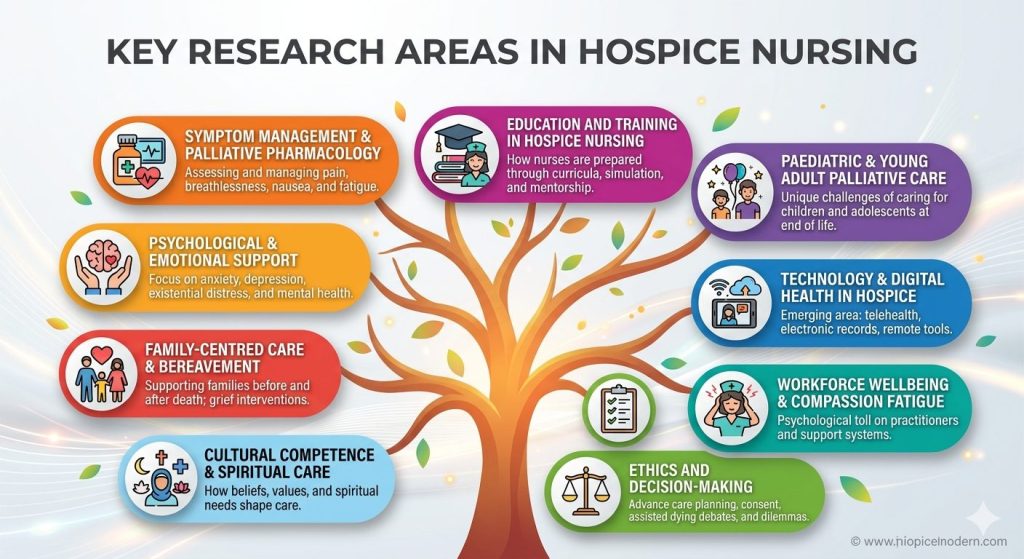
Before selecting a specific topic, it helps to understand the main research areas within hospice nursing. These domains reflect where most of the published scholarship and clinical debate currently sits.
- Symptom management and palliative pharmacology — This area explores how nurses assess and manage pain, breathlessness, nausea, and fatigue in dying patients.
- Psychological and emotional support — Research here focuses on anxiety, depression, existential distress, and the mental health of both patients and their carers.
- Family-centred care and bereavement — This covers how hospice nurses support families before and after a patient’s death, including grief interventions.
- Cultural competence and spiritual care — This area examines how cultural beliefs, religious values, and spiritual needs shape end-of-life care practices.
- Ethics and decision-making — Research in this area covers advance care planning, consent, assisted dying debates, and ethical dilemmas in nursing practice.
- Workforce wellbeing and compassion fatigue — This domain focuses on the psychological toll hospice nursing takes on practitioners and what support systems exist.
- Technology and digital health in hospice settings — An emerging area covering telehealth, electronic records, and digital tools for remote palliative care.
- Paediatric and young adult palliative care — This subfield addresses the unique challenges of caring for children and adolescents at end of life.
- Education and training in hospice nursing — This area looks at how nurses are prepared for end-of-life care work through curricula, simulation, and mentorship.
Five Example Dissertation Topics With Aims and Objectives
The following examples show how a dissertation topic in hospice nursing should be framed. Each includes a research aim and two to three objectives that would typically form the basis of a proposal.
Example 1: Pain Assessment in Non-Verbal Patients
Topic: Evaluating the effectiveness of observational pain assessment tools in non-verbal adult hospice patients.
Aim: To assess how accurately observational tools capture pain experiences in adult hospice patients who are unable to self-report.
Objectives:
- To identify and evaluate the observational pain assessment tools currently used in UK hospice settings.
- To explore the perceptions of hospice nurses regarding the reliability of these tools.
- To examine whether there is consistency in pain management decisions based on observational tool scores.
Example 2: Nurse Burnout in Inpatient Hospice Units
Topic: Exploring the lived experiences of compassion fatigue among registered nurses working in inpatient hospice units.
Aim: To understand how hospice nurses experience and cope with compassion fatigue in inpatient palliative care environments.
Objectives:
- To explore the emotional and psychological factors contributing to compassion fatigue in hospice nursing staff.
- To identify the organisational support mechanisms nurses perceive as most helpful.
- To understand how compassion fatigue affects clinical decision-making and patient care quality.
Example 3: Advance Care Planning and Family Involvement
Topic: Examining the role of hospice nurses in facilitating advance care planning conversations with families of patients with dementia.
Aim: To investigate how hospice nurses support families in making advance care decisions on behalf of patients with advanced dementia.
Objectives:
- To explore the communication strategies used by hospice nurses during advance care planning discussions.
- To identify the barriers nurses face when engaging families in these conversations.
- To assess how family involvement in advance care planning affects perceived quality of dying.
Example 4: Spiritual Care Provision
Topic: Investigating the confidence of hospice nurses in delivering spiritual care to patients from non-Christian backgrounds.
Aim: To evaluate how equipped hospice nurses feel to meet the spiritual needs of patients from diverse religious and cultural traditions.
Objectives:
- To assess the levels of training hospice nurses receive in spiritual care across different faith traditions.
- To explore nurse attitudes towards spiritual care as a clinical responsibility.
- To identify gaps in current hospice education related to cultural and spiritual diversity.
Example 5: Telehealth in Community Palliative Care
Topic: Assessing patient and carer experiences of telehealth consultations in community-based hospice nursing services.
Aim: To understand how patients and family carers experience remote consultations within community palliative nursing programmes.
Objectives:
- To explore the perceived benefits and limitations of telehealth from the perspectives of patients and carers.
- To examine how community hospice nurses adapt their communication and clinical assessment skills in a digital environment.
- To identify the factors that influence whether telehealth is considered an appropriate substitute for in-person hospice nursing visits.
80 Hospice Nursing Dissertation Topics for 2026
The following topics are organised by subfield. They are suitable for undergraduate, master’s, and PhD-level research. Each one is designed to be specific, researchable, and grounded in a genuine gap or debate within the hospice nursing literature.
Symptom Management and Pain Control
- Comparing nurse-led and physician-led pain protocols in adult inpatient hospice settings in the UK.
- Exploring the role of subcutaneous medication delivery in symptom management during the last 48 hours of life.
- Assessing nurse confidence in titrating opioid analgesia for patients with advanced cancer in community hospice settings.
- Examining the use of anticipatory prescribing in UK hospice units and its impact on patient comfort.
- Investigating nurse-perceived barriers to adequate breathlessness management in end-stage COPD patients.
- Evaluating the use of non-pharmacological interventions for pain control in hospice patients with cognitive impairment.
- Exploring the consistency of symptom documentation across multi-disciplinary hospice teams.
- Assessing the role of hospice nurses in managing refractory symptoms in patients ineligible for specialist palliative sedation.
- Examining the accuracy of nurse-reported symptom burden in comparison to patient self-reports in hospice populations.
- Investigating how hospice nurses respond to uncontrolled symptoms during out-of-hours periods in community settings.
Psychological and Emotional Wellbeing of Patients
- Exploring the prevalence and management of existential distress among adult hospice patients in England.
- Assessing the effectiveness of dignity therapy as an intervention for psychological wellbeing in hospice patients.
- Investigating how hospice nurses identify and respond to depression in patients with a terminal prognosis of less than three months.
- Examining the relationship between perceived control and reported quality of life in hospice inpatients.
- Exploring the role of life review in reducing anxiety among patients in the final weeks of life.
- Evaluating nurse attitudes towards discussing death directly with patients in hospice settings.
- Investigating the impact of single-room accommodation on emotional wellbeing in inpatient hospice environments.
- Exploring how hospice nurses support patients experiencing anticipatory grief about their own dying.
- Assessing the role of meaning-centred psychotherapy in hospice nursing practice.
- Examining how spirituality intersects with psychological distress management in hospice nursing care.
Family-Centred Care and Bereavement Support
- Evaluating the structure and perceived effectiveness of bereavement support programmes offered by UK hospices.
- Exploring the experiences of adult children who acted as primary carers during a parent’s hospice admission.
- Investigating how hospice nurses communicate prognosis to family members when patients lack capacity.
- Assessing the emotional labour involved in supporting bereaved family members immediately following a patient’s death.
- Examining the role of hospice nurses in facilitating family meetings in inpatient palliative care units.
- Exploring the experiences of partners of patients who died in hospice care within the first year of bereavement.
- Evaluating nurse-led bereavement follow-up telephone calls and their perceived value to bereaved families.
- Investigating how families experience the transition from curative to palliative care in hospice settings.
- Examining the support needs of young children when a parent is admitted to hospice care.
- Exploring the role of hospice nurses in supporting blended and non-traditional family structures during end-of-life care.
Cultural Competence and Diverse Communities
- Investigating the barriers faced by South Asian families in accessing hospice care services in the UK.
- Exploring how hospice nurses adapt care practices for Muslim patients observing religious practices near the end of life.
- Examining nurse understanding of culturally specific mourning rituals and their impact on post-death care.
- Assessing the cultural competence training available to hospice nursing staff across NHS-funded services.
- Exploring the experiences of Black African patients and families navigating hospice services in urban UK settings.
- Investigating how language barriers affect symptom communication and care quality in hospice settings.
- Examining the hospice engagement patterns of Eastern European migrant communities in the UK.
- Evaluating the appropriateness of standard advance care planning documentation for patients from collectivist cultural backgrounds.
- Exploring how hospice nurses navigate conflicting family and patient preferences in culturally diverse cases.
- Investigating the experiences of LGBTQ+ individuals in hospice care and the specific competencies required of nursing staff.
Ethics, Autonomy, and Decision-Making
- Exploring nurse perspectives on assisted dying legislation and its potential impact on hospice nursing practice in the UK.
- Investigating the ethical tensions hospice nurses experience when family wishes conflict with documented patient preferences.
- Examining how advance decision documents are interpreted and applied by nursing staff in hospice inpatient settings.
- Assessing the role of hospice nurses in supporting patients with learning disabilities to make end-of-life decisions.
- Exploring nurse experiences of withdrawing clinically assisted nutrition and hydration in hospice settings.
- Investigating how ethical decision-making frameworks are applied in complex symptom management scenarios in hospice care.
- Examining the use of continuous deep sedation in UK hospices and the ethical implications for nursing staff.
- Exploring how hospice nurses understand and apply the concept of a good death in clinical practice.
- Assessing the adequacy of ethics education within pre-registration nursing curricula for preparing students for hospice roles.
- Investigating how hospice nurses manage moral distress when institutional decisions conflict with their professional values.
Workforce Wellbeing and Compassion Fatigue
- Exploring the lived experience of hospice nurses who have cared for patients known to them personally.
- Assessing the effectiveness of clinical supervision in reducing burnout among hospice nursing teams.
- Investigating whether hospice nurses who have experienced personal bereavement demonstrate higher levels of empathic care.
- Examining how staffing levels in inpatient hospice units affect nurse-reported stress and patient care outcomes.
- Exploring the relationship between length of service in hospice nursing and the development of compassion satisfaction.
- Assessing how well hospice organisations support nurses returning to work following stress-related absence.
- Investigating the impact of reflective practice groups on the psychological resilience of hospice nursing teams.
- Examining whether pre-employment experience with death affects the adjustment of newly qualified nurses to hospice work.
- Exploring how hospice nurses process the cumulative grief associated with repeated patient loss.
- Assessing the relationship between organisational culture and emotional wellbeing in hospice nursing staff.
Education, Training, and Professional Development
- Evaluating the content and delivery of palliative care modules in UK undergraduate nursing programmes.
- Exploring newly qualified nurses’ perceptions of their readiness to work in hospice settings after registration.
- Investigating the effectiveness of simulation-based training in preparing student nurses for difficult conversations at end of life.
- Assessing the role of hospice nurses as mentors and practice supervisors for student nurses on placement.
- Examining the uptake and perceived value of continuing professional development opportunities for hospice nursing staff.
- Investigating whether dedicated hospice nursing placements during training influence career decisions among newly qualified nurses.
- Exploring the use of reflective journals in developing emotional competence among student nurses in palliative care settings.
- Assessing how postgraduate palliative care qualifications influence nursing practice and clinical confidence in hospice environments.
- Examining the role of palliative care champions in NHS ward settings and their connections to hospice nursing expertise.
- Investigating how hospice nurses engage in knowledge transfer to support generalist colleagues caring for dying patients.
Technology, Innovation, and Digital Care
- Exploring patient and carer experiences of video-based hospice nursing consultations in rural areas of the UK.
- Investigating how electronic patient records affect the quality and continuity of documentation in hospice care.
- Assessing the impact of wearable monitoring devices on symptom detection and nursing responsiveness in hospice inpatients.
- Examining the role of artificial intelligence decision-support tools in hospice nursing triage and care planning.
- Exploring nurse attitudes towards digital advance care planning platforms and their integration into hospice workflows.
- Investigating how online support communities and digital grief resources complement hospice bereavement services.
- Assessing the data privacy implications of digital care records in inpatient and community hospice nursing settings.
- Examining the barriers to technology adoption among older hospice nursing staff in NHS and third-sector organisations.
- Exploring the use of virtual reality as a therapeutic tool for anxiety and pain management in hospice patients.
- Investigating the potential of remote monitoring systems to support hospice patients who wish to die at home.
How to Choose the Right Dissertation Topic for You
Selecting from a list of hospice topics to write a dissertation on can still feel difficult, even with 80 options in front of you. The right choice depends on several factors that are personal to your academic situation.
Start by thinking about what aspect of hospice nursing genuinely interests or concerns you. Passion for your topic will sustain you through a long research process. Then consider what is feasible. Can you access the participants, data, or literature needed for this topic within your timeframe? Also think about your academic level. Undergraduate dissertations are typically smaller in scope, while master’s and PhD dissertations are expected to make a more original contribution to knowledge.
If you are working with a supervisor, bring two or three shortlisted topics to your first meeting. If you are still searching for direction and need dissertation topics in hospice nursing that are tailored to your specific interests, consider requesting the PDF mentioned earlier in this post.
Conclusion
Choosing a dissertation topic in hospice nursing is a significant academic decision. It shapes the next several months of your academic life and, in many cases, influences the direction of your professional career. The 80 topics presented in this post reflect current research priorities, clinical challenges, and emerging debates within hospice and palliative care. They are designed to help you move from uncertainty to clarity.
Good dissertation research in this field does not just earn academic credit. It has the potential to improve how dying patients are cared for, how families are supported, and how nurses are prepared for one of the most demanding and meaningful roles in healthcare.
Approach your topic selection with curiosity, honesty about your own interests, and respect for the people whose experiences your research will touch. If you still feel unsure, do not hesitate to seek guidance. Whether through your supervisor, your university’s research support team, or platforms offering specialist online dissertation help, support is available to you.
Your dissertation is your contribution to a field that genuinely matters. Choose your topic wisely, pursue it with integrity, and trust the process.
