


Wound Care Nursing Dissertation Topics for 2026

Questions Students Are Asking About Wound Care Nursing Dissertation Topics
Students across academic forums and discussion platforms regularly raise similar concerns when it comes to selecting a dissertation topic in nursing. The following questions reflect real search patterns gathered from student communities, peer support threads, and academic guidance spaces online.
- What is the best topic for a Wound Care Nursing dissertation in 2026?
- How do I find a dissertation topic in wound care nursing that is specific enough for a master’s thesis?
- Which wound care research topics are most relevant for current NHS and global healthcare practice?
- I am writing my PhD dissertation in wound care nursing — what areas are still under-researched?
- How can I narrow down research topics in wound care nursing for my undergraduate proposal?
- Can I get dissertation topics for my BSc in Nursing with a focus on wound care?
- What wound care nursing dissertation topics are suitable for mixed-methods research?
- Where can I find a downloadable list of wound care nursing dissertation ideas curated by experts?
If any of these questions sound familiar, this post is written for you.
Introduction: Why Your Wound Care Nursing Dissertation Topic Matters
Choosing the right dissertation topic in wound care nursing is one of the most significant academic decisions you will make during your studies. Wound care is a clinically dynamic and research-active field. It sits at the intersection of patient safety, chronic disease management, public health, and nursing innovation.
Whether you are completing a BSc, pursuing an MSc thesis, or developing a PhD-level study, your topic must reflect current clinical challenges, demonstrate academic rigour, and contribute meaningfully to nursing knowledge. A well-chosen topic does not just help you pass — it positions you as a credible, informed practitioner and researcher.
This post provides structured guidance on wound care research topics, organised by academic subfield. It also offers sample topics with research aims and objectives, so you can see exactly how strong dissertation questions are built. If you are looking for online dissertation help to shape your proposal from the very beginning, early guidance from academic professionals makes a significant difference.
Download Wound Care Nursing Dissertation Topics Pdf
Many students find it useful to have a curated list of dissertation topics they can review offline, share with supervisors, and annotate as they narrow down their focus. A downloadable PDF containing a personalised list of wound care nursing dissertation topics, compiled by academic experts in nursing and healthcare research, is available through a short request form.
The topics in the PDF are aligned with 2026 academic standards and are suitable for undergraduate, postgraduate, and doctoral level research. After completing the form, you will receive the document directly, tailored to your academic level and research interests.
Why Choosing the Right Dissertation Topic in Wound Care Nursing Matters
Wound care nursing is not a single, narrow discipline. It encompasses chronic wound management, post-surgical care, palliative wound care, infection control, tissue viability, patient psychology, and healthcare system design. The breadth of the field means students often feel overwhelmed when trying to commit to one area.
Choosing a topic that is too broad leads to research that lacks focus. Choosing a topic that is too narrow may limit your access to data or relevant literature. The ideal dissertation topic in wound care nursing sits between clinical urgency and academic feasibility. It should address a real gap in practice or evidence, be researchable within your timeframe, and align with your access to resources and participants.
Academic assessors at universities look for research that is original, ethically considered, methodologically sound, and grounded in contemporary evidence. A strong topic demonstrates that you understand both the clinical context and the research landscape.
Key Research Areas in Wound Care Nursing for 2026
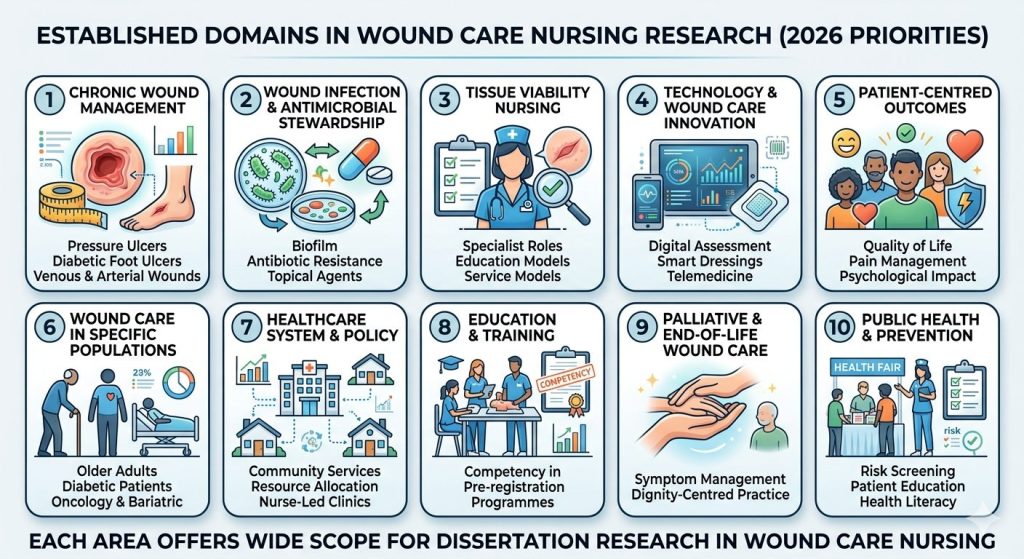
Before selecting a topic, it helps to understand the established domains within wound care nursing research. The following areas reflect current academic and clinical priorities:
- Chronic wound management — including pressure ulcers, diabetic foot ulcers, venous leg ulcers, and arterial wounds
- Wound infection and antimicrobial stewardship — biofilm, antibiotic resistance, and topical antimicrobial agents
- Tissue viability nursing — specialist roles, education, and service models
- Technology and wound care innovation — digital assessment tools, smart dressings, and telemedicine
- Patient-centred outcomes — quality of life, pain management, and psychological impact
- Wound care in specific populations — older adults, diabetic patients, oncology patients, and bariatric patients
- Healthcare system and policy — community wound care services, resource allocation, and nurse-led clinics
- Education and training — wound care competencies in pre-registration nursing programmes
- Palliative and end-of-life wound care — symptom management and dignity-centred practice
- Public health and prevention — wound risk screening, patient education, and health literacy
Each of these areas supports a wide range of dissertation topics in wound care nursing across all academic levels.
Five Example Dissertation Topics With Research Aims and Objectives
The following examples demonstrate how to structure a strong dissertation topic. Each includes a research aim and between two and three objectives.
Example 1 — Diabetic Foot Ulcer Prevention
Topic: The effectiveness of nurse-led education programmes in reducing diabetic foot ulcer recurrence among adults with type 2 diabetes in community settings.
Aim: To evaluate the impact of structured nurse-led patient education on recurrence rates of diabetic foot ulcers in a community nursing context.
Objectives:
- To review existing evidence on nurse-led education interventions for diabetic foot ulcer prevention
- To examine patient adherence to self-care protocols following structured education sessions
- To identify barriers and facilitators to the sustained implementation of education programmes in community nursing settings
Example 2 — Telemedicine in Wound Assessment
Topic: Exploring the accuracy and clinical acceptability of remote wound assessment tools in post-surgical patients managed in primary care.
Aim: To assess whether digital wound monitoring technologies provide clinically reliable data comparable to face-to-face assessment in post-surgical wound care.
Objectives:
- To compare wound assessment outcomes between digital and in-person clinical review
- To evaluate nurses’ and patients’ experiences of using remote monitoring platforms
- To identify factors that influence the adoption of telemedicine in wound care practice
Example 3 — Pressure Ulcer Prevention in Care Homes
Topic: Barriers to pressure ulcer prevention practice among registered nurses and care assistants in residential care homes in the United Kingdom.
Aim: To identify the organisational, educational, and attitudinal barriers that affect the implementation of evidence-based pressure ulcer prevention in care home settings.
Objectives:
- To explore staff knowledge and attitudes towards pressure ulcer risk assessment tools
- To examine how staffing ratios and workload affect compliance with prevention protocols
- To assess the role of leadership and training in supporting consistent prevention practice
Example 4 — Wound Care in Palliative Patients
Topic: Nurses’ experiences of managing malodorous fungating wounds in patients receiving palliative care: a qualitative study.
Aim: To explore how nurses navigate the clinical, emotional, and relational challenges of managing fungating wounds in end-of-life care environments.
Objectives:
Example 5 — Antimicrobial Resistance in Wound Care
Topic: A critical review of topical antimicrobial use in chronic wound management: implications for antimicrobial stewardship in nursing practice.
Aim: To critically evaluate the evidence base for topical antimicrobial agents in chronic wound care and examine their role within broader antimicrobial stewardship frameworks.
Objectives:
- To review the clinical evidence for commonly used topical antimicrobials in chronic wounds
- To assess how current wound care guidelines address antimicrobial stewardship principles
- To explore nurses’ understanding and application of stewardship principles in wound dressing selection
80 Wound Care Nursing Dissertation Topics for 2026
The following topics are organised by subfield. Each is suitable for undergraduate, master’s, or doctoral research. Topics are designed to be narrow, original, and researchable within a 2026 academic context. Students seeking additional topic in wound care nursing for an MSc thesis or PhD proposal will find this list particularly useful.
Chronic Wound Management
- The impact of structured wound care pathways on healing outcomes in patients with venous leg ulcers in community nursing settings
- Exploring the role of compression therapy adherence in reducing venous leg ulcer recurrence among elderly patients
- Nurse-led wound assessment clinics versus GP-led models: a comparative analysis of patient outcomes in chronic wound care
- The relationship between nutritional status and wound healing in adults with chronic leg ulcers: a systematic review
- Patient-reported outcomes in long-term venous ulcer management: a qualitative exploration of lived experience
- Evaluating the use of debridement techniques in the management of sloughy chronic wounds in community nursing
- The role of the tissue viability nurse in reducing unplanned hospital admissions related to chronic wound complications
- Exploring how care coordination models affect healing rates in patients with multiple chronic wounds
- Assessing the accuracy of wound measurement tools used by community nurses in the United Kingdom
- The effect of patient health literacy on self-management behaviour in individuals with chronic lower limb wounds
Diabetic Foot Care and Ulcer Management
- Effectiveness of multidisciplinary team approaches in preventing major amputation in patients with diabetic foot ulcers
- Exploring the delay between diabetic foot ulcer onset and specialist referral in primary care settings
- Nurses’ understanding of the diabetic foot risk classification system and its application in clinical practice
- Patient experiences of living with a diabetic foot ulcer: psychological impact and coping strategies
- Comparing outcomes of offloading interventions for plantar diabetic foot ulcers in outpatient care
- The role of advanced wound dressings in promoting granulation tissue formation in diabetic foot ulcers
- Evaluating culturally sensitive patient education resources for diabetic foot care in diverse UK communities
- The impact of glycaemic control on diabetic foot ulcer healing rates: implications for nursing assessment protocols
- Exploring barriers to podiatry referral for patients with type 2 diabetes in general practice nursing
- Nurse-led diabetic foot screening programmes in primary care: a review of implementation fidelity and clinical outcomes
Pressure Ulcer Prevention and Management
- Evaluating the reliability of the Braden Scale in predicting pressure ulcer risk in acute surgical wards
- The effect of repositioning frequency on pressure ulcer incidence in ventilated intensive care patients
- Knowledge and attitudes of student nurses towards pressure ulcer prevention: a cross-sectional study
- Organisational factors that influence pressure ulcer prevalence rates in NHS acute trusts
- The use of prophylactic foam dressings in reducing heel pressure ulcer incidence in orthopaedic patients
- Exploring how palliative care nurses manage pressure ulcers in patients approaching end of life
- Patient and family perspectives on pressure ulcer development during hospital admission: a qualitative study
- The impact of nursing documentation practices on pressure ulcer risk assessment compliance in hospital settings
- Comparing moisture-associated skin damage with pressure-related skin injury: implications for nursing classification
- Exploring the role of ward leadership in sustaining pressure ulcer prevention initiatives in acute care
Wound Infection, Biofilm, and Antimicrobial Practice
- Nurses’ knowledge and confidence in recognising signs of wound infection in community practice
- The clinical use of honey-based dressings in infected or biofilm-associated chronic wounds: a systematic review
- Evaluating the evidence for silver-containing dressings in the management of critically colonised wounds
- Antimicrobial stewardship in wound care: how nurses make dressing selection decisions in secondary care
- The role of wound swab interpretation in guiding antimicrobial dressing choice among tissue viability nurses
- Exploring how infection prevention and control policies affect wound dressing practices in care homes
- Patient experiences of wound odour associated with biofilm-infected chronic wounds and its impact on wellbeing
- The effect of antimicrobial irrigation techniques on surgical site infection rates in colorectal surgery patients
- Evaluating clinical decision-making in nurses when managing wounds with signs of critical colonisation
- Exploring the alignment between wound care guidelines and antimicrobial prescribing behaviour in wound management
Technology and Innovation in Wound Care
- The accuracy and feasibility of smartphone-based wound measurement applications in community nursing practice
- Exploring nurses’ attitudes towards adopting artificial intelligence tools in wound assessment workflows
- Patient acceptability of remote wound monitoring via telehealth platforms in post-surgical care
- Evaluating the clinical utility of 3D wound imaging in tracking healing trajectories in chronic wounds
- Smart wound dressings with biosensing capabilities: a review of evidence and implications for nursing practice
- Implementing electronic wound care records in community nursing: barriers, facilitators, and staff experiences
- The role of photographic wound documentation in improving clinical communication between care settings
- Evaluating the feasibility of virtual wound care consultations in rural and remote communities
- How nurses engage with digital wound care decision support tools: a qualitative study in secondary care
- Exploring the readiness of community nursing teams to adopt digital wound management platforms
Patient-Centred Outcomes and Quality of Life
- The psychological impact of chronic wound management on adults living with venous leg ulcers: a narrative review
- Exploring how wound-related pain affects daily functioning and sleep quality in patients with chronic wounds
- Patient experiences of wound care dressing changes in community settings: dignity, comfort, and communication
- The effect of wound malodour on social participation and self-esteem in patients with fungating wounds
- Health-related quality of life in adults with diabetic foot ulcers: a comparison of validated measurement tools
- Exploring the relationship between patient engagement and wound healing outcomes in nurse-led wound clinics
- The influence of wound care nurses’ communication styles on patient anxiety during dressing procedures
- Evaluating the use of patient-reported outcome measures in tissue viability nursing practice
- How chronic wound patients describe their experiences of receiving care from multiple healthcare providers
- Exploring the role of peer support in improving psychological wellbeing in patients with long-term wounds
Wound Care in Specific Populations
- Managing wounds in bariatric patients: nurses’ experiences of practical and clinical challenges in acute care
- Wound healing outcomes in immunocompromised patients receiving oncology treatment: a systematic review
- Exploring wound care challenges in patients receiving anticoagulation therapy in community nursing settings
- The prevalence and management of pressure ulcers in people with spinal cord injuries in rehabilitation settings
- Wound care needs in homeless populations: a qualitative study of barriers and access to community nursing
- Exploring the wound care experiences of older adults living in care homes: a patient-centred qualitative study
- Managing post-surgical wounds in patients with obesity: nursing assessment challenges and clinical strategies
- Wound care in neonates and paediatric patients: a review of evidence-based dressing choices and protocols
- Exploring the cultural factors that influence wound care self-management behaviour in South Asian communities
- Chronic wound management in patients with peripheral arterial disease: clinical challenges for community nurses
Healthcare Systems, Policy, and Nurse-Led Practice
- The economic burden of chronic wound care in the NHS: implications for resource allocation in community services
- Evaluating the impact of nurse prescribing authority on wound care management outcomes in primary care
- Exploring how integrated care systems shape the delivery of wound care services across community and acute settings
- The role of clinical nurse specialists in improving wound care quality standards in NHS trusts
- Workforce planning challenges in tissue viability nursing: a policy analysis of current UK service models
- Exploring how wound care clinical guidelines are adopted and adapted in practice by community nursing teams
- Patient safety incidents related to wound care in NHS settings: a review of reported themes and contributing factors
- The role of wound care champions in embedding evidence-based practice within hospital wards
- Evaluating how wound care nurse education programmes prepare graduates for specialist tissue viability roles
- The effect of community wound care service redesign on unplanned hospital readmission rates in older adults
How to Choose the Right Wound Care Nursing Dissertation Topic for Your Level
Not every topic on this list suits every academic level. Understanding the expectations at each stage helps you select wisely.
Undergraduate (BSc) students should focus on topics that involve systematic reviews, service evaluations, or qualitative explorations based on existing literature. Empirical data collection is possible but must be proportionate to your available time and ethical approval processes.
Master’s students are expected to demonstrate methodological awareness and make a modest original contribution to knowledge. A well-designed qualitative study, a critical literature synthesis, or a mixed-methods service evaluation all work well at this level. If you are looking for a topic in wound care nursing for your MSc thesis, consider topics in the 41–60 range, which tend to involve patient experience, technology adoption, or outcome evaluation.
PhD candidates must contribute genuinely new knowledge to the field. Topics should be theoretically grounded, methodologically rigorous, and positioned within a clear research gap. If you are searching for dissertation topics in wound care nursing for your PhD, topics related to healthcare systems, antimicrobial stewardship, or innovation adoption offer strong scope for original inquiry.
If you are unsure which topic suits your level, accessing online dissertation help from a specialist in nursing research can help you refine your idea into a proposal that meets your university’s expectations.
Conclusion
Selecting the right wound care nursing dissertation topic for 2026 is the foundation of a successful research journey. The field is rich with clinical problems that demand evidence-based investigation, and there is no shortage of areas where nursing research can make a genuine difference to patient outcomes and healthcare practice.
This post has covered the key research areas within wound care nursing, provided structured examples of how dissertation topics are built, and offered 80 original and academically sound topics across all major subfields. Whether you are writing at BSc, MSc, or PhD level, the right topic is one that matches your academic expectations, connects to a real gap in evidence or practice, and excites you enough to sustain months of focused research.
Approach your dissertation with confidence, curiosity, and integrity. The work you produce as part of your academic training has the potential to inform real nursing practice and improve patient care. That is a meaningful contribution, regardless of academic level.
