


Human Resource Management Dissertation Topics for 2026

Common student questions before choosing a topic
Students often share similar concerns on academic forums and discussion platforms. These questions reflect real uncertainty about scope, relevance, and academic expectations:
- How do I choose a focused topic from so many human resource management dissertation topics?
- Which areas in HRM are most relevant for 2026 research?
- What makes a topic suitable for undergraduate, master’s, or PhD level?
- How can I make sure my topic is researchable and not too broad?
- Are there current trends in HR that universities expect me to explore?
- How do I turn a topic idea into a clear aim and objectives?
These questions guide the structure of this post.
Introduction
Choosing the right topic in Human Resource Management is one of the most important decisions in your academic journey. A strong topic shapes your research direction, determines your methodology, and influences your final grade. It also reflects your ability to engage with real organisational challenges such as employee wellbeing, leadership, and digital transformation. Many students feel overwhelmed at this stage, especially when exploring human resource management dissertation topics across different academic levels. This guide simplifies the process and provides structured, research-ready ideas for 2026.
Download Human Resource Management Dissertation Topics PDF
Students often prefer a structured list they can review offline. A curated PDF of dissertation topics can help you compare ideas, shortlist options, and refine your research direction. Many academic support platforms offer personalised lists prepared by subject experts after you complete a short request process. This approach ensures your selected topic aligns with your academic level and research interests. If you are already exploring online dissertation help, accessing a tailored PDF can save time and reduce confusion during topic selection.
Why choosing the right HRM dissertation topic matters
A dissertation is not just a long essay. It is an independent research project that demonstrates your understanding of theory, your ability to apply research methods, and your critical thinking skills.
A well-chosen topic will:
- Match your academic level and research skills
- Address a real problem in organisations
- Allow access to reliable data
- Fit within your time and word limits
- Support strong analysis and discussion
Students who struggle often choose topics that are too broad or lack clear research direction. If you are considering dissertation topics on human resource management, focus on clarity and feasibility rather than complexity.
Key research areas in Human Resource Management
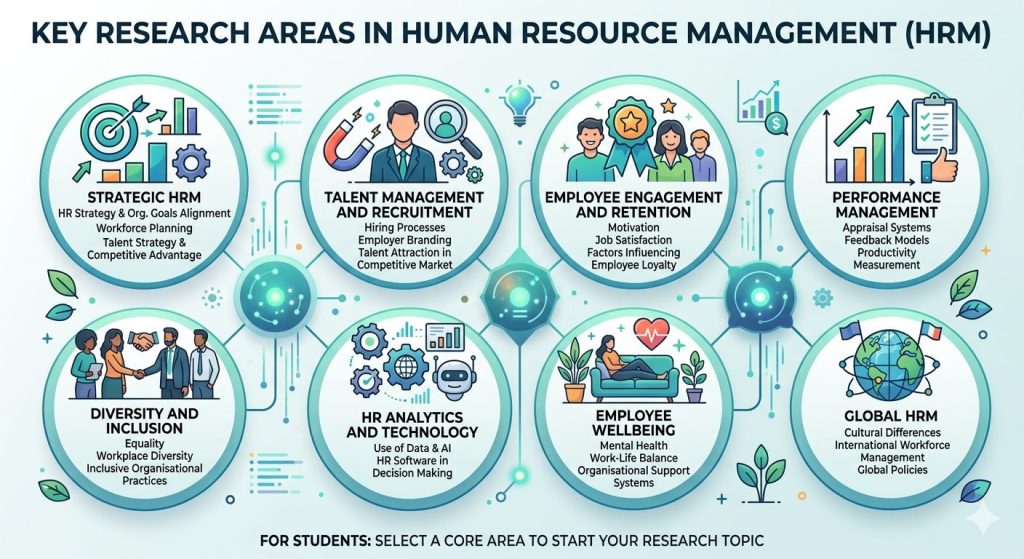
Human Resource Management is a broad field with several established research domains. Understanding these areas helps you narrow your focus.
Strategic HRM
This area explores how HR strategies align with organisational goals. It includes workforce planning, talent strategy, and competitive advantage.
Talent management and recruitment
Focuses on hiring processes, employer branding, and talent attraction in a competitive market.
Employee engagement and retention
Examines motivation, job satisfaction, and factors influencing employee loyalty.
Performance management
Covers appraisal systems, feedback models, and productivity measurement.
Diversity and inclusion
Addresses equality, workplace diversity, and inclusive organisational practices.
HR analytics and technology
Explores the use of data, artificial intelligence, and HR software in decision making.
Employee wellbeing
Focuses on mental health, work-life balance, and organisational support systems.
Global HRM
Examines cultural differences, international workforce management, and global policies.
Students searching for research topics in human resource management should start by selecting one of these core areas.
Five example dissertation topics with aims and objectives
1. Impact of remote work on employee productivity
Aim:
To examine how remote working influences employee productivity in corporate organisations.
Objectives:
- To analyse productivity levels before and after remote work adoption
- To identify challenges faced by remote employees
- To evaluate organisational support systems
2. Role of leadership in employee engagement
Aim:
To explore how leadership styles affect employee engagement levels.
Objectives:
- To identify common leadership styles in organisations
- To measure employee engagement under different leadership approaches
- To assess the relationship between leadership and motivation
3. Effectiveness of diversity policies in multinational companies
Aim:
To evaluate the effectiveness of diversity and inclusion policies.
Objectives:
- To examine existing diversity initiatives
- To analyse employee perceptions of inclusivity
- To assess organisational outcomes
4. Use of HR analytics in recruitment decisions
Aim:
To investigate the role of data analytics in improving recruitment outcomes.
Objectives:
- To explore tools used in HR analytics
- To evaluate decision-making accuracy
- To identify challenges in implementation
5. Employee wellbeing programmes and job satisfaction
Aim:
To assess the impact of wellbeing programmes on employee satisfaction.
Objectives:
- To identify types of wellbeing initiatives
- To measure employee satisfaction levels
- To analyse the relationship between wellbeing and performance
These examples help students understand how to structure human resource management thesis topics effectively.
List of 80 Human Resource Management Dissertation Topics for 2026
Strategic HRM Dissertation Topics
- Impact of strategic HRM on organisational performance in SMEs
- Role of HR strategy in business growth
- HRM as a source of competitive advantage
- Strategic workforce planning in the digital economy
- HR alignment with corporate strategy in multinational firms
- Role of HR in organisational change management
- Strategic HR practices in crisis management
- HR leadership in organisational transformation
- Impact of HR strategy on innovation
- Evaluating strategic HR frameworks in modern organisations
Talent Acquisition and Recruitment
- Effectiveness of employer branding in talent attraction
- Role of social media in recruitment strategies
- AI in recruitment decision making
- Candidate experience and recruitment outcomes
- Diversity hiring practices in organisations
- Recruitment challenges in remote work environments
- Use of data analytics in hiring decisions
- Graduate recruitment strategies in competitive markets
- Recruitment bias and fairness
- Impact of recruitment technology on hiring efficiency
Employee Engagement and Retention
- Factors influencing employee engagement in hybrid workplaces
- Role of organisational culture in retention
- Employee motivation strategies in modern organisations
- Impact of leadership on employee satisfaction
- Retention strategies in high turnover industries
- Employee engagement in remote teams
- Psychological factors affecting employee loyalty
- Impact of rewards on retention
- Work-life balance and employee engagement
- Role of communication in employee satisfaction
Performance Management Systems
- Effectiveness of performance appraisal systems
- Role of continuous feedback in employee performance
- Performance management in remote teams
- Impact of goal setting on productivity
- Employee perceptions of performance reviews
- Digital performance management tools
- Linking performance management to organisational goals
- Bias in performance evaluations
- Role of KPIs in employee performance
- Performance management in public sector organisations
Workforce Diversity and Inclusion
- Impact of diversity on team performance
- Gender equality in the workplace
- Inclusion strategies in multinational companies
- Managing cultural diversity in organisations
- Diversity training effectiveness
- Workplace discrimination and HR policies
- Inclusive leadership and organisational success
- Diversity management in global firms
- Employee perceptions of inclusion
- Role of HR in promoting equality
HR Analytics and Technology
- Role of big data in HR decision making
- Predictive analytics in employee performance
- AI applications in HRM
- HR technology adoption challenges
- Data-driven HR strategies
- Impact of HR software on efficiency
- Ethical issues in HR analytics
- Automation in HR processes
- Digital transformation in HR departments
- HR analytics in talent management
Students working on HRM thesis topics for MBA often find this section particularly relevant.
Employee Wellbeing and Mental Health
- Impact of workplace stress on employee performance
- Role of HR in mental health support
- Work-life balance policies and wellbeing
- Employee burnout in remote work settings
- Wellbeing programmes and productivity
- Organisational support and mental health outcomes
- Flexible working and employee satisfaction
- Psychological safety in the workplace
- HR strategies for stress management
- Impact of workload on employee wellbeing
Remote Work and Flexible Working
- Productivity in remote work environments
- Challenges of managing remote teams
- Hybrid work models and employee satisfaction
- Impact of flexible working on retention
- Remote work and organisational culture
- Communication challenges in virtual teams
- Work-life balance in remote settings
- Leadership in remote work environments
- Employee engagement in hybrid workplaces
- Future of remote work in HRM
Students exploring latest research topics in human resource management for PhD should consider combining themes such as technology and remote work for deeper analysis.
Conclusion
Selecting the right dissertation topic in Human Resource Management requires clarity, focus, and awareness of current research trends. A strong topic is specific, researchable, and aligned with your academic level. This guide has shown you how to move from confusion to structured decision making by understanding key research areas and reviewing carefully designed topic ideas.
Whether you are working on an undergraduate project or developing advanced human resource management thesis topics undergraduate, the key is to choose a topic that interests you and allows meaningful research. Approach your dissertation with confidence, stay organised, and focus on producing work that reflects both academic integrity and real-world relevance.
