


Geriatric Nursing Dissertation Topics for 2026

Questions Students Are Asking About Geriatric Nursing Dissertations
The following questions have been gathered from student forums, academic discussion platforms, and university support communities. They reflect what real students are searching for when they feel stuck or unsure about choosing a dissertation topic in geriatric nursing.
- How do I choose a dissertation topic for Geriatric Nursing that is both original and achievable?
- What Geriatric Nursing topics are suitable for an undergraduate dissertation in 2026?
- Can someone suggest a unique and recent topic for my undergraduate dissertation in Geriatric Nursing?
- What Geriatric Nursing issue should I do my dissertation on if I want to focus on current healthcare challenges?
- Are there any new research ideas in geriatrics that align with NHS or global health priorities?
- How do I narrow down a broad geriatric nursing topic into a focused research question?
- What are the most important geriatric research topics being studied at PhD level right now?
If any of these sound familiar, this post is written for you. It will walk you through the key research areas in geriatric nursing, provide structured topic examples, and offer 80 original dissertation topics you can use as inspiration or a starting point for your own research proposal.
Why Choosing the Right Geriatric Nursing Dissertation Topic Matters
Geriatric nursing is one of the most clinically demanding and emotionally complex fields in healthcare. With ageing populations placing increasing pressure on health systems across the United Kingdom and worldwide, the need for rigorous, practice-based research in this area has never been greater.
Choosing a strong dissertation topic is not simply an academic exercise. It shapes the quality of your research, the feasibility of your methodology, and the real-world relevance of your findings. A well-chosen topic demonstrates to your university that you understand the priorities of your field and are ready to contribute meaningfully to it.
Students who approach topic selection carefully tend to produce more coherent, better-structured dissertations. They also find the writing process less overwhelming, because their research question is clear from the start.
If you are feeling unsure about where to begin, seeking online dissertation help early in the process can make a significant difference. Speaking with an academic advisor or using structured guidance tools can help you move from a broad interest area to a focused, researchable question.
Download Geriatric Nursing Dissertation Topics PDF
Many students find it helpful to have a curated, expert-reviewed list of dissertation topics they can refer to offline, share with supervisors, or annotate during their planning process. A downloadable PDF containing a personalised list of geriatric nursing dissertation topics, selected by academic specialists, is available to students who complete a short online form. The topics in the PDF are tailored to academic level, research interest, and current healthcare priorities, giving students a ready-to-use resource for their early dissertation planning stages.
Key Research Areas in Geriatric Nursing for 2026
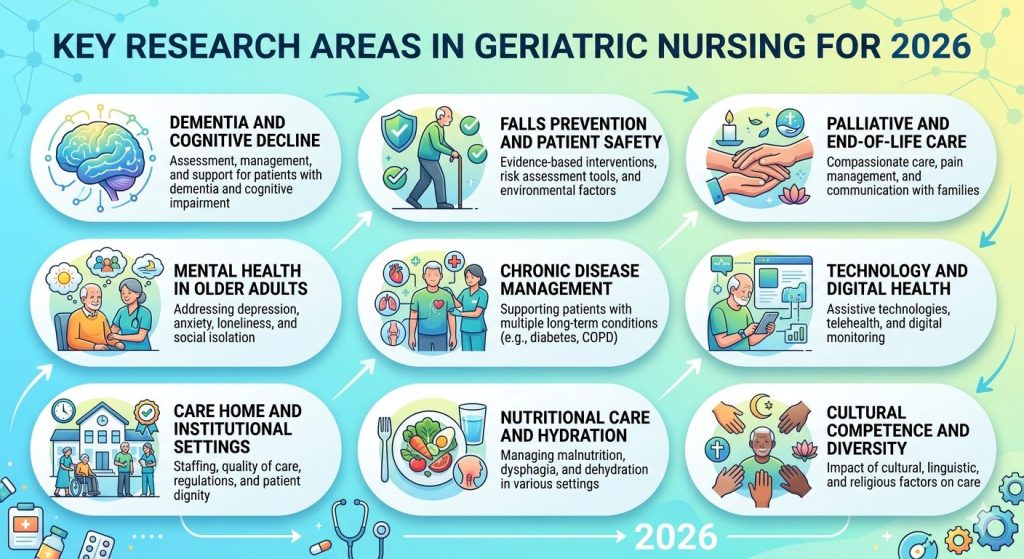
Before selecting a topic, it helps to understand the major research domains within geriatric nursing. These areas are grounded in established academic literature and reflect current clinical and policy priorities.
Dementia and Cognitive Decline Research in this area explores how nurses assess, manage, and support patients experiencing dementia, Alzheimer’s disease, and other forms of cognitive impairment in hospital and community settings.
Falls Prevention and Patient Safety This domain covers evidence-based interventions, risk assessment tools, and environmental factors that contribute to falls in older adults, particularly within care homes and acute wards.
Palliative and End-of-Life Care Researchers examine how geriatric nurses deliver compassionate, patient-centred care to older adults at the end of life, including pain management, family communication, and dignified death.
Mental Health in Older Adults This area addresses depression, anxiety, loneliness, and social isolation among elderly patients, and how nursing practice can better identify and respond to these conditions.
Chronic Disease Management Studies in this domain focus on how nurses support older adults managing multiple long-term conditions such as diabetes, heart failure, COPD, and arthritis simultaneously.
Technology and Digital Health Emerging research explores the role of assistive technologies, telehealth, and digital monitoring in supporting independent living and improving outcomes for elderly patients.
Care Home and Institutional Settings This area examines staffing, care quality, regulatory frameworks, and patient dignity within residential and nursing home environments.
Nutritional Care and Hydration Researchers investigate malnutrition, dysphagia, dehydration, and the nurse’s role in screening and managing these conditions among hospitalised or care-home residents.
Cultural Competence and Diversity This growing area explores how cultural, linguistic, and religious factors influence care delivery for older adults from minority ethnic communities.
Five Structured Dissertation Topic Examples in Geriatric Nursing
The following examples illustrate how to turn a broad interest area into a structured dissertation topic with a clear aim and measurable objectives.
Example 1: Dementia Care Communication
Topic: Evaluating the effectiveness of person-centred communication training for nurses working in dementia wards in NHS acute hospitals.
Aim: To assess whether structured communication training programmes improve nurse-patient interaction quality in dementia care settings.
Objectives:
- To review existing literature on communication training models used in UK dementia nursing
- To evaluate nurse-reported confidence levels before and after completing person-centred communication training
- To identify barriers to implementing communication training within NHS acute ward environments
Example 2: Falls Prevention in Care Homes
Topic: Assessing the impact of multifactorial falls prevention programmes on fall rates among residents aged 80 and above in English care homes.
Aim: To determine whether integrated falls prevention interventions reduce fall frequency among very elderly care home residents.
Objectives:
- To critically appraise current evidence on multifactorial falls prevention in residential care
- To compare fall incidence data before and after programme implementation in selected care homes
- To explore staff perceptions of barriers and facilitators to falls prevention practice
Example 3: Technology-Assisted Care
Topic: Exploring the experiences of older adults using wearable health monitoring devices in community-based geriatric nursing programmes.
Aim: To understand how elderly patients perceive and engage with wearable monitoring technology in their daily lives.
Objectives:
- To examine existing literature on patient acceptance of wearable health technologies in elderly populations
- To gather qualitative data on patient experiences through semi-structured interviews
- To identify factors that support or hinder sustained use of monitoring devices among older adults
Example 4: Nutritional Screening
Topic: Evaluating the accuracy and clinical utility of the Malnutrition Universal Screening Tool (MUST) in identifying malnourished elderly patients on general medical wards.
Aim: To assess how effectively MUST identifies malnutrition risk in hospitalised older adults within a UK NHS context.
Objectives:
- To review the evidence base supporting MUST as a screening tool in geriatric populations
- To compare MUST scores with clinical dietitian assessments in a ward-based observational study
- To propose improvements to nutritional screening practices based on study findings
Example 5: End-of-Life Dignity
Topic: Understanding how geriatric nurses in care homes interpret and implement the concept of dying with dignity for residents with advanced dementia.
Aim: To explore nurse interpretations of dignified death and how these shape care practices in dementia-specific residential settings.
Objectives:
- To analyse existing definitions of dying with dignity within the geriatric nursing literature
- To collect qualitative data from nurses using focus group discussions
- To identify gaps between policy intentions and clinical practice in end-of-life dementia care
80 Geriatric Nursing Dissertation Topics for 2026
The following topics are organised by subfield. They are numbered in fixed ranges for ease of navigation and are suitable for undergraduate, master’s, and PhD-level research proposals. Students looking for nursing research topics in geriatrics will find a wide range of options here, from clinical practice to policy and ethics.
Dementia and Cognitive Decline
- Examining the role of music therapy in reducing agitation among nursing home residents with moderate-to-severe dementia
- Assessing the impact of reminiscence therapy on quality of life in older adults with early-stage Alzheimer’s disease
- Evaluating nurse attitudes towards physical restraint use in patients with advanced dementia across NHS trusts
- Exploring the experiences of family caregivers supporting a relative with dementia in a residential care home
- Investigating the barriers nurses face when delivering person-centred dementia care in busy acute ward environments
- Analysing the effectiveness of structured cognitive stimulation therapy delivered by nurses in community memory clinics
- Understanding the role of named nurses in supporting continuity of care for dementia patients in hospital settings
- Evaluating how dementia-specific training affects the confidence and practice of newly qualified nurses
- Examining the use of life story books as a communication aid in dementia nursing care
- Assessing the accuracy of cognitive screening tools used by nurses in identifying early dementia in primary care settings
Falls Prevention and Patient Safety
- Evaluating the effectiveness of hourly rounding protocols in reducing fall rates among elderly inpatients in acute hospital wards
- Examining the relationship between polypharmacy and fall risk in community-dwelling older adults aged 75 and above
- Assessing nurse compliance with fall risk assessment documentation in care home settings
- Exploring older adult perspectives on their own fall risk and willingness to engage in prevention activities
- Evaluating the role of physiotherapy-nurse collaboration in designing individualised falls prevention plans for frail elderly patients
- Investigating the impact of footwear guidance provided by nurses on fall rates in care home residents
- Examining the effectiveness of post-fall nursing care protocols in reducing repeat falls within 30 days of an initial incident
- Assessing the influence of ward lighting and environmental design on falls among hospitalised elderly patients
- Exploring nursing staff perceptions of fall reporting cultures in NHS community hospitals
- Evaluating the use of bed alarm technology in falls prevention among elderly patients with cognitive impairment
Palliative and End-of-Life Care
- Examining how nurses in care homes initiate advance care planning conversations with elderly residents
- Exploring the emotional impact of repeated patient deaths on geriatric nurses in long-term care settings
- Assessing the adequacy of pain management provided by nurses during the last 48 hours of life for elderly patients
- Evaluating the use of the Liverpool Care Pathway successor frameworks in nursing home end-of-life care
- Investigating how cultural and religious beliefs influence nurse decision-making in end-of-life geriatric care
- Exploring the role of specialist palliative care nurses in supporting general ward nurses caring for dying elderly patients
- Examining the experiences of older adults with terminal diagnoses in community settings supported by district nurses
- Assessing the quality of nurse-family communication during the final stages of life for elderly care home residents
- Evaluating the impact of Schwartz rounds on nurse wellbeing in palliative geriatric care settings
- Exploring how nurses document and communicate a patient’s preferred place of death across multidisciplinary teams
Mental Health in Older Adults
- Assessing the effectiveness of brief psychological interventions delivered by nurses for depression in elderly care home residents
- Exploring the experiences of older adults with late-onset anxiety receiving care from community mental health nurses
- Examining the role of social prescribing facilitated by nurses in reducing loneliness among elderly patients in urban settings
- Evaluating nurse knowledge and attitudes towards suicide risk assessment in older adult populations
- Investigating the impact of pet therapy programmes facilitated by nursing staff on depression scores in care home residents
- Assessing how nurses identify and respond to signs of elder abuse in residential care settings
- Exploring the experiences of LGBTQ+ older adults accessing mental health nursing services in later life
- Examining the influence of staffing ratios on nurse ability to provide meaningful psychological support to elderly patients
- Evaluating the effectiveness of structured activity programmes led by nursing staff in reducing depression among elderly inpatients
- Investigating the role of nursing documentation in tracking changes in mental health status for older adults with comorbid physical conditions
Chronic Disease Management
- Evaluating the effectiveness of nurse-led heart failure clinics in reducing hospital readmissions among elderly patients
- Examining how nurses support self-management of type 2 diabetes in older adults living with cognitive decline
- Assessing the role of community nurses in COPD management for elderly patients transitioning from hospital to home
- Exploring patient and carer experiences of nurse-led osteoporosis education programmes in primary care
- Investigating the impact of nurse-initiated medication reviews on treatment adherence among elderly patients with polypharmacy
- Evaluating the effectiveness of telemonitoring programmes managed by nurses in controlling hypertension in older adults
- Assessing nurse understanding of frailty assessment tools and their application in chronic disease management
- Examining how nurses coordinate multidisciplinary care for elderly patients living with three or more long-term conditions
- Evaluating nurse-led smoking cessation interventions tailored to elderly patients with chronic respiratory disease
- Exploring the barriers and facilitators to nurse-delivered exercise guidance for older adults managing chronic musculoskeletal conditions
Technology and Digital Health in Geriatric Nursing
- Examining older adult acceptance of telehealth consultations with community nurses during and after the COVID-19 pandemic
- Evaluating the effectiveness of remote monitoring systems managed by nurses in detecting early deterioration in elderly patients at home
- Assessing the digital literacy levels of older adults and their impact on engagement with nurse-delivered digital health programmes
- Exploring nurse perceptions of electronic health record systems and their influence on care documentation quality in geriatric wards
- Investigating the role of robotic assistive devices in supporting nursing care for elderly patients with limited mobility
- Evaluating the use of AI-powered falls detection systems within care home nursing practice
- Examining how nurses support elderly patients in using smart medication dispensers to improve adherence
- Assessing the ethical implications of surveillance technologies used by nurses to monitor cognitively impaired elderly patients at home
- Exploring the integration of wearable vital sign monitors into nurse-led chronic disease management for frail elderly patients
- Evaluating the readiness of geriatric nurses in the UK to adopt digital care planning tools in clinical practice
Care Home and Institutional Settings
- Examining the relationship between nurse staffing levels and quality of care outcomes in English residential care homes
- Evaluating the impact of leadership style on nursing team performance and resident outcomes in care home settings
- Assessing how care home nurses interpret and implement CQC inspection guidance in their daily practice
- Exploring the experiences of nurses transitioning from acute hospital settings to long-term care home employment
- Investigating the role of dignity champions within care homes in shaping nursing culture and resident experience
- Examining how infection prevention and control policies are implemented by nursing staff in care home settings post-pandemic
- Evaluating the effectiveness of structured handover communication tools in care home nursing to reduce care errors
- Assessing the impact of staff continuity on resident wellbeing and trust in nursing home care
- Exploring the challenges nurses face in maintaining professional boundaries in long-term care home relationships with elderly residents
- Investigating how care home nurses document and respond to changes in resident capacity and consent over time
Nutritional Care and Hydration
- Evaluating the effectiveness of nurse-led nutritional screening programmes in identifying malnutrition risk in elderly hospital inpatients
- Examining the barriers nurses face in implementing hydration monitoring for cognitively impaired elderly patients in care homes
- Assessing the impact of protected mealtimes on nutritional intake among elderly patients in NHS acute wards
- Exploring the role of nurses in identifying and managing dysphagia in elderly patients following stroke
- Investigating nurse knowledge of texture-modified diets and their application in meeting the nutritional needs of elderly residents
Cultural Competence and Diversity in Geriatric Nursing
- Examining the experiences of South Asian elderly patients receiving end-of-life nursing care within UK NHS settings
- Assessing the cultural competence of geriatric nurses working with elderly patients from Black African and Caribbean communities
- Evaluating the effectiveness of interpreter services in supporting nurse-patient communication for elderly patients with limited English
- Exploring how religious practices and beliefs influence nursing care planning for elderly Muslim patients in UK care homes
- Investigating the impact of unconscious bias training on nurse attitudes towards elderly patients from minority ethnic backgrounds
How to Use These Dissertation Topics in Geriatric Nursing
Selecting a topic from the list above is only the first step. Once you have identified an area that interests you, the next stage is to narrow it into a focused research question. A topic becomes a dissertation when it is specific enough to be answered through a defined methodology within the time and resources you have available.
Consider the following when shortlisting topics:
- Your academic level: Undergraduate dissertations tend to focus on a single setting or patient group. Master’s and PhD research often addresses theoretical gaps or policy implications.
- Access to participants or data: Some topics require ethics approval and access to clinical settings. Others can be addressed through secondary data or systematic literature review.
- Supervisor expertise: Your university supervisor’s knowledge area can make a significant difference to the support you receive. Choose a topic your department has capacity to supervise well.
- Current healthcare policy: Aligning your topic with NHS priorities, NICE guidelines, or WHO frameworks adds academic and practical relevance to your research.
Students who are unsure which topic suits their level should consider speaking with a dissertation advisor or seeking structured dissertation topics in geriatric nursing support as early as possible in the academic year.
Conclusion
Geriatric nursing is a field where research truly matters. The decisions nurses make every day, and the policies that guide those decisions, affect the lives of millions of older adults. Dissertation research in this area has the power to contribute something meaningful to that picture.
Choosing the right dissertation topic is the foundation of a successful research project. Whether you are drawn to dementia care, digital health, palliative nursing, or nutritional support, there is a strong and relevant research question waiting to be developed within your area of interest.
Use the 80 geriatric research topics in this post as a starting point rather than a final answer. Take one that resonates with you, talk to your supervisor, read around the subject, and then refine your question until it is specific, achievable, and academically grounded.
Your dissertation is an opportunity to develop as a researcher and as a nurse. Approach it with curiosity and confidence, and you will produce work you can be proud of.
