


Mental Health Nursing Dissertation Topics for 2026

Questions Students Are Asking Right Now
The following questions have been gathered from student forums, university discussion boards, and academic support platforms. They reflect genuine concerns shared by nursing students at all levels who are trying to choose the right dissertation topic.
- What are the best mental health nursing dissertation topics for 2026?
- How do I choose a dissertation topic in mental health nursing that is relevant and researchable?
- What are some inspiring mental health nursing research topics for undergraduate students?
- Which mental health nursing topics are suitable for a master’s thesis or PhD proposal?
- What trending mental health dissertation topics should I consider for 2026?
- How do I narrow down my research idea into a strong dissertation topic?
- Are there mental health research topics for nursing students that focus on current NHS challenges?
- What are good dissertation topics about mental health that align with evidence-based practice?
If you have asked yourself any of these questions, this post was written for you.
Why Choosing the Right Mental Health Nursing Dissertation Topic Matters
Choosing a dissertation topic is one of the most important academic decisions a nursing student will make. In mental health nursing, this decision carries even greater weight. The field is evolving rapidly, influenced by policy changes, new clinical evidence, and growing public awareness of mental health.
A well-chosen topic does more than satisfy academic requirements. It positions you to contribute meaningfully to a field that affects millions of people worldwide. It allows you to develop clinical insight, sharpen your research skills, and demonstrate professional competence to future employers or academic supervisors.
Students who choose topics with both personal relevance and academic depth tend to produce stronger dissertations. They stay motivated through the process, engage more deeply with the literature, and produce findings that carry real-world value.
This guide will help you understand what makes a topic academically strong, explore key subfields within mental health nursing, and select from 80 carefully structured dissertation topics aligned with 2026 research expectations.
Download Mental Health Nursing Dissertation Topics PDF
Many students find it easier to review dissertation topics in a structured document they can annotate and return to. A downloadable PDF containing a personalised list of mental health nursing dissertation topics, curated by academic subject specialists, is available to students on request.
After completing a brief form with details about your academic level and area of interest, the PDF is sent directly to your inbox. It is designed to support your topic selection process and can be used alongside supervisor meetings or research proposal drafts. Students seeking online dissertation help will find this resource particularly useful when starting their research journey.
Key Research Areas in Mental Health Nursing
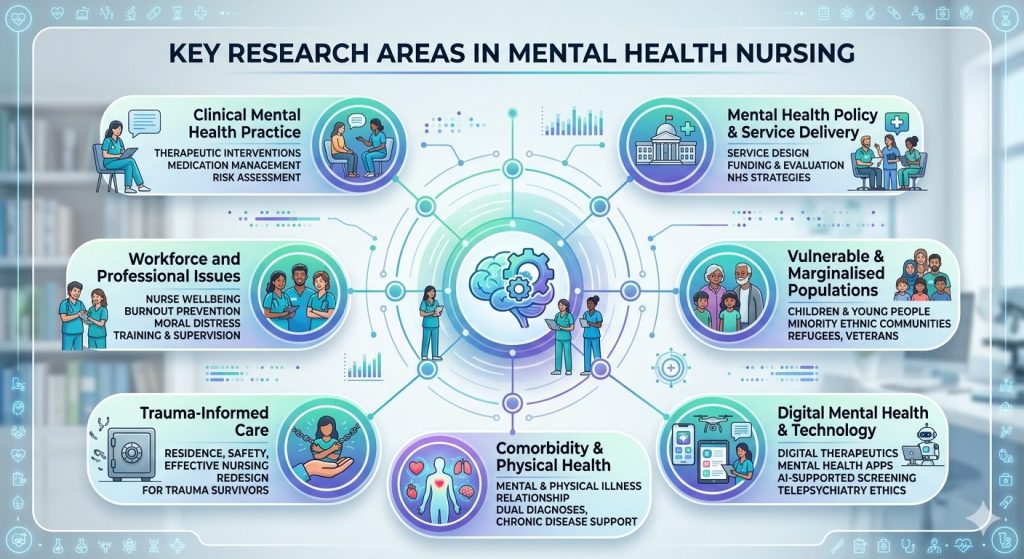
Before exploring specific topics, it helps to understand the major academic domains within mental health nursing. These areas represent established fields of inquiry where strong research is being actively produced. They also reflect where clinical practice is developing most quickly.
Clinical Mental Health Practice This area covers therapeutic interventions, medication management, risk assessment, and the day-to-day responsibilities of mental health nurses working in inpatient and community settings.
Mental Health Policy and Service Delivery Research in this domain examines how healthcare systems design, fund, and evaluate mental health services. It includes work on NHS mental health strategy, access to care, and integrated care models.
Vulnerable and Marginalised Populations This area focuses on groups with specific mental health needs, including children and young people, older adults, refugees, prisoners, veterans, and individuals from minority ethnic communities.
Digital Mental Health and Technology This is a fast-growing area covering digital therapeutics, mental health apps, telepsychiatry, AI-supported screening, and the ethics of technology use in psychiatric care.
Comorbidity and Physical Health Research in this domain explores the relationship between mental and physical illness, including how nurses manage dual diagnoses and support patients with conditions such as diabetes, cardiovascular disease, or chronic pain alongside a mental health condition.
Trauma-Informed Care This domain examines how trauma shapes mental health presentations and how nursing practice can be redesigned to be more responsive, safe, and effective for trauma survivors.
Workforce and Professional Issues Research here addresses nurse wellbeing, burnout, moral distress, training, supervision, and the challenges of delivering compassionate care under systemic pressure.
Five Dissertation Topic Examples with Aims and Objectives
Understanding how to frame a dissertation topic with clear research aims and objectives is essential. The examples below demonstrate how to move from a broad area of interest to a focused, academically sound research question.
Example 1: Therapeutic Relationships in Acute Inpatient Settings
Research Aim: To explore how mental health nurses build and maintain therapeutic relationships with patients in acute inpatient psychiatric wards.
Objectives:
- To identify barriers that prevent therapeutic engagement in high-acuity settings
- To examine how ward culture and nurse-to-patient ratios affect relationship quality
- To assess whether current nursing models adequately support relational care
Example 2: Digital Mental Health Interventions for Young People
Research Aim: To evaluate the effectiveness of smartphone-based mental health applications in supporting adolescents with anxiety disorders.
Objectives:
- To review current evidence on app-based cognitive behavioural therapy for adolescents
- To explore young people’s experiences of using digital tools for anxiety management
- To identify ethical and safeguarding concerns raised by mental health app use in under-18s
Example 3: Perinatal Mental Health Nursing in Community Settings
Research Aim: To investigate the role of mental health nurses in identifying and supporting women with perinatal depression in primary care.
Objectives:
- To examine screening practices used by community mental health nurses during the perinatal period
- To identify gaps between national guidelines and clinical reality in perinatal mental health care
- To explore the experiences of mothers who received mental health nursing support during pregnancy
Example 4: Moral Distress and Burnout Among Mental Health Nurses
Research Aim: To examine the relationship between moral distress and burnout in mental health nurses working within NHS inpatient services.
Objectives:
- To measure the prevalence and severity of moral distress among qualified mental health nurses
- To explore how institutional culture either reduces or intensifies moral distress
- To identify evidence-based interventions that have reduced burnout in comparable settings
Example 5: Culturally Competent Care for Black and Minority Ethnic Patients
Research Aim: To assess whether current mental health nursing practice in England adequately meets the cultural needs of Black and minority ethnic patients.
Objectives:
- To review literature on racial disparities in mental health diagnosis and detention under the Mental Health Act
- To explore the experiences of Black and minority ethnic patients receiving inpatient care
- To evaluate training approaches designed to improve cultural competence in mental health nursing teams
80 Mental Health Nursing Dissertation Topics for 2026
The following topics are organised by subfield. Each one is designed to be specific, researchable, and appropriate for undergraduate, master’s, or PhD-level study. Students are encouraged to adapt these topics to reflect their own clinical interests, academic level, and institutional context.
Therapeutic Practice and Nurse-Patient Relationships
- The impact of trauma-informed communication on patient engagement in acute psychiatric wards
- How mental health nurses use self-disclosure as a therapeutic tool in community mental health teams
- The role of non-verbal communication in building trust with patients experiencing psychosis
- Nurse-led de-escalation strategies and their effectiveness in reducing physical restraint incidents
- Patient perspectives on what makes a mental health nurse feel genuinely therapeutic
- How recovery-oriented practice changes the quality of nurse-patient interactions in rehabilitation settings
- The influence of nurse burnout on therapeutic relationship quality in forensic mental health units
- Boundaries in therapeutic relationships: how mental health nurses navigate emotional closeness
- The effect of staff continuity on therapeutic alliance in community mental health nursing
- Exploring the use of motivational interviewing techniques by mental health nurses in substance misuse services
Mental Health in Young People and Adolescents
- Barriers to help-seeking behaviour among adolescent males with depression in secondary schools
- Mental health nurses’ experiences of supporting young people with eating disorders in CAMHS
- The effectiveness of school-based mental health nursing interventions for anxiety in children aged 10–16
- How social media use relates to self-harm presentations in adolescents: implications for nursing assessment
- Transition experiences of young people moving from CAMHS to adult mental health services: a nursing perspective
- The role of mental health nurses in identifying and responding to childhood trauma in looked-after children
- Parental involvement in the treatment of adolescent depression: mental health nurses’ views and practices
- LGBTQ+ young people’s experiences of mental health nursing care in inpatient CAMHS settings
- Assessing the effectiveness of dialectical behaviour therapy delivered by mental health nurses to adolescents with borderline traits
- How mental health nurses support young people with autism spectrum conditions in general psychiatric settings
Older Adults and Dementia Care
- Mental health nursing assessment of depression in older adults living in care homes
- The experience of mental health nurses providing end-of-life psychological support to patients with dementia
- How mental health nurses respond to behavioural and psychological symptoms of dementia in community settings
- Dignity and personhood in dementia nursing: ethical challenges facing mental health nurses in acute wards
- Loneliness as a mental health issue in older adults: the nursing response in primary care
- Carer burden and the role of mental health nursing in supporting family members of people with dementia
- The use of reminiscence therapy by mental health nurses working with older adults in residential care
- Ageism in mental health services: how it affects nursing assessments and treatment plans for over-65s
- Recognising late-onset bipolar disorder in older adults: challenges for mental health nurses
- How mental health nurses support older adults with co-occurring depression and frailty in general hospitals
Severe Mental Illness and Psychosis
- The mental health nurse’s role in supporting medication adherence in patients with schizophrenia
- Physical health monitoring for patients with serious mental illness: gaps in current nursing practice
- Clozapine monitoring and the lived experience of patients: implications for nursing care planning
- Community treatment orders and mental health nursing: ethical dilemmas and patient rights
- The impact of early intervention in psychosis services on nursing workload and clinical outcomes
- How mental health nurses support employment recovery in people with psychosis
- Family intervention in schizophrenia: mental health nurses’ roles and confidence levels
- Relapse prevention planning in bipolar disorder: a review of mental health nursing practices
- The experiences of mental health nurses working with patients who have treatment-resistant depression
- Recovery college participation among people with severe mental illness: mental health nursing involvement
Suicide, Self-Harm and Crisis Care
- Mental health nurses’ experiences of therapeutic risk assessment following a patient suicide attempt
- The effectiveness of safety planning interventions delivered by mental health nurses in crisis resolution teams
- How mental health nurses in emergency departments respond to patients presenting with self-harm
- Lived experience of being cared for by mental health nurses following a suicide attempt
- Moral distress in mental health nurses who have experienced patient suicide on their caseload
- Repetitive self-harm and the challenges this presents for therapeutic nursing relationships
- The impact of zero-suicide frameworks on clinical decision-making in mental health nursing
- How mental health nurses talk about suicide risk with patients who are reluctant to engage
- Grief and bereavement support provided by mental health nurses after patient death by suicide
- Nurse-led crisis assessment centres as an alternative to emergency department mental health presentations
Diversity, Equity and Culturally Sensitive Care
- Racial disparities in the use of the Mental Health Act: implications for mental health nursing practice
- How mental health nurses provide culturally sensitive care to Muslim patients in UK inpatient settings
- The experiences of Black African and Caribbean patients receiving compulsory mental health treatment
- Gender identity and mental health: how mental health nurses support transgender patients in acute care
- Refugees and asylum seekers with post-traumatic stress disorder: mental health nursing challenges in the UK
- Cultural competence training for mental health nurses: current provision and its effectiveness
- Mental health nursing care for Gypsy, Roma and Traveller communities: understanding barriers to engagement
- How mental health nurses respond to patients whose religious beliefs shape their understanding of mental illness
- Intersectionality in mental health nursing: how race, gender and class affect nursing care decisions
- The experiences of South Asian women with postnatal depression receiving mental health nursing support
Digital Health, Technology and Innovation
- Mental health nurses’ attitudes toward the use of artificial intelligence tools in clinical risk assessment
- Telepsychiatry and the changing role of the mental health nurse in remote consultations
- Digital exclusion and its impact on mental health nursing care for older adults in community settings
- Patient experiences of using mental health apps as an adjunct to community mental health nursing
- The ethics of monitoring mental health patients through wearable technology: a nursing perspective
- How electronic patient records affect therapeutic interactions between mental health nurses and patients
- Virtual reality as a therapeutic tool in mental health nursing: current evidence and clinical implications
- Social media and nursing professionalism: challenges facing mental health nurses in digital environments
- Data privacy concerns in digital mental health nursing: implications for patient trust and engagement
- Online peer support communities and their relationship with formal mental health nursing care
Workforce, Education and Professional Development
- The impact of student mental health nurses’ own mental health on their professional development
- Compassion fatigue among community mental health nurses: prevalence, causes and responses
- How clinical supervision supports reflective practice in newly qualified mental health nurses
- Preceptorship experiences of newly registered mental health nurses in NHS trusts
- The value of lived experience workers in mental health nursing teams: nurses’ perspectives
- How undergraduate mental health nursing programmes prepare students for working with personality disorders
- Nursing associates in mental health settings: role clarity and patient safety implications
- The relationship between nurse staffing levels and patient safety incidents in inpatient mental health wards
- How mental health nurses maintain professional boundaries when using social media outside of work
- Leadership development in mental health nursing: what shapes a nurse’s decision to move into management
How to Choose the Right Topic for Your Level
Not every topic in this list will suit every student. Selecting the right dissertation topic depends on several factors, including your academic level, clinical experience, access to data, and the research methods you feel confident using.
Undergraduate students typically focus on literature-based or small-scale empirical studies. A topic that explores patient experiences or reviews clinical practice guidelines is generally manageable within the scope of an undergraduate dissertation.
Students pursuing mental health nursing topics for a master’s thesis should aim for a topic with greater theoretical depth or original data collection. Systematic reviews, qualitative studies with multiple participants, or mixed-methods designs are well suited to master’s level work.
For those developing dissertation topics on mental health nursing for PhD students, the expectation is an original contribution to knowledge. This means identifying a genuine gap in the literature, applying a robust theoretical framework, and designing a study that is innovative in its approach or findings.
Students working on a mental health nursing research proposal for MSc study should pay particular attention to feasibility. A topic that can be explored within the time and resources available to a taught master’s student is more likely to succeed than one that requires years of data collection.
Aligning Your Topic with Current Research Priorities
The best research topics for nursing students are not chosen in isolation. They reflect what the academic and clinical community considers important. In 2026, several priorities are shaping mental health nursing research.
The NHS Long Term Plan places significant emphasis on mental health integration and parity of esteem. Research that examines how these policy ambitions translate into everyday nursing practice is both timely and academically valuable.
There is also growing recognition of the mental health needs of healthcare workers themselves, particularly following the pressures of recent years. Research exploring nursing workforce wellbeing, moral injury, and sustainable staffing has real practical significance.
Students who align their topics with these priorities are more likely to find current literature, access willing participants, and produce findings that contribute to meaningful change.
Conclusion
Selecting a dissertation topic in mental health nursing is both an academic challenge and a professional opportunity. The topics and guidance in this post are designed to support you at every stage of that process, from the first moment of uncertainty to a confident, well-framed research proposal.
A strong dissertation begins with a topic that is specific, researchable, and meaningful. It is grounded in evidence, informed by clinical reality, and shaped by a genuine desire to contribute to the field. Whether you are an undergraduate exploring patient experience or a doctoral student designing an original study, the principles of good topic selection remain the same.
Approach your dissertation with academic honesty and intellectual curiosity. Engage deeply with the literature. Seek supervision early and use every resource available to you. The research you produce today may one day inform the care that someone receives tomorrow.
