


Medical-Surgical Nursing Dissertation Topics for 2026

The questions below were gathered from student forums, academic discussion platforms, and peer communities where nursing students regularly share their concerns about research and dissertation planning.
Common questions students ask include:
- What are the most relevant Medical-Surgical Nursing dissertation topics for 2026?
- Which Medical Surgical Nursing research topics are appropriate for my undergraduate level?
- How do I find dissertation topics in Medical-Surgical Nursing for PhD students?
- Are there MSc Nursing research topics in Medical Surgical Nursing that align with NHS priorities?
- How do I know if my chosen topic is academically sound and researchable?
- Where can I get a Medical Surgical Nursing dissertation topics PDF to help me get started?
Why Choosing the Right Dissertation Topic in Medical-Surgical Nursing Matters
Selecting the right dissertation topic is one of the most consequential decisions a nursing student will make during their academic journey. Medical-surgical nursing covers a broad range of clinical conditions, patient populations, and care environments. This breadth can feel exciting but also overwhelming, especially when you are trying to identify a topic that is specific, researchable, and aligned with current healthcare priorities.
A well-chosen topic demonstrates academic rigour. It also reflects your understanding of both clinical practice and the research landscape. Whether you are writing at undergraduate level, working on an MSc, or pursuing a PhD, your topic needs to be focused, evidence-based, and relevant to contemporary nursing challenges.
This post is designed to guide you through that process. It explains the key research areas within medical-surgical nursing, offers structured examples of dissertation topics with aims and objectives, and provides 80 unique topic ideas to support your planning. Students who need additional personalised guidance may also benefit from online dissertation help to ensure their chosen topic aligns with both academic expectations and institutional requirements.
Download Medical-Surgical Nursing Dissertation Topics PDF
Students who want a curated and personalised list of dissertation topics can access a downloadable PDF prepared by academic experts in nursing research. This resource is available after completing a short form and is designed to match your academic level, area of interest, and institutional requirements. The PDF includes topic suggestions, brief research rationale, and guidance notes to help you move forward with your proposal.
Key Research Areas in Medical-Surgical Nursing for 2026
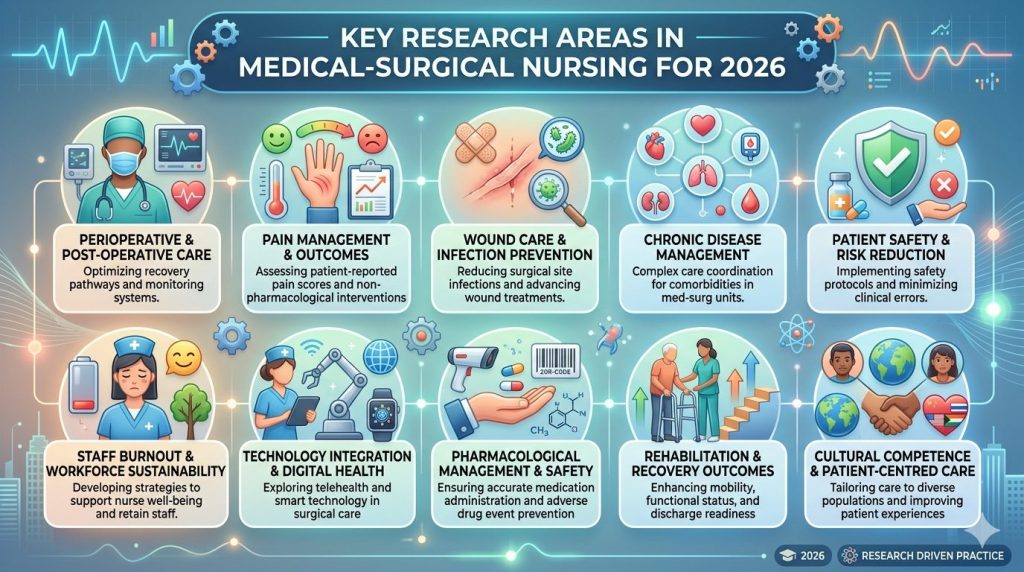
Medical-surgical nursing is a clinically rich and academically evolving field. The following research areas represent established academic domains and emerging directions that are particularly relevant for 2026-level dissertation work.
- Perioperative and post-operative nursing care
- Pain management and patient-reported outcomes
- Wound care and infection prevention in surgical settings
- Chronic disease management within medical-surgical units
- Patient safety, clinical errors, and risk reduction
- Nursing staff burnout and workforce sustainability
- Technology integration and digital health in surgical care
- Pharmacological management and medication safety
- Rehabilitation and recovery outcomes in post-surgical patients
- Cultural competence and patient-centred care in diverse populations
Five Example Dissertation Topics with Aims and Objectives
The following examples illustrate how a strong Medical-Surgical Nursing dissertation topic is structured academically. Each example includes a clear research aim and two to three focused research objectives.
Example 1: Post-Operative Pain Management in Adult Patients
Research Aim: To examine the effectiveness of nurse-led pain assessment protocols in reducing post-operative pain in adult patients within surgical units.
Research Objectives:
- To review existing pain assessment tools used in medical-surgical nursing practice.
- To evaluate the impact of structured nurse-led protocols on patient-reported pain scores.
- To identify barriers faced by nurses in implementing consistent pain management strategies.
Example 2: Surgical Site Infection Prevention
Research Aim: To investigate the role of pre-operative nursing interventions in reducing surgical site infection rates in elective surgical patients.
Research Objectives:
- To identify pre-operative nursing actions shown to reduce infection risk in existing literature.
- To assess how consistently evidence-based infection prevention practices are applied in NHS surgical settings.
- To explore patient and nurse perspectives on pre-operative preparation protocols.
Example 3: Nurse Burnout in Medical-Surgical Units
Research Aim: To explore the contributing factors to burnout among medical-surgical nurses and the impact on patient care quality.
Research Objectives:
- To identify organisational and clinical factors associated with burnout among medical-surgical nurses.
- To assess the relationship between nurse burnout levels and patient safety incident rates.
- To review institutional strategies that have effectively reduced burnout in comparable settings.
Example 4: Technology Use in Post-Surgical Monitoring
Research Aim: To evaluate the use of remote patient monitoring technologies in improving post-surgical outcomes in hospital settings.
Research Objectives:
- To examine which digital monitoring tools are currently deployed in surgical nursing care.
- To analyse the clinical outcomes associated with technology-assisted post-operative monitoring.
- To identify training gaps among nursing staff in using digital monitoring systems effectively.
Example 5: Patient Education and Surgical Recovery
Research Aim: To determine the effect of structured patient education programmes on recovery outcomes following elective surgery.
Research Objectives:
- To review the content and delivery methods of existing patient education programmes in surgical settings.
- To measure the correlation between patient education engagement and recovery timeframes.
- To explore patient perspectives on the adequacy of pre-discharge education provided by nursing staff.
80 Medical-Surgical Nursing Dissertation Topics for 2026
The following 80 topics are original, academically sound, and suitable for undergraduate, master’s, or PhD research in medical-surgical nursing. They are organised under subfield headings to help you identify the area that best matches your interests and institutional focus.
1. Pain Management and Patient Comfort
- The effectiveness of multimodal pain management protocols in post-operative orthopaedic patients
- Nurse-led pain assessment tools and their reliability in non-verbal post-surgical patients
- Opioid stewardship in surgical nursing: barriers to reducing opioid dependency in acute care
- Patient-controlled analgesia versus nurse-administered analgesia: a comparative analysis of outcomes
- The role of pre-operative education in reducing anxiety and post-surgical pain perception
- Cultural factors influencing pain reporting among patients in medical-surgical wards
- Non-pharmacological pain management strategies in elderly surgical patients
- The impact of nurse attitude and knowledge on post-operative pain management quality
- Chronic pain transitions following acute surgical events: a nursing perspective
- Assessing pain management documentation practices in NHS medical-surgical units
2. Wound Care and Infection Prevention
- Pre-operative skin preparation and its role in reducing surgical site infection rates
- Evidence-based wound dressing selection in complex surgical wounds: a nursing audit
- The effectiveness of nurse-led wound care clinics in reducing hospital readmission rates
- Antibiotic prophylaxis compliance among nursing teams in elective surgical settings
- Patient adherence to wound care instructions post-discharge: contributing factors
- Hand hygiene compliance in medical-surgical units: observational study of nursing behaviour
- The relationship between surgical wound complications and patient nutritional status
- Nursing documentation accuracy in wound care records within acute surgical settings
- Negative pressure wound therapy outcomes in post-operative abdominal surgical patients
- Infection control knowledge among newly qualified nurses in surgical environments
3. Perioperative and Post-Operative Care
- The impact of pre-operative nursing assessments on surgical outcome predictability
- Post-anaesthesia care unit nursing practices and their effect on patient recovery speed
- Enhanced recovery after surgery (ERAS) protocols: the nurse’s role and clinical impact
- Pre-operative fasting compliance in elective surgical patients and nursing communication strategies
- Discharge planning in post-operative patients: timeliness, accuracy, and patient understanding
- Nursing assessment of deep vein thrombosis risk in immobile post-surgical patients
- Post-operative delirium in older adults: early nursing identification and intervention
- Pressure injury prevention in perioperative nursing: evidence-based positioning practices
- Blood glucose monitoring in surgical patients with Type 2 diabetes: nursing protocol adherence
- The role of nursing handover quality in post-operative patient safety outcomes
4. Chronic Disease Management in Surgical Contexts
- Managing hypertension in patients admitted to medical-surgical wards: a nursing care analysis
- Nursing challenges in caring for obese patients undergoing elective surgery
- Diabetes management in the peri-operative period: gaps in nursing knowledge and practice
- Heart failure exacerbation in post-surgical patients: nursing monitoring and intervention strategies
- The impact of renal impairment on medication management in medical-surgical nursing care
- Nurse-led chronic disease education for patients with multimorbidity in surgical settings
- Optimising medication reconciliation in patients with complex chronic conditions on surgical wards
- The influence of chronic respiratory conditions on post-operative complication rates and nursing outcomes
- Nursing management of inflammatory bowel disease flares in medical-surgical environments
- Post-operative anaemia in chronic disease patients: nursing detection and escalation patterns
5. Patient Safety and Clinical Risk
- Medication error prevention in medical-surgical nursing: the role of double-checking protocols
- Fall risk assessment tools and their predictive accuracy in post-surgical nursing contexts
- Nurse-to-patient staffing ratios and their correlation with adverse events in surgical wards
- Near-miss incident reporting in surgical nursing: culture, barriers, and improvement strategies
- Safe patient handling practices and musculoskeletal injury prevention among surgical nurses
- Sepsis recognition and early nursing response in medical-surgical unit patients
- The impact of alarm fatigue on nursing response times in monitored surgical settings
- Deteriorating patient identification: nursing escalation practices in medical-surgical units
- Informed consent processes in surgical settings: the nurse’s role in patient understanding
- Clinical handover and communication failures in medical-surgical nursing transitions
6. Nursing Workforce and Professional Practice
- Compassion fatigue among medical-surgical nurses: prevalence, causes, and coping strategies
- The impact of shift patterns on clinical decision-making quality among surgical nurses
- Newly qualified nurse transition experiences in medical-surgical units: a qualitative study
- Mentorship effectiveness in supporting junior nurses in high-acuity surgical environments
- Continuing professional development participation rates among medical-surgical nursing staff
- The effect of mandatory overtime on nurse well-being and patient care quality in surgical wards
- Reflective practice adoption among experienced medical-surgical nurses: barriers and enablers
- Nursing autonomy and decision-making confidence in medical-surgical care environments
- Workplace incivility in surgical nursing teams and its impact on patient safety culture
- Gender disparities in career progression among nurses working in medical-surgical specialties
7. Technology and Innovation in Surgical Nursing
- Electronic health record usability and its effect on nursing documentation accuracy in surgical settings
- Artificial intelligence tools for early deterioration detection in post-surgical patients: nursing perspectives
- Telehealth use for post-discharge surgical patient monitoring: nursing roles and outcomes
- Barcode medication administration systems and nursing compliance in medical-surgical units
- Digital health literacy among medical-surgical nurses and implications for patient education
- Robotic-assisted surgery and its impact on peri-operative nursing roles and responsibilities
- Point-of-care testing devices in surgical nursing: accuracy, training, and clinical application
- Simulation-based training for clinical skill development among medical-surgical nurses
- Wearable monitoring technology in post-operative patients: nursing adoption and integration
- Decision support systems in surgical nursing: impact on clinical confidence and error rates
8. Patient-Centred Care and Diversity in Surgical Nursing
- Language barriers and their effect on patient safety outcomes in medical-surgical nursing
- Cultural humility training for medical-surgical nurses: current gaps and educational strategies
- Older adult dignity and respect in surgical nursing: patient experience research
- Family involvement in post-operative recovery: nursing attitudes and institutional practices
- LGBTQ+ patient experiences in medical-surgical settings and implications for nursing practice
- Religious and spiritual care needs of surgical patients: nursing awareness and provision
- Health literacy and patient-centred communication in medical-surgical nursing consultations
- Immigrant and refugee patient experiences in NHS surgical settings: a nursing perspective
- Disability-inclusive care practices in medical-surgical environments: staff knowledge and attitudes
- Patient involvement in care planning within medical-surgical nursing: barriers and best practice
Conclusion
Choosing a dissertation topic in medical-surgical nursing requires more than identifying something you find interesting. It demands careful thought about academic relevance, clinical applicability, and the availability of evidence. The 80 topics presented in this post are designed to give you a strong starting point, each grounded in real clinical challenges and aligned with 2026 research expectations.
Whether you are writing at undergraduate level or pursuing Medical Surgical Nursing dissertation topics for PhD students, the most important step is selecting a topic that is focused, feasible, and meaningful to your professional development. Broad topics lead to broad findings. Narrow, well-defined topics produce sharper, more credible research.
If you are still unsure where to begin, take time to revisit the key research areas outlined in this post and consider which aligns most closely with your clinical experience or academic interests. Speaking with your academic supervisor early in the process will also help you refine your ideas and ensure your proposal meets institutional standards.
Approach your dissertation with confidence, intellectual curiosity, and a commitment to academic integrity. The field of medical-surgical nursing is rich with opportunity for meaningful research, and your contribution matters.
