


Palliative Care Nursing Dissertation Topics for 2026

Questions Students Are Asking About Palliative Care Nursing Dissertations
Students across academic forums and discussion platforms frequently raise similar concerns when they begin searching for dissertation topics in palliative care nursing. The following questions reflect genuine worries collected from those conversations, and this post is structured to answer every one of them.
- What are some strong palliative care nursing dissertation topics for 2026?
- What are the current issues in palliative care that would make a good research focus?
- Where can I find a palliative care nursing dissertation topics PDF to help me plan?
- What ideas work best for an undergraduate thesis on palliative care nursing?
- What topics for a master’s dissertation on palliative care nursing are most relevant right now?
- How do I find a palliative care dissertation topic for my PhD that is both original and researchable?
- Which dissertation topic related to palliative care nursing suits my level of study?
- How do I narrow down my research idea into a clear aim and set of objectives?
If any of these questions sound familiar, you are in the right place.
Why Choosing the Right Dissertation Topic in Palliative Care Nursing Matters
Palliative care nursing sits at the heart of compassionate healthcare. It addresses pain management, emotional support, end-of-life decision-making, and the dignity of patients with life-limiting conditions. Choosing a dissertation topic in this field is not simply an academic exercise. It is an opportunity to contribute meaningfully to a discipline that shapes how people live and die with dignity.
A well-chosen topic sets the tone for your entire research journey. It determines the scope of your literature review, the strength of your methodology, and ultimately the impact your work can have on clinical practice. Students who rush this stage often find themselves stuck halfway through their research because their topic is either too broad, too vague, or too difficult to study ethically.
For 2026-level research, the expectations have also shifted. Universities are now looking for topics that demonstrate awareness of digital health innovations, health inequities, policy reform, and interdisciplinary approaches to care. A topic that felt fresh five years ago may now need a new angle to be considered original.
Getting this step right gives your dissertation a firm academic foundation, and this post is designed to support you in doing exactly that.
Download Palliative Care Nursing Dissertation Topics PDF
Many students find it helpful to have a curated, personalised list of dissertation topics in hand before they begin their formal proposal. A downloadable PDF prepared by academic experts in palliative care and nursing research can make that early planning stage significantly easier.
Students can receive a PDF containing a selection of targeted, level-appropriate dissertation topics after completing a short form. The topics in the PDF are matched to your area of interest and academic level, giving you a focused starting point rather than an overwhelming list to work through alone.
Key Research Areas in Palliative Care Nursing for 2026
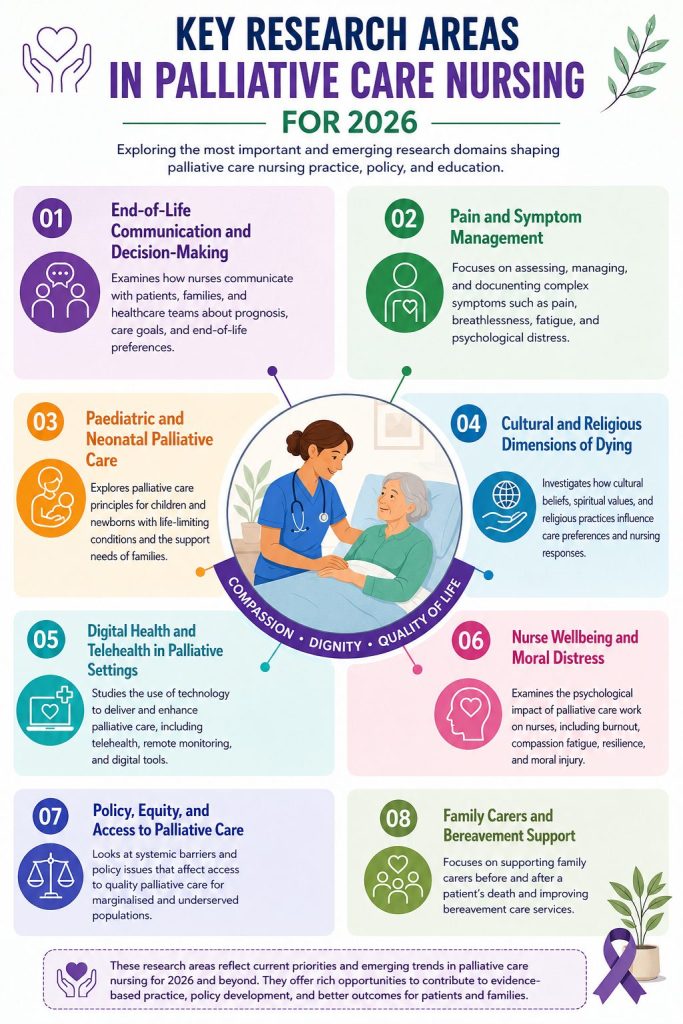
Before selecting a specific dissertation topic, it is helpful to understand the broader landscape of palliative care research. The following areas represent established academic domains and active research directions that are particularly relevant for 2026.
End-of-Life Communication and Decision-Making How nurses communicate with patients, families, and multidisciplinary teams during the final stages of life remains a central concern in clinical practice and research.
Pain and Symptom Management Research continues to explore how palliative care nurses assess, manage, and document complex symptoms including pain, breathlessness, fatigue, and psychological distress.
Paediatric and Neonatal Palliative Care This is a growing and emotionally sensitive area of research that looks at how palliative principles apply to children and newborns with life-limiting conditions.
Cultural and Religious Dimensions of Dying With increasingly diverse patient populations, researchers are examining how cultural beliefs, religious practices, and community values influence care preferences and nursing responses.
Digital Health and Telehealth in Palliative Settings The use of technology to deliver and support palliative care, particularly in remote and community settings, has expanded rapidly and opened many research opportunities.
Nurse Wellbeing and Moral Distress Research in this area examines the psychological impact of palliative care work on nursing staff, including compassion fatigue, burnout, and moral injury.
Policy, Equity, and Access to Palliative Care Studies in this domain look at systemic barriers that prevent marginalised or underserved populations from accessing quality end-of-life care.
Family Carers and Bereavement Support Nursing research also focuses on how palliative care services can better support unpaid family carers during and after the dying process.
Five Example Dissertation Topics With Aims and Objectives
The following examples show how a dissertation topic in palliative care nursing is structured with a clear aim and focused objectives. These are illustrative models to guide your own thinking.
Example 1
Topic: The role of specialist palliative care nurses in advance care planning conversations in UK community settings.
Aim: To explore how specialist palliative care nurses facilitate advance care planning discussions with patients who have non-cancer diagnoses in community-based care.
Objectives:
- To identify the communication strategies used by specialist nurses during advance care planning.
- To examine the barriers nurses experience when initiating these conversations.
- To explore patients’ perceptions of advance care planning discussions led by nursing staff.
Example 2
Topic: Compassion fatigue among palliative care nurses working in inpatient hospice settings: a qualitative inquiry.
Aim: To understand the lived experiences of compassion fatigue among registered nurses employed in inpatient hospice environments.
Objectives:
- To explore how nurses define and recognise compassion fatigue in their own practice.
- To identify the organisational and individual factors that contribute to its development.
- To assess the coping strategies nurses employ and their perceived effectiveness.
Example 3
Topic: Cultural competence in palliative care nursing: how nurses navigate end-of-life preferences in South Asian communities in England.
Aim: To examine how palliative care nurses adapt their practice to respond to end-of-life cultural and religious preferences within South Asian patient communities.
Objectives:
- To explore nurses’ understanding of cultural competence in the context of palliative care delivery.
- To identify specific cultural beliefs that influence end-of-life care decisions in South Asian families.
- To evaluate current training and support available to nurses in this area.
Example 4
Topic: Telehealth-delivered palliative care support for rural patients: a mixed-methods evaluation of nursing practice.
Aim: To evaluate the effectiveness and acceptability of telehealth-based nursing interventions for palliative care patients living in rural areas.
Objectives:
- To assess patient-reported quality of care outcomes in telehealth versus in-person palliative nursing visits.
- To explore nurses’ experiences of delivering palliative care remotely.
- To identify the clinical, ethical, and logistical challenges associated with telehealth-based palliative nursing.
Example 5
Topic: Family carer experiences of overnight nursing support in home-based palliative care: implications for service design.
Aim: To investigate how family carers experience overnight nursing support provided during home-based palliative care, and how these experiences can inform service improvement.
Objectives:
- To explore family carers’ emotional and practical responses to overnight nursing support.
- To identify gaps in current nursing provision during out-of-hours home care.
- To propose evidence-informed recommendations for redesigning overnight nursing support services.
80 Palliative Care Nursing Dissertation Topics for 2026
The following 80 topics cover the full breadth of palliative care nursing research. They are organised by subfield and suitable for undergraduate, master’s, and PhD proposals. Each topic is specific, researchable, and grounded in current academic and clinical concerns.
End-of-Life Communication and Advance Care Planning
- How do palliative care nurses initiate goals-of-care conversations with patients recently diagnosed with heart failure?
- The influence of nurse communication style on patient engagement in advance care planning: a qualitative study.
- Barriers to do-not-resuscitate discussions in nursing homes: perspectives of registered nurses.
- How do nurses support patients with limited health literacy in making advance care decisions?
- The role of non-verbal communication in palliative nursing consultations with patients approaching end of life.
- Nurse-led family meetings in inpatient palliative care: a content analysis of meeting outcomes and follow-up actions.
- Exploring how palliative care nurses document advance care planning conversations in electronic health records.
- Patients’ preferences for how nurses deliver prognostic information in the final weeks of life.
- How community palliative care nurses navigate disagreements between patients and families over end-of-life wishes.
- The impact of structured communication training on palliative care nurses’ confidence in advance care planning discussions.
Pain and Symptom Assessment in Palliative Settings
Nurses’ use of validated pain assessment tools in patients with advanced dementia receiving palliative care.
- The relationship between frequency of nursing assessment and symptom burden in hospice inpatients: a retrospective analysis.
- How do palliative care nurses assess and respond to refractory breathlessness in patients with advanced COPD?
- Nurses’ experiences of managing nausea and vomiting in patients receiving palliative chemotherapy.
- The use of anticipatory prescribing and its implications for nursing decision-making in community palliative care.
- Exploring nurses’ confidence in assessing existential distress alongside physical symptoms in end-of-life care.
- Pain documentation practices among palliative care nurses in acute hospital settings: an audit-based study.
- How do palliative care nurses respond to patients who refuse opioid analgesia due to personal beliefs?
- Fatigue assessment in palliative nursing: are current tools adequate for patients with multiple comorbidities?
- Nurses’ perspectives on the challenges of managing agitation and terminal restlessness in the final hours of life.
Paediatric and Neonatal Palliative Care Nursing
- How do neonatal nurses provide palliative support to parents of infants with life-limiting conditions in the NICU?
- Nurses’ experiences of transitioning children from curative to palliative care: a phenomenological study.
- Communication strategies used by paediatric palliative care nurses when speaking with siblings of dying children.
- How do school nurses support children with life-limiting conditions who are receiving community palliative care?
- The emotional impact of neonatal end-of-life care on nursing staff: a mixed-methods investigation.
- Parent-nurse relationships in children’s hospices: how trust is built and maintained over time.
- Palliative care decision-making for children with complex neurodisability: the nursing perspective.
- How do paediatric nurses manage pain in non-verbal children with life-limiting conditions using behavioural indicators?
- Transition of adolescents from paediatric to adult palliative care services: the nursing role in continuity of care.
- Exploring bereavement support provided by nurses to families following the death of a child in a hospice setting.
Cultural, Religious, and Spiritual Dimensions of Palliative Nursing
- How do palliative care nurses respond to spiritual distress in patients who identify as non-religious?
- The role of nurses in facilitating culturally appropriate death rituals for Muslim patients in UK hospices.
- Nurses’ experiences of providing end-of-life care to patients from Black African communities in community settings.
- How do palliative care nurses navigate family-centred decision-making in Chinese patient communities?
- Spiritual care competencies among general ward nurses providing palliative care: a cross-sectional survey.
- Cultural humility training for palliative care nurses: a programme evaluation study.
- How nurses in UK hospices adapt care practices in response to Orthodox Jewish end-of-life traditions.
- The experience of Hindu patients receiving palliative care: implications for nursing practice and service design.
- How do palliative care nurses in diverse urban settings balance individual patient preferences with family expectations?
- Nurses’ perceptions of their role in providing spiritual care within NHS palliative care services.
Nurse Wellbeing, Moral Distress, and Resilience
- The relationship between workload intensity and burnout in palliative care nursing: a cross-sectional study.
- Moral distress experienced by nurses when patients request assisted dying in countries where it remains illegal.
- How do newly qualified nurses cope with their first patient death in a palliative care setting?
- Peer support programmes in hospices: their impact on nurse wellbeing and retention.
- The role of clinical supervision in building emotional resilience among palliative care nurses.
- How do male nurses experience emotional labour differently in palliative care compared to their female colleagues?
- Compassion satisfaction and its relationship to years of experience in palliative nursing: a quantitative study.
- The impact of organisational culture on moral distress in NHS inpatient palliative care units.
- How do palliative care nurses maintain professional boundaries while building therapeutic relationships with dying patients?
- Nurses’ experiences of grief following the death of patients with whom they have had long-term care relationships.
Technology, Digital Health, and Innovation in Palliative Care
- Patients’ and nurses’ perspectives on the use of electronic symptom-monitoring apps in community palliative care.
- How do palliative care nurses use telehealth consultations to maintain therapeutic relationships with housebound patients?
- The acceptability of wearable monitoring devices for symptom tracking in hospice inpatients: a nursing perspective.
- Digital literacy among palliative care nurses and its impact on the adoption of electronic care planning tools.
- How artificial intelligence-based triage systems are perceived by nurses in specialist palliative care teams.
- Nurses’ views on the use of virtual reality for pain and anxiety management in palliative care settings.
- The use of real-time dashboards in hospice nursing: how data visualisation supports symptom management decisions.
- Ethical concerns raised by nurses regarding the use of predictive algorithms to identify patients approaching end of life.
- How palliative care nurses support patients and families in using online bereavement resources following a death at home.
- The role of digital communication platforms in maintaining continuity between community palliative care nurses and GPs.
Policy, Equity, and Access to Palliative Care
- Access to specialist palliative care nursing among patients with non-cancer diagnoses in England: an equity analysis.
- How do palliative care nurses advocate for patients from deprived communities who face barriers to hospice access?
- The impact of NHS policy changes on the caseload and scope of community palliative care nursing teams.
- Homeless individuals and access to palliative care: the role of specialist nurses in outreach settings.
- How do nurses in care homes experience the gap between palliative care policy and day-to-day practice?
- Palliative care for prisoners: a qualitative study of nursing practice in custodial settings.
- Ethnicity and disparities in referral rates to specialist palliative care nursing services in urban NHS trusts.
- The experience of migrants with uncertain immigration status when receiving palliative nursing care in the UK.
- How do palliative care nurses engage with integrated care systems to improve coordination across service boundaries?
- The role of nurse education in reducing inequalities in access to palliative care for people with learning disabilities.
Family Carers, Bereavement, and Psychosocial Support
- How do community palliative care nurses assess and support the psychological needs of spousal carers?
- Nurses’ experiences of delivering bereavement follow-up to families after a patient’s death at home.
- The adequacy of information provided by palliative care nurses to family carers preparing for a death at home.
- How do nurses in hospice day services support family carers who are at risk of social isolation?
- Family carers’ perceptions of the quality of nurse-led handover when a patient transitions from hospital to home.
- The role of nurses in recognising complicated grief in bereaved family members of palliative care patients.
- How do palliative care nurses navigate situations where family carers and patients hold conflicting wishes?
- Young carers supporting a dying parent: how palliative care nurses identify and respond to their needs.
- Nurse-facilitated carer support groups in hospices: a qualitative evaluation of participant experiences.
- How do palliative care nurses support family members of patients who die unexpectedly during a planned home death?
Aligning Your Topic With Your Academic Level
Choosing the right level of research complexity is just as important as choosing the right subject area. At undergraduate level, your dissertation is expected to engage with existing evidence and demonstrate critical analysis. A topic that draws on a focused literature review and perhaps a small qualitative study or service evaluation works well.
At master’s level, you are expected to show deeper engagement with theory, methodology, and the implications of your findings for practice or policy. Topics related to hot topics in palliative care, such as moral distress, equity of access, or digital care, tend to suit this level well.
PhD-level research demands genuine originality. Your topic must fill a clear gap in knowledge, use a rigorous and well-justified methodology, and contribute substantively to the academic field. If you are looking for palliative care dissertation topics for your PhD, focus on areas where current evidence is limited, contested, or underdeveloped.
Students at all levels benefit from seeking online dissertation help early in the process, especially when it comes to refining a broad interest into a specific, researchable question.
How to Narrow Down Your Palliative Care Dissertation Topic
Start With What You Know
If you have clinical experience in palliative care, begin there. Your observations and frustrations from practice are often the strongest starting point for genuine research questions. Ask yourself what puzzled you, what seemed inconsistent, or what patients and families often asked about that you could not fully answer.
Review Recent Literatur
Before committing to a topic, spend time reading systematic reviews and meta-analyses published in the last three to five years. This will help you understand where the evidence is strong, where gaps exist, and where new research is most needed.
Consider Ethical Feasibility
Palliative care research involves vulnerable populations. When finalising your topic, think carefully about ethical approval requirements, access to participants, and whether your proposed methods are proportionate and respectful. Your institution’s ethics committee will expect evidence that you have thought this through from the outset.
Speak With a Supervisor Early
A preliminary conversation with your dissertation supervisor can save significant time. They will quickly be able to tell you whether a topic is viable, original, and appropriate for your level of study.
Conclusion
Palliative care nursing is one of the most meaningful and academically rich areas in health sciences research. Choosing a dissertation topic in this field gives you the opportunity to explore questions that genuinely matter, both to patients and to the profession.
The 80 palliative care topics for research presented in this post are designed to offer a range of starting points across every major subfield. Whether you are looking for ideas for an undergraduate thesis on palliative care nursing or pursuing a doctoral investigation into systemic inequities, there is a researchable and academically sound direction here for you.
Take your time with this stage. The right topic should feel both personally meaningful and academically defensible. A dissertation that begins with a genuine question, grounded in real-world nursing concerns, will always be stronger than one built around what seems easy or convenient.
Approach your dissertation with confidence, intellectual curiosity, and a commitment to academic integrity. The work you produce may well shape how care is delivered in the future.
