


Orthopaedic Nursing Dissertation Topics for 2026

Questions Students Are Asking About Orthopaedic Nursing Dissertations
The questions below were gathered from student forums, academic discussion platforms, and postgraduate research communities. They reflect the real concerns that nursing students face when trying to select a dissertation topic in orthopaedic care.
- What are the best orthopaedic nursing dissertation topics for 2026?
- How do I find a dissertation topic in orthopaedic nursing that is narrow enough to research?
- What orthopedic research topics are suitable for my undergraduate dissertation?
- Are there specific orthopaedic nursing dissertation topics that work at master’s or PhD level?
- What current trends in orthopaedic care should my dissertation address?
- How do I write strong research aims and objectives for an orthopaedic nursing topic?
- Where can I find an orthopaedic nursing dissertation topics PDF to help me get started?
If you have asked any of these questions, this post will help you find clear, structured, and academically grounded answers.
Why Choosing the Right Dissertation Topic in Orthopaedic Nursing Matters
Selecting the right dissertation topic is one of the most important decisions you will make during your academic journey. In orthopaedic nursing, this decision carries even more weight because the field sits at the intersection of surgical care, rehabilitation, chronic disease management, and patient safety.
A well-chosen topic allows you to contribute meaningfully to clinical practice. It also gives you a clear direction for your research methodology, literature review, and data collection strategy. Students who choose vague or overly broad topics often struggle to maintain academic focus and produce high-quality dissertations.
Orthopaedic nursing as a discipline is evolving rapidly. With an ageing global population, rising rates of musculoskeletal conditions, and advances in surgical technology, there is no shortage of relevant, current, and researchable areas to explore. Your dissertation is your opportunity to examine one of these areas with genuine depth and academic rigour.
Whether you are working on topics in orthopaedic nursing for your undergraduate dissertation or building towards a master’s or doctoral thesis, choosing a focused, evidence-based topic from the outset will save you significant time and strengthen your final submission.
Download Orthopaedic Nursing Dissertation Topics PDF
Many students find it helpful to have a curated list of dissertation topics available offline. A downloadable PDF containing personalised orthopaedic nursing dissertation topics, reviewed and compiled by academic experts, is available to support your research journey.
Students receive this PDF after completing a short online form. The document is tailored to your academic level and research interests, giving you a shortlist of topics that are academically suitable and aligned with current nursing standards. This resource is particularly useful if you are in the early stages of your proposal and need expert guidance to narrow your focus before approaching your supervisor.
Key Research Areas in Orthopaedic Nursing
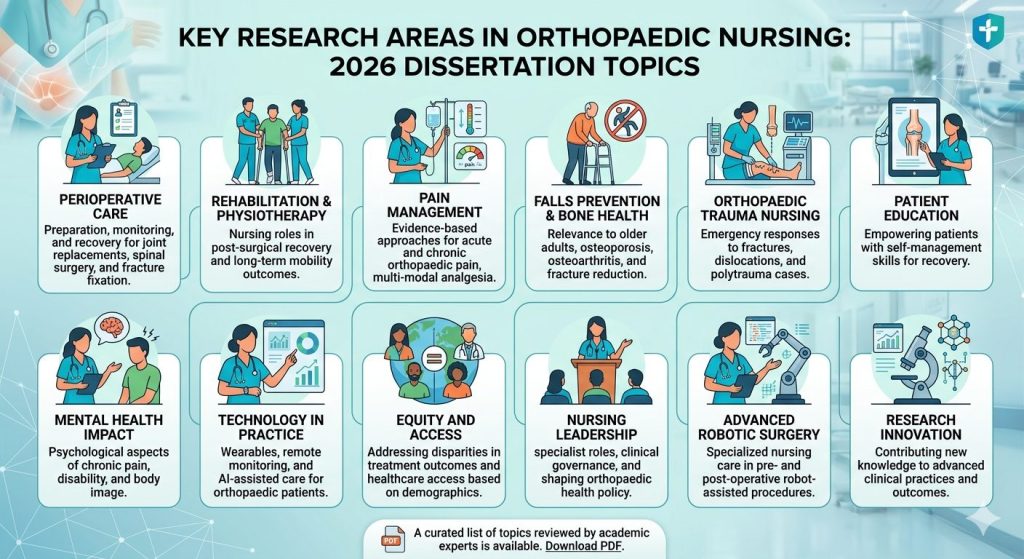
Before selecting a dissertation topic, it helps to understand the established research domains within orthopaedic nursing. These areas represent active fields of scholarly inquiry and clinical development.
- Perioperative care in orthopaedic surgery: Preparation, monitoring, and recovery practices surrounding joint replacement, spinal surgery, and fracture fixation.
- Rehabilitation and physiotherapy integration: How nursing roles intersect with post-surgical recovery and long-term mobility outcomes.
- Pain management and pharmacological care: Evidence-based approaches to acute and chronic pain in orthopaedic patients.
- Falls prevention and bone health: Particularly relevant to older adults with osteoporosis or osteoarthritis.
- Orthopaedic trauma nursing: Emergency responses to fractures, dislocations, and polytrauma presentations.
- Patient education and self-management: Supporting patients in understanding their conditions and managing recovery independently.
- Mental health and orthopaedic conditions: The psychological impact of chronic musculoskeletal pain and long-term disability.
- Technology in orthopaedic nursing practice: The use of digital tools, wearable devices, and AI-assisted monitoring in patient care.
- Equity and access in orthopaedic care: Disparities in treatment outcomes based on demographics, geography, and socioeconomic status.
- Nursing leadership and workforce development: The role of specialist orthopaedic nurses in shaping policy and clinical governance.
Five Example Dissertation Topics With Aims and Objectives
The following examples show how a strong dissertation topic is structured academically. Each includes a research aim and two to three objectives to guide your thinking.
Example 1: Pain Management After Total Knee Replacement
Topic: Evaluating the effectiveness of nurse-led multimodal pain management protocols following total knee replacement surgery in NHS settings.
Research Aim: To assess how nurse-led multimodal analgesia approaches influence postoperative pain outcomes and patient satisfaction after total knee replacement.
Objectives:
- To review current evidence on multimodal pain management protocols used in orthopaedic nursing practice
- To evaluate patient-reported pain scores and satisfaction levels in units with and without structured nurse-led protocols
- To identify barriers and facilitators to implementing multimodal pain management in orthopaedic wards
Example 2: Falls Prevention in Elderly Orthopaedic Patients
Topic: Assessing the role of orthopaedic nurses in implementing falls prevention strategies for older adults with hip fractures during inpatient rehabilitation.
Research Aim: To explore how orthopaedic nursing interventions contribute to reducing secondary falls risk in elderly patients during inpatient hip fracture recovery.
Objectives:
- To identify evidence-based falls prevention interventions used by orthopaedic nurses in rehabilitation settings
- To examine the relationship between nursing assessment frequency and fall incidents in elderly orthopaedic patients
- To assess patient and staff perceptions of current falls prevention practices
Example 3: Digital Technology in Post-Surgical Monitoring
Topic: Exploring the use of wearable sensor technology in orthopaedic nursing care to monitor patient mobility outcomes after spinal surgery.
Research Aim: To investigate how wearable monitoring devices can support orthopaedic nurses in tracking and improving mobility recovery in post-spinal surgery patients.
Objectives:
- To review existing literature on wearable technologies used in surgical nursing and orthopaedic rehabilitation
- To examine nurse and patient experiences with wearable devices in post-surgical care settings
- To identify the implications of wearable technology adoption for orthopaedic nursing roles and responsibilities
Example 4: Nurse-Patient Communication and Surgical Anxiety
Topic: Examining the impact of preoperative nurse-led communication strategies on anxiety levels in patients awaiting elective orthopaedic surgery.
Research Aim: To determine how structured preoperative communication by orthopaedic nurses affects anxiety and preparedness in elective surgery patients.
Objectives:
- To review evidence on the relationship between preoperative information delivery and patient anxiety outcomes
- To assess the effectiveness of specific nurse-led communication tools, such as structured information booklets and verbal briefings
- To explore patient preferences for preoperative communication formats in orthopaedic settings
Example 5: Cultural Competence in Orthopaedic Nursing
Topic: Investigating culturally competent nursing practices and their influence on treatment adherence in diverse orthopaedic patient populations.
Research Aim: To explore how culturally responsive care delivered by orthopaedic nurses affects adherence to postoperative rehabilitation plans in ethnically diverse patient groups.
Objectives:
- To examine frameworks for cultural competence as applied to orthopaedic nursing practice
- To assess patient experiences of culturally sensitive care in orthopaedic inpatient and outpatient settings
- To identify staff training gaps in cultural competence within orthopaedic nursing teams
80 Orthopaedic Nursing Dissertation Topics for 2026
The following topics are organised by subfield. They are original, current, and suitable for undergraduate, master’s, or PhD research in 2026. If you are looking for an orthopaedic nursing topic for your undergraduate dissertation, the earlier subfields offer well-scoped entry points. Topics further into the list tend to suit postgraduate-level inquiry.
Perioperative and Surgical Care
- The role of orthopaedic nurses in reducing surgical site infections following total hip arthroplasty in UK hospitals
- Nurse-led preoperative assessment and its impact on surgical readiness in elective joint replacement patients
- Comparing enhanced recovery after surgery (ERAS) outcomes across nurse-led and physician-led orthopaedic teams
- Orthopaedic nurses’ knowledge and application of venous thromboembolism prophylaxis protocols post-surgery
- Patient safety culture in orthopaedic operating theatres: a nursing perspective
- Postoperative hypothermia management by orthopaedic nurses following lower limb surgery
- Intraoperative nursing documentation accuracy and its impact on postoperative care continuity
- Patient handover communication between orthopaedic theatre nurses and ward nurses: identifying risks and improvements
- The effect of nurse-led skin integrity checks on pressure injury rates in perioperative orthopaedic patients
- Use of antibiotic prophylaxis in orthopaedic surgery: nursing knowledge, compliance, and education needs
Pain Management and Pharmacological Care
- Nurse-administered patient-controlled analgesia in orthopaedic wards: safety outcomes and nursing competency
- The effectiveness of cold therapy protocols managed by orthopaedic nurses in reducing postoperative pain
- Non-pharmacological pain management strategies used by nurses in orthopaedic rehabilitation settings
- Chronic pain assessment tools in orthopaedic nursing: comparing validity across patient demographics
- The relationship between nursing communication style and postoperative pain reporting in orthopaedic patients
- Opioid stewardship in orthopaedic nursing: barriers to reducing opioid dependence in post-surgical care
- Nurse perceptions of pain undertreatment in older orthopaedic inpatients: a qualitative exploration
- Preoperative pain education delivered by orthopaedic nurses and its effect on postoperative analgesic consumption
- Assessment and management of neuropathic pain following spinal surgery in orthopaedic nursing practice
- The impact of nursing shift patterns on postoperative pain assessment frequency in orthopaedic wards
Rehabilitation and Mobility Recovery
- Orthopaedic nurse involvement in early mobilisation protocols after total knee replacement: patient outcomes
- The influence of nurse-to-patient ratios on rehabilitation progress in orthopaedic inpatient settings
- Patient motivation and engagement in physiotherapy: the role of orthopaedic nurses in rehabilitation support
- Discharge planning by orthopaedic nurses and readmission rates following joint replacement surgery
- The effectiveness of nurse-led home exercise instruction in improving mobility after hip fracture repair
- Barriers to early ambulation in orthopaedic patients: nursing staff attitudes and institutional factors
- Long-term functional outcomes following total shoulder arthroplasty: the contribution of nursing-led rehabilitation guidance
- Nurse-led telephone follow-up after orthopaedic discharge and its impact on patient recovery confidence
- Occupational therapy and orthopaedic nursing collaboration in post-surgical rehabilitation planning
- Patient-reported outcomes in spinal rehabilitation: exploring the nursing contribution to recovery support
Orthopaedic Trauma Nursing
- Triage accuracy by orthopaedic trauma nurses in emergency departments: a skills assessment study
- Nursing management of open fractures in trauma settings: protocol adherence and complication rates
- The psychological impact of traumatic orthopaedic injury on patients: nursing assessment and intervention
- Cervical spine injury management in emergency orthopaedic nursing: knowledge and confidence levels
- Nursing care of patients with pelvic ring fractures in intensive care orthopaedic trauma units
- Family communication practices by orthopaedic trauma nurses in acute hospital settings
- Time-to-surgery delays in hip fracture patients and the nursing role in preoperative optimisation
- The use of traction in femoral fracture management: current nursing practices and clinical rationale
- Orthopaedic trauma nursing in rural versus urban hospitals: resource disparities and patient outcome differences
- Nursing documentation in orthopaedic trauma cases: completeness, accuracy, and medicolegal implications
Falls Prevention and Bone Health
- Nurse-led osteoporosis risk screening in orthopaedic outpatient clinics: current practice and gaps
- Falls risk assessment tool accuracy in predicting secondary falls in hip fracture patients during inpatient stay
- The role of orthopaedic nurses in calcium and vitamin D supplementation education for post-fracture patients
- Environmental safety modifications recommended by orthopaedic nurses and fall prevention rates at home
- Frailty assessment by orthopaedic nursing teams and its relationship to rehabilitation planning
- Nurse-led bone health programmes in orthopaedic outpatient settings: patient engagement and outcomes
- Medication review by nursing staff and polypharmacy-related falls risk in elderly orthopaedic patients
- Patient adherence to nurse-prescribed fall prevention strategies following lower limb fracture
- The effectiveness of orthopaedic nursing education on reducing fall incidents in long-term care facilities
- Multidisciplinary falls prevention in orthopaedic wards: measuring the nursing contribution to team-based interventions
Patient Education and Self-Management
- Orthopaedic nurse-led patient education programmes and their effect on self-management after knee replacement
- Health literacy levels in orthopaedic outpatients and the adequacy of current nurse-delivered written information
- Digital health platforms used by orthopaedic nurses to support patient education and remote recovery monitoring
- Patient understanding of wound care following orthopaedic surgery: the quality of nurse-provided instruction
- The role of peer support groups facilitated by orthopaedic nurses in chronic musculoskeletal pain management
- Shared decision-making between orthopaedic nurses and patients: measuring its effect on postoperative satisfaction
- Postoperative activity restriction guidance given by orthopaedic nurses: patient comprehension and adherence rates
- The impact of preoperative nurse-led education on postoperative anxiety and complication reporting in arthroplasty patients
- Nurse-initiated return-to-work counselling for patients recovering from orthopaedic trauma: current practice review
- The relationship between nurse-delivered dietary and lifestyle education and bone density outcomes in orthopaedic patients
Mental Health and Psychosocial Dimensions of Orthopaedic Care
- Depression and anxiety screening by orthopaedic nurses in patients with chronic musculoskeletal conditions
- The psychological burden of awaiting elective orthopaedic surgery: nursing assessment and support strategies
- Body image concerns in patients following amputation or limb-preserving surgery: the orthopaedic nursing role
- Nurse-led psychosocial support for patients with degenerative spinal conditions and chronic disability
- Sleep disturbance in orthopaedic inpatients: nursing assessment, interventions, and outcome monitoring
- The impact of social isolation on recovery motivation in older orthopaedic patients: a nursing-led inquiry
- Post-traumatic stress responses in orthopaedic trauma patients: recognition and intervention by nursing staff
- Resilience and coping in patients undergoing repeated orthopaedic surgical procedures: nursing perspectives
- The relationship between pain catastrophising and postoperative recovery in orthopaedic patients: a nursing assessment study
- Nurse-facilitated mindfulness-based approaches to pain management in chronic orthopaedic conditions
Technology, Innovation, and Digital Nursing Practice
- Artificial intelligence-assisted imaging in orthopaedic nursing: implications for preoperative assessment roles
- The use of electronic patient records in orthopaedic nursing: impact on documentation quality and continuity of care
- Wearable activity monitors as tools for orthopaedic nurses to support postoperative mobility goal-setting
- Telehealth consultations delivered by orthopaedic nurses: patient satisfaction and clinical effectiveness
- 3D-printed orthopaedic devices and the evolving role of the orthopaedic nurse in patient preparation and education
- Robotic-assisted orthopaedic surgery and the changing intraoperative responsibilities of scrub nurses
Equity, Access, and Workforce Development
- Socioeconomic disparities in orthopaedic nursing care access: evidence from NHS waiting list data and nursing practice
- Cultural barriers to seeking orthopaedic nursing care among minority ethnic populations in urban UK settings
- The career development pathways of specialist orthopaedic nurses in the UK: challenges and opportunities
- Burnout among orthopaedic nursing staff in high-volume surgical units: contributing factors and retention strategies
Conclusion
Selecting a well-defined dissertation topic is the foundation of meaningful academic research. As this post has shown, orthopaedic nursing offers a wide range of academically rich and clinically relevant areas to investigate. Whether your interest lies in surgical care, patient rehabilitation, digital innovation, or health equity, there is a researchable topic that can align with your academic level and career goals.
The 80 orthopaedic nursing dissertation topics listed here are designed to inspire focused, original research. Each topic presented reflects current academic standards and clinical priorities for 2026. Students who take the time to select a narrow, well-structured topic will find the dissertation process more manageable and their final submission more academically compelling.
When you need additional support, seeking online dissertation help from qualified academic professionals can make a meaningful difference in the clarity and quality of your work. Equally, drawing on the expertise of your supervisors and engaging with peer-reviewed literature will strengthen your research from proposal to submission.
Approach your dissertation with curiosity, rigour, and confidence. The field of orthopaedic nursing needs well-trained, research-literate practitioners, and your dissertation is one important step towards becoming one.
