


Pediatric Intensive Care Nursing Dissertation Topics for 2026

Common Questions Students Ask About This Topic
Students across university forums and academic discussion platforms frequently post questions about how to choose a dissertation topic in nursing, particularly in highly specialised areas like paediatric intensive care. The questions below reflect what real students ask when they feel uncertain, overwhelmed, or stuck at the very first stage of their research journey.
- What are the most relevant Pediatric Intensive Care Nursing dissertation topics for 2026?
- What are the hot topics in Pediatric Intensive Care Nursing right now?
- How do I know if a nursing dissertation topic is suitable for undergraduate or master’s level?
- What are the trending topics in Pediatric Intensive Care Nursing that journals are currently publishing?
- Which current research topics in Pediatrics are most likely to get supervisor approval?
- Are there any Pediatric Intensive Care topics for a PhD thesis that are both original and feasible?
- How narrow should my dissertation topic be in paediatric nursing?
- What research gaps exist in paediatric critical care that I could explore?
If any of these questions sound familiar, this post is written specifically for you. Read on to find structured guidance, 80 original dissertation topics, and practical advice to help you move forward with confidence.
Why Choosing the Right Dissertation Topic in Paediatric Intensive Care Nursing Matters
Selecting the right dissertation topic is one of the most important academic decisions a nursing student will make. In a field as demanding and emotionally complex as paediatric intensive care, the stakes are even higher. Your topic shapes the direction of your entire research, influences which methodology you will use, and determines whether your findings will be considered relevant by academic reviewers and clinical practitioners alike.
Paediatric intensive care nursing (PICN) sits at the intersection of advanced clinical practice, family-centred care, ethics, and rapidly evolving medical technology. This makes it a rich field for academic inquiry, but also one where poorly defined topics can lead to vague, unfocused dissertations. Students who choose topics that are too broad often struggle to produce coherent findings. Those who choose topics without academic grounding may find their work lacks credibility during the viva or review process.
A well-chosen dissertation topic in this field does three things. First, it addresses a genuine gap in existing literature. Second, it is specific enough to be answered within the time and word count constraints of the degree level. Third, it connects clinical practice with academic theory in a meaningful way.
Whether you are at undergraduate, master’s, or PhD level, getting this decision right early will save you significant time and stress later. If you feel uncertain about where to start, seeking online dissertation help from an academic expert can give you a clearer sense of direction before you commit to a topic.
Download Paediatric Intensive Care Nursing Dissertation Topics PDF
Students who want a curated, ready-to-use list of dissertation topics in this field can access a downloadable PDF prepared by academic subject specialists. The PDF contains a personalised selection of topics matched to your level of study, research interests, and current academic trends. It is available after completing a short online form where you provide basic details about your degree and area of focus. This resource is designed to save you time and give you a professionally curated starting point.
Key Research Areas in Paediatric Intensive Care Nursing
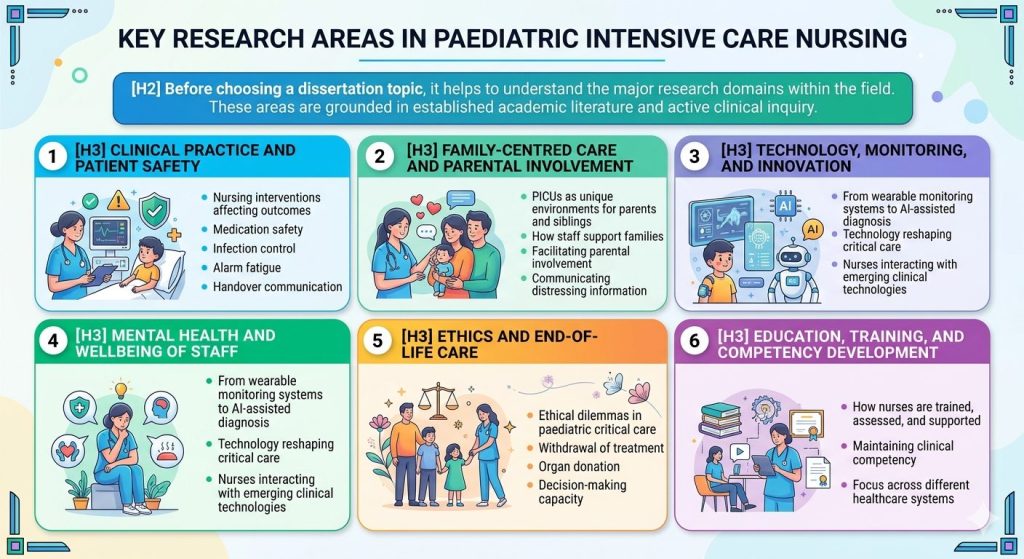
Before choosing a dissertation topic, it helps to understand the major research domains within the field. These areas are grounded in established academic literature and active clinical inquiry.
Clinical Practice and Patient Safety
This area covers how nursing interventions affect outcomes in critically ill children. It includes medication safety, infection control, alarm fatigue, and handover communication.
Family-Centred Care and Parental Involvement
Paediatric intensive care units (PICUs) are unique environments where parents and siblings are deeply affected by the child’s admission. Research here focuses on how nursing staff support families, facilitate involvement, and communicate distressing information.
Technology, Monitoring, and Innovation
From wearable monitoring systems to AI-assisted diagnosis, technology is reshaping paediatric critical care. This area explores how nurses interact with and respond to emerging clinical technologies.
Mental Health and Wellbeing of Staff
PICU nurses experience high levels of moral distress, burnout, and secondary traumatic stress. Research in this domain examines nurse wellbeing, retention, and the structural supports that sustain the workforce.
Ethics and End-of-Life Care
Ethical dilemmas in paediatric critical care, including withdrawal of treatment, organ donation, and decision-making capacity, form a critical and sensitive area of academic inquiry.
Education, Training, and Competency Development
This area focuses on how nurses in paediatric intensive care are trained, assessed, and supported in maintaining clinical competency across different healthcare systems.
Five Example Dissertation Topics With Research Aims and Objectives
The following examples are designed to show you how a well-structured paediatric intensive care nursing dissertation topic is built. Each includes a research aim and two to three clear objectives.
Example 1: Nurse-Led Family Communication in the PICU
Research Aim: To examine how nurse-led communication strategies influence the emotional wellbeing of parents whose children are admitted to a paediatric intensive care unit.
Research Objectives:
- To identify the communication approaches currently used by PICU nurses when engaging with parents during critical admissions.
- To explore parental perceptions of clarity, empathy, and support in nurse-delivered information.
- To assess whether structured communication frameworks improve parental satisfaction and reduce anxiety levels.
Example 2: Alarm Fatigue Among PICU Nurses
Research Aim: To investigate the impact of clinical alarm fatigue on nursing response times and patient safety outcomes in paediatric intensive care settings.
Research Objectives:
- To determine the frequency and types of alarms most associated with delayed nursing responses in PICUs.
- To explore nursing staff perceptions of alarm burden and its effect on decision-making.
- To recommend evidence-based strategies for reducing alarm fatigue without compromising patient safety.
Example 3: Burnout and Retention in Paediatric Critical Care Nursing
Research Aim: To examine the relationship between burnout levels and intention to leave among nurses working in paediatric intensive care units in the United Kingdom.
Research Objectives:
- To measure burnout prevalence among PICU nursing staff using a validated assessment tool.
- To identify workplace factors most strongly associated with high burnout and low retention.
- To evaluate the effectiveness of existing wellbeing interventions within PICU environments.
Example 4: Sedation Management and Developmental Outcomes
Research Aim: To explore the long-term neurodevelopmental implications of sedation protocols used in mechanically ventilated paediatric patients.
Research Objectives:
- To review current sedation practices across PICUs and identify variations in protocol use.
- To assess existing evidence linking sedation duration and type with developmental outcomes in children.
- To propose a framework for monitoring developmental milestones post-PICU discharge.
Example 5: Ethical Decision-Making in End-of-Life Paediatric Care
Research Aim: To analyse how PICU nurses navigate ethical decision-making during end-of-life care for critically ill children.
Research Objectives:
- To explore the ethical frameworks that guide nursing practice in paediatric end-of-life situations.
- To identify the emotional and professional challenges nurses face when participating in withdrawal-of-treatment decisions.
- To examine how multidisciplinary communication influences the nursing role in these decisions.
80 Paediatric Intensive Care Nursing Dissertation Topics for 2026
The following 80 dissertation topics reflect current research priorities, gaps identified in recent literature, and the evolving landscape of paediatric critical care nursing. They are organised by subfield and suitable for undergraduate, master’s, and PhD research proposals.
Clinical Practice and Patient Safety
- The effect of structured nursing handover protocols on patient safety outcomes in paediatric intensive care units.
- Medication error rates in PICUs and the role of double-checking practices in reducing adverse events.
- Central line-associated bloodstream infections in critically ill children and nursing-led prevention strategies.
- The influence of nursing workload on clinical decision-making accuracy in paediatric critical care.
- Nurse-to-patient ratios in PICUs and their association with preventable complications.
- Early warning scoring systems for clinical deterioration in paediatric inpatients and nursing response times.
- The role of PICU nurses in preventing ventilator-associated pneumonia through evidence-based bundle care.
- Unplanned extubation incidents in paediatric intensive care and the nursing factors involved.
- Skin integrity and pressure injury prevention among immobile paediatric ICU patients.
- The accuracy of pain assessment tools used by nurses in non-verbal paediatric patients.
Family-Centred Care
- Parental presence during invasive procedures in the PICU and its effect on nursing practice.
- Sibling visitation policies in paediatric intensive care and their psychological impact on families.
- The effectiveness of family liaison nurse roles in improving communication during critical paediatric admissions.
- Cultural competency in PICU nursing and its influence on family engagement in non-English-speaking communities.
- The impact of open visiting hours on parental anxiety and nursing workload in paediatric intensive care.
- Parent-to-nurse communication breakdown during PICU admissions and its effect on care quality.
- Family participation in daily ward rounds and its relationship with nursing job satisfaction in PICUs.
- Information needs of parents whose children are receiving long-term mechanical ventilation in intensive care.
- Barriers to delivering family-centred care in under-resourced paediatric intensive care settings.
- The role of written care plans in supporting parental understanding of their child’s treatment in the PICU.
Technology, Monitoring, and Innovation
- Artificial intelligence tools for predicting clinical deterioration in paediatric intensive care and their impact on nursing workflows.
- The adoption of electronic health records in PICUs and nurses’ perceptions of efficiency and patient safety.
- Wearable continuous monitoring devices in paediatric critical care and nursing response to real-time data.
- Telemedicine and remote consultation in paediatric intensive care and implications for nursing governance.
- High-fidelity simulation in PICU nurse training and its effect on clinical competency outcomes.
- Point-of-care testing in paediatric intensive care and the evolving nursing role in result interpretation.
- Digital alarm management systems in PICUs and their effectiveness in reducing unnecessary nursing interruptions.
- The role of nursing informatics in improving documentation accuracy in paediatric critical care.
- Bedside ultrasound use by advanced PICU nurses and its impact on clinical decision support.
- Smart infusion pump technology in paediatric intensive care and the nursing implications for safety and dose accuracy.
Mental Health and Wellbeing of Nursing Staff
- Secondary traumatic stress among paediatric intensive care nurses and its effect on clinical performance.
- The relationship between organisational support and burnout prevention in PICU nursing teams.
- Compassion fatigue in paediatric critical care nurses following repeated patient deaths.
- Peer support programmes in PICU settings and their effectiveness in reducing nurse psychological distress.
- The impact of shift length on emotional exhaustion among paediatric intensive care nurses.
- Nurses’ experiences of moral distress following futile treatment decisions in the PICU.
- Mindfulness-based interventions for PICU nursing staff and their effect on reported stress levels.
- The influence of management leadership styles on nurse wellbeing in paediatric intensive care.
- Staff retention challenges in paediatric intensive care and the role of professional development in reducing turnover.
- The psychological impact of caring for children with non-accidental injuries in intensive care nursing.
Ethics and End-of-Life Care
- Nursing involvement in withdrawal-of-life-sustaining treatment decisions for critically ill children.
- Communication of prognosis to parents of dying children in PICU settings and the nursing perspective.
- The ethical dimensions of long-term sedation for comfort in paediatric palliative intensive care.
- Organ donation conversations in paediatric intensive care and the nurse’s role in supporting families.
- Disagreements between parents and medical teams in PICU and their effect on nursing practice.
- Advance care planning for children with life-limiting conditions admitted to intensive care units.
- Nurses’ moral agency in advocating for dying children in the paediatric intensive care unit.
- The role of clinical ethics committees in supporting PICU nurses through ethically complex cases.
- Documentation practices in paediatric end-of-life care and implications for nursing accountability.
- The influence of religion and spirituality on end-of-life decision-making in paediatric intensive care.
Education, Training, and Competency
- Competency assessment frameworks for newly qualified nurses entering paediatric intensive care settings.
- The effectiveness of clinical simulation in preparing nurses for emergency scenarios in the PICU.
- Preceptorship experiences of newly qualified nurses in UK paediatric intensive care units.
- The role of continuing professional development in maintaining clinical standards in PICU nursing.
- Cross-training programmes between adult and paediatric intensive care units and their impact on clinical adaptability.
- Nursing perceptions of confidence and competency when managing rare paediatric conditions in the ICU.
- The use of e-learning platforms in PICU nurse education and the effect on knowledge retention.
- Interprofessional education in paediatric critical care and its impact on teamwork and patient outcomes.
- The transition experience of adult intensive care nurses moving to paediatric settings.
- Assessment of communication skills training for PICU nurses in delivering difficult news to families.
Sepsis, Infection, and Critical Illness
- Early recognition of sepsis in paediatric patients and the nursing assessment practices that improve outcomes.
- Nursing adherence to sepsis bundles in PICUs and the barriers to consistent implementation.
- The role of nurses in antimicrobial stewardship programmes within paediatric intensive care units.
- Nursing-led infection surveillance in PICUs and its contribution to hospital-acquired infection reduction.
- The impact of hand hygiene compliance on infection rates in paediatric intensive care settings.
- Nursing assessment of fluid resuscitation adequacy in paediatric septic shock.
- Post-sepsis syndrome in paediatric survivors and the nursing role in long-term follow-up support.
- Multi-drug-resistant organism transmission in PICUs and nursing-led containment strategies.
- The role of nursing education in improving early paediatric sepsis recognition on general wards.
- Blood culture collection practices by PICU nurses and their effect on diagnostic accuracy.
Respiratory Care and Ventilation
- Nursing management of children receiving non-invasive ventilation in paediatric intensive care units.
- Weaning protocols from mechanical ventilation in paediatric patients and the nurse’s coordinating role.
- Nursing assessment of respiratory distress in infants admitted to paediatric intensive care.
- The impact of prone positioning on oxygenation in paediatric ARDS and nursing care considerations.
- Tracheostomy care standards for paediatric patients in intensive care and nursing competency requirements.
- High-flow nasal cannula therapy in paediatric intensive care and the nursing monitoring responsibilities.
- Nursing documentation of ventilator settings and its relationship with adverse respiratory events in PICUs.
- Spontaneous breathing trials in paediatric ICU patients and nurse-led assessment protocols.
- Noise levels in PICU environments and the nursing implications for sleep and respiratory recovery in children.
- The nursing role in preventing post-extubation stridor in paediatric intensive care patients.
What Are the Most Trending Issues in Paediatric Intensive Care for PhD Thesis Research?
For students pursuing doctoral-level research, the most significant trending issues in paediatric intensive care currently include post-intensive care syndrome in children (PICS-p), the long-term neurodevelopmental effects of sedation, workforce sustainability and nurse retention in PICU settings, and the integration of artificial intelligence into critical care decision-making. These are all areas where evidence remains underdeveloped and where original doctoral research could make a substantial academic contribution.
Students exploring Pediatric Intensive Care topics for a PhD thesis should pay particular attention to longitudinal outcomes for PICU survivors, since this is an area where nursing research specifically remains relatively sparse compared to medical literature.
If you are unsure whether your topic is original enough or too similar to published work, reviewing systematic reviews and meta-analyses in journals such as Pediatric Critical Care Medicine, Intensive and Critical Care Nursing, and The Lancet Child and Adolescent Health can help you identify genuine gaps worth exploring.
Aligning Your Topic With Your Academic Level
Not every dissertation topic suits every level of study. Here is a general guide to help you match your topic to your degree.
Undergraduate level topics should focus on a clearly defined clinical question with a structured literature review as the primary method. Topics related to nursing practice, care delivery, or patient safety work well at this level.
Master’s level dissertations are expected to go beyond description. Students at this level should engage critically with theoretical frameworks, include primary or mixed-methods data where appropriate, and contribute to professional understanding.
PhD level research must make an original contribution to knowledge. Doctoral students in PICU nursing should aim for topics that are theoretically grounded, methodologically rigorous, and capable of informing clinical policy or practice guidelines.
Conclusion
Choosing a dissertation topic in paediatric intensive care nursing is not simply a matter of picking something that sounds interesting. It is a decision that determines the academic rigour, practical relevance, and long-term value of your research. The 80 topics in this post have been carefully constructed to reflect current research priorities, unresolved clinical questions, and emerging areas of inquiry within the field.
Whether you are drawn to family-centred care, staff wellbeing, infection management, or advanced technology, there is a researchable and academically sound topic here for you. The key is to select a topic that is specific, informed by existing literature, and realistic within the constraints of your degree and timeframe.
Take the time to discuss your preferred topic with your academic supervisor, review recent publications in specialist journals, and consider whether your methodology matches your research question. A thoughtful approach at this stage will serve you well throughout the entire dissertation process.
Students who approach their dissertation with curiosity, academic honesty, and a clear focus are far more likely to produce work they are proud of. You have the tools to do this well.
