


Radiology Nursing Dissertation Topics for 2026
Questions Students Are Asking About Radiology Nursing Dissertations
The following questions have been gathered from student forums, academic discussion boards, and university support platforms. They reflect the real concerns students face when choosing a dissertation topic in this specialist field.
- What are the most relevant radiology nursing dissertation topics for 2026?
- How do I find a topic in radiology nursing for my undergraduate dissertation that is narrow enough to research properly?
- What makes a good radiology nursing topic for my master’s thesis?
- Where can I find a list of radiology nursing dissertation topics that are current and academically sound?
- Which trending topics in radiology are suitable for a postgraduate research proposal?
- Is radiology nursing broad enough for a PhD thesis, and which subfields have research gaps?
- How do I align my dissertation topic with current clinical practice and NHS or global healthcare priorities?
If any of these questions sound familiar, this post is written for you.
Why Choosing the Right Radiology Nursing Dissertation Topic Matters
Selecting the right dissertation topic is one of the most consequential academic decisions a student makes. In a specialist clinical field like radiology nursing, the stakes are particularly high. Your topic determines the scope of your research, the relevance of your findings, and ultimately the contribution your work makes to patient care and professional practice.
Radiology nursing sits at the intersection of diagnostic imaging, patient safety, clinical assessment, and technological innovation. This means a well-chosen topic can draw on a rich range of methodologies, from qualitative patient experience studies to quantitative clinical outcome analyses. A poorly chosen topic, however, can leave a student struggling to find enough literature, access appropriate data, or justify the academic significance of their work.
Students who seek online dissertation help early in the process tend to feel more confident about topic selection and research design. This post aims to provide that same level of structured, expert guidance to help you move forward with clarity.
Download Radiology Nursing Dissertation Topics PDF
Many students find it helpful to have a curated reference document they can return to throughout their research planning process. A downloadable PDF containing a personalised list of radiology nursing dissertation topics, compiled by subject-specialist academic consultants, is available to students who complete a short academic preferences form. The topics in the PDF are tailored to your level of study, research interests, and institutional requirements, making it a practical starting point for your proposal.
Key Research Areas in Radiology Nursing
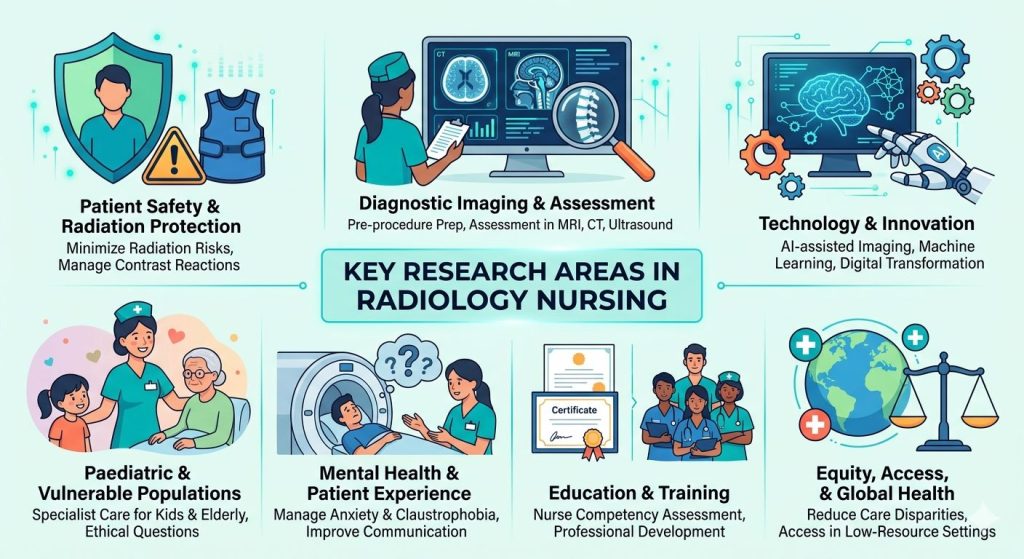
Before exploring specific topics, it is worth understanding the major subfields within radiology nursing that currently attract academic and clinical attention. These areas are grounded in established research domains and reflect evolving healthcare priorities.
Patient Safety and Radiation Protection This area focuses on minimising radiation exposure risk, ensuring informed consent, and managing adverse reactions to contrast media.
Diagnostic Imaging and Clinical Assessment Research in this area examines how nurses contribute to image interpretation, pre-procedure assessment, and patient preparation across modalities such as MRI, CT, and ultrasound.
Technology and Innovation in Radiology AI-assisted imaging, machine learning in diagnostics, and digital health transformation are reshaping radiology nursing roles and responsibilities.
Paediatric and Vulnerable Populations in Radiology Specialist care for children, elderly patients, and those with complex needs raises unique ethical and clinical questions for radiology nurses.
Mental Health and Patient Experience Anxiety, claustrophobia, and communication barriers during imaging procedures are well-documented challenges that offer strong research potential.
Education, Training, and Professional Development This subfield explores how radiology nurses are trained, how competency is assessed, and how continuing professional development affects clinical outcomes.
Equity, Access, and Global Health Disparities in access to diagnostic imaging services, particularly in low-resource settings, represent a growing area of international research concern.
Five Example Dissertation Topics with Aims and Objectives
Understanding how a well-structured dissertation topic is framed academically can help you develop your own. The following examples demonstrate the relationship between a topic, its research aim, and its supporting objectives.
Example 1: Contrast Media Safety in Adult Radiology Patients
Research Aim: To examine the role of radiology nurses in reducing adverse reactions to iodinated contrast media during CT procedures.
Objectives:
- To identify current pre-screening protocols used by radiology nurses in NHS trusts
- To evaluate the effectiveness of nurse-led patient education in reducing contrast-related anxiety
- To explore barriers to consistent protocol adherence across radiology departments
Example 2: AI Tools and the Changing Role of the Radiology Nurse
Research Aim: To investigate how artificial intelligence in diagnostic imaging is reshaping the clinical responsibilities of radiology nurses.
Objectives:
- To review existing literature on AI implementation in radiology settings
- To assess radiology nurses’ perceptions of AI tools in clinical decision support
- To identify training gaps associated with AI adoption in radiology nursing practice
Example 3: Paediatric Sedation Management in MRI Environments
Research Aim: To explore best practices in nurse-led sedation assessment for paediatric patients undergoing MRI scans.
Objectives:
- To map current sedation protocols used in paediatric radiology units across the UK
- To evaluate parental perceptions of nurse communication before and during sedation
- To identify risk factors associated with sedation-related complications in paediatric MRI settings
Example 4: Radiation Dose Optimisation and Nursing Advocacy
Research Aim: To assess the extent to which radiology nurses advocate for radiation dose reduction in clinical practice.
Objectives:
- To review international guidelines on radiation protection and nursing responsibilities
- To explore how nursing advocacy influences radiological decision-making in multidisciplinary teams
- To assess patient awareness of radiation risks and the role of nursing communication
Example 5: Claustrophobia and Patient-Centred Care in MRI
Research Aim: To evaluate nurse-led interventions for managing claustrophobia in patients undergoing MRI procedures.
Objectives:
- To review evidence-based interventions for claustrophobia management in diagnostic imaging
- To compare patient-reported outcomes across anxiety management strategies used in MRI units
- To identify how nursing communication styles influence patient tolerance during closed-bore MRI
Comprehensive List of Radiology Nursing Dissertation Topics for 2026
The following 80 dissertation topics are organised by subfield. Each topic is designed to be narrow, researchable, and relevant to current academic and clinical priorities. These topics are suitable for undergraduate, master’s, and PhD-level research proposals.
Patient Safety and Radiation Protection
- Nurse-led pre-procedure checklists and their impact on radiation safety compliance in CT departments
- Radiology nurses’ knowledge of radiation dose optimisation principles in NHS trusts
- The effectiveness of patient consent processes in diagnostic radiology from a nursing perspective
- Occupational radiation exposure among radiology nurses and its long-term health implications
- Nursing roles in implementing ALARA principles during fluoroscopy-guided procedures
- Patient understanding of radiation risk before diagnostic imaging and the nurse’s communication role
- Barriers to incident reporting in radiology nursing practice
- The relationship between nursing experience levels and radiation protection knowledge in interventional radiology
- Radiology nursing practice in managing extravasation injuries from contrast media
- The role of radiology nurses in supporting radiation protection audits in secondary care
Contrast Media and Adverse Reaction Management
- Nurse-led protocols for identifying patients at high risk of contrast media reactions
- Pre-hydration strategies and renal protection in contrast-enhanced CT: a nursing practice review
- Radiology nurses’ confidence in managing anaphylactic reactions to gadolinium-based contrast agents
- Patient education delivered by radiology nurses and its effect on contrast media anxiety
- Metformin management guidelines and the role of radiology nurses in patient counselling
- Delayed hypersensitivity reactions to iodinated contrast media: nursing assessment and follow-up
- Communication between radiology nurses and referring clinicians regarding contrast contraindications
- Nurse perceptions of their role in contrast media decision-making across modalities
- Comparison of oral versus intravenous hydration protocols in nurse-administered contrast preparation
- Training gaps in contrast reaction management among newly qualified radiology nurses in the UK
Technology, AI, and Digital Transformation
- Radiology nurses’ perceptions of artificial intelligence tools in diagnostic imaging workflows
- The impact of electronic patient records on radiology nursing documentation practices
- Digital health literacy among radiology nurses and its influence on patient safety
- Teleradiology and the evolving responsibilities of nurses in remote diagnostic imaging services
- Machine learning in imaging: implications for nursing roles and competency frameworks
- Nursing staff attitudes toward automation and job displacement in radiology departments
- Patient-facing digital communication tools in radiology departments and their nursing oversight
- The role of radiology nurses in cybersecurity incident response within imaging departments
- Simulation-based training technologies and their effectiveness in radiology nursing education
- Wearable monitoring devices in pre-procedure radiology assessment: a nursing feasibility review
Paediatric Radiology Nursing
- Nurse-led distraction techniques for reducing procedure-related anxiety in children undergoing MRI
- Parental presence during paediatric radiological procedures and its influence on child cooperation
- Radiation dose awareness among paediatric radiology nurses compared with adult radiology nurses
- Challenges in obtaining informed assent from adolescent patients in diagnostic radiology
- Nursing communication strategies that reduce the need for sedation in paediatric imaging
- Nurse perceptions of child safeguarding responsibilities in paediatric radiology settings
- Long-term radiation risk counselling for children undergoing repeated diagnostic imaging
- Play therapy in paediatric radiology: the nurse’s role in non-pharmacological anxiety management
- Cultural competence in paediatric radiology nursing and its effect on family engagement
- Nurse-led preparation programmes for children with autism spectrum disorder undergoing MRI
Mental Health, Anxiety, and Patient Experience
- Prevalence and management of claustrophobia in adult patients undergoing closed-bore MRI
- The effectiveness of nurse-led breathing techniques in reducing MRI scan abandonment rates
- Patient experiences of anxiety during PET-CT scanning and the role of nursing support
- Music therapy as a nurse-administered intervention for reducing procedural anxiety in radiology
- Nursing communication and its impact on patient-reported experience measures in radiology
- Psychological preparation for invasive radiology procedures and the nurse’s educational role
- Radiology nurses’ perceptions of their role in supporting patients with post-traumatic stress
- Nursing support for patients with needle phobia undergoing contrast-enhanced imaging
- Patient loneliness and isolation during prolonged diagnostic imaging procedures
- Nurse-led pre-procedure telephone assessments and their impact on patient anxiety outcomes
Education, Training, and Professional Development
- Undergraduate nursing curricula and the adequacy of radiology-specific content in UK universities
- Mentorship models for newly qualified nurses working in radiology departments
- Continuing professional development participation among radiology nurses and its clinical impact
- Simulation training for radiology nurses managing medical emergencies during imaging procedures
- Nurse prescribing rights in radiology: attitudes, barriers, and opportunities in the UK
- The influence of specialist radiology nursing qualifications on patient outcomes
- Interprofessional education between radiographers and nurses in diagnostic imaging settings
- Nursing leadership development programmes within NHS radiology departments
- Staff retention challenges in radiology nursing and the role of professional development
- Competency assessment tools used in radiology nursing orientation programmes
Equity, Access, and Diversity in Radiology Nursing
- Health inequalities in access to diagnostic imaging services and the nursing advocacy role
- Cultural barriers to breast screening uptake and the role of radiology nurses in outreach
- Language access in radiology departments and the nursing response to interpreter availability
- Racial disparities in cancer diagnosis via imaging and implications for nursing practice
- Gender-sensitive practice in radiology nursing for transgender and non-binary patients
- Rural and remote access to diagnostic radiology services: nursing roles in outreach models
- Disability inclusion in radiology environments and nursing adaptations for patients with mobility impairments
- Socioeconomic factors affecting patient adherence to follow-up imaging and nursing support strategies
- The role of radiology nurses in global health partnerships for diagnostic imaging in low-income settings
- Faith-based concerns about radiation and imaging procedures: nursing communication approaches
Interventional and Advanced Radiology Nursing
- Nurse-led pre-assessment clinics for interventional radiology procedures and patient outcomes
- Post-procedural nursing care following percutaneous nephrolithotomy: a protocol review
- Pain management practices among nurses in interventional radiology units in the UK
- Haemostasis monitoring and nursing responsibilities following arterial access procedures
- Patient education provided by nurses before image-guided biopsies and its effect on anxiety
- The role of radiology nurses in informed consent processes for interventional procedures
- Nursing challenges in managing anticoagulation therapy in patients undergoing IR procedures
- Vascular access nursing in interventional radiology: competency standards and training needs
- Nursing documentation practices in interventional radiology and their influence on clinical governance
- Post-procedural complication recognition by radiology nurses following transjugular intrahepatic portosystemic shunt (TIPS) procedures
Conclusion
Choosing a radiology nursing dissertation topic is not simply a bureaucratic step before your research begins. It is the foundation upon which your entire academic argument rests. A well-defined, narrow, and future-facing topic gives you a clear research direction, helps you identify relevant literature, and positions your work within a field that is evolving rapidly.
Radiology nursing in 2026 sits at the intersection of clinical care, digital innovation, patient safety, and healthcare equity. As this post demonstrates, there is no shortage of meaningful, researchable questions in this field. Whether you are developing a radiology nursing topic for a PhD thesis or looking for a focused topic in radiology nursing for your undergraduate dissertation, the breadth of options available reflects the genuine intellectual depth of this specialty.
The 80 topics presented here are not exhaustive, but they are designed to give you a concrete starting point. Each one reflects real clinical challenges and academic conversations that are happening right now in healthcare research communities around the world.
Students who approach their dissertation with curiosity, intellectual honesty, and a genuine desire to contribute to patient care will always produce more compelling research. Use this list as a thinking tool. Let the topics provoke questions, challenge your assumptions, and help you identify where your own academic interests lie.
If you need further guidance on structuring your research proposal or narrowing your focus, the academic team behind this resource is available to support you through every stage of the process.
